

TL;DR:
- D&D is a highly social activity centered on shared storytelling and collaboration.
- Building trust through consistency and skilled facilitation strengthens group bonds over time.
- Flexibility and safety measures are essential for adapting D&D to diverse communities and settings.
People still picture D&D as a basement activity for solitary nerds rolling dice alone. That image couldn’t be more wrong. At its core, Dungeons & Dragons is one of the most socially rich experiences you can have. It’s collaborative storytelling, shared risk-taking, and genuine friendship baked into a rulebook. Whether you’re a first-time player nervously rolling a d20 or a veteran Dungeon Master (DM) who’s guided dozens of campaigns, the community around your table shapes EVERYTHING. This article breaks down exactly how that community works, why it matters, and what you can do to build something truly legendary.
Table of Contents
- Why community is the heart of D&D gameplay
- Building a strong group: Campaigns, consistency, and the Dungeon Master
- Organized play and community: From home campaigns to Adventurers League
- Edge cases and adapting D&D for diverse communities
- Our perspective: Beyond the rulebook—what makes a D&D community thrive
- Build your next D&D community with the right tools
- Frequently asked questions
Key Takeaways
| Point | Details |
|---|---|
| Shared storytelling matters | D&D’s narrative design brings people together for co-creation and trust-building. |
| Group stability is key | Consistent players and skilled Dungeon Masters make for the strongest communities. |
| Adaptability ensures inclusion | D&D accommodates diverse groups, venues, and purposes, from therapy to pure fun. |
| Tools strengthen bonds | Maps, accessories, and shared resources help create memorable, collaborative gameplay. |
Why community is the heart of D&D gameplay
Here’s the thing about D&D that makes it genuinely different from almost every other game out there. You can’t really play it alone. Sure, some solo variants exist, but the real magic? It only happens with other people. You’re not just competing or following rules. You’re co-authoring a story that nobody has ever told before.
This isn’t just feel-good talk. D&D’s structural design fosters community through four key mechanisms: structured narrative co-authorship, recurring group formation over months or years, role embodiment for perspective-taking, and collaborative decision-making requiring negotiation. That’s baked into the game’s DNA. Not bolted on as an afterthought.
Think about what actually happens at the table. Someone’s rogue makes a chaotic choice. The paladin has to morally wrestle with it. The wizard figures out a workaround. Everybody negotiates, laughs, groans, and moves forward together. That kind of dynamic is rare in any social setting, let alone a game.
What separates D&D from drop-in board game nights or solitary video games is the recurring nature of it. If you’re checking out a tabletop role-playing guide for the first time, one of the biggest surprises is how quickly trust builds when the same group meets consistently over weeks and months. You learn each other’s playstyles. You know who’ll charge in recklessly and who’ll spend ten minutes planning the perfect heist.
That trust? It bleeds off the table too. Real friendships form. Shared inside jokes. Group traditions. A sense of belonging that’s genuinely hard to find elsewhere.
Here’s a quick look at what makes D&D uniquely community-powered:
- Co-authorship: Every player actively shapes the story, not just reacts to it
- Recurring bonds: Same group, session after session, builds real trust
- Perspective-taking: Playing a character different from yourself builds empathy
- Negotiation: Decisions require listening, compromising, and working together
- Shared stakes: The party succeeds or fails as one unit
“The table becomes something bigger than the game itself. It’s a space where people show up, take creative risks, and invest in each other’s stories.” That’s the real power of role-playing immersion.
Setting the foundation here is important because everything else about enhancing tabletop gameplay builds on this base truth: the community IS the game.
Building a strong group: Campaigns, consistency, and the Dungeon Master
So you want a group that actually sticks together? Great. Here’s what the data and experience both say: consistency is king.
Groups that play 8+ sessions together see the greatest community and psychological benefits. That makes total sense when you think about it. You need time to get past the awkward early sessions where everyone’s still figuring out the social contract. Real cohesion comes later, once the group has faced a few dragons together.
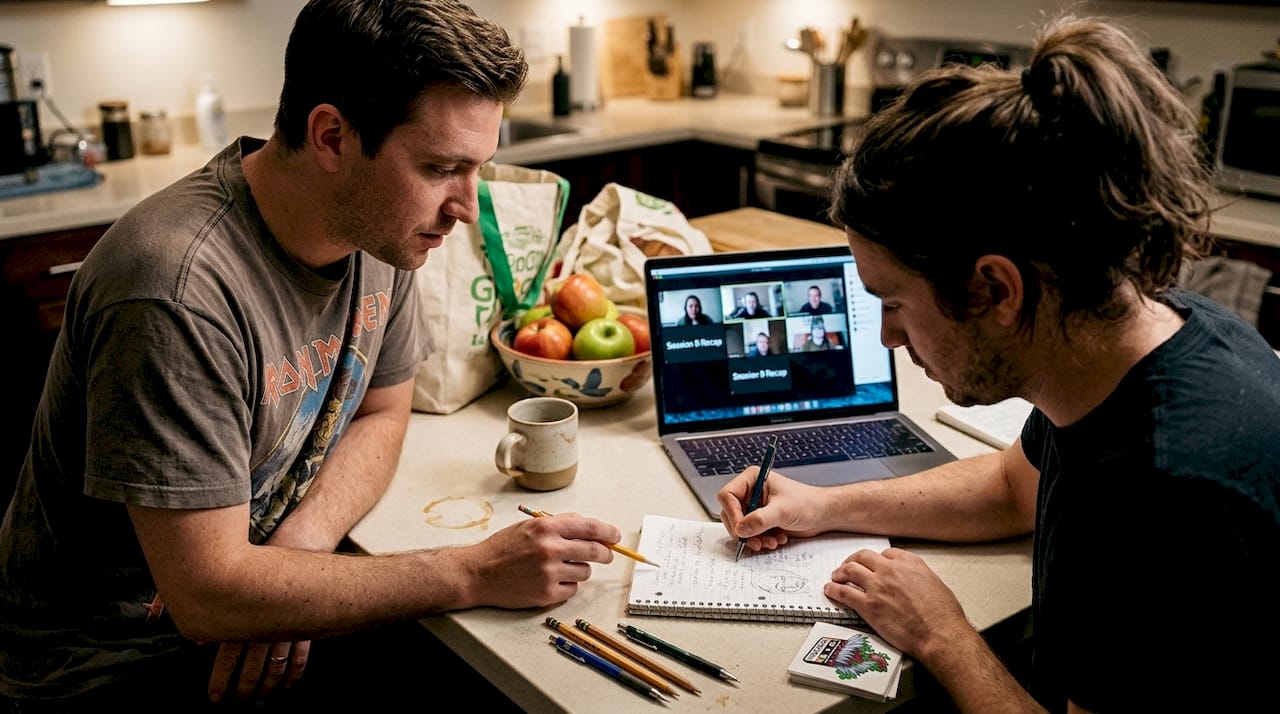
Stat callout: Groups with 8 or more consistent sessions report significantly deeper social bonds, higher trust levels, and better conflict resolution within the group.
The Dungeon Master plays a massive role in all of this. A great DM isn’t just a rule referee or a storyteller. They’re a community facilitator. They set the emotional tone of the table, manage disputes when a player gets upset about a ruling, and make sure everyone feels included in the narrative. Developing strong Dungeon Master skills is honestly one of the best investments you can make for your group’s long-term health.
Here’s a practical framework for building real group cohesion:
- Hold a Session Zero. Before the campaign starts, gather everyone to discuss expectations, safety tools, and character concepts. This sets shared norms immediately.
- Establish a regular schedule. Same day, same time, every week or two. Consistency builds anticipation and commitment.
- Use the X-Card or Lines and Veils. These safety tools let players flag uncomfortable content without drama. Psychological safety is non-negotiable.
- Celebrate milestones together. Level-ups, big story moments, campaign endings. These shared victories bond groups powerfully.
- Create space for off-table connection. A group chat, a shared playlist, a recap document. The game lives between sessions too.
Pro Tip: Keep a short recap doc or shared notes file after each session. It shows players their choices matter AND makes the next session feel connected. New players especially love seeing their impact tracked.
A good DM checklist also helps newer DMs stay organized without losing the creative energy that makes D&D feel alive. And don’t underestimate the power of physical props: using maps for group focus gives everyone a shared visual anchor that dramatically improves engagement during complex scenes.
Organized play and community: From home campaigns to Adventurers League
Not everyone has a consistent home group. That’s where organized play comes in, and it’s a genuinely exciting corner of the D&D community.
Adventurers League (AL) provides structured organized play for portable characters across venues, enabling community via game stores, conventions, and libraries. Your character travels WITH you. Show up at a new city, find a game store, and jump right in. That portability is remarkable.
| Feature | Home Campaign | Adventurers League |
|---|---|---|
| Character portability | Fixed to one group | Portable across all venues |
| Social depth | Deep, long-term bonds | Broader but shallower connections |
| Rules flexibility | DM can customize freely | Standardized rules required |
| Scheduling | Fixed group dependent | Drop-in friendly |
| Community size | Small and intimate | Large, diverse network |
AL has some real tradeoffs, though. Because you’re often playing with strangers, the emotional depth of a long-running home campaign is harder to replicate. Players might prioritize character optimization over collaborative storytelling since they won’t see these tablemates again next week.
That said, AL shines as a gateway. New players discover the game in low-pressure settings. Experienced players stay sharp between home campaigns. And the community across conventions like Gen Con is genuinely electric.
Venues beyond game stores also do remarkable things with D&D:
- Libraries and schools use D&D to build literacy, teamwork, and social confidence in students
- Veteran programs leverage the game for camaraderie and shared narrative, supporting community reintegration
- Youth organizations run D&D clubs that give kids a creative, safe social space
The art of collaborative storytelling in RPGs looks different in each of these contexts, but the underlying human need it satisfies is identical: connection, purpose, and a shared story worth telling.
Edge cases and adapting D&D for diverse communities
D&D is incredibly flexible. But flexibility also means you’ll hit edge cases that require real thoughtfulness to handle well.
Large groups are one of the trickiest challenges. Groups of 9 or more players benefit hugely from branching mini-adventures rather than one single narrative thread. Split the party intentionally. Run connected side quests simultaneously. Bring the threads together for dramatic payoff. This keeps everyone engaged instead of waiting forty-five minutes for their turn.
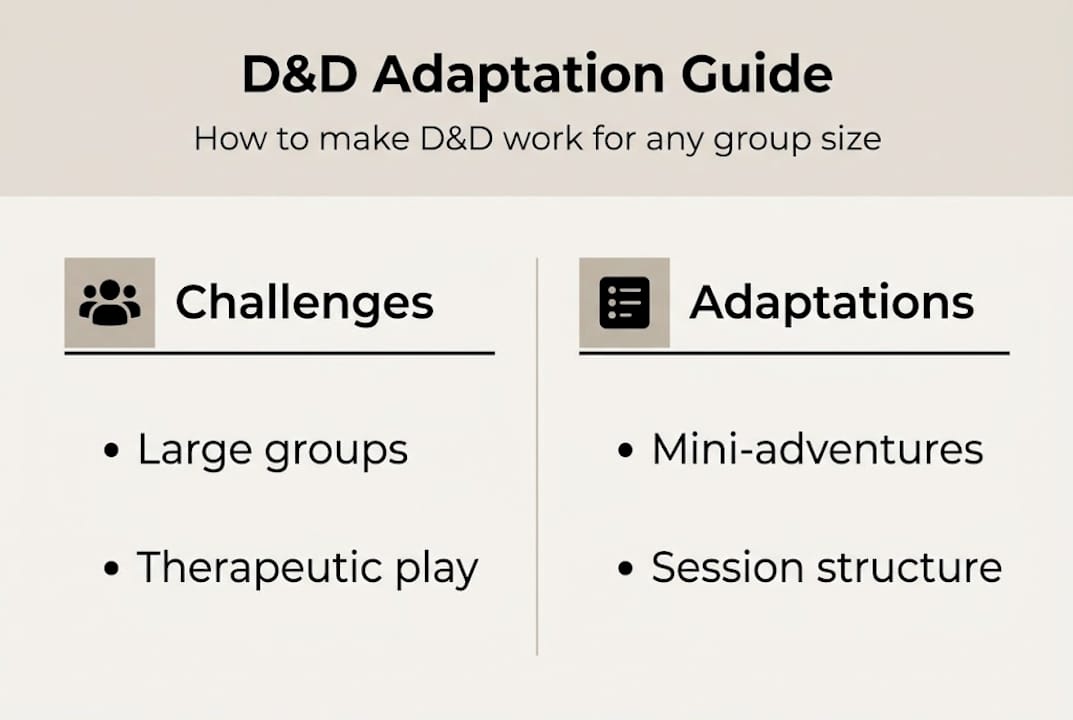
| Context | Key challenge | Best adaptation |
|---|---|---|
| Large groups (9+) | Player downtime | Split mini-adventures |
| Online sessions | Trust and presence | Consent/recording policies |
| Therapeutic settings | Safety and professional oversight | Licensed practitioners only |
| Youth programs | Age-appropriate content | Modified rules and DM training |
Therapeutic D&D, where the game is used clinically for anxiety, trauma processing, or social skill building, is a genuinely powerful frontier. But it requires licensed professionals who understand both the game and the clinical context. This is NOT a DIY project. When done right, though, the outcomes are remarkable.
Online play has exploded since 2020 and brought its own community-building challenges. Without physical presence, trust takes longer to build. Clear policies around session recording, voice versus video, and content consent become essential. Setting these norms in a Session Zero prevents a LOT of friction later.
Pro Tip: For online groups, invest five minutes at the start of each session in a quick “check-in” round. Each player shares one word describing their mood. It sounds small, but it humanizes the digital space fast.
“Adaptability is what makes D&D a community tool rather than just a game. The framework bends to fit the people, not the other way around.”
Whether you’re running large group sessions of nine players or creating immersive campaigns for an intimate group of four, the principles of consent, inclusion, and clear communication remain constant. And for DMs running D&D campaigns of any size, flexibility is your most powerful tool.
Our perspective: Beyond the rulebook—what makes a D&D community thrive
Here’s the hot take we don’t hear often enough: the rulebook is the least important part of a thriving D&D community.
Sure, knowing the mechanics matters. But we’ve seen groups with flawless rules knowledge absolutely collapse because nobody trusted each other. And we’ve seen groups who barely remember what a saving throw is create campaigns that became lifelong memories, because they genuinely cared about each other’s experience at the table.
Buy-in and vulnerability are the real secret ingredients. When a player commits to their character, shares their creative ideas without fear of judgment, and shows up emotionally present? That’s when the magic fires up like a Nat 20 on a persuasion check. The DM’s real job isn’t encounter design. It’s creating psychological safety so those moments can happen.
We also believe strongly that the best communities live BETWEEN sessions as much as at the table. The group chat that celebrates a wild dice roll. The fan art someone drew of the party. The inside joke that shows up three campaigns later. That’s what mastering the DM role actually means: building a culture, not just running encounters. Invest in each other off the table, and watch what happens on it.
Build your next D&D community with the right tools
Here’s the truth, dice goblins: the right physical tools can transform a good session into an unforgettable one. When your group gathers around a stunning battle map, something shifts. Players lean in. Decisions feel weightier. The story becomes real.
We’ve got exactly what your community needs to level up the shared experience. The Dungeon Craft Volume 2 and Dungeon Craft Cursed Lands map sets give your table a visual anchor that makes every encounter feel epic and collaborative. And if your group hasn’t found their signature dice yet, our collection of dice sets for your group makes finding the perfect set a whole party event. Because community starts with showing up and having the right tools to play.
Frequently asked questions
What social benefits can playing D&D provide?
D&D builds lasting friendships through narrative co-authorship, perspective-taking, and collaborative decision-making, supporting teamwork and genuine social connection across all ages.
How does the Dungeon Master influence group cohesion?
A skilled DM builds psychological safety and mediates conflict, and optimal community benefits depend directly on that skilled facilitation and the trust it creates within the group.
Can D&D be used in schools or for therapy?
Absolutely. Empirical D&D use spans schools, libraries, and veteran programs, while therapeutic applications are managed by licensed practitioners to support social and developmental outcomes.
What are the challenges with large or online D&D groups?
Large groups need split adventures to maintain engagement, while online groups require clear consent policies and intentional trust-building practices to keep the community feeling connected and safe.