

TL;DR:
- RPG narrative is a collaborative, living process shaped by players, the GM, and game structure.
- The GM’s role involves improvisation, pacing, and worldbuilding, with player choices driving the story.
- Human GMs excel in emotional intelligence and long-term coherence, unlike current AI systems.
Think RPG narrative is just the DM reading boxed text out loud while everyone else listens? Yeah, that’s a pretty common misconception, and we’re here to lovingly blow it up. Real RPG narrative is alive. It’s messy, surprising, and built by everyone at the table, not just the person behind the screen. The DM sets the stage, sure, but the players are writing the script in real time. This guide breaks down what RPG narrative actually means, how it works across different systems, and how you can use that knowledge to make every session feel like the best episode of your favorite fantasy series.
Table of Contents
- Defining RPG narrative: More than just storytelling
- Collaborative storytelling: How GMs and players shape the narrative
- Narrative mechanics in D&D: The DM’s role and player agency
- Narrative vs. crunch: Different approaches to RPG storytelling
- New frontiers: AI and academic approaches to RPG narrative
- Our take: The real secret to unforgettable RPG narratives
- Enhance your RPG storytelling toolkit
- Frequently asked questions
Key Takeaways
| Point | Details |
|---|---|
| RPG narrative is collaborative | The story emerges from both GM and player decisions within the structure of the game. |
| DM and player roles vary by system | Some RPGs give more narrative control to the GM, while others share it with players. |
| Balance rules and story | Finding the right mix between mechanics and narrative keeps storytelling flexible and engaging. |
| AI can assist, but not replace | While AI offers new narrative tools, human improvisation remains crucial for vibrant RPG storytelling. |
Defining RPG narrative: More than just storytelling
Let’s get one thing straight. RPG narrative is not just “the DM tells a cool story and everyone reacts.” It’s so much bigger than that.
Narrative design is the intentional structuring of fictional events, character arcs, dramatic pacing, and thematic throughlines. That’s a fancy way of saying: every choice, every dice roll, every awkward silence after a villain’s monologue is part of the narrative engine.
RPG narrative actually spans three phases of play:
- Pre-session prep: Worldbuilding, NPC creation, plot hooks, and lore drops
- In-session facilitation: Pacing, dramatic beats, improvisation, and consequence delivery
- Post-session management: Tracking story threads, updating the world, and setting up future arcs
Each phase feeds the next. Skip one and your story starts to feel hollow.
“RPG narrative is shaped within the game’s structure and player interaction, not just delivered by the GM. It lives in the space between the rules and the people playing them.”
The major elements that make up RPG narrative include world lore, character arcs, dramatic beats, pacing, and consequences. Notice that most of those elements are directly influenced by what players do. That’s the magic. For a deeper look at how this plays out at the table, check out this immersive gameplay guide that breaks down the full experience.
Narrative is not a script. It’s a living conversation between the game’s structure and the humans playing it.
Collaborative storytelling: How GMs and players shape the narrative
Okay, so who actually creates the story? Short answer: everyone. Longer answer: it depends on the system.
In most tabletop RPGs, the GM or DM acts as the situation framer. They set up the world, introduce conflicts, and portray NPCs. But the players? They’re the story drivers. Their choices, their character decisions, their wildly unexpected plans are what actually move the plot forward.
Narrative authority in RPGs exists on a spectrum. On one end, you have tightly bound systems where the GM controls almost everything. On the other, you have highly collaborative systems where players can introduce facts about the world or narrate outcomes themselves.
Here’s a quick comparison of how different systems handle narrative control:
| System | GM narrative control | Player narrative input |
|---|---|---|
| D&D 5e | High | Moderate (through choices) |
| Fate Core | Moderate | High (Aspects, Compels) |
| Powered by the Apocalypse | Moderate | High (Moves trigger narration) |
| Call of Cthulhu | High | Low to moderate |
Player input styles vary a lot. Some players love describing their actions in vivid detail. Others just say “I attack” and let the dice talk. Both are valid. But the most memorable sessions usually happen when players lean into the story and treat their characters as real people with wants and fears.
Collaboration leads to outcomes nobody planned. That’s not a bug. That’s the whole point. Want pro tips for immersion that help players lean into the story? We’ve got you covered. And if you’re looking for practical advice on running engaging D&D sessions, that’s worth a read too.
Narrative mechanics in D&D: The DM’s role and player agency
D&D is the most popular tabletop RPG on the planet, and it has a very specific approach to narrative. The Dungeon Master wears a LOT of hats.
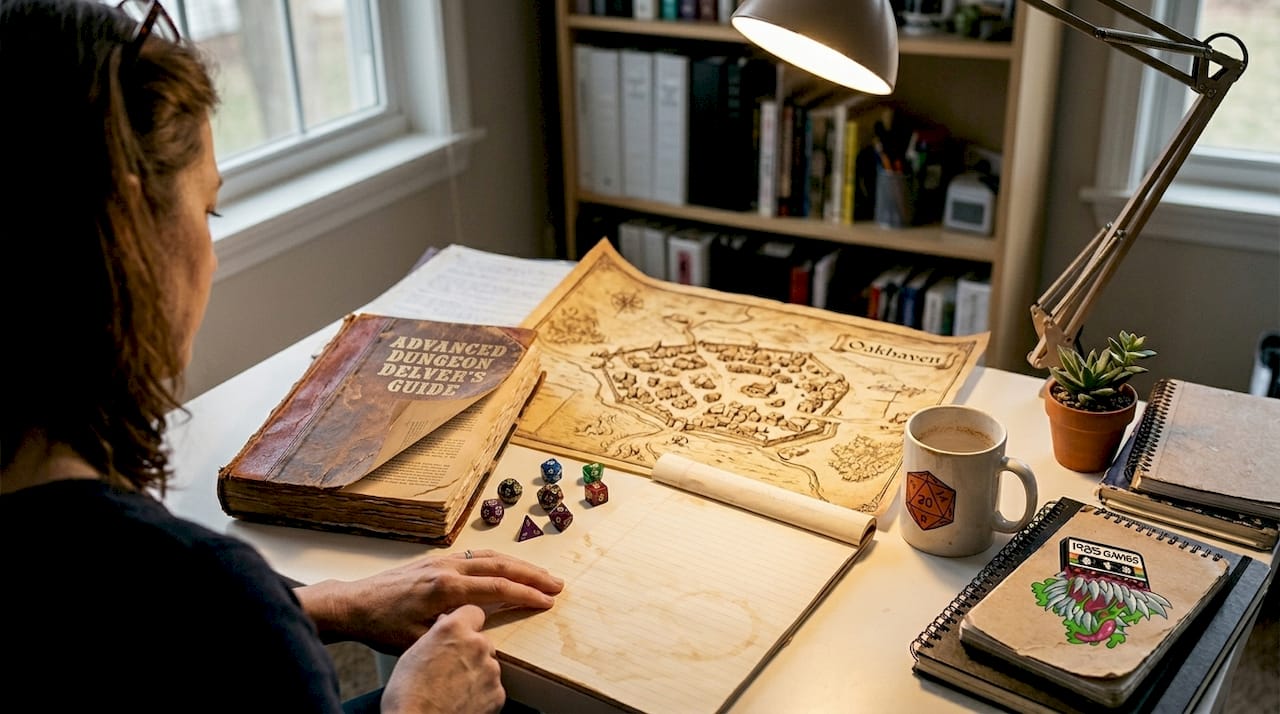
According to Dungeon Master rules, the DM is the creative force and adjudicator, responsible for narrating, portraying NPCs, managing pacing, and handling improvisation. That’s basically being a writer, actor, referee, and improv comedian all at once. Respect.
Here’s how a DM’s narrative functions break down in practice:
- Worldbuilding: Creating the setting, history, factions, and geography that give the story its texture
- Arbitration: Deciding how rules apply when things get weird (and they always get weird)
- Improvisation: Responding to player choices that were absolutely not in the notes
- NPC portrayal: Giving voice to every character from the tavern keeper to the final boss
- Pacing: Knowing when to speed up, slow down, or drop a dramatic bombshell
Then there’s Rule Zero: the DM can override any rule in service of the story. It’s a powerful tool, and it’s what gives D&D its narrative flexibility. But with great power comes great responsibility (yes, we went there).
Pro Tip: Don’t over-prep your narrative arcs. Build a solid situation with interesting NPCs and clear motivations, then let the players crash into it. The story that emerges will be better than anything you scripted alone.
For a full walkthrough of building story-rich campaigns, our D&D campaign creation guide is a great starting point. And for ongoing campaign management, our D&D campaign tips resource has practical tools for every session.
Narrative vs. crunch: Different approaches to RPG storytelling
Not all RPGs tell stories the same way. Some games trust the narrative. Others trust the math.
The narrative vs. crunch spectrum describes how different systems balance story momentum against mechanical detail. Narrative-focused games prioritize keeping the story moving, even if that means bending or skipping rules. Rules-heavy games (high crunch) use detailed mechanics to resolve almost every outcome, which can create precision but sometimes slows the story down.
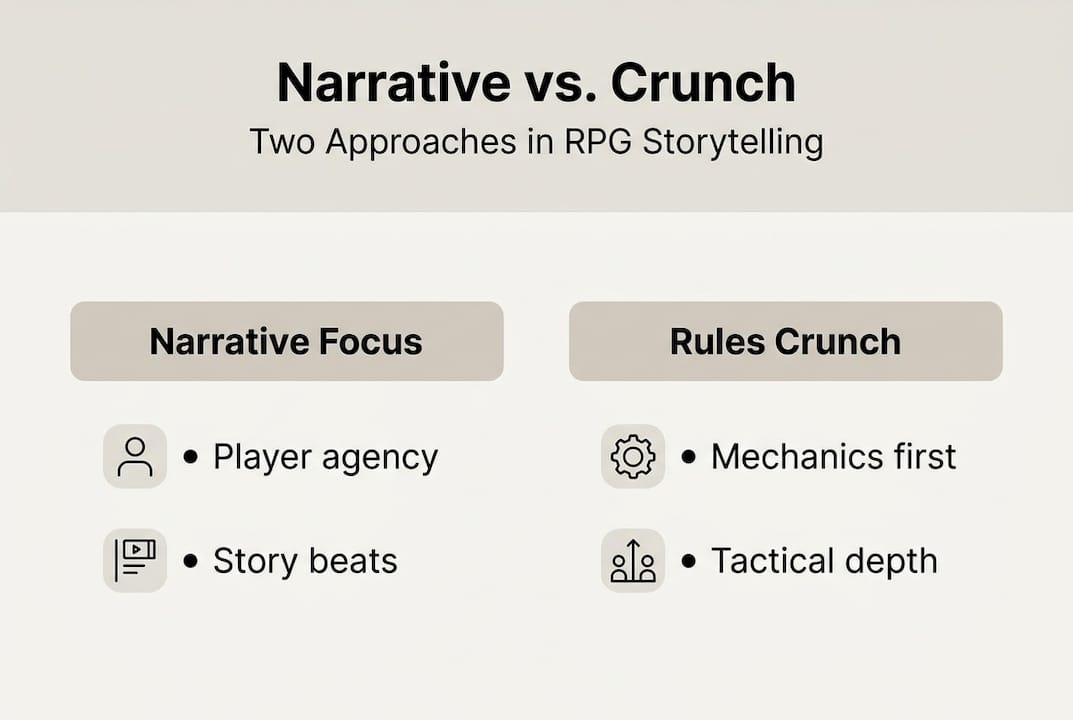
Here’s how that plays out at the table:
| Feature | Narrative-focused | Rules-heavy (crunch) |
|---|---|---|
| Failure handling | Story-driven consequence | Mechanical penalty |
| GM prep demand | Lower (flexible) | Higher (system mastery) |
| Player agency feel | Broad and expressive | Precise and tactical |
| Pacing | Fast and fluid | Slower, more deliberate |
Statistic callout: Research shows that narrative-focused systems tend to produce faster session pacing and higher player satisfaction in story-driven campaigns, while crunch-heavy systems shine in tactical, combat-focused play.
Pro Tip: Match your system to your group’s vibe. If your players love tactical decisions and min-maxing, lean into crunch. If they’re here for the drama and the feels, pick a narrative-forward system and let the story breathe.
The consequences of this choice ripple through everything. In a narrative system, failure is a story beat. In a crunch system, failure is a mechanical result that may or may not fit the story. Neither is wrong. But knowing the difference helps you choose the right RPG system for your group. And if you’re new to the jargon, our D&D terminology guide will help you decode the lingo fast.
New frontiers: AI and academic approaches to RPG narrative
Here’s where things get genuinely fascinating, dice goblins. Researchers are now studying RPG narrative as a serious academic subject, and they’re even building AI systems to generate it.
The RPGBENCH benchmark evaluates AI-generated RPG narrative for engagement and mechanical consistency. The findings? State-of-the-art large language models can produce interesting story content, but they struggle hard with long-term rules coherence. In other words, AI can write a dramatic scene, but it often forgets what happened three sessions ago.
What does AI struggle with compared to human GMs?
- Tracking long-term consequences across many sessions
- Maintaining consistent NPC personalities and motivations
- Improvising in response to truly unexpected player decisions
- Reading the emotional temperature of the table
- Knowing when to break the rules for the sake of a great moment
“AI-generated RPG content often lacks the mechanical consistency and long-term coherence that experienced human GMs develop through play and intuition.”
This is actually great news for human storytellers. It tells us exactly what makes human GMs irreplaceable: emotional intelligence, contextual memory, and the ability to improvise with meaning. The research also highlights what metrics matter in narrative quality: engagement, consistency, player agency, and dramatic satisfaction. These are things you can actively work on at your own table. The AI experiments basically handed us a rubric for better storytelling. We’ll take it.
Our take: The real secret to unforgettable RPG narratives
Here’s our honest, slightly spicy take: the best RPG narratives happen when GMs stop trying to tell a perfect story.
We’ve seen it a hundred times. A DM preps a gorgeous, intricate plot with a satisfying three-act structure. The players arrive, roll dice, and immediately go sideways. The DM either forces the story back on rails (players feel it and disengage) or panics and improvises badly.
The real magic lives in the mess. The moments that players remember for years are almost never the ones in the DM’s notes. They’re the unexpected alliance, the villain who got redeemed because one player asked the right question, the plan that failed spectacularly and became legend.
Our advice? Build situations, not stories. Give your NPCs real motivations. Set up interesting tensions. Then let go. Trust your players to drive. Trust yourself to respond. That’s where the immersion best practices actually live: not in perfect prep, but in genuine, flexible collaboration. Embrace the chaos. The table will thank you.
Enhance your RPG storytelling toolkit
Ready to put these narrative strategies into action? Great storytelling deserves great tools to match.

At 1985 Games, we build physical tools that make narrative richer and sessions more immersive. The Dungeon Craft Volume 2 map pack gives your world a visual anchor that players can actually see and interact with, making worldbuilding feel real and tactile. Our Player’s Journals help players track their character arcs, decisions, and story moments so nothing gets lost between sessions. When your table has the right tools, the narrative flows naturally. Give your story the physical presence it deserves.
Frequently asked questions
What does ‘RPG narrative’ mean in tabletop games?
RPG narrative is the shared story built through the combined decisions and actions of the GM and players, shaped by the game’s rules and improvisation. As narrative design theory explains, it’s the structuring of fictional events and arcs within shared play.
How is storytelling different in D&D compared to other systems?
D&D puts more narrative authority in the DM’s hands, while some other systems let players contribute directly to the story and worldbuilding. The DM as adjudicator model is central to D&D, whereas other systems vary from tightly bound GM authority to highly collaborative structures.
Can mechanics get in the way of storytelling?
Yes, in rules-heavy RPGs, mechanics can sometimes produce outcomes that don’t fit the desired story, requiring the group to balance narrative and rules. Mechanical resolution can create narratively unsatisfying results, prompting debate on whether to override mechanics for story quality.
What is player agency in RPG narrative?
Player agency is the freedom players have to make meaningful decisions that impact the story’s direction and outcomes. It’s fundamental in collaborative RPG narratives and varies significantly by system.
Can artificial intelligence create engaging RPG narratives?
AI can generate interesting RPG content, but current systems struggle with consistent rules and long-term story coherence. AI-generated RPGs show engagement potential but often lack the mechanical consistency that experienced human GMs bring to the table.