

You’ve probably heard that Dungeons & Dragons is complicated, full of endless math and obscure rules that only hardcore gamers can master. That’s a myth. Rules can be scaled from simple to complex, making D&D accessible to all skill levels, which means anyone curious about collaborative storytelling can jump in. This article covers D&D’s origins, gameplay mechanics, the role of the Dungeon Master, different editions, digital and physical tools, and how to get started confidently.
Table of Contents
- Introduction And Origins Of D&D
- Gameplay Mechanics And Roles
- Role Of The Dungeon Master
- Evolution And Editions Of D&D
- Digital Tools And Resources For D&D
- Physical Accessories To Enhance Gameplay
- Common Misconceptions About D&D
- Conclusion And Getting Started With D&D
- Enhance Your D&D Adventures With 1985 Games Accessories
- Frequently Asked Questions About Dungeons & Dragons
Key takeaways
| Point | Details |
|---|---|
| Origins | Created by Gary Gygax and Dave Arneson in 1974, D&D pioneered tabletop role-playing games and influenced modern video games. |
| Gameplay | Players create characters and roll a d20 to determine outcomes, gaining experience points to level up and improve abilities. |
| Dungeon Master | The DM narrates the story, controls non-player characters, and acts as referee, shaping adventures based on player choices. |
| Editions | 5th edition, released in 2014, streamlined rules and sparked global popularity with flexible, accessible gameplay. |
| Tools and resources | Digital platforms like D&D Beyond and Roll20 simplify character management and enable remote play, while physical accessories enhance immersion. |
Introduction and origins of D&D
Dungeons & Dragons was created by Gary Gygax and Dave Arneson and first published in 1974 as the original tabletop role-playing game that introduced collaborative storytelling and dice-driven fantasy adventure. Before D&D, tabletop gaming consisted mainly of miniature wargames focused on historical battles. Gygax and Arneson took those wargaming mechanics and layered on character creation, narrative arcs, and open-ended problem solving.
This innovation sparked the modern role-playing game industry and influenced countless video games, novels, and entertainment franchises. D&D established core concepts that gamers now take for granted: persistent character progression, improvised storytelling, and shared world-building. The game’s flexibility allowed players to craft unique stories rather than follow predetermined scripts.
Key milestones in D&D’s origins include:
- Evolved from miniature wargaming traditions in the early 1970s
- Published by TSR, Inc. in 1974 as the first commercially available tabletop RPG
- Introduced the concept of a Game Master who narrates and referees gameplay
- Established character classes like fighters, wizards, and clerics that became genre standards
- Inspired the fantasy gaming industry, including early computer RPGs and modern MMORPGs
Understanding Dungeons & Dragons history on Wikipedia provides context for how the game shaped interactive storytelling. D&D transformed gaming from competitive to cooperative, where players work together to overcome challenges and build shared narratives.
Gameplay mechanics and roles
Players begin by creating unique characters, selecting from various fantasy races like elves, dwarves, and humans, then choosing a class such as wizard, rogue, or fighter. Backgrounds add personality and history, giving characters motivations and quirks that drive roleplay. Players typically form parties of multiple characters, guided by one Dungeon Master, working together to overcome challenges and complete quests.
The d20 is the central die in rules and gameplay, determining whether actions succeed or fail. When you want to do something uncertain, you roll the d20 and add modifiers based on your character’s abilities. The DM sets a target number called the Difficulty Class (DC), and meeting or exceeding that number means success. This simple mechanic handles everything from picking locks to persuading guards.

Characters gain experience points through completing quests, defeating monsters, and clever problem solving. Accumulating experience allows characters to level up, gaining new abilities, stronger attacks, and improved skills. This progression system gives players tangible rewards for their adventures and encourages long-term campaign play.
Core gameplay elements include:
- Character creation with race, class, ability scores, and backgrounds
- Collaborative party dynamics where each player has distinct strengths
- Rolling d20 plus modifiers against difficulty targets
- Experience points leading to level progression and character growth
- Roleplay opportunities for creative storytelling beyond combat
- Exploration, social interaction, and tactical combat balanced together
Pro Tip: When starting out, focus on one or two simple character traits rather than crafting elaborate backstories. This makes learning rules easier while still giving you personality to explore during play.
For detailed guidance on building your first character and understanding game flow, check out this beginner’s practical guide to starting D&D. The gameplay explanation on Wikipedia offers additional mechanical depth for those ready to explore advanced rules.
Role of the dungeon master
The Dungeon Master occupies a unique position that combines storyteller, referee, and worldbuilder into one role. While players control their individual characters, the DM narrates the story and controls the game world, managing non-player characters and environmental challenges to create an immersive experience. The DM describes what players see, hear, and encounter, bringing the fantasy setting to life through words.
As referee, the DM interprets rules fairly and adjudicates disputes when game mechanics create ambiguity. This responsibility requires balancing rules-as-written with narrative flow, ensuring fun takes priority over rigid adherence to manuals. The DM shapes the adventure dynamically based on player choices, adjusting encounters and plot threads to match the group’s interests and actions.
Facilitating player engagement means creating opportunities for each character to shine. The DM designs challenges that let different character types contribute their strengths, whether that’s a rogue sneaking past guards or a wizard deciphering ancient runes. Problem solving becomes collaborative as the DM presents situations with multiple solutions.
Key DM responsibilities include:
- Narrating the game world and describing scenes vividly
- Controlling villains, allies, monsters, and environmental hazards
- Interpreting rules and making judgment calls to maintain game flow
- Preparing story hooks, encounters, and plot developments
- Responding flexibly to unexpected player decisions and creativity
- Ensuring all players have spotlight moments and feel engaged
Pro Tip: Good DMs prepare campaign outlines and key NPCs but stay flexible when players take unexpected paths. Your best stories emerge when you adapt to player creativity rather than forcing predetermined plots.
For aspiring DMs, this guide to becoming a Dungeon Master covers essential preparation and improvisation techniques. The Dungeon Master role on Wikipedia explains how this position evolved alongside the game itself.
Evolution and editions of D&D
The original 1974 rules were more complex and less standardized than modern editions, with mechanics borrowed directly from wargaming that didn’t always translate smoothly to narrative play. Early D&D required extensive DM interpretation because printed rules left many situations ambiguous. Advanced D&D, released in the late 1970s, added detailed mechanics and expanded options for character customization, though it also increased complexity.
Throughout the 1980s and 1990s, D&D went through multiple revisions as designers refined mechanics and responded to player feedback. Each edition attempted to balance accessibility with depth, though some versions leaned more toward simulation while others emphasized storytelling. The fifth edition of Dungeons & Dragons, released in 2014 and widely regarded as the most accessible yet deep version, introduced streamlined rules and increased flexibility that led to a resurgence in popularity worldwide.
5th edition succeeded by simplifying core mechanics without sacrificing strategic depth. The advantage/disadvantage system replaced fiddly modifiers, bounded accuracy kept low-level and high-level play balanced, and streamlined spell lists made magic users more approachable. This edition also embraced online tools and community content, expanding D&D’s reach beyond traditional hobby shops.
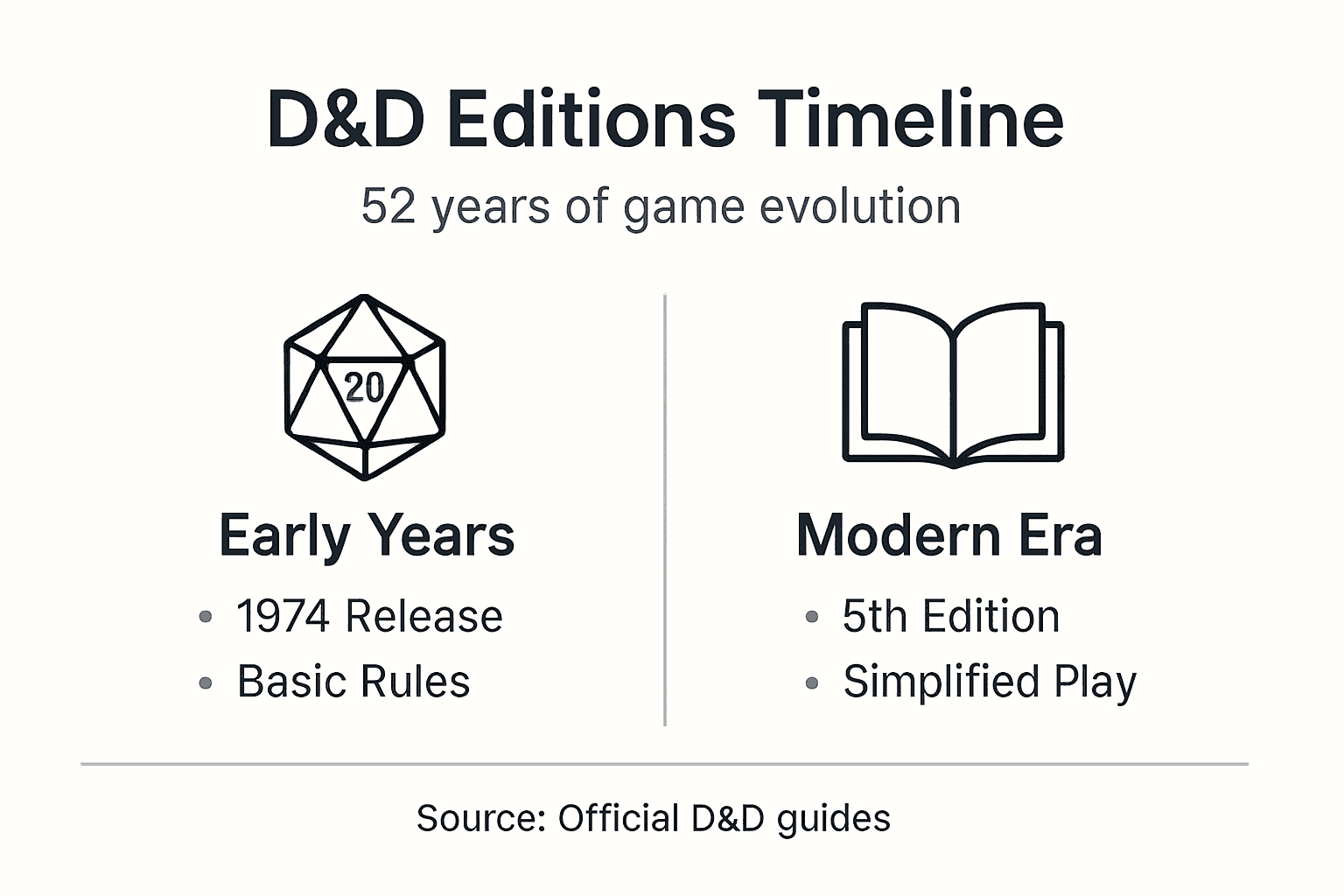
| Edition | Years Active | Key Characteristics |
|---|---|---|
| Basic D&D | 1977-1996 | Simplified rules for new players, focused on levels 1-3, easy entry point |
| Advanced D&D | 1977-1999 | Complex mechanics, extensive options, detailed simulation, higher learning curve |
| 5th Edition | 2014-present | Streamlined rules, advantage system, bounded accuracy, broad accessibility, digital integration |
The evolution from Basic to Advanced to 5th edition shows D&D constantly refining the balance between accessibility and depth. Modern players benefit from decades of design iteration, getting rules that support creative play without overwhelming newcomers. Understanding Dungeons & Dragons editions history helps you choose which version best fits your group’s preferences.
Digital tools and resources for D&D
D&D Beyond is the official digital toolset for D&D 5th edition providing character builders, digital sheets, and virtual tabletops, significantly reducing preparation time and enhancing gameplay immersion for both players and Dungeon Masters. The platform integrates rulebooks, character management, and dice rolling into one streamlined interface. Players can build characters step-by-step with guided prompts, automatically calculating modifiers and tracking resources.
Roll20 hosts over 1,200 game systems, including D&D, offering integrated VTT functionality that lets groups play together remotely with shared maps, tokens, and dice rolling. The platform combines video chat, character sheets, and tactical maps, recreating the tabletop experience online. DMs can prepare encounters in advance, hide information from players, and reveal maps progressively as exploration unfolds.
Online resource libraries and forums enhance community support by sharing homebrew content, adventure modules, and rules clarifications. Sites like Reddit’s D&D communities and the official Wizards forums connect players worldwide, offering advice for beginners and veterans alike. Digital tools reduce prep time by automating calculations and organizing campaign notes, letting DMs focus on storytelling instead of bookkeeping.
Main digital tool benefits include:
- Automated character creation with guided prompts and instant calculations
- Digital character sheets that track hit points, spells, and inventory automatically
- Virtual tabletops enabling remote play with maps, tokens, and shared dice
- Searchable rulebooks with hyperlinked cross-references
- Campaign management tools for organizing NPCs, locations, and plot threads
- Community content libraries offering thousands of free adventures and resources
For physical play enhancement, explore Dungeon Craft DnD maps that complement digital tools, and learn how player’s journals for D&D track campaign details alongside digital sheets. Additional information is available through D&D Beyond overview and Roll20 virtual tabletop platform.
Physical accessories to enhance gameplay
Themed dice sets enrich player experience and personalization by reflecting character personality and campaign themes. Players often collect multiple sets, choosing dice that match their character’s color scheme or aesthetic. Custom dice become ritual objects, adding tactile satisfaction to every roll and creating memorable moments when that critical natural 20 appears.
Terrain and battle maps support tactical combat and visualization by providing clear spatial relationships during encounters. Physical maps help players understand positioning, movement ranges, and environmental hazards at a glance. Grid-based maps with miniatures or tokens transform abstract combat descriptions into concrete tactical decisions, making fights more engaging and strategic.
Player journals help track narratives, quests, and character development by recording campaign events, NPC relationships, and personal character arcs. Written notes capture details that might otherwise be forgotten between sessions, building continuity and investment. Journaling also encourages reflection on character motivations and growth, deepening roleplay beyond the game table.
Crafted accessories add to immersion and enjoyment by making the game feel special and intentional. Quality components signal that this activity matters, transforming a casual hobby into a cherished ritual. Physical items also create shared group identity, with matching dice sets or custom DM screens becoming symbols of the campaign’s unique character.
Key physical accessories include:
- Themed dice sets in various materials like resin, metal, or gemstone
- Battle maps with grid layouts for tactical positioning
- Miniatures representing player characters, monsters, and NPCs
- Player journals for tracking quests, notes, and character development
- DM screens organizing rules and hiding notes from players
- Spell cards and reference sheets for quick rule lookup
Pro Tip: Choose accessories that fit your group’s play style and budget. A simple set of dice and a basic grid map provide excellent value for new groups, while experienced players might invest in custom terrain and premium journals.
Learn more about the role of accessories in D&D and how physical tools complement digital platforms for the complete gaming experience.
Common misconceptions about D&D
D&D is not overly complex or math-heavy. D&D offers scalable rule complexity, allowing groups to simplify rules and focus on storytelling and social play, making it accessible to players who prefer narrative over number crunching. Basic gameplay requires only simple addition and subtraction. You roll a die, add a number from your character sheet, and compare it to a target. That’s the core mechanic, and everything else builds from that foundation.
Gameplay is not just combat-focused but rich with storytelling and problem-solving opportunities. Many memorable D&D sessions contain zero combat encounters, instead featuring negotiation, exploration, mystery solving, or social intrigue. Combat exists as one tool among many, and groups can emphasize whichever aspects they find most engaging. Some campaigns focus on political machinations, others on dungeon exploration, and still others on character-driven drama.
Players come from diverse backgrounds beyond common stereotypes, including professionals, artists, parents, educators, and people of all ages and genders. The modern D&D community reflects broad cultural interests in collaborative storytelling and creative expression. Popular shows like Critical Role showcase how D&D appeals to theater enthusiasts, voice actors, and narrative fans, not just traditional gamers.
Common misconceptions and clarifications:
- Myth: D&D requires advanced math skills. Reality: Basic addition covers 95% of gameplay calculations.
- Myth: You need expensive books and materials to play. Reality: Free basic rules online and simple dice sets get you started.
- Myth: D&D is only for young people or hardcore gamers. Reality: Players range from children to retirees across all experience levels.
- Myth: Sessions require huge time commitments. Reality: Groups can play satisfying one-hour sessions or epic four-hour adventures based on preference.
- Myth: You need to memorize hundreds of rules. Reality: Core mechanics fit on one page, and you learn additional rules gradually through play.
To overcome barriers, try simplified rules and focus on social play when introducing new players. This beginner’s practical guide to starting D&D addresses common concerns, while D&D campaigns explained shows how flexible campaign structures accommodate different play styles. Additional misconception debunking appears in D&D misconceptions on Wikipedia.
Conclusion and getting started with D&D
D&D is a dynamic, creative collaborative storytelling game with simple core mechanics that scale to your comfort level. The game thrives on shared imagination, where players and DM work together to craft unique adventures that no video game or movie could replicate. Whether you’re drawn to tactical combat, intricate roleplay, puzzle solving, or exploration, D&D accommodates your preferred play style.
Starting with character creation and simple adventures lets you learn mechanics gradually while having fun immediately. You don’t need to master every rule before your first session. Many groups begin with pre-generated characters and short one-shot adventures, then expand into longer campaigns as everyone gains confidence. The learning curve feels natural when you focus on story first and mechanics second.
Considering the Dungeon Master role deepens storytelling involvement and gives you creative control over entire worlds. While DMing seems intimidating, many players find it more rewarding than playing characters because you shape the entire narrative landscape. Starting with published adventures provides training wheels, offering structured scenarios while you develop improvisation skills.
Digital tools like D&D Beyond simplify play by automating calculations and organizing information. Physical accessories enhance fun and immersion by adding tactile satisfaction and visual clarity to your sessions.
Four actionable steps to get started:
- Read the free basic rules online or watch beginner tutorials to understand core concepts without financial commitment.
- Create your first character using D&D Beyond’s free tier or a simple character sheet, focusing on concept over optimization.
- Join a local game at a hobby shop or find an online group through Roll20 or Reddit’s LFG forums to experience actual play.
- Gather dice, a notebook, and friends to run a simple one-shot adventure using a published module or homebrew scenario.
For comprehensive guidance, visit how to start playing D&D to access step-by-step instructions for launching your first campaign.
Enhance your D&D adventures with 1985 Games accessories
Physical accessories transform good D&D sessions into unforgettable experiences by adding visual clarity, tactile satisfaction, and personal expression to every roll and encounter. Quality dice sets, detailed battle maps, and organized player journals elevate immersion while simplifying gameplay logistics. 1985 Games offers curated collections designed specifically for D&D enthusiasts who want their table to reflect the epic nature of their adventures.

Explore how accessories deepen engagement in this guide about the role of accessories in D&D, then optimize your setup using the tabletop game setup guide. For campaign organization that keeps your stories coherent across months of play, check out Dungeon Notes player journals designed specifically for tracking D&D adventures. Visit 1985 Games today to discover handcrafted accessories that match your play style and bring your campaigns to life.
Frequently asked questions about Dungeons & Dragons
What do I need to start playing D&D?
You need the basic rules (available free online), dice (at minimum a set including a d20), character sheets, pencils, and friends willing to play. One person should be prepared to act as Dungeon Master. Many groups start with the D&D Starter Set, which includes pre-generated characters and a beginner adventure. For detailed setup steps, see this starting D&D guide.
How long does a typical D&D session last?
Most groups play for 2-4 hours per session, though this varies widely based on schedule and preference. Some groups run quick one-hour sessions during lunch breaks, while others commit to marathon 6-8 hour weekend sessions. New players often benefit from shorter 2-hour sessions to avoid overwhelm.
Can I play D&D online with friends remotely?
Absolutely. Platforms like Roll20 and D&D Beyond provide virtual tabletops, digital character sheets, and integrated video chat specifically designed for remote D&D play. Online play has become increasingly popular, with thousands of games running daily across time zones. The experience differs slightly from in-person play but offers convenience and access to global player communities.
What is a Dungeon Master’s main role in the game?
The DM narrates the story, controls all non-player characters and monsters, interprets rules, and shapes the world based on player choices. Think of the DM as a combination of narrator, referee, and collaborative storyteller who creates challenges for players to overcome creatively. The DM facilitates fun rather than competing against players.
Are there simple ways to learn D&D rules quickly?
Watch actual play shows like Critical Role or Dimension 20 to see rules in action, which provides context that rulebooks alone can’t offer. Start with the free basic rules covering core mechanics, then learn additional rules as they become relevant during play. Many groups successfully play their first session knowing only how to roll a d20, add modifiers, and compare results to target numbers.