

Many new Dungeon Masters feel overwhelmed by campaign preparation, believing they need exhaustive plans before starting. Effective campaigns begin with simple core ideas, not endless details. This guide offers clear steps for planning and managing a successful D&D campaign that keeps players engaged without burning you out. You’ll learn how to organize your ideas, choose settings, manage ongoing play, and use quality accessories to create memorable sessions your group will talk about for years.
Table of Contents
- Prerequisites: What You Need Before Starting Your D&D Campaign
- Planning Your Campaign: Starting With An Idea
- Choosing Or Creating Your Campaign Setting
- Campaign Management And Journaling
- Launching Your Campaign: Session 0 And Early Play
- Choosing The Campaign Style: Sandbox Vs. Linear
- Using Accessories To Enhance Immersion
- Maintaining Player Engagement And Feedback
- Avoiding Common Pitfalls And Troubleshooting
- Expected Campaign Timelines And Outcomes
- Enhance Your Campaign With Premium D&D Accessories
- Frequently Asked Questions
Key takeaways
| Point | Details |
|---|---|
| Start with core ideas | Focus on one central problem or theme to prevent creative burnout and launch your campaign quickly. |
| Choose balanced settings | Published settings save prep time with ready lore, while homebrew worlds offer creative freedom with more work. |
| Use quality accessories | Handcrafted maps, themed dice, and player journals boost immersion and make gameplay tactile and memorable. |
| Conduct Session 0 | Align player and DM expectations on safety, tone, and character integration before the campaign begins. |
| Track and adapt regularly | Maintain detailed journals and gather player feedback to improve narrative consistency and engagement. |
Prerequisites: what you need before starting your D&D campaign
Before running your first session, you need foundational knowledge and tools. Understanding basic D&D rules and player character creation is essential for guiding your group through the mechanics. You don’t need to memorize every rule, but knowing core systems like ability checks, combat, and spellcasting helps you answer questions and keep the game moving.
Select physical and digital accessories that fit your style and group size. Terrain battle maps, themed dice sets, and player journals enhance immersion without overwhelming your budget. Start with versatile items you can reuse across multiple sessions. Digital tools like campaign management software or virtual tabletops work well for remote groups.
Decide on a campaign setting: published or homebrew. Published settings from Wizards of the Coast offer ready-made lore, maps, and NPCs. Homebrew worlds give you complete creative control but require more planning. Consider your available prep time and creative preferences when choosing.
Plan a Session 0 to discuss expectations, safety, and character integration. DMs who conduct Session 0 report higher retention and smoother narrative progression. This meeting establishes ground rules before story investment deepens.
- Master basic rules for ability checks, combat, and spellcasting
- Gather terrain maps, dice, and journals that match your campaign theme
- Choose between published settings or homebrew worlds based on prep capacity
- Schedule Session 0 to align group expectations and safety boundaries
- Review beginner guidance on starting D&D for additional setup tips
Planning your campaign: starting with an idea
Shaping your campaign’s foundational idea fuels creative storytelling without overwhelming you. Record all initial ideas without judgment or over-planning. Write down every concept that excites you, from grand villains to quirky tavern NPCs. This brainstorming phase builds your creative reservoir.
Focus on shaping a cohesive, core problem or theme next. Starting with a single core concept helps avoid creative burnout and jumpstarts progress. Ask yourself what conflict drives your story: a looming invasion, a mysterious plague, or political intrigue. This central tension becomes the spine supporting all other elements.
Limit early detail to prevent overwhelm and burnout. New DMs often create elaborate timelines, genealogies, and economies before running a single session. Instead, develop only what you need for the first three sessions. Let details emerge organically through play.
Draw inspiration from media, player interests, and settings. Borrow plot structures from favorite books, movies, or video games. Ask players what themes excite them during character creation. Combine these elements into something uniquely yours.
- Brainstorm freely and record every idea without editing or judging
- Identify one core conflict or mystery that drives the campaign forward
- Sketch only the first three sessions in detail, leaving room for improvisation
- Poll players about their favorite fantasy tropes and character goals
- Combine borrowed concepts with original twists to create fresh narratives
Pro Tip: Keep a running document of unused ideas for future sessions. That dragon lair you cut from session two might perfectly fit session ten. Nothing goes to waste when you maintain an idea bank.
Explore foundational D&D concepts to strengthen your campaign planning framework.
Choosing or creating your campaign setting
With your core idea, the next critical step is choosing the world where your campaign unfolds. Published settings offer immediate lore, maps, and NPCs to save prep time. Forgotten Realms, Eberron, and other official worlds come with established histories, factions, and geography. You can focus on storytelling rather than worldbuilding.
Homebrew worlds provide creative freedom but require more work and consistency control. Published settings reduce prep time with ready lore, while homebrew settings require extensive research and management. Building from scratch means tracking every detail yourself, from currency systems to pantheons.
Tie setting elements into player backstories and campaign themes. When a player creates a character from a distant kingdom, develop that location collaboratively. This investment makes players care about the world because their characters shaped it.

Adapt setting details flexibly to fit evolving storylines. No setting remains static during play. Players will surprise you with unexpected decisions, and the world should respond organically. Modify established lore when it serves your story better.
| Aspect | Published Setting | Homebrew Setting |
|---|---|---|
| Prep Time | Low, ready resources available | High, requires extensive creation |
| Creative Freedom | Moderate, within established lore | Complete, limited only by imagination |
| Player Accessibility | High, many players know the world | Variable, depends on documentation |
| Consistency Management | Easier, official sources provide canon | Harder, requires detailed tracking |
| Resource Availability | Abundant maps, modules, guides | Self-created or adapted materials |
Understand what defines effective campaign settings to make informed choices for your group.
Campaign management and journaling
Once the setting is in place, managing the ongoing story with effective journaling keeps your campaign coherent and immersive. Maintain detailed notes before, during, and after sessions. Pre-session notes outline planned encounters and NPCs. During sessions, jot down player decisions, dice outcomes, and improvised details. Post-session notes consolidate what happened and set up future threads.
Track plot threads, NPCs, and player decisions for continuity. Campaign journaling maximizes narrative consistency and player engagement through session notes and plot tracking. When players reference an NPC from ten sessions ago, accurate notes let you bring that character back meaningfully.
Plan foreshadowing and callbacks to deepen narrative. Journals help you spot opportunities to reference earlier events. That mysterious stranger from session three becomes the villain’s spy in session fifteen. These connections make your world feel alive and reactive.
Encourage a designated player scribe to enhance engagement. When a player volunteers to write session recaps, they engage more deeply with the story. Their perspective also reveals what moments resonated most.
- Record NPC names, motivations, and player interactions in a searchable format
- Note player character goals and tie future plot hooks to their ambitions
- Track ongoing mysteries and clues revealed each session for consistency
- Document improvised details immediately so they become canon
- Review notes before each session to refresh memory and spot callback opportunities
Pro Tip: Use color coding in your notes. Red for urgent plot threads, blue for character development, green for worldbuilding details. This visual system helps you balance story elements at a glance.
| Journaling Element | Purpose | Frequency |
|---|---|---|
| NPC Tracker | Maintain consistency of personalities and relationships | After each appearance |
| Plot Thread Log | Ensure no storylines are dropped or forgotten | Weekly review |
| Player Decision Record | Track choices that shape campaign direction | During each session |
| Foreshadowing Notes | Plan future reveals and callbacks | Monthly planning |
| Session Recap | Consolidate events and set up next session | Immediately post-session |
Learn how to craft comprehensive player journals that complement your DM notes. Explore Dungeon Notes for organized campaign tracking tools.
Launching your campaign: Session 0 and early play
With preparation and management in place, launching with Session 0 builds group alignment and strengthens your campaign’s foundation. Discuss the campaign’s theme, tone, and premise openly. Is this a gritty survival story or heroic high fantasy? Clarifying tone prevents mismatched expectations that derail engagement.
Define safety tools like lines and veils to ensure comfort. Session 0 improves group cohesion and reduces conflicts by setting clear expectations and safety measures. Lines are hard boundaries never crossed in play. Veils are topics handled off-screen. This framework protects everyone’s wellbeing.
Collaborate on character creation and integrate backstories. Help players tie their characters to your world and each other. When characters share connections before session one, roleplay flows more naturally. A shared mentor, hometown, or quest bonds the party immediately.
Set clear expectations around session structure and frequency. Will you play weekly or biweekly? How long will sessions run? What happens if someone misses a game? Answering these logistical questions prevents frustration later.
- Present your campaign premise and core conflict without revealing major spoilers
- Establish lines and veils using tools like the X-Card or consent checklists
- Facilitate character creation collaboratively, linking backstories to the world and party
- Agree on session length, frequency, and attendance policies as a group
- Distribute any house rules or setting-specific mechanics clearly
Review comprehensive beginner tips to ensure a smooth campaign launch.
Choosing the campaign style: sandbox vs. linear
After launching, choosing a campaign style defines how your story will unfold and how much freedom players have. Sandbox style offers multiple plot hooks promoting player agency. You present several adventure options each session, and players choose which to pursue. This approach rewards proactive, engaged players who enjoy exploration.
Linear campaigns focus on a clear, directed storyline. You guide players through a sequence of planned events toward a climactic conclusion. This structure suits groups who prefer cohesive narratives without decision paralysis.
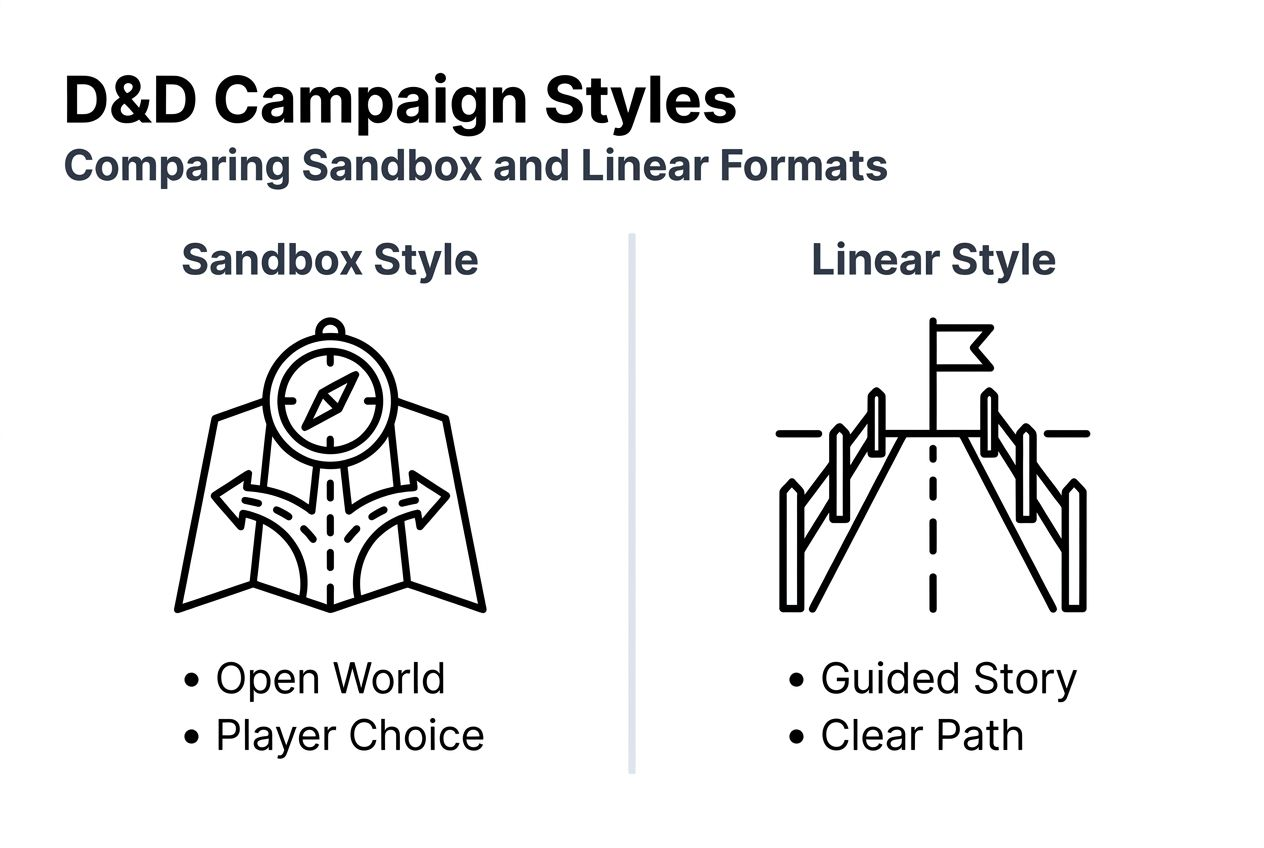
Open-world campaigns increase freedom but require more prep and flexibility. Sandbox campaigns offer autonomy but require improvisation, while linear campaigns provide focused story progression. Be ready to improvise when players ignore your prepared content and chase unexpected leads.
Match style to what your players enjoy and your DM style. Some groups thrive with structure, others with freedom. Your comfort with improvisation also matters. If you prefer planning, lean toward linear. If you love spontaneous storytelling, embrace sandbox.
- Sandbox: Present 3-5 plot hooks each session and let players choose their path
- Linear: Design a clear story arc with planned beats and climactic moments
- Hybrid: Offer player choice within a structured main questline
- Poll your group on preferred playstyle during Session 0
- Start structured and gradually introduce more freedom as you gain confidence
Using accessories to enhance immersion
Once your gameplay style is set, physical tools and accessories significantly boost immersion and player excitement. Select terrain battle maps that fit your campaign theme. A detailed dungeon map transforms abstract combat into tactical positioning. Players visualize the battlefield and strategize more creatively when they see physical terrain.
Choose thematic dice sets to enrich sensory experience. Rolling dice feels different with weighted metal or precision-cut resin compared to standard plastic. Themed sets matching your campaign, like dragon-etched dice for a draconic storyline, add flavor to every roll.
Encourage use of player journals for note-taking and story connection. When players write in physical journals, they engage more deeply with lore and character development. Journals become treasured keepsakes of the campaign.
Solicit feedback to refine which accessories best serve your group. Not every tool fits every table. Some groups love miniatures, others prefer theater of the mind. Ask what enhances immersion without slowing gameplay.
- Choose battle maps with versatile terrain features usable across multiple encounters
- Match dice aesthetics to campaign tone: elegant for courtly intrigue, rugged for survival adventures
- Provide or recommend journals that fit character themes and player preferences
- Introduce accessories gradually to avoid overwhelming new players
- Rotate accessories based on story beats to keep sensory experiences fresh
Discover how accessories elevate D&D gameplay and learn about immersion through RPG accessories.
Maintaining player engagement and feedback
Sustaining long-term engagement requires ongoing dialogue and tailoring the campaign to player preferences. Regularly ask players for feedback on sessions and story direction. Short post-session surveys or casual check-ins reveal what’s working and what needs adjustment. Players appreciate when their input shapes the narrative.
Adjust pacing to avoid burnout or stagnation. Soliciting regular player feedback increases satisfaction and player retention by up to 30%. Some groups love weekly combat-heavy sessions, others prefer biweekly roleplay-focused games. Match your schedule and content to group energy levels.
Incorporate player choices meaningfully to increase agency. When players make decisions, show consequences in future sessions. If they spare a villain, that NPC returns with a new scheme. If they ignore a plot hook, that threat escalates elsewhere. Responsive storytelling validates player investment.
Refine accessory use to keep gameplay fresh and engaging. Introduce new maps or dice for major story arcs. Rotate tools to maintain novelty without cluttering your setup. Players notice when you tailor accessories to story moments.
- Send brief surveys asking what players enjoyed and what felt slow or confusing
- Watch for signs of disengagement like distracted players or declining attendance
- Adjust session frequency or length if players report fatigue or scheduling stress
- Highlight how player decisions changed the story to reinforce their agency
- Celebrate character milestones with thematic accessories or in-game rewards
Avoiding common pitfalls and troubleshooting
Gaining momentum is important, but knowing common mistakes and solutions protects your campaign’s longevity. Avoid over-planning by starting small and iterating. Over 60% of new DMs report exhaustion due to excessive initial prep leading to stalled campaigns. You can’t predict every player choice, so detailed plans often go unused. Build just enough for the next session, then expand based on what happens.
Balance story control with player freedom to keep engagement. Railroading frustrates players who feel their choices don’t matter. Conversely, complete sandbox freedom overwhelms groups lacking direction. Offer guided choices: multiple paths toward a common goal.
Manage pacing actively, using feedback to adapt. Some sessions need intense combat, others need quiet character moments. Alternate between action and downtime to give players breathing room. If energy drops, inject a surprise encounter or plot twist.
Quickly address narrative or engagement issues to prevent drop-off. When a player seems bored or a storyline falls flat, pivot immediately. Ask what’s missing and adjust on the fly. Flexibility prevents small problems from ending campaigns.
- Prepare only essential details for the next session, improvising the rest
- Offer players meaningful choices within a guided narrative framework
- Alternate high-energy combat with roleplay and exploration scenes
- Check in privately with disengaged players to understand their needs
- Be willing to abandon prepared content if player interest goes elsewhere
Pro Tip: Keep a backup encounter ready for every session. When energy lags or players finish early, drop in a surprise. This keeps pacing tight without requiring extensive prep.
“The best campaigns are those where the DM listens as much as they narrate. Player investment grows when they see their choices shape the world. Flexibility isn’t a weakness; it’s the heart of collaborative storytelling.”
Expected campaign timelines and outcomes
Understanding normal timelines and success factors helps you plan realistically and celebrate campaign milestones. Campaign duration ranges from short (6 months) to epic (3+ years). Typical campaigns last 6 months to 3 years with weekly sessions; success ties to engagement and narrative coherence. Short campaigns suit busy groups or contained stories. Long campaigns allow deep character development and complex narratives.
Player retention and engagement are key success indicators. If players show up consistently and reference past events enthusiastically, your campaign is thriving. High retention means your story resonates and logistics work.
Narrative coherence and flexibility support longevity. Campaigns that balance planned arcs with improvised moments adapt to player interests. Rigid stories break when players act unpredictably. Responsive narratives evolve gracefully.
Accessory use correlates positively with immersion and satisfaction. Groups using physical maps, thematic dice, and journals report higher engagement. Tangible tools make abstract storytelling concrete and memorable.
| Campaign Length | Sessions | Typical Scope | Success Metrics |
|---|---|---|---|
| Short | 10-20 | Single story arc, focused threat | Story resolution, player satisfaction |
| Medium | 21-50 | Multiple arcs, evolving threats | Character growth, consistent attendance |
| Long | 51-100 | Epic narrative, world-changing events | Deep investment, memorable moments |
| Epic | 100+ | Generational stories, legacy play | Campaign completion, lasting friendships |
Enhance your campaign with premium D&D accessories
After learning about campaign building and accessory benefits, explore how 1985 Games’ products help you craft unforgettable sessions. Running an immersive campaign requires more than planning; it demands tools that bring your world to life.

Find handcrafted terrain battle maps that transform abstract combat into tactical engagement. These maps feature detailed environments matching your campaign’s aesthetic, from haunted forests to arcane towers. Use premium player journals to help your group track lore and character development. When players write their stories in quality journals, investment deepens naturally. Choose themed dice and accessories tailored to your campaign style through products like Dungeon Craft Vol 2. 1985 Games offers curated products designed by DMs for DMs, ensuring every item enhances gameplay without overwhelming your setup. These tools bridge preparation and execution, turning your campaign concepts into shared memories.
Frequently asked questions
What is the best way to prepare for Session 0?
Plan to discuss campaign themes, safety tools, and character integration openly. Prepare clear talking points about tone, logistics, and house rules. Be ready to adapt based on player input, as Session 0 should be collaborative, not a lecture.
How can I use accessories without overwhelming my players?
Introduce one or two thematic accessories at a time rather than deploying everything at once. Ask players for feedback on what helps immersion most and what feels distracting. Prioritize tools that align with your campaign’s style and your group’s preferences.
What tips help balance player freedom and story control?
Use modular story arcs and multiple plot hooks so players choose their path within your narrative framework. Allow player choices to influence key outcomes and major story beats. Be ready to improvise while guiding the overall direction toward climactic moments.
How long should a typical D&D campaign last?
Most campaigns run 6 months to 3 years with weekly sessions, though length varies widely. Duration depends on story scope, player availability, and DM pacing preferences. Short campaigns suit contained stories, while epic campaigns support generational narratives and deep character arcs.