

Understanding Dungeons & Dragons terminology can feel overwhelming when you first encounter terms like ‘saving throw,’ ‘proficiency bonus,’ or ‘initiative.’ These specialized words form the backbone of gameplay communication, yet many players struggle to grasp their practical meaning. Whether you’re a complete beginner or an experienced adventurer seeking clarity on nuanced terms, mastering D&D vocabulary transforms confusion into confident, immersive play. This guide breaks down essential terminology into digestible explanations that enhance your understanding and enjoyment of every session.
Table of Contents
- Understanding Core Dungeons & Dragons Roles And Concepts
- Essential Game Mechanics And Terminology In D&D
- Specialized D&D Terms For Storytelling And Gameplay
- Communicating Effectively Using D&D Slang And Abbreviations
- Explore D&D Accessories To Elevate Your 2026 Game
- Frequently Asked Questions About D&D Terminology Explained
Key takeaways
| Point | Details |
|---|---|
| Core roles define gameplay | Understanding DM, PC, and NPC roles establishes how the game functions and who controls what. |
| Mechanics drive actions | Dice types, ability scores, and saving throws determine success or failure in every game situation. |
| Storytelling terms enrich narrative | Alignment, conditions, and roleplaying vocabulary help players create compelling character moments. |
| Slang improves communication | Common abbreviations like AC, HP, and XP speed up gameplay and build community connection. |
| Mastery enhances immersion | Knowing terminology allows you to focus on story and strategy instead of constantly asking for clarification. |
Understanding core Dungeons & Dragons roles and concepts
Every D&D game revolves around distinct roles that shape how stories unfold. The Dungeon Master (DM) guides the story and controls the game world, while players create characters that embark on adventures. The DM acts as narrator, referee, and controller of non-player characters (NPCs), which are all the inhabitants of the game world that players encounter but don’t control themselves. Player characters (PCs) are the heroes of the story, each controlled by one person at the table who makes decisions about their character’s actions, dialogue, and choices.
A campaign represents the overarching story that unfolds across multiple game sessions. Think of it like a television series where each session is an episode contributing to larger narrative arcs. Campaigns can last months or even years, developing complex storylines, character growth, and world-changing events. Some groups prefer shorter adventures that conclude in a few sessions, while others commit to epic sagas spanning dozens of meetings.
The interaction between DM and players creates D&D’s unique collaborative storytelling experience. The DM describes situations and environments, then players respond with their intended actions. This back-and-forth continues throughout the session, with dice rolls determining outcomes when success isn’t certain. Understanding what is DND storytelling adventures helps clarify how these roles work together to create memorable moments.
The distinction between narrative and mechanics matters significantly. Narrative encompasses the story, character development, and dramatic moments that emerge from play. Mechanics refer to the rules, numbers, and systems that determine what happens when characters attempt actions. Both elements work together to create engaging gameplay.
Pro Tip: New players should focus on understanding their character’s abilities before worrying about every rule in the game. The DM and experienced players can help with complex mechanics while you learn.
Key terminology for understanding game structure includes:
- Session: A single meeting where the group plays D&D, typically lasting 2-4 hours
- Adventure: A self-contained story that might span one or several sessions
- Module: A pre-written adventure published for DMs to run
- Homebrew: Custom content created by the DM or players rather than official published material
Essential game mechanics and terminology in D&D
Dice form the foundation of D&D’s mechanical systems. Dice rolls, especially the d20, determine the success or failure of actions in D&D. The notation system uses a ‘d’ followed by the number of sides, so a d20 is a twenty-sided die, a d6 is a standard six-sided die, and so on. Players roll different dice types depending on the situation, from determining damage to deciding random encounters.
| Dice Type | Common Uses | Example |
|---|---|---|
| d20 | Ability checks, attack rolls, saving throws | Rolling to hit an enemy or pick a lock |
| d12 | Damage for heavy weapons like greataxes | Barbarian weapon attacks |
| d10 | Damage for martial weapons, percentile rolls | Longsword damage or random tables |
| d8 | Damage for medium weapons and some spells | Rapier attacks or healing spells |
| d6 | Damage for light weapons, common spells | Dagger attacks or fireball damage |
| d4 | Damage for smallest weapons and minor effects | Dart attacks or small healing |
Ability scores represent your character’s innate capabilities across six categories: Strength (physical power), Dexterity (agility and reflexes), Constitution (endurance and health), Intelligence (reasoning and memory), Wisdom (awareness and insight), and Charisma (force of personality). Each score typically ranges from 3 to 20, with 10-11 representing average human capability. These scores generate ability modifiers, which are the actual numbers you add to rolls.
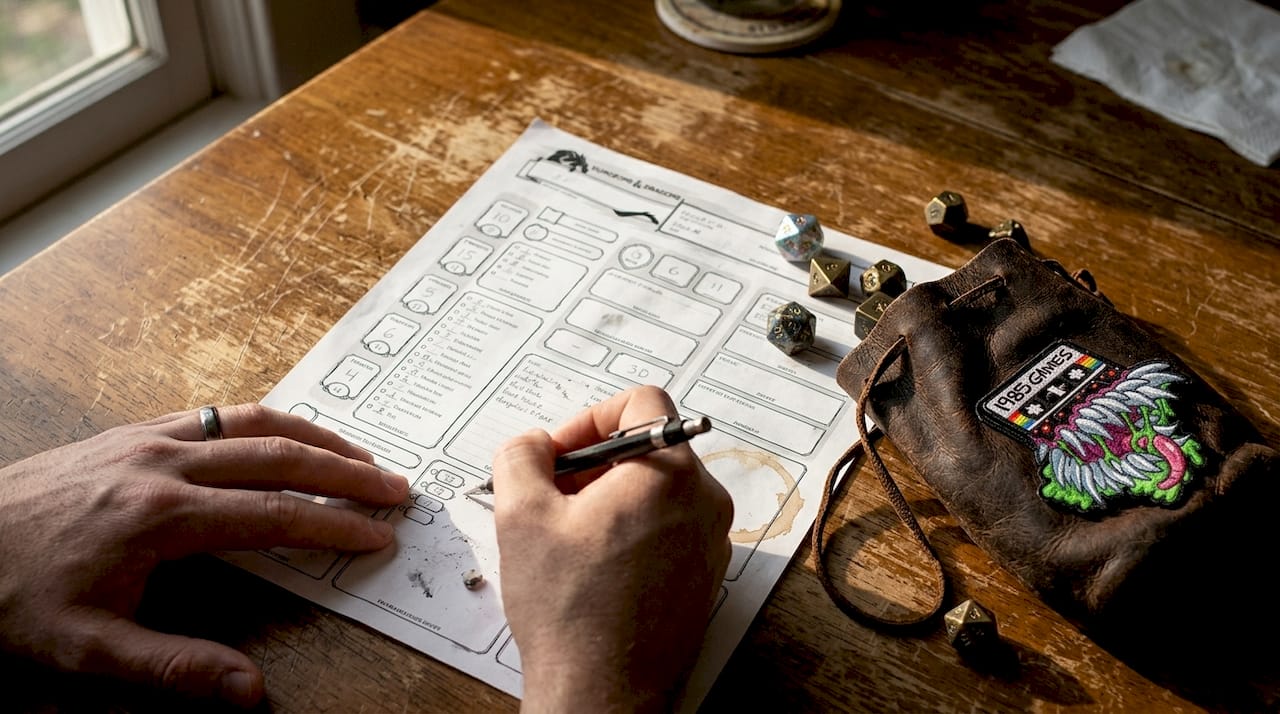
Proficiency represents training and expertise in specific skills, tools, weapons, or saving throws. When you’re proficient in something, you add your proficiency bonus to related rolls. This bonus starts at +2 for first-level characters and increases as you gain levels. For example, a rogue proficient in Stealth adds their proficiency bonus when making Dexterity (Stealth) checks.
Saving throws are special rolls you make to resist harmful effects like spells, traps, or poisons. Each saving throw uses one of the six ability scores. When a dragon breathes fire, you might make a Dexterity saving throw to dodge partially, reducing damage. Understanding types of dice sets helps you recognize which die to roll in different situations.
Combat terminology includes several critical concepts. Initiative determines turn order at the start of combat, with each participant rolling a d20 and adding their Dexterity modifier. Attack rolls determine whether your strike hits, comparing your d20 roll plus modifiers against the target’s Armor Class (AC). Damage rolls use various dice depending on your weapon or spell.
Here’s how a typical action roll works:
- Declare what your character attempts to do
- The DM determines which ability check applies and sets a Difficulty Class (DC)
- Roll a d20 and add your relevant ability modifier
- Add your proficiency bonus if you’re proficient in the relevant skill
- Compare your total to the DC; meeting or exceeding it means success
Pro Tip: Keep a reference sheet with your character’s most common modifiers written down. This speeds up gameplay dramatically and reduces the need to recalculate bonuses every roll. Check out DND tips for beginners 2026 for more practical advice.
Specialized D&D terms for storytelling and gameplay
Alignment describes a character’s ethical and moral outlook using a two-axis system. The lawful-chaotic axis represents attitude toward rules and structure, while the good-evil axis reflects moral intentions. Understanding alignment helps players shape character behavior consistently within the game world. A lawful good paladin follows codes of honor and helps others, while a chaotic neutral rogue prioritizes personal freedom without strong moral leanings. Alignment guides roleplay decisions but shouldn’t restrict creative character development.
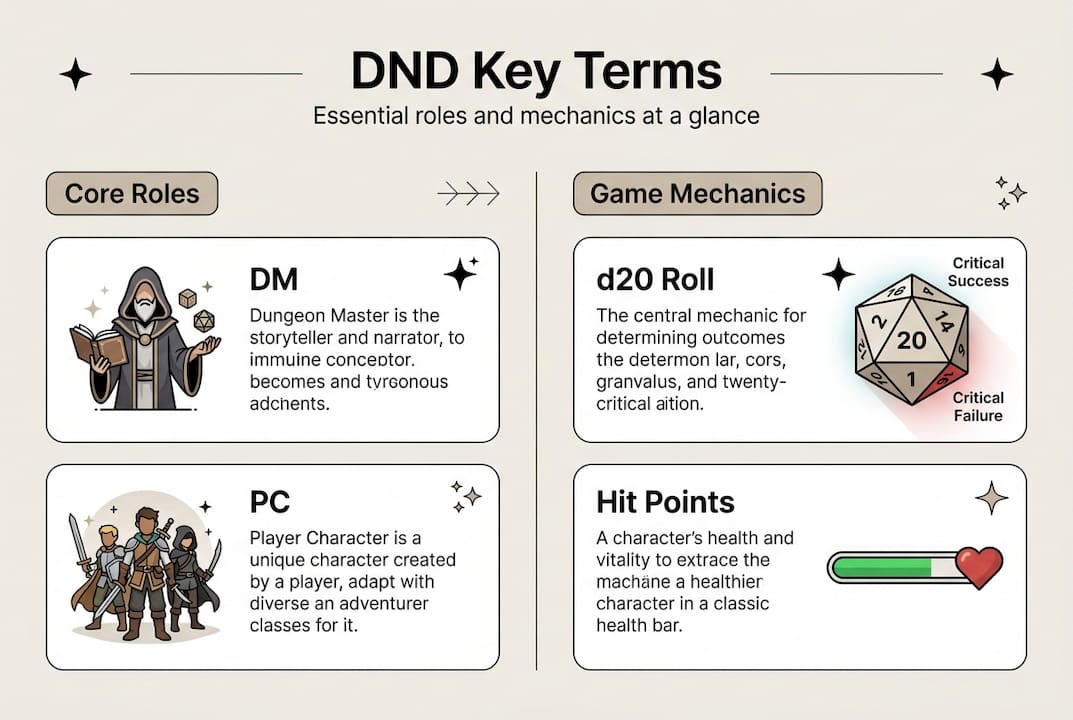
Hit points (HP) measure how much damage your character can sustain before falling unconscious or dying. This abstraction represents physical stamina, luck, and will to survive rather than literal wounds. When damage reduces you to 0 HP, you fall unconscious and begin making death saving throws. Temporary hit points provide a buffer that absorbs damage first but can’t be healed, only granted by specific abilities or spells.
Spellcasting introduces complex terminology that defines magical abilities. Spell slots represent how many spells of each level you can cast before needing a rest. Cantrips are simple spells you can cast unlimited times without consuming resources. Concentration requires maintaining focus on certain spells, meaning you can only concentrate on one spell at a time and must make Constitution saves when taking damage to maintain it. Components include verbal (spoken words), somatic (hand gestures), and material (physical items) requirements for casting.
Conditions are status effects that alter how characters function in specific ways:
- Blinded: Cannot see, automatically fails sight-based checks, attacks against you have advantage
- Charmed: Cannot attack the charmer, who has advantage on social interactions with you
- Frightened: Disadvantage on ability checks and attacks while the source of fear is visible
- Paralyzed: Incapacitated and cannot move or speak, automatically fail Strength and Dexterity saves
- Poisoned: Disadvantage on attack rolls and ability checks
- Stunned: Incapacitated, cannot move, and automatically fail Strength and Dexterity saves
Roleplaying terms help describe player behavior and game style. Metagaming occurs when players use out-of-character knowledge their characters wouldn’t possess to make decisions. Homebrew refers to custom rules, items, or content created by the DM or players rather than official sources. Min-maxing describes optimizing character builds for maximum mechanical effectiveness, sometimes at the expense of roleplay considerations.
“The best D&D sessions balance mechanical mastery with creative storytelling, allowing players to engage both strategically and narratively.”
Understanding these nuanced terms helps you run a DND session for engaging gameplay by communicating clearly about both mechanical effects and narrative intentions. When everyone at the table shares vocabulary, you spend less time explaining and more time adventuring. Learning how to run a DND campaign immersive gameplay requires mastering this specialized language.
Communicating effectively using D&D slang and abbreviations
D&D culture has developed shorthand terminology that experienced players use to communicate efficiently during sessions. These abbreviations and slang terms speed up gameplay by condensing complex concepts into quick references. Common D&D slang and abbreviations improve in-game communication among players and DMs, creating a shared language that builds community.
Essential abbreviations every player should know:
- AC: Armor Class, the target number you must meet or exceed to hit with an attack
- HP: Hit Points, your health pool before falling unconscious
- XP: Experience Points, earned through encounters and used to level up
- DC: Difficulty Class, the target number for ability checks and saving throws
- DPR: Damage Per Round, used when discussing combat optimization
- AoE: Area of Effect, describing spells or abilities that affect multiple targets
- RAW: Rules As Written, referring to strict interpretation of official rules
- RAI: Rules As Intended, referring to the designers’ intended meaning
Popular slang terms enhance table communication and create memorable moments. A “crit” or critical hit occurs when you roll a natural 20 on an attack roll, dealing extra damage and often creating dramatic turning points in combat. The opposite, a critical failure or “nat 1,” happens when you roll a natural 1, typically resulting in automatic failure and sometimes humorous consequences at the DM’s discretion.
Min-maxing describes the practice of optimizing character builds for maximum mechanical effectiveness. While sometimes viewed negatively, thoughtful optimization can enhance gameplay when balanced with roleplay. Power gaming takes this further, prioritizing mechanical advantage over story or group enjoyment. Most tables find a middle ground that allows strategic character building while maintaining narrative focus.
Metagaming deserves special attention because it affects game integrity. This occurs when players use knowledge their characters don’t possess to influence decisions. Knowing a troll’s weakness to fire because you read the Monster Manual is metagaming if your character has never encountered trolls. Responsible players separate player knowledge from character knowledge, making decisions based on what their character would realistically know or do.
Table talk refers to out-of-character discussion during gameplay. Some groups minimize this to maintain immersion, while others embrace casual conversation as part of the social experience. Session zero describes a preliminary meeting where the group discusses expectations, boundaries, and campaign themes before play begins. This crucial conversation helps align everyone’s vision for the game.
Using slang appropriately means considering your audience. New players benefit from clear explanations rather than abbreviation-heavy speech. As your group develops shared understanding, incorporating shorthand naturally speeds up play without creating confusion. The goal is efficient communication that enhances rather than hinders the experience. Exploring DND tips for beginners provides additional guidance on table communication.
Pro Tip: Create a shared glossary document for your gaming group that defines terms as they come up. This living reference helps new players learn vocabulary without interrupting gameplay for explanations.
Understanding role of accessories in DND extends beyond terminology to include the physical tools that support communication and gameplay. Quality dice, clear character sheets, and visual aids all contribute to smoother sessions where everyone stays engaged and informed.
Explore D&D accessories to elevate your 2026 game
Mastering D&D terminology creates the foundation for exceptional gameplay, but the right accessories transform good sessions into unforgettable experiences. Quality dice sets ensure reliable rolls while adding personal style to your character’s story.

Explore our buy 2 get 1 dice sets collection to find the perfect dice for your adventuring party, with premium options that feel substantial in hand and roll true. Our battle maps bring encounters to life with detailed terrain that helps everyone visualize combat positioning and environmental features. For players who love variety and surprise, our mystery dice 6 pack delivers unique sets that spark creativity and conversation at the table. These carefully crafted accessories complement your growing vocabulary knowledge, helping you communicate clearly while enjoying the tactile pleasures of tabletop gaming.
Frequently asked questions about D&D terminology explained
What does ‘homebrew’ mean in D&D?
Homebrew refers to custom content created by DMs or players rather than official published material from Wizards of the Coast. This includes house rules, original monsters, custom classes, unique magic items, or entirely original campaign settings. Many groups incorporate homebrew elements to personalize their games and address specific table preferences.
How can I quickly learn important D&D terms?
Start by focusing on terms relevant to your character class and common gameplay situations you’ll encounter frequently. Keep a reference sheet with essential abbreviations and mechanics during your first few sessions. Playing regularly accelerates learning more effectively than studying rules in isolation. Check out how to start DND beginners guide for structured learning approaches.
What is a ‘critical hit’ and why is it important?
A critical hit occurs when you roll a natural 20 on an attack roll, automatically hitting regardless of the target’s AC and dealing extra damage by rolling your damage dice twice. Critical hits create exciting dramatic moments and can turn the tide of difficult encounters. They represent perfect strikes that exploit weaknesses or catch opponents off guard.
Can I create my own dice notation?
While you can use shorthand at your table, standard dice notation (like 2d6+3) is universally understood across the D&D community. This notation indicates the number of dice, die type, and any modifiers. Stick with conventional notation when sharing content online or with new groups to avoid confusion.
How do I use the term ‘metagaming’ responsibly?
Accusing someone of metagaming can create tension, so approach the topic diplomatically. Instead of calling out specific instances, discuss as a group how you want to handle player versus character knowledge. Some tables embrace limited metagaming for smoother gameplay, while others prefer strict separation. Establish expectations during session zero to prevent misunderstandings.