

TL;DR:
- A well-designed DM checklist focuses on session flow, player goals, mechanics, flexibility, and safety.
- Most DMs spend 1-3 hours preparing per session, balancing thoroughness and avoiding burnout.
- Checklists are flexible tools that should evolve with experience and adapt to player surprises.
Picture this: you’re three minutes into your session, the players are hyped, and you suddenly realize you forgot to stat out the boss encounter. Cue the internal screaming. Every DM has been there, and honestly, it’s one of the most avoidable disasters in tabletop gaming. A solid Dungeon Master checklist is your secret weapon against those “oh no” moments. It keeps your prep focused, your sessions flowing, and your players totally immersed. Whether you’re running your first campaign or your fiftieth, the right checklist turns chaotic prep into a smooth, confident process. Let’s build yours together.
Table of Contents
- Core criteria for a Dungeon Master checklist
- The ultimate DM session prep checklist
- Prep styles: Lazy DM, DMG, and hybrid approaches
- Expert tips for session zero and edge cases
- A fresh perspective: Checklists are tools, not rules
- Level up your DM prep with the right tools
- Frequently asked questions
Key Takeaways
| Point | Details |
|---|---|
| Prep must cover essentials | The best checklists include hooks, scenes, NPCs, encounters, and safety tools. |
| Different prep styles work | Lazy DM, DMG, and hybrid methods can all be effective if tailored to your group. |
| Session zero is vital | Prepping a session zero aligns rules, boundaries, and play expectations up front. |
| Checklists should be flexible | Adapt your checklist every session for continuous improvement and smoother play. |
| Tools make prep easier | Journals, resources, and dice sets streamline your prep for more fun at the table. |
Core criteria for a Dungeon Master checklist
Before you start scribbling bullet points, it helps to understand what a great checklist actually does. It’s not just a to-do list. It’s a framework that protects your session from falling apart when the players inevitably go off-script (and they will, bless them).
Every strong DM checklist covers five core areas:
- Session flow: Your hook, key scenes, rising stakes, and a satisfying ending (or cliffhanger, you glorious chaos agent).
- Player focus: Notes on each character’s goals, backstory threads, and personal storylines. Prioritize player-centric prep over pure world-building to avoid spending hours on lore nobody touches.
- Mechanical prep: Statted encounters, NPC names and motivations, skill challenge DCs (Difficulty Classes), and reward tables.
- Flexibility tools: Backup scenes, random tables, and improvisation prompts for when players surprise you.
- Safety and comfort: Lines and veils, X-card reminders, and pacing awareness so everyone stays comfortable at the table.
Mastering the Dungeon Master essentials means knowing which of these areas needs the most attention for YOUR group. A combat-heavy crew needs more encounter prep. A roleplay-focused table needs deeper NPC work.
“The best prep is the prep your players actually experience.” Prep smart, not long.
Pro Tip: Before every session, spend five minutes reviewing each player character’s current arc. One small callback to a character’s backstory can make a player feel like the whole world was built just for them. That’s the magic of engaging play sessions.
Think of your checklist as a living document, not a rigid script. It should flex with your group’s energy and evolve as your campaign grows.
The ultimate DM session prep checklist
Okay, fellow worldbuilders, here’s the good stuff. This checklist is modular, meaning you can trim or expand it based on your session length and group’s playstyle. Use it as-is or make it your own.
Pre-session checklist:
- Write or refine your adventure hook (what pulls players into action immediately).
- Draft your opening scene with at least two sensory details (smell, sound, sight).
- Identify 2-3 key locations with brief descriptions and any interactive elements.
- Prep 5 NPCs with a name, goal, and one obstacle they face.
- Stat out 2 combat encounters fully, including initiative order and terrain notes.
- Set 1 skill challenge with a clear DC and consequences for failure.
- Review all PC (player character) goals and find one way to poke at each.
- Confirm session length and communicate it to players beforehand.
- Set up safety tools (X-card, open door policy, lines and veils).
- Gather maps, minis, dice, and any immersion tools you plan to use.
This first-session prep framework covers hooks, scenes, NPCs, combat setup, and safety tools as the non-negotiable core.
During-session checklist:
- Track initiative and HP in real time.
- Note any player decisions that change your planned story.
- Drop at least one unexpected twist or memorable moment.
Post-session checklist:
- Jot down what worked and what flopped.
- Update NPC notes based on how players interacted with them.
- Set up your hook for next session while it’s fresh.
Pro Tip: Adapt this checklist to fit your session. A one-shot needs tighter prep than a campaign session. Check out tips for new Dungeon Masters if you’re just getting started and feeling the pressure. And if you want a dedicated place to track all of this, the Dungeon Notes tool is a game-changer for organized prep.
| Phase | Key focus | Time estimate |
|---|---|---|
| Pre-session | Hook, NPCs, encounters, safety | 60-120 min |
| During session | Tracking, adapting, memorable moments | Full session |
| Post-session | Notes, NPC updates, next hook | 15-20 min |
Prep styles: Lazy DM, DMG, and hybrid approaches
Not all DMs prep the same way, and that’s actually a beautiful thing. Let’s compare the three main philosophies so you can find your fit.
The DMG (Dungeon Master’s Guide) approach is structured and thorough. It covers improv fallbacks, session zero, rewards and XP, traps, environmental conditions, NPC stats and motivations, DCs, encounters, PC review, and session scope. It’s the “measure twice, cut once” method. Great for consistency-focused DMs who love having answers ready.
The Lazy DM approach flips the script. It encourages modular secrets, shorter prep windows, and trusting your improvisation skills. Less burnout, more flexibility. It’s built around the idea that most prep material never gets used anyway, so why spend hours on it?
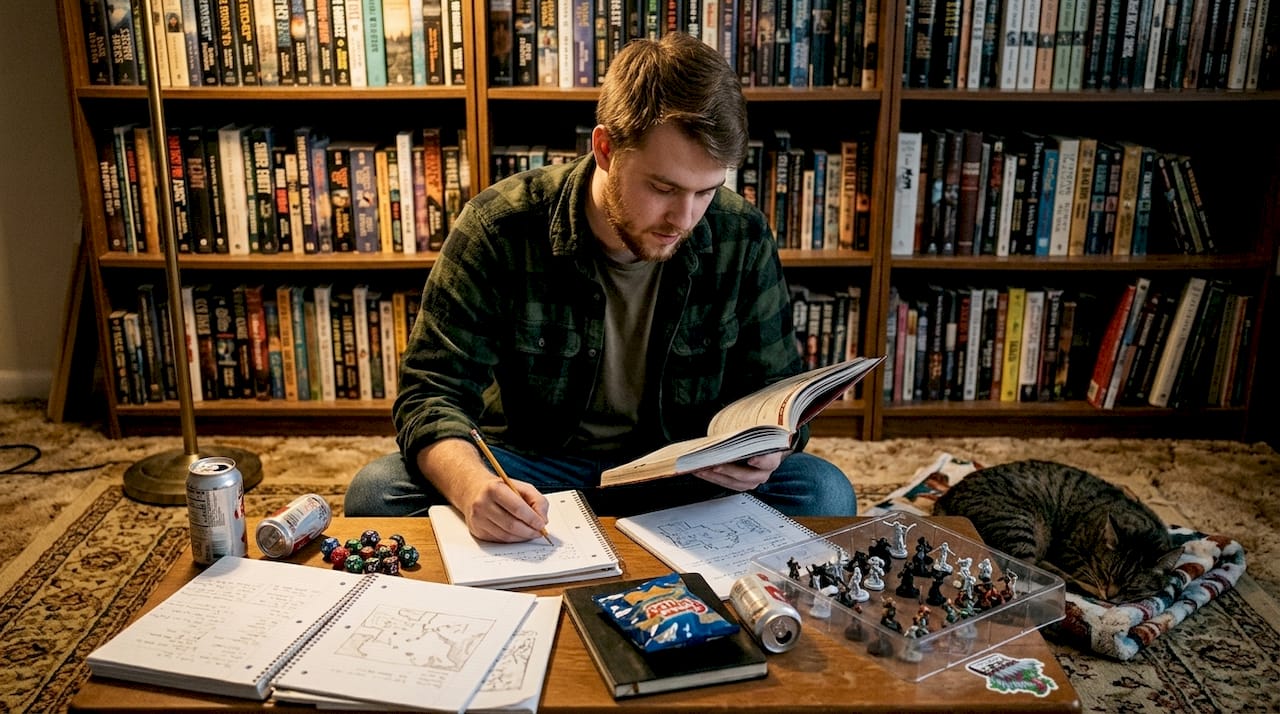
The hybrid approach is where most experienced DMs land. You borrow the DMG’s structural rigor for big story moments and lean on Lazy DM principles for filler scenes and NPC banter.
| Prep style | Checklist focus | Best for |
|---|---|---|
| DMG/Traditional | Full scene-by-scene structure | New DMs, complex campaigns |
| Lazy DM | Modular secrets, improvisation | Experienced DMs, busy schedules |
| Hybrid | Depth where it matters, flex elsewhere | Most ongoing campaigns |
Key traits of each approach:
- DMG: Rewards thorough prep with consistency and confidence.
- Lazy DM: Rewards trust in your players and your instincts.
- Hybrid: Rewards knowing when to plan and when to let go.
Most DMs limit prep to 1-3 hours per session to avoid burnout. That’s the sweet spot. If your prep is bleeding into five or six hours regularly, something needs to be cut. For ideas on running immersive campaigns without drowning in prep, we’ve got you covered. And if you want a physical place to track your campaign arc, TTRPG campaign journals are genuinely wonderful for staying organized between sessions.
Expert tips for session zero and edge cases
Session zero (the pre-campaign meeting where everyone aligns before the first dice roll) is one of the most underused tools in a DM’s kit. Skip it and you’re basically starting a road trip without agreeing on the destination. Not great.
Here’s a solid session zero checklist:
- Align on rules and house rules so nobody gets surprised mid-session.
- Discuss content limits using lines (hard stops) and veils (fade to black).
- Confirm scheduling and session length expectations.
- Talk about play style: Are players here for roleplay, combat, exploration, or all three?
- Set table etiquette: Phones, side conversations, and player agency at the table.
A thorough session zero checklist covers rules alignment, content limits, scheduling, and etiquette as the foundation for a healthy campaign.
“A great session zero prevents 90% of table drama before it ever starts.”
For edge cases, like rule disputes mid-session, remember Rule Zero: the DM’s ruling is final at the table, but balance consistency with flexibility so players feel respected. Don’t be rigid. Don’t be a pushover either. Find the middle ground.
For expert or rules-savvy player groups, prep a few tricky RAW (Rules As Written) edge cases in advance. Know your action economy cold. Have your key D&D terms locked down so you can rule quickly and move on.
Pro Tip: At session zero, ask every player one question: “What moment would make this campaign unforgettable for your character?” Their answers become your most powerful prep material. Also, check out this campaign session gear guide to make sure your table is physically set up for success.
A fresh perspective: Checklists are tools, not rules
Here’s the thing we see over and over again: DMs treat their checklist like a contract. If something isn’t on the list, it doesn’t happen. If something IS on the list, it MUST happen. That’s the trap.
Checklists are scaffolding, not walls. The moment your players take a wild left turn (and they will, gloriously), your checklist needs to flex. The DMs who struggle most are the ones who can’t let go of a planned scene because they spent two hours on it.
The real skill is iteration. After every session, spend ten minutes updating your checklist. What questions came up that you weren’t ready for? What NPC became unexpectedly beloved? Add those to next session’s prep. Your checklist should grow smarter with every game.
We also see new DMs lean on their checklist as a crutch, reading from it during the session instead of being present. The checklist lives in your prep phase. At the table, you’re the storyteller. Trust your prep and trust yourself. If you’re starting out as a DM, building this confidence early makes everything easier down the road.
Level up your DM prep with the right tools
A great checklist gets you 80% of the way there. The other 20% is having the right gear to bring your session to life at the table. Good prep deserves good tools.

At 1985 Games, we’re obsessed with helping DMs run sessions that their players talk about for years. Our variety dice sets add tactile excitement to every roll, and our unique mystery dice are basically a Nat 20 in a box. Pair those with a solid session journal and your prep workflow transforms from stressful scramble to creative ritual. Your players feel the difference. We promise.
Frequently asked questions
What are the absolute must-have items on a D&D Dungeon Master checklist?
The essentials include an adventure hook, key scenes, major NPCs, statted encounters and safety tools, and a review of each PC’s current goals. These cover the mechanical and narrative foundations every session needs.
How long should session prep take for Dungeon Masters?
Most DMs find 1-3 hours sufficient for solid session prep without hitting burnout. Both the DMG and Lazy DM philosophies point to this range as the practical sweet spot.
What should be covered in a session zero checklist?
Session zero should address rules and content agreements, scheduling, play style preferences, and table etiquette. Getting these aligned early prevents most mid-campaign friction.
How do checklists differ for ‘Lazy DM’ and DMG approaches?
Lazy DM encourages modular prep and improvisation, while the DMG prioritizes structured, scene-by-scene preparation. One saves time, the other builds confidence through thoroughness.
What tools help streamline the checklist process for DMs?
Digital or paper session journals, session zero worksheets, and varied dice sets can make prep faster and way more enjoyable. Having everything in one organized place means less scrambling and more storytelling.