

TL;DR:
- True immersion involves inhabiting your character’s mind, feelings, and decision-making process.
- Mechanics and group effort are crucial for creating and maintaining immersive tabletop RPG experiences.
- Group investment and sensory-rich environment foster genuine immersion and enhance emotional engagement.
Most gamers think immersion means slapping on a funny voice and saying “I attack the darkness.” Relatable? Absolutely. Accurate? Not quite. True immersion in tabletop role-playing games is a full psychological experience where your brain lights up like a Nat 20, your character’s fears become your fears, and the decisions you make feel genuinely real. It’s emotional, cognitive, and deeply social. And honestly? Most tables are only scratching the surface of what’s possible. This guide breaks down what immersion actually is, the mechanics behind it, and how both players and GMs can build it together, session by session.
Table of Contents
- What is role-playing immersion?
- The mechanics and principles behind immersion
- Techniques to immerse yourself as a player
- The GM’s role: Fostering immersion at the table
- The real secret to immersion: It’s group-driven, not solo
- Ready to level up your immersion?
- Frequently asked questions
Key Takeaways
| Point | Details |
|---|---|
| Immersion is mindset and emotion | True role-playing immersion means thinking and feeling as your character, not just acting or speaking in-character. |
| System and group alignment matter | The right mechanics and group culture are essential for deep immersion at the table. |
| Players and GMs co-create experience | Both players and Game Masters share responsibility for building and maintaining immersion. |
| Practical tools boost immersion | Props, sensory details, and unique accessories enhance the immersive feel of RPG sessions. |
What is role-playing immersion?
Now that you understand why true immersion is often misunderstood, let’s define exactly what it looks like.
Immersion isn’t just performing your character. It’s inhabiting them. Think of it like the difference between reading a map and actually walking the terrain. When you’re truly immersed, you’re not deciding what your character would do. You’re deciding what YOU would do, given that you ARE the character. That’s a subtle but massive shift.
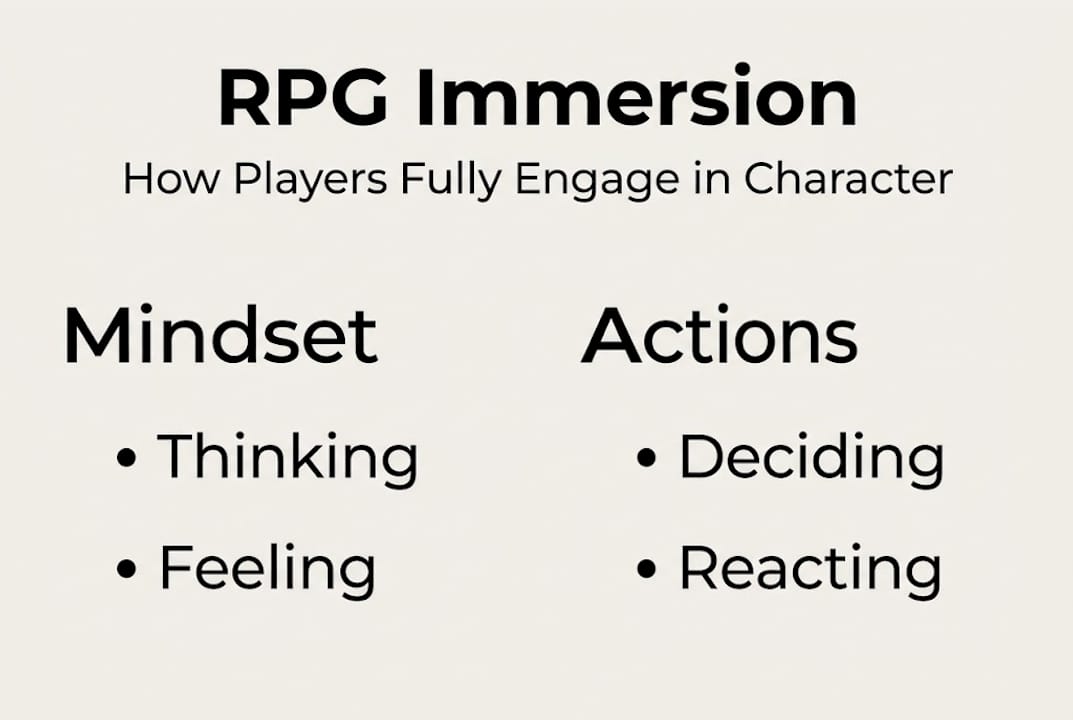
As one of the best resources on this topic puts it, immersion in RPGs is a state where players think, feel, and decide as their character, tuning out the real world. That means your character’s knowledge, senses, and motivations drive every choice, not your player-level awareness of the rulebook.
Game designer Ron Edwards described this as the “actor stance,” where you behave as your character in the moment, much like improv theater. You’re not writing a story about them from the outside. You’re living it from the inside. Check out our tabletop role-playing guide for a broader look at how this fits into the full TTRPG experience.
Here’s why immersion matters beyond just “feeling cool”:
- Stronger memories: Immersive sessions create emotionally charged moments that stick with players for years.
- Deeper engagement: Players who are emotionally invested make bolder, more interesting choices.
- Richer group storytelling: When everyone is in the world, the narrative builds itself organically.
- Character consistency: Immersed players make decisions that feel true to their character, not just tactically optimal.
“Role-playing immersion is a state where players think, feel, and decide as their character, tuning out the real world.” — Run a Game
Here’s a common misconception worth busting: immersion is NOT required for a good RPG session. Some groups love a more casual, author-stance approach where players narrate their character’s actions from the outside. Both are valid. But if you want to know what full immersion feels like and how to get there, keep reading. The payoff is worth it. Understanding how custom dice and immersion connect can also give you a surprising edge at the table.
The mechanics and principles behind immersion
With a foundational understanding of immersion, let’s dig into the specific mechanics and principles that enhance, or undermine, it.
Not all game mechanics are created equal when it comes to immersion. There’s a key distinction between diegetic and dissociated mechanics, and it matters more than most players realize.
Mechanics supporting immersion are associated, meaning diegetic and character-triggered. Dissociated mechanics break immersion by pulling players into meta-game thinking. Here’s a quick comparison:
| Mechanic type | Example | Effect on immersion |
|---|---|---|
| Diegetic (in-world) | “My character senses danger” | Keeps you in the character’s perspective |
| Dissociated (meta-game) | “I’ll use my Action Surge now” | Pulls you out to think about rules |
| Hybrid | Inspiration points for roleplay | Can support immersion if framed narratively |
The goal isn’t to eliminate all meta-game thinking. It’s to minimize unnecessary breaks in the fictional frame. Here are the top principles that support immersion at the mechanical level:
- Use diegetic framing. Describe actions in character terms, not rule terms.
- Practice “yes, and.” Borrowed from improv, this principle keeps the story moving forward without shutting down player choices.
- Define character flags. These are your character’s core motivations, fears, and values that guide decisions automatically.
- Lean into consequences. Let in-world results drive the story rather than GM fiat.
- Build collaborative RPG storytelling habits as a group, not just as an individual player.
Pro Tip: Whenever you face a decision at the table, ask yourself: “Does my character know this, or do I?” If only you know it (as the player), set it aside. Make the call based solely on what your character would perceive. That single habit can transform your roleplay overnight.
For even more roleplaying tips for immersion, check out resources that break down these principles with real session examples.
Techniques to immerse yourself as a player
Understanding the mechanics is one thing. Here’s how you as a player can start immersing yourself right now.
There are three main roleplay styles, and knowing which to use and when is a game-changer. Techniques include descriptive, active, and performative roleplay, each serving a different immersion depth.

| Style | What it looks like | Best used when |
|---|---|---|
| Descriptive | “My character looks around nervously” | Casual moments, new players |
| Active | “I move toward the door and listen” | Action scenes, exploration |
| Performative | Speaking fully in character, first person | High-drama moments, social encounters |
You don’t have to pick one and stick with it. Fluid players shift between styles depending on the scene’s energy. Here’s a toolkit of techniques to try:
- First-person roleplay: Speak AS your character during social scenes. “I don’t trust him” hits harder than “My character doesn’t trust him.”
- Body language cues: Lean forward when your character is tense. Cross your arms when they’re defensive. Your body helps your brain commit.
- Sensory anchors: A specific scent (like cedar or smoke) or a particular playlist can trigger your brain to shift into character mode faster.
- Character journals: Writing in your character’s voice between sessions deepens your connection to their inner world.
- Personal stakes: Tie your character’s goals to something emotionally meaningful, even if fictional. Fear of loss, desire for belonging, hunger for justice.
And here’s the science to back it up: role-playing increases engagement, empathy, and perspective-taking in measurable ways. Higher levels of engagement during roleplay directly correlate with increased empathy ratings. Your brain is literally growing through this hobby. That’s wild and wonderful.
Pro Tip: Before each session, write down one specific goal your character wants to achieve that night. Not a combat goal. An emotional one. “Earn the ranger’s trust.” “Confess the secret.” Personal stakes are the fastest route to genuine immersion. Pair this with our immersion tools and tips and your essential RPG gear checklist for a full session setup.
The GM’s role: Fostering immersion at the table
Individual effort is powerful, but true immersion is a group activity. Here’s how GMs set the tone.
A great GM is basically an immersion architect. They’re building the sensory and emotional environment that makes it easy, even natural, for players to slip into their characters. GMs support immersion using sensory and social details, focused prompts, spotlight rotation, and tools like music, lighting, and props.
Here are the most effective GM habits for building immersion:
- Sensory narration: Describe what characters smell, hear, and feel, not just what they see. “The tavern reeks of tallow and old ale” beats “You enter the tavern.”
- Ambient audio: A well-chosen playlist does more for immersion than almost anything else. Seriously. Try it once and you’ll never go back.
- Physical props: Maps, letters, and handouts make the fictional world feel tangible.
- Spotlight rotation: Make sure every player gets a moment to shine each session. Immersion dies when someone feels invisible.
“The GM’s job isn’t to tell a story. It’s to create the conditions where the story can happen.” — Advanced RPGs
Here’s a numbered list of GM tips for maintaining and troubleshooting immersion:
- Open with a recap in character. Start each session by describing the world, not summarizing the plot.
- Use targeted prompts. Ask players “What does your character feel right now?” during key moments.
- Calibrate emotional intensity. Check in with players if scenes get heavy. Safety tools like the X-card are your friend.
- Address metagaming gently. Redirect with in-world questions instead of calling players out.
- Debrief after sessions. Ask what felt immersive and what pulled people out.
Edge cases like metagaming, spotlight monopolization, and emotional imposition are real risks. The best GMs treat these as calibration opportunities, not failures. For full session planning, our guide on running immersive D&D sessions and game setup for immersion have you covered.
The real secret to immersion: It’s group-driven, not solo
After all these strategies, let’s tackle a truth many guides miss about immersion.
Here’s our honest, slightly spicy take: most immersion guides treat it like a solo skill. Practice your voice. Write your backstory. Nail your character’s accent. And sure, those things help. But immersion is fundamentally a social contract. It only works when the whole table is invested in creating and protecting the shared fictional space.
One person going full method-actor while everyone else is scrolling their phone? That’s not immersion. That’s theater with an uninterested audience. Immersion is one stance among actor, author, and director approaches, and it’s genuinely not required for role-playing or even great storytelling.
Veteran DMs we’ve talked to consistently say the same thing: the most immersive sessions aren’t the ones with the best performers. They’re the ones where everyone is listening, reacting, and building on each other’s contributions. Small emotional cues, a knowing glance across the table, a callback to something another character said two sessions ago. That’s the real magic.
Our advice? After your next session, do a quick debrief. Ask everyone: “What moment felt most real to you tonight?” You’ll learn more about your group’s immersion style in five minutes than from any rulebook. And check out our thoughts on D&D campaign immersion for long-form storytelling ideas that the whole table can build together.
Ready to level up your immersion?
Take the techniques above and bring immersion to life at your table. It’s easier with the right gear.
All the roleplay techniques in the world hit different when you’ve got the tactile magic of a beautiful dice set in your hand. There’s something about rolling a set of dice that feels like yours, that matches your character’s vibe, that makes every roll feel like a moment. It’s a small thing with a big impact.

At 1985 Games, we’ve got curated collections built for dice goblins who take their immersion seriously. Treat yourself to our mystery dice sets for a surprise that’ll have your whole table gasping, or stock up with our incredible Buy 2 Get 1 Dice Sets deal and never run low on table magic again. Your next legendary session is one roll away.
Frequently asked questions
What does immersion mean in RPGs?
Immersion in RPGs means deeply experiencing the story by thinking, feeling, and making decisions as your character based on their knowledge, senses, and motivations rather than your own player-level awareness.
Is full immersion necessary for a fun RPG session?
Not at all. Immersion is one stance among several valid approaches, including author and director styles, and many groups have a blast without pursuing deep character immersion.
How can GMs help players become more immersed?
GMs can foster immersion by using sensory details, spotlight rotation, targeted character prompts, ambient music, and physical props that make the fictional world feel real and tangible.
Do immersive techniques make players better at empathy?
Yes. Role-play increases empathy and perspective-taking in measurable ways, with higher levels of engagement during roleplay directly correlating with stronger empathy ratings among participants.
Are there risks to pursuing immersion?
Risks include emotional discomfort, spotlight monopolization, and group misalignment, all of which can be managed through calibration tools, safety mechanics, and regular post-session check-ins.