

TL;DR:
- Session Zero establishes campaign tone, boundaries, and expectations to enhance player buy-in and campaign longevity.
- Preparing a flexible, node-based framework allows for adaptive storytelling that responds to player choices.
- Post-session notes help refine future sessions by tracking engaging scenes, NPCs, and player decision impacts.
Master the session planning process for immersive gameplay
We’ve all been there. You sit down at the table, notes in hand, and within twenty minutes the players have gone completely sideways, your plot hook is gathering dust, and someone’s arguing about encumbrance rules while another player stares at their phone. Chaotic sessions don’t just hurt immersion. They drain the fun out of the game for everyone, including you, the Dungeon Master. The good news? A structured session planning process fixes almost all of this. In this guide, we’re walking you through every stage, from Session Zero all the way to post-session notes, so you can run smoother, richer, more memorable games that your players will talk about for years.
Table of Contents
- Laying the groundwork: Session Zero essentials
- Gathering your toolkit: What to prepare before gameplay
- Building a flexible skeleton: Modular prep that adapts to players
- Running and refining: In-session delivery and post-session tweaks
- Why the best session plans embrace player chaos
- Equip your table for legendary sessions
- Frequently asked questions
Key Takeaways
| Point | Details |
|---|---|
| Start with Session Zero | Align group tone and expectations before the campaign for fewer mid-game conflicts. |
| Use modular prep | Prepare flexible scenes and NPC motives to react to your players’ choices. |
| Track and refine | Take post-session notes to identify what worked and adjust your prep next time. |
| Embrace spontaneity | The most memorable sessions often come from adapting to unexpected player decisions. |
Laying the groundwork: Session Zero essentials
Once you understand the value of planning, it all starts with laying the right foundation before anyone even rolls a die. That foundation has a name: Session Zero.
Session Zero is the meeting you hold with your players BEFORE the campaign begins. No monsters. No dice. Just conversation. As the Session Zero Guide explains, Session Zero is foundational for establishing campaign tone, expectations, content boundaries, and logistics before play. Skip it, and you’re basically building a house on sand. Hold it, and you’ve given your whole table a shared map.
So what goes on your Session Zero agenda? Here’s what we always recommend covering:
- Campaign tone and genre: Gritty survival horror or swashbuckling adventure? Get everyone on the same page early.
- Content boundaries: Use safety tools like the X-Card or Lines and Veils to protect everyone at the table.
- Character creation rules: Allowed sourcebooks, stat-rolling methods, multiclassing rules.
- Session logistics: Frequency, session length, platform (in-person or online), house rules.
- Player expectations: Roleplay-heavy vs. combat-heavy, spotlight balance, party cohesion.
Here’s a quick comparison of what sessions look like with and without a Session Zero:
| Factor | Without Session Zero | With Session Zero |
|---|---|---|
| Tone alignment | Often inconsistent | Clear and shared |
| Content issues | Risk of uncomfortable surprises | Boundaries set in advance |
| Player buy-in | Lower, more passive | Higher, more invested |
| Campaign longevity | Shorter on average | Significantly longer |
| DM stress | Higher throughout | Lower from session one |
Player buy-in is HUGE. When players help shape the world’s tone and their characters’ place in it, they show up to sessions ready to play, not just to observe.
“The table is a collaborative space. Your job as DM is to facilitate great storytelling, not deliver a performance. Session Zero is where that collaboration begins.”
Pro Tip: Introduce the TTRPG Safety Toolkit (available free online) to your group during Session Zero. It includes the X-Card, Lines and Veils, and the Open Door Policy. These tools give every player a voice when things get uncomfortable, and that safety net makes everyone braver and more engaged during play.
For more ideas on running engaging D&D sessions and truly achieving RPG immersion, we’ve got you covered with deeper guides to explore after this one.
Gathering your toolkit: What to prepare before gameplay
After setting expectations with your group, the next step is having the right arsenal for smooth session management. Think of your prep kit like a chef’s mise en place. Everything in its place, ready to grab, so you can focus on cooking up a great story instead of scrambling for ingredients.
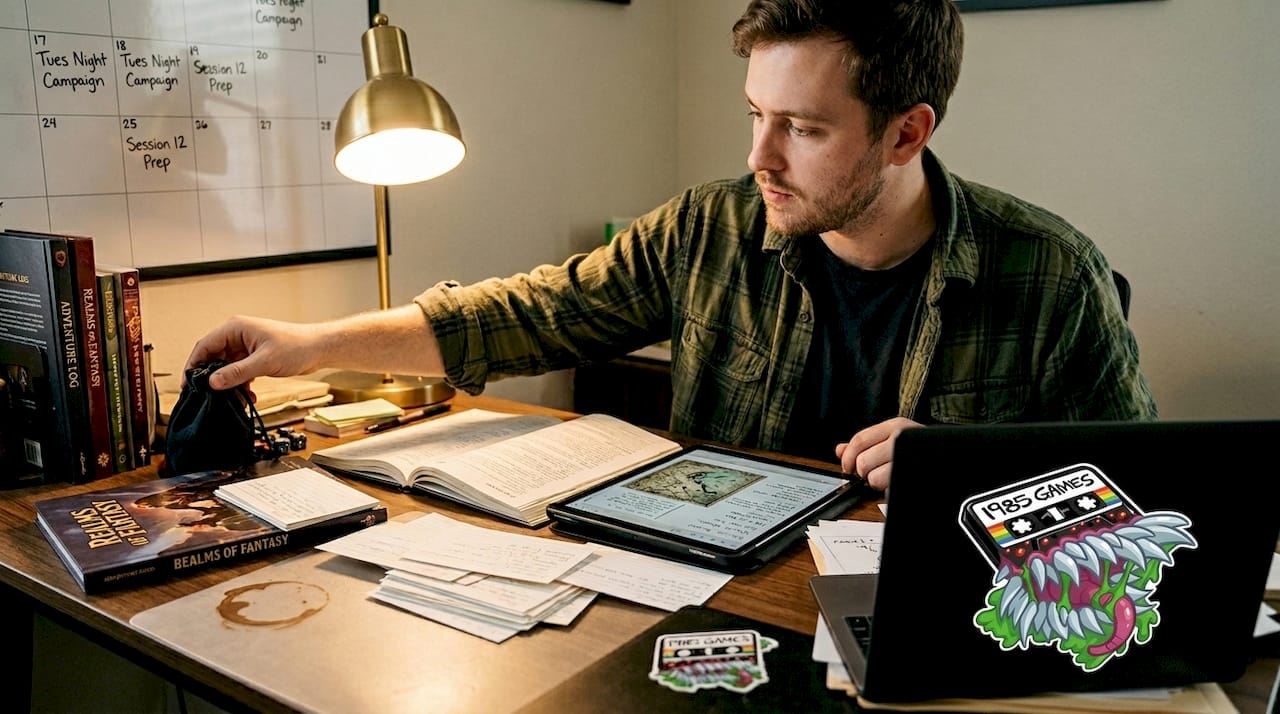
Node-based preparation empowers DMs to be flexible and reduces wasted effort. Part of what makes it work is having the right tools already assembled before you sit down to plan.
Here’s what a solid DM toolkit looks like, whether you’re running in-person or online:
- Physical tools: Printed maps or a wet-erase battle map, a DM screen, miniatures or tokens, index cards for NPC notes, physical dice (yes, plural, always plural).
- Digital tools: Notion or Obsidian for campaign notes, Google Docs for shared session recaps, DnDBeyond for rules reference, Owlbear Rodeo or Foundry VTT for virtual tabletop play.
- Reference materials: Monster stat blocks, spell cards, condition reminder tokens.
- Ambiance tools: Syrinscape or Spotify playlists for mood music, a candle or lighting setup for atmosphere.
- Improvisation aids: A random name generator app, a d100 encounter table, a list of reusable NPC archetypes.
Let’s compare two levels of prep to see what impact each has on your session quality:
| Prep level | Tools included | Session impact |
|---|---|---|
| Minimal | Notes app, core rulebook, scratch paper | Functional but improvisation-heavy |
| Advanced | Battle maps, DM screen, digital notes, music, props | High immersion, faster pacing, smoother transitions |
The gap between minimal and advanced isn’t just about looking cool. It’s about mental bandwidth. Every tool that handles a small task (like mood music running in the background) frees up your brain to focus on player responses and story beats.
Pro Tip: If you’re running hybrid or fully online sessions, set up a digital “DM dashboard” in Notion before each session. Include your key NPCs, encounter triggers, session goals, and a notes column for real-time updates. Your future self will thank you.
Looking for a solid starting point? Check out our guide to RPG session essentials and learn how to enhance your game with tools that actually make a difference at the table.
Building a flexible skeleton: Modular prep that adapts to players
With your toolkit ready, it’s time to plan scenes and characters in a way that’s both effective and flexible. And here’s the thing, rigidly scripted sessions are a trap. Players will ALWAYS do something you didn’t expect. The solution isn’t to script harder. It’s to build smarter.
Enter node-based prep. As noted in Game Master Tips and Best Practices, node-based scaffolding of locations, NPC motivations, and decision points avoids railroading and enables adaptive storytelling. Instead of writing a plot, you design a living world with pieces that snap together however the players move through them.
Here’s how to build one in practice:
- Define 3 to 5 key locations relevant to this session. Give each a mood, a potential conflict, and at least one interesting detail players can interact with.
- Create motivated NPCs, not puppets. Each NPC should have a want, a fear, and a secret. That’s it. Three things. You don’t need a 10-page backstory to make someone feel real.
- Set up decision points. These are moments where player choices branch the story. Place at least two per session. They don’t need to lead to wildly different outcomes; just give players the feeling that their choices matter.
- Attach information to locations, not sequences. The clue about the missing merchant can be found at the tavern, the blacksmith, OR the town well. Players can find it however they explore. You’re not locked to a fixed order.
- Keep a “flex pile.” This is a short list of encounters, NPCs, or mini-scenes you can drop in anywhere if players go off-map. Think of it as narrative duct tape.
How do you know you’re over-prepping or railroading? Watch for these signals:
- You feel anxious when players ignore your plot hooks.
- You keep nudging players back toward a specific location or NPC.
- Your notes have more than three “must happen” events in a single session.
- Players seem passive, waiting for direction rather than making choices.
- You’ve written NPC dialogue word for word.
Studies of DM communities suggest that a majority of experienced game masters who shifted from linear scripting to modular prep reported sessions feeling more dynamic and player-driven, with less time wasted on unused content.
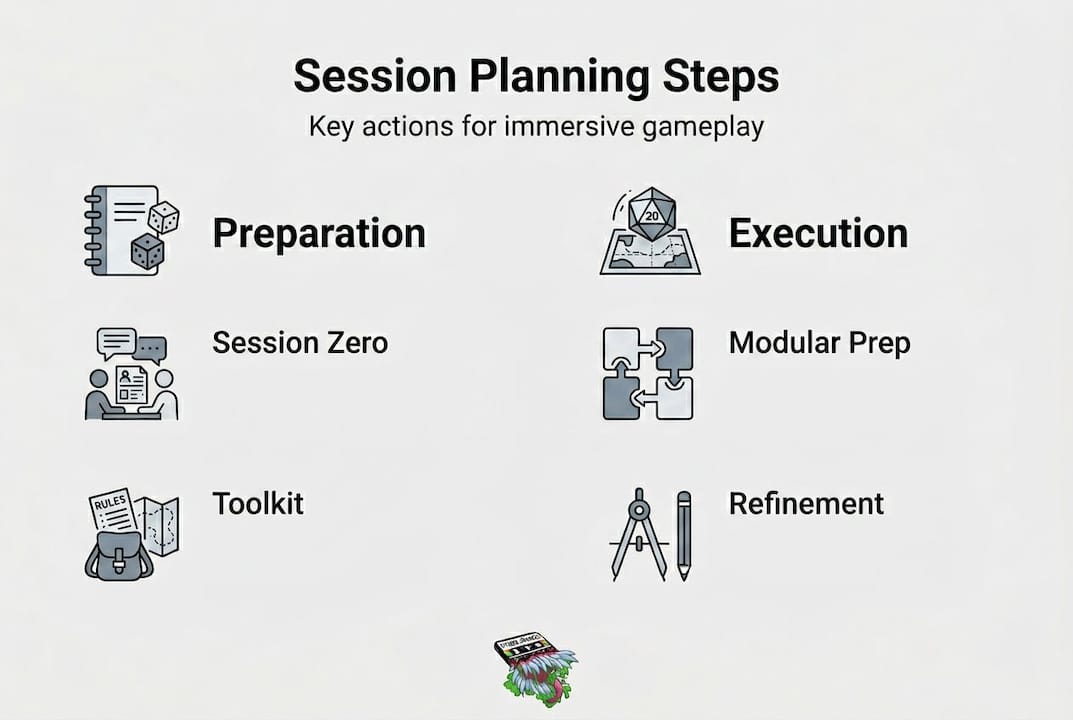
Explore our DM prep checklist for a printable session-planning resource, and dive into our tips for creating immersive campaigns that players actually stay invested in, session after session.
Running and refining: In-session delivery and post-session tweaks
You’ve set up flexible content. Now it’s time to run the session and learn from each game for continuous improvement. Planning is only half the equation. What you do at the table and after it is where the real magic happens.
Here’s a numbered framework for running an adaptive session:
- Before the session: Review your node map, warm up your NPC voices, cue your music playlist, and do a one-sentence recap of last session to get everyone oriented.
- Opening scene: Start in the action or in a moment of tension. Skip long recaps. Players hate waiting to play.
- During play, track energy: If the table is buzzing and engaged, let it run. If energy dips, introduce a new NPC or light a narrative fuse (a distant explosion, a messenger arriving, a rumor surfacing).
- Adapt your node map in real time: If players ignore Location A and sprint toward Location C, move your key information accordingly. The world bends to feel responsive, not punishing.
- Wrap with a cliffhanger or emotional beat: End on something that makes players want to come back. A revelation, a choice, a threat on the horizon.
- Post-session, within 24 hours: Write your session notes while memory is fresh.
Speaking of post-session notes, they are genuinely one of the most underused DM tools in existence. Post-session notes on player engagement and rule confusion reduce prep time for future sessions significantly. What do you track?
- Which scenes generated the most energy and laughter?
- Which NPCs did players latch onto unexpectedly?
- Any rules that slowed the game down or caused arguments?
- Player choices that need consequences next session.
- Unused content from your flex pile that can be recycled.
“The players are the protagonists. Your notes, maps, and monsters exist to serve THEIR story. Listen more than you plan, and you’ll always know what to prep next.”
Using props for immersion during your sessions can dramatically shift the energy at the table. And if you’re newer to this whole adventure, our guide on immersive play guidance breaks it all down from the ground up. For the big-picture storytelling side of things, our piece on collaborative RPG storytelling is a must-read.
Why the best session plans embrace player chaos
Here’s the hot take we’ve earned after years in the TTRPG community: the DMs who run the most legendary sessions are NOT the ones with the most detailed notes. They’re the ones who prepared just enough to let go.
There’s a quiet trap in the DM hobby. You spend so many hours building your world, your plot, your villain’s monologue, that when players subvert it, it stings. We get it. But that sting? That’s actually the game working PERFECTLY. Player unpredictability isn’t a bug. It’s the whole feature.
Your job as a DM is to build the stage, not script the play. Great collaborative RPG storytelling only happens when players feel genuinely free to surprise you. And honestly? The moments you’ll remember most aren’t the scenes you scripted. They’re the ones that came out of nowhere when a player did something wild and you rolled with it.
Plan with purpose. But hold your plans loosely. The chaos IS the story.
Equip your table for legendary sessions
Having mastered the session planning framework, it’s time to level up your table with the perfect gear. Because honestly, a great plan deserves great tools to bring it to life.

At 1985 Games, we’ve curated a collection of handcrafted accessories built specifically for Dungeon Masters who care about the craft. From atmospheric battle maps that make your carefully designed locations POP off the table, to premium dice sets that bring personality to every roll, we’ve got your session toolkit covered. Beautiful dice make players feel the stakes. Detailed maps make your world feel real. The right tools turn a good session into an unforgettable one. Come explore and find your next favorite thing.
Frequently asked questions
What is the purpose of Session Zero in role-playing games?
Session Zero sets expectations, defines boundaries, and organizes campaign logistics before gameplay begins. It’s the single most effective way to prevent future table conflicts and boost long-term player investment.
How does node-based prep help a Dungeon Master?
Node-based preparation allows DMs to adapt to player choices, reduce wasted work, and keep sessions dynamic. It replaces rigid plot scripts with a flexible web of locations, NPCs, and decision points players can explore in any order.
What should a DM track in post-session notes?
Track scenes that engaged players and any house rules or moments that caused confusion to streamline future sessions. Post-session notes reduce prep time for future sessions and help you recycle unused content effectively.
How can a DM avoid railroading players?
Create modular scenes and decision points so players feel their choices matter, and adapt the story as you go. Node-based scaffolding is specifically designed to avoid railroading by decoupling information and story beats from a fixed sequence.