

TL;DR:
- Core essentials include a rulebook, polyhedral dice, character sheets, and pencils for every game.
- Dungeon Masters benefit from tools like DM screens, battle mats, and condition rings to streamline gameplay.
- Optional accessories such as miniatures and sound Apps enhance immersion but are not necessary for fundamental play.
Decision fatigue is real, dice goblins. You’re standing in the game store (or doom-scrolling an online shop at midnight), staring at a wall of accessories, and your brain is doing that thing where it short-circuits like a failed Arcana check. Rulebooks, dice trays, battle mats, miniatures, condition rings — where do you even start? Not all gear is created equal. Some items are absolute non-negotiables. Others are delightful flavor upgrades. And a few are pure “ooh shiny” traps that slow your sessions down. This guide cuts through the noise and maps out exactly what you need, what’s worth adding later, and what’s optional for your specific table.
Table of Contents
- Core essentials: Non-negotiable gear for every table
- Beyond basics: Dungeon Master tools & advanced essentials
- Immersion upgrades: Miniatures, terrain, sound, and props
- Digital tools and alternatives: Virtual and hybrid play
- How to choose: Essential checklists & situational recommendations
- Our take: Rethinking essentials for the modern game table
- Upgrade your kit: Shop essential and unique tabletop gear
- Frequently asked questions
Key Takeaways
| Point | Details |
|---|---|
| Start with the basics | Rulebooks, polyhedral dice, and character sheets form the foundation for every tabletop role-playing session. |
| Add advanced gear as needed | Dungeon Masters and frequent players benefit most from screens, mats, and specialized tools for smooth gameplay. |
| Boost immersion with upgrades | Miniatures, terrain, and sound increase atmosphere, but are optional enhancements. |
| Digital tools offer flexibility | Virtual tabletops can fully replace physical gear for online groups or hybrid play. |
| Choose based on your group | Prioritize gear purchases according to budget, session type, and player preferences. |
Core essentials: Non-negotiable gear for every table
Let’s start with the absolute core items every RPG player or DM should bring to the table. Strip everything back to basics and you get a surprisingly short list. Seriously, early D&D sessions ran on graph paper and borrowed dice with zero fancy gear in sight. The barrier to entry has always been low, and that’s a beautiful thing.
Here’s what you genuinely cannot skip:
- A rulebook or basic rules. The Player’s Handbook is the gold standard, but free basic rules work perfectly for new groups. The Dungeon Master’s Guide and Monster Manual matter more once you’re running full campaigns.
- One set of polyhedral dice. You need the classic seven: d4, d6, d8, d10, d12, d20, and percentile. One set per player is ideal, though sharing works fine for beginners.
- Character sheets. Printed or digital, these track everything your character is and does. Grab extras because pencil erasure is a contact sport at this table.
- Pencils and paper. Simple. Essential. Irreplaceable for notes, sketches, and tracking initiative.
For new groups, starter sets bundle a rulebook, dice, and sheets for just $14 to $20. That’s an incredible deal for a full night of adventure. The D&D Starter Set and Essentials Kit are both fantastic entry points, and the D&D shopping guide from New York Magazine breaks down exactly which one fits your group.
If you want to level up your first session, check out these beginner D&D tips to avoid the most common rookie mistakes. And our setup guide for tabletop games walks you through arranging your table for maximum immersion from session one.
Pro Tip: Print three extra character sheets before every session and toss two spare pencils in your bag. Someone always forgets theirs, and being the prepared hero feels amazing.
Beyond basics: Dungeon Master tools & advanced essentials
Once the core gear is covered, Dungeon Masters and frequent players can consider specialty items that enhance sessions and keep games running smoothly. Being a DM is basically being a director, improv actor, and referee all at once. The right tools make that juggling act way more manageable.
DMs need additional tools that players simply don’t: a DM screen for hiding notes and referencing rules quickly, a 24x36 inch vinyl battle mat, dry-erase markers, extra dice, initiative trackers, and condition markers or rings. Each one solves a real problem at the table.
Here’s the DM toolkit breakdown:
- DM screen. Hides your notes, monster HP, and secret plans. Also doubles as a quick-reference card for rules you always forget. Check this DM screen guide for what to look for.
- Battle mat and dry-erase markers. Tactical combat gets messy fast without a grid. A vinyl mat wipes clean between encounters.
- Extra dice. Veteran GMs often keep signature dice for dramatic moments. Rolling a handful of damage dice at once? Chef’s kiss.
- Initiative trackers. Tent cards, magnetic strips, or digital apps all work. Anything that stops the “wait, whose turn is it?” loop.
- Condition rings. Snap these onto miniature bases to track poisoned, stunned, or charmed status without flipping through notes every round.
“The best DM screen is the one that keeps your players guessing and your session moving.” Seriously, even a homemade cardboard screen beats nothing.
Pro Tip: Keep a dedicated DM bag packed and ready. When your gear lives in one place, setup takes five minutes instead of twenty.
Understanding the role of accessories in D&D can help you prioritize what to grab first. And if you want to go deeper on atmosphere, our guide to RPG accessories for immersion is worth a read.
One edge case worth noting: organized play events (like D&D Adventurers League) sometimes restrict certain tools, including custom DM screens. Always check event rules before packing everything.
Immersion upgrades: Miniatures, terrain, sound, and props
With gameplay basics in place, many groups look to ramp up their sessions with gear that brings worlds to life. This is where tabletop gaming becomes a full sensory experience. And yes, it’s also where budgets can spiral faster than a wild magic surge.
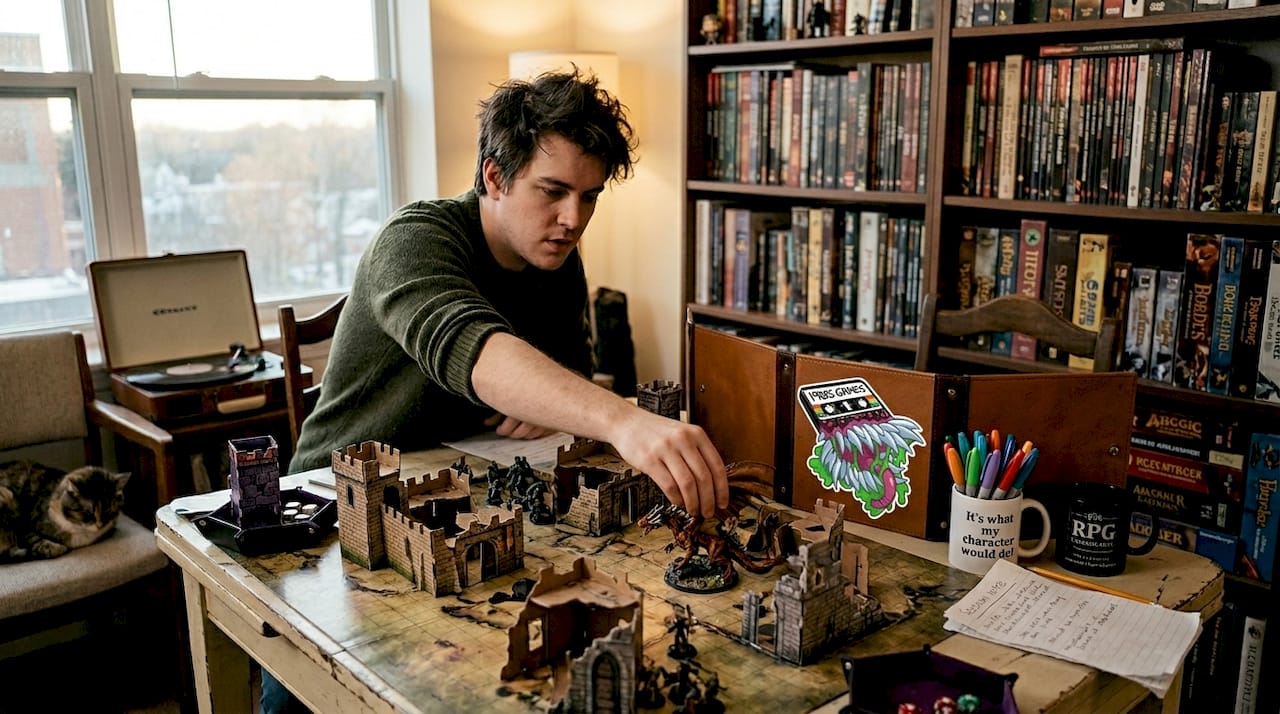
Optional immersion enhancements include miniatures or tokens, 3D terrain, props and handouts, ambient sound tools like Syrinscape, and dice trays or towers that reduce noise and protect your table.
Here’s a quick price comparison to help you plan:
| Upgrade | Avg. cost | Immersion boost | Setup time |
|---|---|---|---|
| Miniatures (set of 6) | $15 to $40 | High | Low |
| Vinyl battle mat | $20 to $50 | High | Very low |
| 3D terrain pieces | $30 to $100+ | Very high | High |
| Dice tray | $10 to $30 | Medium | None |
| Ambient sound app | Free to $10/mo | High | Low |
| Props and handouts | $5 to $25 | Medium | Medium |
Dice trays and towers deserve a special mention. They keep dice on the table (not the floor), muffle that 2 a.m. clatter, and honestly just feel satisfying to use. Small upgrade, big quality-of-life win.
The big debate in every group: tactical grid combat versus theater of the mind. Some tables love the precision of miniatures and maps. Others find it slows things down and prefer pure storytelling. Neither is wrong. Know your group. Our guide on how to enhance immersion covers both approaches with practical tips.
For a broader look at what other groups are using, the RPG essentials breakdown is a solid resource.
Digital tools and alternatives: Virtual and hybrid play
For those seeking flexibility or running remote campaigns, the digital frontier offers powerful alternatives and complements to physical gear. Online play exploded in popularity over the past few years, and the tools have kept pace beautifully.
Virtual tabletops like Roll20 and Owlbear Rodeo handle maps, miniatures, dice rolling, and session notes all in one place. D&D Beyond manages character sheets and rules references digitally. For fully online or hybrid groups, these platforms can replace most physical gear entirely.
Here’s how digital and physical stack up:
| Feature | Physical gear | Digital tools |
|---|---|---|
| Dice rolling | Tactile, satisfying | Convenient, always available |
| Battle maps | Reusable, tangible | Infinitely customizable |
| Character sheets | Easy to annotate | Auto-calculates stats |
| Setup time | Moderate | Fast (once learned) |
| Cost | One-time purchase | Free to subscription |
| Atmosphere | High (in-person) | Varies by platform |
Physical dice win on feel. There’s something about the weight of a d20 in your hand before a critical roll that no digital roller can replicate. That tactile feedback is real, and many players consider it part of the ritual.
Digital tools shine for D&D session enhancements when your group is spread across time zones. No shipping, no storage, no setup. Just log in and play.
For a deeper look at building a hybrid setup, the DM toolkit blog covers how experienced DMs blend physical and digital tools effectively.
How to choose: Essential checklists & situational recommendations
With everything laid out, it’s time to make practical decisions. Here’s how to build your own essentials list based on your specific needs.
Beginner checklist:
- Starter set (includes rules, dice, and adventure)
- Extra pencils and printed character sheets
- Notebook for session notes
- Optional: a second set of dice (because one is never enough)
Dungeon Master checklist:
- Player’s Handbook, Dungeon Master’s Guide, Monster Manual
- DM screen
- Battle mat and dry-erase markers
- Initiative tracker and condition rings
- Two to three extra sets of dice
Upgrade path for established groups:
- Miniatures or tokens for key characters and monsters
- Dice tray or tower
- Ambient sound app (Syrinscape or Spotify playlist)
- 3D terrain for major set-piece encounters
- Handouts and props for narrative moments
Organized play and session frequency should drive your investment decisions. Weekly groups benefit from durable, quality gear. Occasional players can keep it minimal. And if your group plays in organized events, double-check what’s allowed before buying a custom DM screen.
Exploring unique dice sets is a fun next step once your core kit is sorted. And the D&D essentials article from New York Magazine is a great sanity check before any big purchase.
Pro Tip: Budget for the gear you’ll actually use, not the gear you wish you’d use. A $60 terrain set gathering dust is a worse investment than a $15 dice tray you reach for every session.
Our take: Rethinking essentials for the modern game table
Having mapped out the essentials, extras, and situational picks, here’s our honest take: the “more gear equals better sessions” assumption is one of the biggest myths in the TTRPG community.
Early D&D ran on graph paper and borrowed dice, and those sessions became legendary. The magic was never in the accessories. It was in the people, the story, and the shared imagination around the table.
We love a gorgeous set of sharp-edge dice as much as anyone (maybe more, honestly). But we’ve seen groups grind to a halt because someone spent twenty minutes arranging 3D terrain for a combat that lasted two rounds. That’s not immersion. That’s a setup simulator.
Our slightly unpopular opinion: maximize your group’s imagination before you maximize your gear collection. The best immersion tips we know don’t require a single purchase. They’re about engagement, storytelling, and the energy you bring to the table.
Buy the things that remove friction and add joy. Skip the things that add friction while looking like they’d add joy. Your future self (and your table) will thank you.
Upgrade your kit: Shop essential and unique tabletop gear
Whether you’re assembling core tools or adding creative upgrades, the right gear can make every session more memorable. We’ve got you covered, dice goblins.

At 1985 Games, we stock everything from beginner-friendly essentials to collector-worthy accessories for seasoned DMs. Right now, our dice deals are running a buy 2, get 1 free offer that’s basically a Nat 20 for your wallet. If you love a surprise, our mystery dice packs deliver a six-pack of handpicked sets that feel like opening a loot chest. Browse the full range of RPG accessories and find the perfect fit for your play style and budget. Global shipping available, because great adventures happen everywhere.
Frequently asked questions
What are the absolute minimum items needed to play D&D?
Core essentials for D&D are a rulebook or basic rules, one set of polyhedral dice, character sheets, and pencils or paper. That’s genuinely all you need to start playing tonight.
Do I need miniatures and a battle map for every session?
Nope. Miniatures and battle maps are optional and depend entirely on your group’s play style. Some groups prefer theater of the mind over tactical grid combat, and both approaches create incredible sessions.
Are digital tools like Roll20 good replacements for physical gear?
Absolutely. Virtual tabletops like Roll20 handle maps, dice, and character sheets for online or hybrid play with no physical purchases required. They’re especially powerful for groups spread across different locations.
What’s the main advantage of using a DM screen?
A DM screen hides notes from players and provides quick rules reference and trackers for efficient gameplay. It keeps your secrets safe and your session moving without constant book-flipping.