

TL;DR:
- Props enhance immersion and storytelling in D&D by making scenes tangible and memorable.
- Effective use involves strategic timing, choosing simple DIY or specialty items, and balancing their use.
- Physical props work best in person, while digital options suit online play; moderation is key for impact.
Most players think props are just for show. A cool skull on the table, a fancy candle flickering nearby — decoration, right? Wrong. Used with intention, even a crumpled piece of paper handed across the table can make your players’ brains light up like a Nat 20. Props are one of the most underused storytelling tools in D&D, and the gap between a forgettable session and a legendary one is sometimes as small as a single tactile object. This guide breaks down exactly how to use props, what types to grab, and when to drop them for maximum magic.
Table of Contents
- Why props matter: Immersion and storytelling in D&D
- Types of D&D props: From DIY to specialty accessories
- Strategic use: When to introduce props for maximum impact
- Digital or physical: Props in online and in-person D&D
- Our perspective: Mastering prop balance for sustained engagement
- Enhance your sessions with terrain and accessories from 1985 Games
- Frequently asked questions
Key Takeaways
| Point | Details |
|---|---|
| Props fuel immersion | Well-timed props turn ordinary scenes into standout moments by deepening player engagement. |
| Start with simple items | Even household objects or printed handouts can instantly upgrade your campaign’s feel. |
| Less is more | Strategic prop use, not quantity, keeps players excited and avoids distraction. |
| Adapt to your format | Choose between physical and digital props based on whether you play in-person, online, or hybrid. |
Why props matter: Immersion and storytelling in D&D
Immersion is the beating heart of any great D&D adventure. When players stop thinking about their grocery lists and start genuinely feeling like they’re standing in a haunted tavern or negotiating with a dragon, that’s when the real magic happens. Props are one of the fastest ways to get there.
Physical objects pull players out of pure abstraction and into the story. Handing someone a wax-sealed letter instead of just saying “you receive a letter” creates a completely different energy at the table. It’s the difference between reading about a thunderstorm and actually getting rained on. You feel it.
“Combine props with
sensory elements for deeper immersion” — and when you do, players stop being observers and become participants.
Here’s what makes props genuinely powerful in storytelling:
- Handouts (maps, letters, wanted posters) give players something to hold, examine, and reference later
- Coins or tokens make rewards feel real instead of just a number on a sheet
- Artifacts and relics (a strange gem, a broken compass) spark curiosity and conversation between players
- Ambient props (a small hourglass, a candle) set tone without stealing focus
The key insight is intention. Props aren’t set dressing. The best DMs deploy them at specific story beats, like the moment a villain’s true identity is revealed, or when players finally find the cursed item they’ve been chasing for three sessions. Those are the moments players talk about months later.
We’ve seen it time and again in the community. The most memorable sessions aren’t the ones with the most elaborate battle maps. They’re the ones where someone passed a handwritten note across the table and the whole group went silent. That silence? That’s immersion doing its job.
Exploring immersive gameplay tools is a great next step once you start thinking about props as a system rather than a one-off trick. The shift in how your table engages will genuinely surprise you.
Types of D&D props: From DIY to specialty accessories
Good news: you don’t need to spend a fortune to run a prop-rich session. The spectrum runs from items already sitting in your junk drawer to beautifully crafted specialty accessories. Both ends work. Let’s break it down.
| Prop type | Best for | Effort level | Cost range |
|---|---|---|---|
| Printed handouts | All DMs | Low | Free to $5 |
| Household objects | Beginners | Very low | $0 |
| DIY aged maps | Intermediate DMs | Medium | $1 to $10 |
| 3D-printed miniatures | Advanced DMs | High | $10 to $50+ |
| Specialty terrain/maps | Veteran DMs | Low (ready-made) | $20 to $80+ |
For new DMs, start simple with printed handouts or household items. A handful of pennies becomes gold coins. A ring from a craft store becomes a legendary artifact. A torn map edge makes any dungeon feel older and more dangerous.
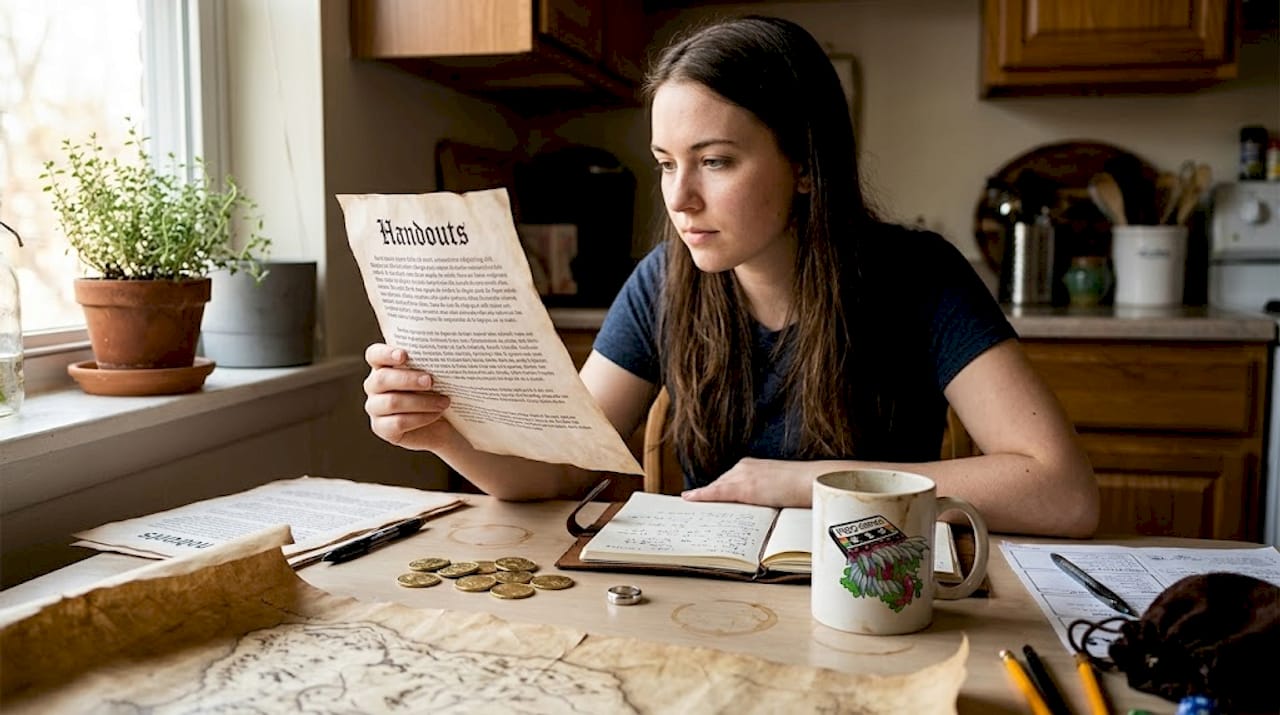
DIY props are where things get genuinely fun. Affordable techniques for aging paper include soaking it in tea, burning the edges lightly, and crumpling it repeatedly before drying. The result looks like it came out of a museum. Players lose their minds.
Here are some easy DIY ideas to get you started:
- Tea-stained letters: Brew strong black tea, soak your printed text, dry flat, and crinkle for that ancient-scroll feel
- Wax seals: A cheap wax seal kit from a craft store adds serious drama to any royal decree
- Tactile clues: Sand glued to a card to hint at desert ruins, or a small piece of bark as a forest token
- Potion bottles: Small glass vials filled with colored water look incredible on the table
Pro Tip: Print your handouts in a period-appropriate font (think gothic or serif styles) before aging them. The combination of font choice and aged texture makes the prop feel genuinely old and world-built.
For veteran DMs ready to level up, specialty map packs and terrain sets transform your table into a visual spectacle. Paired with unique dice sets, the overall table aesthetic creates an atmosphere players step into rather than just sit around. Your RPG essentials list should absolutely include at least one specialty map in rotation.
Strategic use: When to introduce props for maximum impact
Knowing what prop to use is only half the equation. Knowing when to drop it is the art form. And yes, it absolutely is an art form.
Overuse diminishes impact; the magic fades when players expect a prop at every turn. Novelty is your best friend here. Treat props like a surprise boss mechanic: rare enough to be exciting, meaningful enough to matter.
Here’s a simple framework for deciding when a prop makes sense:
- Is this a pivotal story beat? Plot twists, villain reveals, and major discoveries are prime prop territory.
- Does the prop add clarity or emotion? If it helps players visualize or feel something they couldn’t from narration alone, use it.
- Is it ready to go? A fumbled prop breaks immersion. Prepare it fully before the session.
- Will it slow down the game? If passing it around kills momentum, reconsider or set it aside for a natural pause.
- Have you used a prop recently? Space them out. One great prop per session often outperforms five mediocre ones.
| Scenario | Prop impact | Recommendation |
|---|---|---|
| Boss fight reveal | Very high | Yes, use a prop |
| Random merchant encounter | Low | Skip it |
| Key NPC delivers a message | High | Handwritten note works great |
| Dungeon room description | Medium | Only if unique or critical |
| Campaign milestone reward | Very high | Physical artifact or token |
Pro Tip: Prepare one “hero prop” per session. This is your big reveal item, fully made and ready. Everything else can be improvised. One unforgettable moment beats five forgettable ones every time.
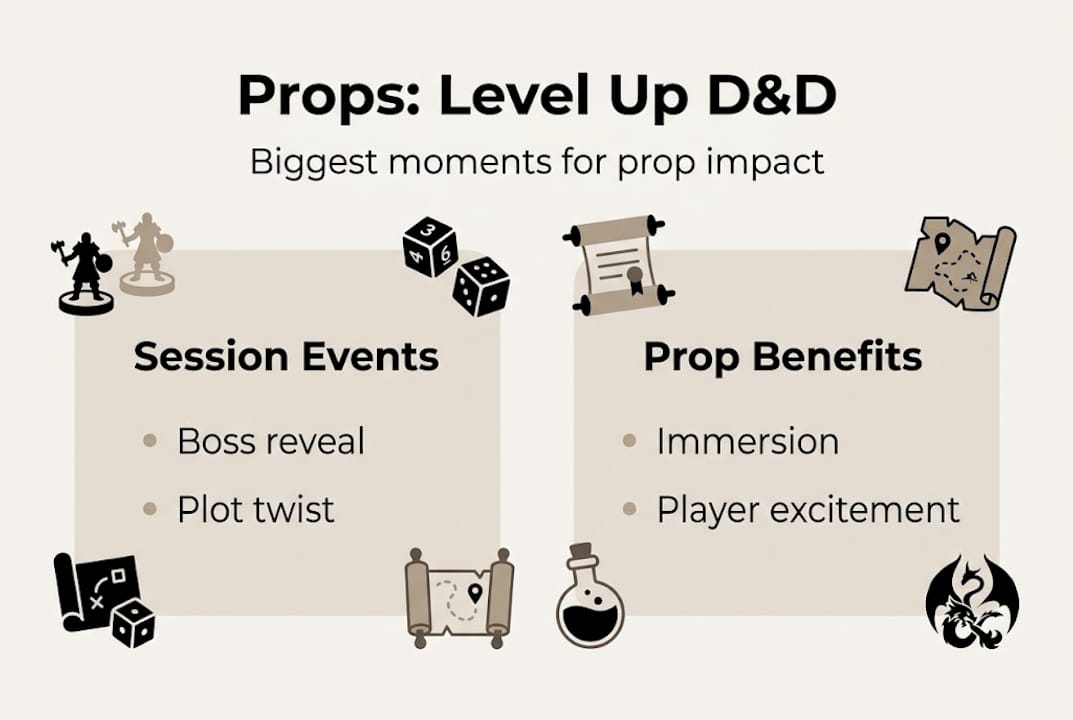
Avoid the trap of prop overload. When players receive something every ten minutes, it stops feeling special. Think of it like seasoning. A little enhances everything. Too much ruins the dish. For more on running engaging D&D sessions, timing and pacing go hand in hand with prop strategy. And if you’re thinking bigger picture, campaign immersion techniques can help you plan prop moments across an entire arc rather than session by session.
Digital or physical: Props in online and in-person D&D
D&D has gone global. Online play exploded and never really went back down, which means prop strategy now needs to account for two very different table formats.
The community consensus is pretty clear: physical props work best for in-person games and are less practical for online play. That’s not a knock on online games. It’s just physics.
“The tactile experience of holding a prop, feeling its weight, passing it between players — that’s something a screen simply cannot replicate. But digital tools can come close in their own way.”
Here’s how to think about props by format:
For in-person sessions:
- Physical handouts, letters, and maps with full tactile impact
- Real coins, tokens, and small artifacts placed on the table
- Terrain and miniatures for visual clarity and dramatic effect
- Ambient props (candles, background music) to enhance atmosphere
For online sessions:
- Screen-shared images and handouts via tools like Owlbear Rodeo or Google Slides
- Digital maps with layered reveals for plot-specific moments
- Shared mood boards or image drops in chat for instant visual context
- Sound effects and music via browser-based tools
Hybrid solutions (players both remote and in-person):
- Send physical props by mail ahead of major campaign milestones (yes, really — players love this)
- Photograph physical props and share them digitally in real time
- Use digital displays at the in-person table that remote players can also see
Storage and prep are real concerns for in-person DMs. Investing in a dedicated prop box or binder keeps everything organized and ready to grab mid-session. The role of accessories in D&D extends well beyond props too. And if you want to see what the current gold standard looks like, checking out top TTRPG accessories gives you a great roadmap.
Our perspective: Mastering prop balance for sustained engagement
Here’s an opinion that might ruffle some feathers: more props is almost never better. We’ve seen DMs go all-in on spectacle, and while the first session dazzles, by session four the players are barely glancing at the elaborate artifact box sitting on the table. Novelty has a shelf life.
The DMs who create truly legendary tables understand rhythm. They build anticipation. They let sessions breathe without props. And then, at exactly the right moment, they slide a mysterious handwritten note across the table, and the whole room goes still.
That’s the cocktail of charm you’re chasing. Anticipation plus surprise plus delight. A cursed relic handed to a player at a campaign’s darkest hour will be talked about for years. Five random props handed out in session one will be forgotten by session two.
Our advice: experiment. Learn your group. Some tables go wild for visual spectacle. Others are pure theater-of-the-mind and one prop is all they need. There’s no universal formula, just attentiveness and iteration. Start by boosting gameplay immersion in small, targeted ways and build from there.
Enhance your sessions with terrain and accessories from 1985 Games
Ready to turn all this inspiration into something real? We’ve got you covered. Whether you’re running a gritty dungeon crawl or an epic open-world campaign, having the right battle maps and terrain takes your storytelling from good to genuinely unforgettable.
Dungeon Craft: Volume 2 gives you a full set of modular terrain pieces ready to deploy at your next session, no crafting required. And if your campaign has a darker edge, Dungeon Craft: Cursed Lands delivers moody, atmospheric maps that do half the storytelling work for you. These aren’t just accessories. They’re conversation starters, immersion engines, and the kind of table pieces players photograph and share. Level up your next session today.
Frequently asked questions
What props should beginner DMs use in D&D?
Beginner DMs can start with handouts and common household items like coins or tokens to represent key objects and clues. These low-cost options are surprisingly effective and easy to prepare before a session.
How do props improve immersion in D&D sessions?
Props create tangible connections to the narrative, making scenes more vivid and memorable for players. Pairing props with sensory elements like music or atmosphere deepens that effect significantly.
When is the best time to introduce a prop during a campaign?
Props have the most impact at major story beats, like plot reveals, boss encounters, or key discoveries. Targeting pivotal moments prevents overuse and keeps props feeling special and meaningful.
Are physical props worth it for online D&D games?
Physical props are less practical for online play, but digital handouts and screen-shared visuals are excellent alternatives. For remote games, shared images and layered digital maps deliver strong immersion without the logistics headache.