

TL;DR:
- Accessories create shared visual anchors that enhance engagement and focus during sessions.
- Choosing targeted tools suited to your group’s needs improves gameplay flow and immersion.
- Minimalism and intentionality in accessory use prevent clutter and keep storytelling at the forefront.
Imagine sitting down to your next session with a freshly inked battle map spread across the table, a beautifully crafted DM screen hiding your notes, and a player journal open beside each adventurer. Does it feel different from a bare table and a handful of loose notebook pages? You bet it does. A lot of folks believe pure imagination is the only ingredient for legendary RPG storytelling, and sure, imagination is queen. But the right accessories? They are the throne she sits on. This guide breaks down exactly how accessories elevate your sessions, what to look for, and how to keep things balanced.
Table of Contents
- Why accessories matter more than you think
- Types of accessories and what they actually do
- Imagination versus immersion: finding the right balance
- Choosing and integrating accessories for your group
- What most guides miss about accessories: a practical perspective
- Ready to upgrade your RPG sessions?
- Frequently asked questions
Key Takeaways
| Point | Details |
|---|---|
| Accessories enhance immersion | The right tools help players and DMs become more absorbed in the story. |
| Balance is essential | Too many or too few accessories can disrupt gameplay, so tailor your toolkit to your group. |
| Streamline with purpose | Choose accessories that genuinely solve a gameplay or organization problem. |
| Imagination still leads | Accessories support, not replace, creativity and narrative focus at the table. |
Why accessories matter more than you think
Let’s challenge the “all you need is your brain” myth right off the bat. Yes, imagination is the heart of any tabletop RPG. But even the most imaginative DM has lost precious momentum flipping through a rulebook mid-encounter, or watched a player zone out because there was nothing tactile to anchor their focus. Accessories fix those exact problems. Think of them as the support crew to your narrative superstar.
Great accessories do more than look cool on the table (though, let’s be honest, looking cool is definitely a bonus). They create shared visual anchors that pull every player into the same mental space. When someone can look at a terrain battle map and say, “I run toward the broken pillar,” the whole scene snaps into focus. No one has to imagine the same pillar slightly differently. Everyone’s in the same dungeon.
Here is a quick breakdown of what well-chosen accessories actually do at the table:
- Reduce rulebook interruptions so story momentum never gets killed by a 10-minute page flip
- Give players tactile engagement that keeps them present between their turns
- Help the DM track encounter complexity without a wall of sticky notes
- Create visual storytelling moments that are genuinely memorable
And it is not just vibes, either. DM screens with initiative trackers and reference pockets streamline gameplay flow, reducing rule lookup time and aiding encounter management. That is a real, measurable improvement to your session quality.
“The best accessory is the one that becomes invisible at the table. When a tool just works, no one notices it. They just notice how fun the session felt.” — This is the sweet spot every DM and player should chase.
You can dig deeper into practical gameplay immersion tips to see how accessories and atmosphere work together in ways that genuinely surprise even seasoned players.
Types of accessories and what they actually do
Once you see why accessories matter, it is time to survey which types offer what benefits. Not every tool works for every table. A dungeon crawler group grinding through combat encounters has wildly different needs from a story-heavy political intrigue campaign. Knowing your options means you can pick like a pro instead of panic-buying whatever looks shiny.
Here is a helpful comparison table to get you oriented:
| Accessory type | Primary function | Best for | Potential drawback |
|---|---|---|---|
| DM screen | Hides DM notes, holds reference tables | All groups | Can feel like a wall between DM and players |
| Battle maps / terrain | Visual encounter anchoring | Combat-heavy groups | Storage and setup time |
| Player journals | Character tracking, note-taking | Story-focused groups | Requires buy-in from all players |
| Initiative trackers | Combat order management | Any group running combat | Limited use outside combat |
| Reference cards | Quick rule lookups | New players and DMs | Can become redundant over time |
| Dice trays | Prevent runaway dice, add flair | Everyone | Purely convenience and style |
The three broad categories worth knowing are visual aids, organizational tools, and DM aids.
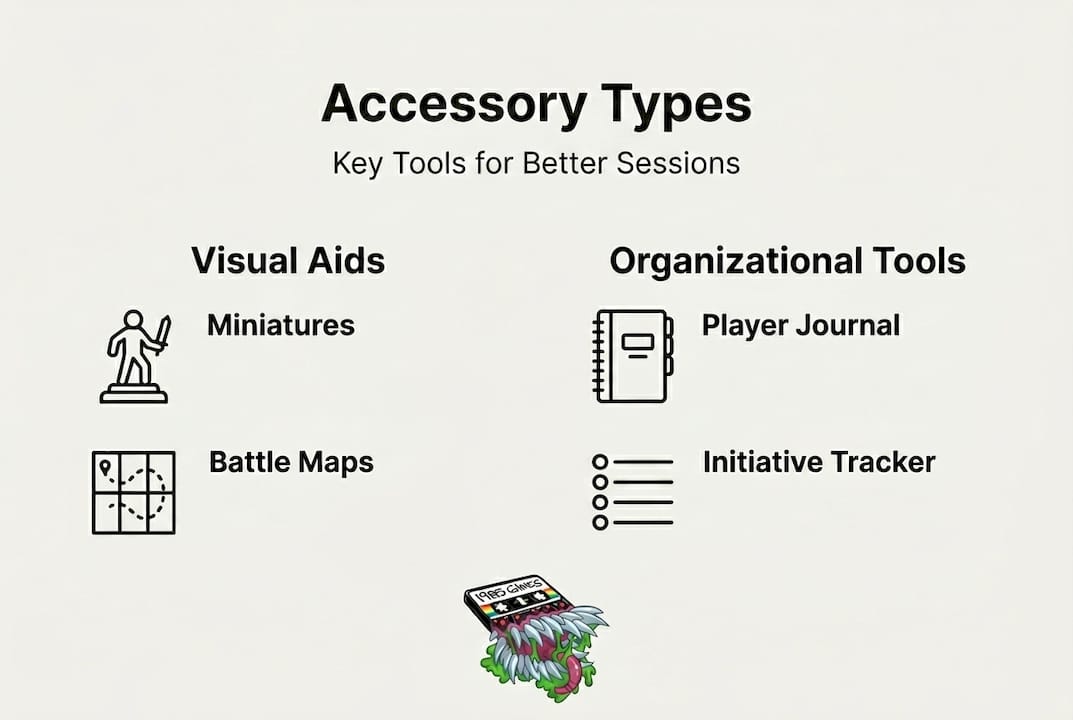
Visual aids include miniatures, terrain pieces, and battle maps. They answer the question, “Where exactly is my character right now?” Battle maps especially are game-changers for groups that love tactical combat. Organizational tools like player journals and campaign notebooks help players track everything from NPC names to potion counts. No more “wait, what was that merchant’s name again?” moments. DM aids like screens and reference cards mean the DM spends less time searching and more time storytelling.
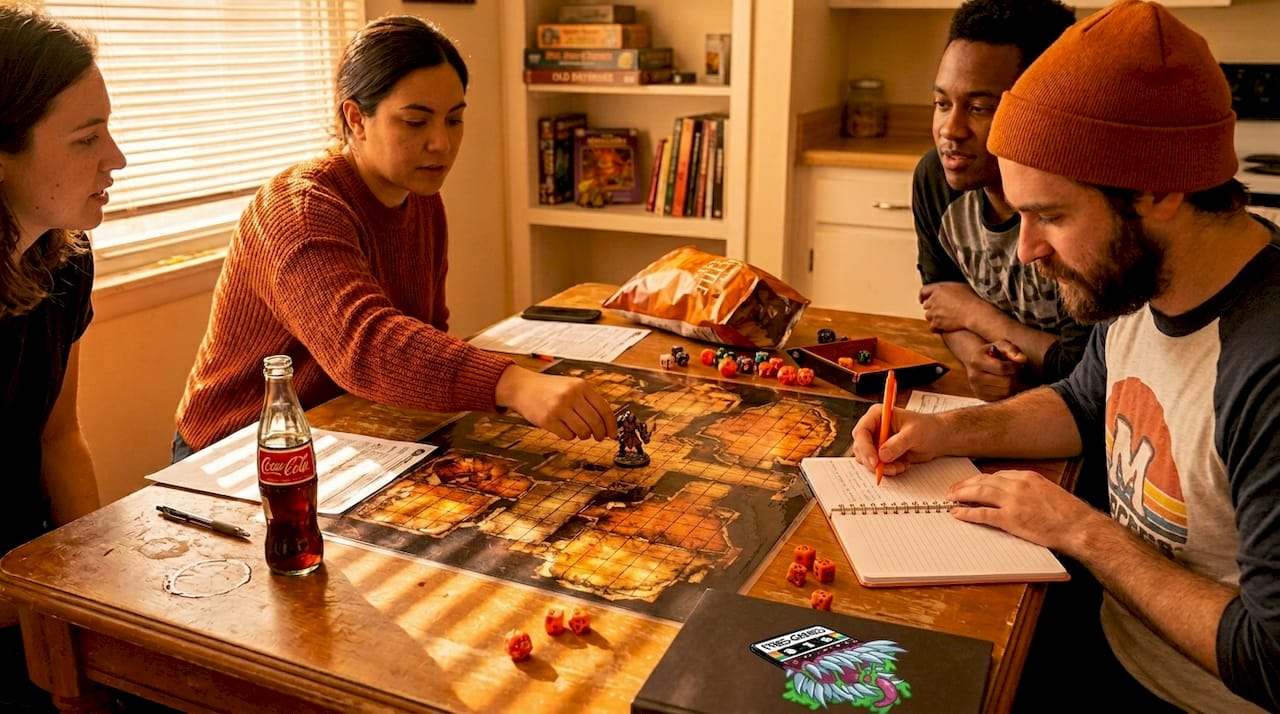
Thinking about all the roles these items play in your game? Check out this deep-dive into accessories in D&D for an even broader look. And if you are wondering which tools are truly non-negotiable for a solid setup, this list of essential TTRPG accessories is a fantastic starting point.
Pro Tip: If you are new to accessories, start with just one organizational tool (like a player journal) and one DM aid (like an initiative tracker). Two well-chosen items beat a table cluttered with tools nobody knows how to use.
A quick note on digital versus physical: apps and tablet tools are genuinely useful, especially for remote games. But there is something about physical objects that fires up the sensory imagination in a way screens simply cannot replicate. The weight of a journal, the texture of a dice tray, the satisfying slide of a DM screen into position. These things hit differently. They make the game feel real in a way that a PDF never quite manages.
Imagination versus immersion: finding the right balance
Armed with an understanding of accessory options, let’s consider how much is just right for your table. Because yes, you absolutely can go overboard. We have all seen the DM who shows up with a full terrain set, six supplementary decks of cards, two dice towers, and a fog machine. By the time everyone sits down, the session feels like setting up a stage production rather than playing a game.
The Dungeon Master Toolkit community makes this point clearly: some DMs prefer minimalism to avoid clutter, emphasizing Rule Zero flexibility. And Rule Zero is the golden rule here. Rule Zero simply means the DM’s judgment takes priority over any written rule or trend. If your table plays best with nothing but pencils and imagination, that is completely valid. The goal is never to match some Instagram-perfect setup.
Here is a useful data snapshot comparing two play styles:
| Play style | Accessories used | Pros | Cons |
|---|---|---|---|
| Minimalist | Dice, pencils, maybe a screen | Fast setup, low cost, freedom | Less visual engagement, more mental load |
| Maximalist | Maps, minis, journals, screens, cards | High immersion, tactile richness | Long setup, possible overwhelm, high cost |
Most tables land somewhere in the middle, and that sweet spot shifts depending on the campaign. A gritty one-shot dungeon crawl might beg for a battle map and initiative tracker. A long-form narrative campaign might shine brightest with player journals and a gorgeous DM screen.
Here are the steps we suggest for finding YOUR balance:
- Run a baseline session with minimal accessories and note what felt clunky or broke the flow
- Identify one specific problem (combat chaos, lost notes, player distraction) and pick one tool to address it
- Introduce the tool for two sessions and check in with your players honestly
- Rotate or remove any accessory that is not pulling its weight
- Build slowly rather than dropping a full accessory arsenal on your players all at once
“Accessories should serve the story. The moment players are paying more attention to the stuff on the table than to the adventure, something has gone sideways.” — This is the litmus test.
Want to level up immersion without overwhelming your table? These guides on transforming tabletop immersion and pro tips for immersion are packed with practical ideas that work in the real world, not just in theory.
Choosing and integrating accessories for your group
Knowing what works in theory is useful, but applying it to your unique play group brings real benefits. Every group is its own micro-culture with preferences, quirks, and collective tolerance for “table stuff.” The key is matching accessories to your group’s actual needs rather than chasing what looks good on social media.
Start here: What is currently slowing your sessions down?
- Are players constantly losing track of initiative order?
- Does the DM spend too long flipping through the rulebook?
- Do players forget key story details between sessions?
- Is combat confusing because no one knows where anyone is spatially?
Each of these pain points maps directly to an accessory solution. Initiative tracking chaos? Enter the initiative tracker or DM screen with dedicated tracker panels. Rulebook rabbit holes? Reference cards and a solid DM screen with tables printed on the inside. Story amnesia between sessions? Player journals are a revelation. Spatial combat confusion? A basic battle map or even a simple grid solves this almost instantly.
Here is a step-by-step framework for integrating accessories without disrupting your group’s groove:
- Announce the addition before the session so nobody feels ambushed by new table stuff
- Explain the purpose briefly (“This initiative tracker keeps combat moving faster, I promise”)
- Model how to use it for the first encounter or scene
- Keep it low stakes by introducing accessories during a lighter session, not a climactic boss fight
- Ask for feedback after two or three uses and be genuinely willing to ditch what is not landing
The data is clear: DM screens with initiative trackers and reference pockets streamline gameplay flow, reducing rule lookup time and making encounter management much smoother. But even the best tool flops if it gets dropped on the table without context.
A few pitfalls to genuinely watch out for:
- Accessory overload: Too many new items introduced at once creates noise, not immersion
- DM-only accessories: If only the DM is engaging with the tools, players may feel left out
- Neglecting player journals: A shared journal mechanic can transform player investment in the story
- Forgetting the basics: Fancy accessories mean nothing if you don’t have enough dice or pencils for everyone
Real talk: one of the best low-effort, high-reward integrations is simply adding a shared player journal to your table. Players who write things down engage more deeply. They notice clues, track NPCs, and invest emotionally in outcomes. It is almost unfair how much one notebook changes the energy in a room.
For DMs specifically, knowing your must-have DM items and building a system to organize your TTRPG accessories transforms prep from chaos into something that actually feels enjoyable.
What most guides miss about accessories: a practical perspective
Here is the take you will not find in most “best accessories” roundups: the accessory obsession can be its own trap. We live in a golden age of gorgeous tabletop gear, and the temptation to keep upgrading, collecting, and adding more is genuinely real. We get it. We love this stuff too. But the best sessions we have ever seen often happened at a kitchen table with a hand-drawn map and whatever dice were in the bag.
The Dungeon Master Toolkit wisdom that some DMs prefer minimalism to avoid clutter and prioritize Rule Zero flexibility? That is not a consolation prize for people who can’t afford gear. That is actual experience talking. Some of the most immersive sessions we know of have zero accessories beyond a pencil and a set of dice.
What actually matters is fit. An accessory that fits your group’s play style, energy level, and story needs is worth ten accessories that look great but sit untouched. Experienced DMs rotate their tools deliberately, bringing in a battle map for a big set piece combat and then stripping back to pure narration for an emotional character moment. That intentionality is a skill in itself, and it is developed through experimentation, not shopping.
Our honest recommendation? Treat accessories as a living toolkit, not a permanent setup. Try something, assess it honestly, keep it or move it along. The top immersive accessories for your table are the ones that disappear into the background and let the story breathe. The moment your players are remarking on the gear instead of the narrative, scale back. The story is always the star.
Ready to upgrade your RPG sessions?
If this guide has your adventurer’s heart beating a little faster (Nat 20 on the excitement roll), you are in exactly the right place. The difference between a good session and an unforgettable one often lives in the small, deliberate choices you make about your table setup.

At 1985 Games, we have curated the kind of accessories that genuinely earn their spot at the table. The Obojima Player’s Journals are a fan-favorite for groups who want to deepen player investment in the story without a complicated setup. For DMs running long campaigns, our DM’s Journals keep prep organized and sessions smooth. And if you want even more ideas and resources curated for dungeon runners, Dungeon Notes is the place to explore. Quality accessories should feel like they belong at your table, and we are here to help you find exactly that.
Frequently asked questions
Do accessories slow down or speed up RPG gameplay?
Well-chosen accessories like DM screens and initiative trackers speed up gameplay by reducing rule lookup time and keeping encounters organized, so the story keeps moving instead of stalling.
What’s the downside to using too many accessories?
Too many accessories can clutter your table and pull focus away from role-play, which is why minimalism is valued by experienced DMs who prioritize Rule Zero flexibility and a clutter-free storytelling space.
How do I decide which RPG accessories my group really needs?
Start by identifying the moments in your sessions that feel clunky or slow, then introduce one targeted accessory that directly addresses that specific problem rather than overhauling your whole setup at once.
Do experienced DMs use many accessories?
Most experienced DMs use a curated selection tailored to their group’s style rather than a fixed set, often rotating tools in and out depending on the campaign’s tone and intensity.