

TL;DR:
- Essential DM tools include core rulebooks, a DM screen, and campaign tracking systems.
- Accessories should improve session flow but are not substitutes for creativity and preparation.
- Build your kit gradually based on your playstyle and specific campaign needs.
Every Dungeon Master knows the feeling. You’re staring at a table full of dice, notebooks, and random printouts, wondering which tools actually matter and which are just shiny distractions. The sea of TTRPG accessories is real, and it’s deep. But here’s the good news: you don’t need everything. You just need the right things. This guide walks you through the essential must-have items for Dungeon Masters, from core rulebooks to battle mats, with honest comparisons and practical advice so you can build a kit that actually serves your table.
Table of Contents
- How to evaluate must-have items for Dungeon Masters
- Core rulebooks: The foundation of every DM’s kit
- DM screen and behind-the-scenes essentials
- Notebooks and campaign tracking tools
- Battle mats, miniatures, and tactical essentials
- Why accessories help, but imagination is your greatest tool
- Upgrade your DM game with quality tools
- Frequently asked questions
Key Takeaways
| Point | Details |
|---|---|
| Rulebooks first | Every DM needs the Player’s Handbook, Dungeon Master’s Guide, and Monster Manual to run great sessions. |
| DM screen essentials | A good DM screen and the right behind-the-scenes tools boost confidence and efficiency. |
| Track your story | Systematic note-taking keeps campaigns, NPCs, and storylines organized for recurring adventures. |
| Tactical tools boost immersion | Battle mats and minis help visualize epic encounters but are optional for ‘theater of the mind’ play. |
| Creativity is key | No item replaces imagination—adapt and focus on fun over collecting every accessory. |
How to evaluate must-have items for Dungeon Masters
Let’s start by establishing what makes an item essential for your DM toolbox. Not every shiny accessory earns a permanent spot at the table. The best tools pass a simple test: do they make your sessions smoother, more fun, or more immersive? If the answer is yes, they’re worth considering.
Here are the key factors to weigh before adding anything to your kit:
- Usefulness: Does it solve a real problem you face during prep or play?
- Frequency: Will you use it every session, or just once in a blue moon?
- Group fit: Does your table play in-person, online, or hybrid? This changes everything.
- Price: Is the value proportional to the cost?
- Portability: Can you carry it easily if you’re not hosting at home?
Your playstyle matters enormously here. Physical tools work best for in-person sessions, while digital platforms like D&D Beyond and virtual tabletops (VTTs) shine for online play. A DM running a weekly home game has very different needs than one running a convention one-shot.
Accessories also fall into two camps: required and optional. Required items are things you’d genuinely struggle without, like rules references and note-taking tools. Optional items, like fancy terrain or ambient sound systems, are wonderful but not urgent. Knowing the difference saves you money and decision fatigue.
For RPG session essentials, think about what you reach for most often. Those are your must-haves. Everything else is a bonus.
Pro Tip: If you run remote sessions, explore free digital tools before buying physical gear. Many VTTs offer built-in maps, dice rollers, and character sheets that replace several physical accessories at once.
Core rulebooks: The foundation of every DM’s kit
With criteria in hand, let’s look at the most vital items for any DM, beginning with the core rulebooks.
The core rulebooks are non-negotiable. Full stop. The Player’s Handbook, Dungeon Master’s Guide, and Monster Manual form the holy trinity of D&D. Every other tool you own builds on top of these three.
Here’s what each one brings to the table:
- Player’s Handbook (PHB): Covers races, classes, spells, and the core rules of play. Your players need this too, but you need it more.
- Dungeon Master’s Guide (DMG): Your secret weapon. World-building advice, magic item tables, encounter design, and the mechanics behind the curtain.
- Monster Manual (MM): Hundreds of creatures with stat blocks, lore, and tactics. Essential for combat prep and improvised encounters.
Physical copies are fantastic for quick flipping during sessions. Digital versions, especially through D&D Beyond, are searchable and convenient for prep. Many experienced DMs own both. The physical book sits on the table for fast reference; the digital version gets searched during the week when building encounters.
“The rulebooks aren’t just reference material. They’re the shared language of the game. When everyone at the table trusts the same source, disputes resolve faster and play flows better.”
Rulebooks also serve as creative fuel. Browsing the Monster Manual before a session often sparks ideas you never planned. That’s not a bug; it’s a feature. Build your essential DM toolkit around these three books and everything else becomes easier to choose.
DM screen and behind-the-scenes essentials
Once you’ve got the rulebooks, the next must-have is what protects your secrets and keeps you organized.
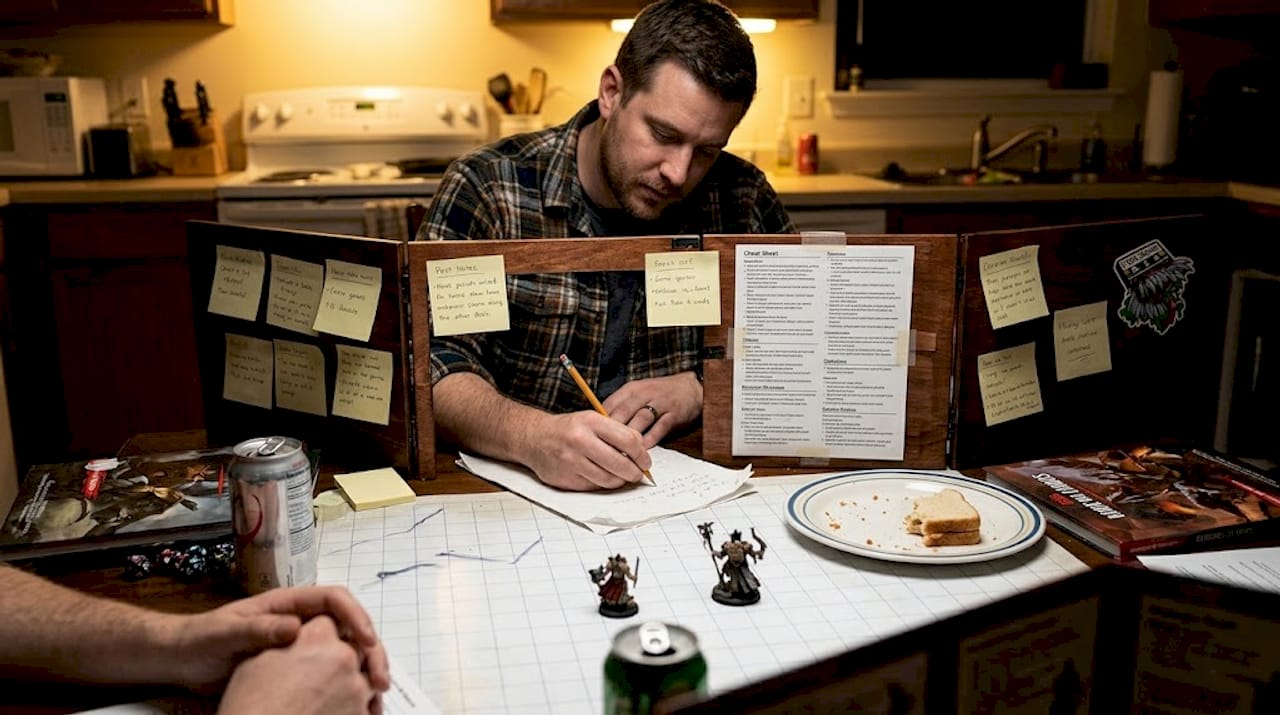
A good DM screen does three things beautifully. It hides your notes and dice rolls from curious players. It displays quick rule references on the inside panels. And it creates a psychological boundary that signals, “the DM is in charge here.” That last one is underrated.
Behind the screen, the real magic happens. Here’s what we recommend keeping back there:
- Sticky notes: For initiative order, reminders, and last-minute NPC names
- Initiative tracker: A simple tent card system or a magnetic strip works perfectly
- Custom reference sheet: Your personal cheat sheet for house rules, common DCs, and encounter tables
- Pencils and erasers: Old school but irreplaceable
- Condition tokens or cards: Speed up status tracking during combat
DM screens come in several styles. Fold-out cardboard screens are affordable and portable. Magnetic screens let you attach printed references directly to the surface. Custom-printed screens can match your campaign’s aesthetic, which adds a surprising amount of immersion for players.
Pro Tip: Create a one-page house rules cheat sheet and tape it inside your screen. You’ll save five minutes every session by not hunting through rulebooks for that one rule your group always debates.
For a deeper look at session organization, check out this DM checklist for smooth sessions. And if you’re curious about how accessories shape the overall experience, the role of accessories in D&D is worth exploring.
Notebooks and campaign tracking tools
You’ve set the stage, but to keep it all together, you need a robust system for notes and tracking.
A notebook or tracking system is one of the most underestimated tools in any DM’s kit. Campaigns get complicated fast. NPCs multiply. Plot threads tangle. Players do unexpected things that break your carefully planned arc. Without a reliable tracking system, you’re flying blind.
Here’s what you should be tracking:
- NPC names, motivations, and relationships
- Active story arcs and player goals
- Combat notes and encounter outcomes
- Key decisions players made and their consequences
- World-building details like factions, locations, and lore
| Tool | Pros | Cons |
|---|---|---|
| Physical notebook | Fast, tactile, always available | Hard to search, can get messy |
| Campaign journal | Structured, beautiful, great for history | Pricier, less flexible |
| Digital app (Notion, Obsidian) | Searchable, linkable, shareable | Requires a device, learning curve |
| Index cards | Modular, easy to reorganize | Easy to lose, limited space |
The best system is the one you’ll actually use consistently. Some DMs love the ritual of writing by hand. Others prefer the speed of digital search. Many use a hybrid: handwritten session notes during play, then transferred to a digital app after.
Dedicated campaign journals are worth a mention here. They’re purpose-built for DMs, with sections for session recaps, NPC logs, and world maps. They make your campaign feel like a real artifact. Explore essential game aids and the full Dungeon Master checklist for more ideas on keeping campaigns organized.
Battle mats, miniatures, and tactical essentials
The next step in creating memorable encounters is visualizing the action with tactical tools.
Battle mats and miniatures transform abstract combat into something your players can see. Suddenly, “the goblin is near the door” becomes a tactical decision with real stakes. Spatial awareness changes everything about how players engage with encounters.
Battle mats and miniatures are widely recommended for tactical combat, though they’re not the only option. Here’s a breakdown of mat types:
| Type | Average cost | Key features |
|---|---|---|
| Vinyl grid mat | $15 to $30 | Erasable, portable, durable |
| Neoprene mat | $30 to $60 | Premium feel, printed terrain |
| Terrain battle map | $20 to $50 | Pre-printed, immersive art |
| Digital VTT map | Free to $10/month | Online play, dynamic lighting |
For miniatures, you have options at every budget. Prepainted plastic minis are beginner-friendly and affordable. Resin or metal minis offer more detail but cost more. Cardboard tokens are a perfectly valid budget option that many experienced DMs still use.
Must-have tactical gear for every style:
- Grid battle mat: The foundation of tactical play
- Condition rings or tokens: Track status effects visually
- Miniatures or tokens: Represent players and enemies
- Ruler or range tool: Helpful for spell areas and movement
For a deeper look at how these tools shape play, read about tactical play with battle mats and how RPG accessories enhance immersion at the table.
Why accessories help, but imagination is your greatest tool
With all the tools laid out, there’s one more secret every DM should know.
Here’s our honest take: the best sessions we’ve ever heard about didn’t happen because the DM had a $200 terrain set. They happened because the DM was present, creative, and genuinely invested in their players’ experience. Theater of the mind is always a valid option, and some of the most legendary campaigns ran with nothing but rulebooks, dice, and a storyteller who cared.
Accessories are amplifiers, not substitutes. A beautiful battle map amplifies a well-designed encounter. A campaign journal amplifies a DM who already tracks their story. But no tool fixes poor preparation or a disengaged table.
Don’t feel pressure to buy everything at once. Build your kit gradually, based on real gaps you notice in your sessions. That’s how experienced DMs do it. They add tools when they feel a genuine need, not because a list told them to.
Trust your instincts as a storyteller first. The gear follows naturally. For more inspiration on immersive TTRPG accessories, explore what actually resonates with your playstyle before spending a single dollar.
Upgrade your DM game with quality tools
Ready to upgrade your kit? Take the next step with professional tools designed by and for DMs.

At 1985 Games, we build accessories that DMs actually reach for every session. Our DM Campaign Journals are crafted with campaign management in mind, featuring dedicated sections for NPCs, session notes, and world-building details. They’re the kind of journal that makes your campaign feel like a living, breathing world. Browse the full 1985 Games shop for battle maps, game aids, and more gear built to make your storytelling shine. Your players deserve a DM who’s prepared. We make that easier.
Frequently asked questions
What’s the most important item a Dungeon Master should own?
The core rulebooks, specifically the Player’s Handbook, Dungeon Master’s Guide, and Monster Manual, are foundational for every DM and the best starting point for any kit.
Are digital tools as effective as physical accessories for DMing?
Physical tools excel in in-person play while digital platforms like D&D Beyond and VTTs are ideal for online sessions; most experienced DMs blend both based on how they run their games.
What do you recommend for first-time Dungeon Masters on a budget?
Start with the core rulebooks and a basic notebook for tracking; accessories like battle mats and minis can be added gradually as your sessions grow in complexity.
Do all groups need battle mats and miniatures?
Not at all. Theater of the mind is always a valid choice, and battle mats are best added when your group wants more tactical depth in combat rather than as a default requirement.
How can DMs keep track of complicated campaigns?
Campaign journals, organized notebooks, or digital apps like Notion or Obsidian help DMs track NPCs, storylines, and key session details without losing the thread of a long campaign.