

TL;DR:
- Organizing TTRPG accessories with a structured workflow prevents chaos and enhances collection pride.
- Digital and physical tools should be chosen based on collection size, mobility needs, and categories.
- Regular verification, backup, and value tracking keep collections well-maintained and valuable over time.
Picture this: three dice bags, two half-finished campaign binders, a miniature that’s been “temporarily” sitting on your nightstand since 2024, and absolutely no idea where that gorgeous hand-painted battle map went. Sound familiar? Collecting TTRPG accessories is pure joy until it becomes pure chaos. The good news? A structured workflow flips that script completely. We’re talking clear systems for preparation, cataloging, value tracking, and optimization that turn your sprawling hoard into a collection you’re actually proud to show off. This guide walks you through every step, so you spend less time searching and more time rolling.
Table of Contents
- Choose your workflow tools and set up your collection
- Catalog and record accessory details efficiently
- Evaluate, update, and track accessory values and lending
- Verify workflow results and optimize for future sessions
- Why most TTRPG collectors overlook workflow—and how you can do better
- Enhance your collection with premium TTRPG accessories
- Frequently asked questions
Key Takeaways
| Point | Details |
|---|---|
| Tool selection matters | Choosing workflow tools based on collection size and play style prevents chaos and improves organization. |
| Record details consistently | Cataloging each accessory properly—digital or analog—builds a reliable and searchable inventory. |
| Value tracking adds security | Monitoring item values and lending history safeguards your collection and supports smarter trading. |
| Optimize and verify | Regular workflow reviews keep your processes efficient and your collection ready for gameplay. |
Choose your workflow tools and set up your collection
Before you touch a single dice bag, you need to pick your tools. Think of this like choosing your character class. The right choice shapes everything that follows.
The big decision is digital vs. analog. Digital tools scale fast, sync across devices, and let you search your entire collection in seconds. Analog systems (binders, index cards, spreadsheets) feel tactile and satisfying, and they never crash. Most serious collectors end up using both.
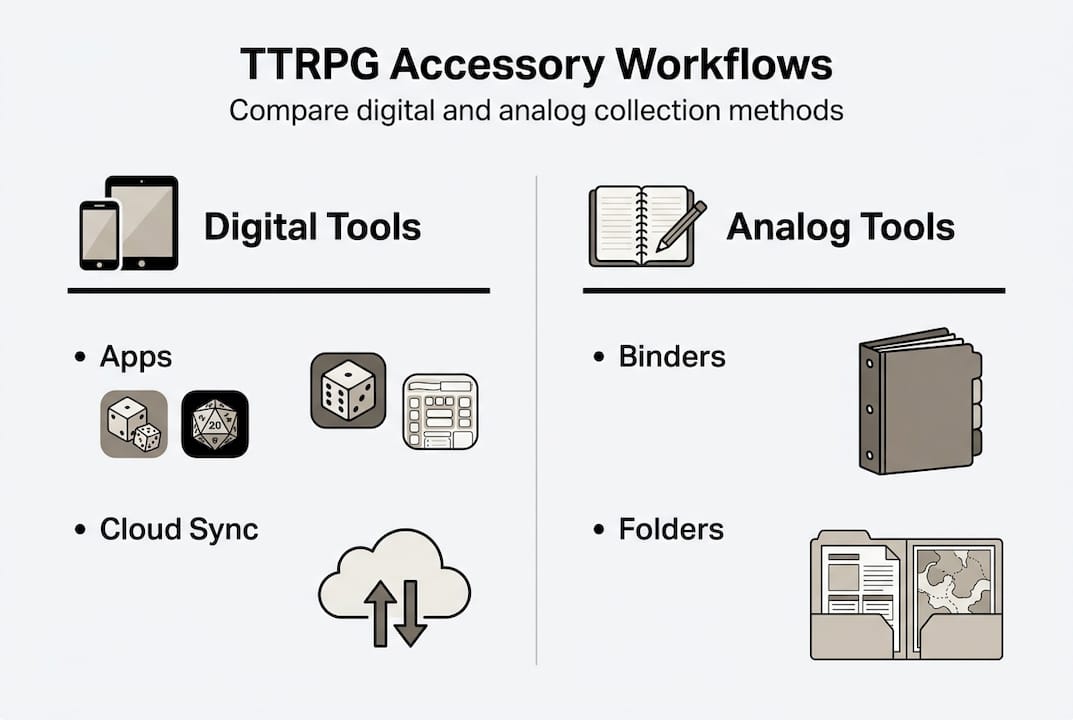
Here’s a quick comparison to help you decide:
| Tool Type | Best For | Mobility | Scalability |
|---|---|---|---|
| Collector app (e.g., iCollect) | Large, growing collections | High | Unlimited (pro) |
| Spreadsheet | Mid-size, budget-friendly | Medium | Hundreds of items |
| Physical binder | Campaign-specific items | Low | Limited |
| Dedicated software | Full-featured management | Medium | High |
Dedicated collector software like Ashampoo Collector and iCollect Everything supports flexible, customizable inventories for games, minis, and dice, with features like images, custom properties, lending tracking, cloud sync, barcode scanning, and estimated values. These aren’t just spreadsheets with a pretty face. They’re built for collectors who mean business.
Not sure which to pick? Ask yourself these questions:
- How big is your collection? Under 50 items? A spreadsheet works great. Over 200? Go app or software.
- Do you travel to game nights? Mobile apps with cloud sync win here because your data is always with you.
- Do you collect across categories? Dice, minis, journals, maps? You need custom fields and image support.
- Do you lend items to friends? Lending tracking is a must-have feature, not a bonus.
Before you start logging anything, check out our TTRPG essentials list to make sure you’re accounting for every accessory type. And if you’re still building your collection, our roundup of top immersive accessories gives you a solid benchmark for what’s worth tracking.
Pro Tip: Enable cloud backup from day one. Losing a physical collection is heartbreaking. Losing your entire digital catalog because your laptop died? That’s a campaign-ending tragedy.
Catalog and record accessory details efficiently
Okay, tools are ready. Now comes the part that separates the casual hoarders from the true collector elite: actually logging everything.
This doesn’t have to be a weekend-long ordeal. Break it into sessions. Start with one category (dice, for example), then move to the next. Here’s a step-by-step workflow that works:
- Sort items into categories. Dice, miniatures, journals, maps, terrain, and campaign notes each get their own section.
- Create a record for each item. Include name, type, material, condition, acquisition date, and source.
- Add custom fields. Things like “set name,” “edition,” or “campaign used in” add serious searchability later.
- Photograph every unique item. One clear photo per item, front and back for minis or special dice.
- Tag and cross-reference. Link related items (e.g., a dice set that matches a specific campaign journal).
- Back up immediately. Save to cloud AND a local drive. Yes, both.
Here’s a sample record structure to get you started:
| Field | Example Entry |
|---|---|
| Item name | Obsidian Sharp Edge Dice Set |
| Category | Dice |
| Condition | Mint |
| Acquisition date | March 2026 |
| Source | 1985 Games |
| Notes | Used in “Curse of Strahd” campaign |
Physical binders and folders work beautifully for campaign-specific accessories like maps and notes in open-table play, accumulating organically over time. The catch? They need backups to avoid loss. Scan those precious hand-drawn maps, dice goblins. Seriously.

For deeper ideas on organizing your gear, our accessory cataloging tips page is packed with smart strategies. And if you’re logging dice specifically, browsing unique dice set examples helps you identify and name sets you might have forgotten about.
Pro Tip: Snap photos in natural light against a plain background. Blurry or dark photos make identification nearly impossible six months later when you’re trying to remember if that’s a d20 or a d12 at the bottom of the bag.
Evaluate, update, and track accessory values and lending
Here’s where your workflow levels up from “organized” to genuinely powerful. Tracking values and lending history transforms your catalog from a simple list into a living asset record.
Why does value tracking matter? Because TTRPG accessories, especially limited edition dice sets and discontinued miniatures, can appreciate significantly. A set you bought for $30 might be worth $80 two years later. You won’t know unless you’re tracking it.
Dedicated collector software supports estimated values and lending tracking, making it easy to monitor asset changes and borrow/return history. Tools like Ashampoo Collector (rated 4.1/5) and iCollect Everything (rated 4.6/5) both include value fields you can update manually or link to market references.
Here’s what to log for each item beyond the basics:
- Estimated current value (update quarterly for rare items)
- Purchase price (so you know your actual gain or loss)
- Condition changes (note any chips, fading, or wear)
- Lending status (in collection, lent out, or lost in the void)
- Borrower name and date lent (your future self will thank you)
- Return date (expected and actual)
Lending to friends is one of the great joys of the TTRPG community. But we’ve all had that one dice set that “went on an adventure” and never came back. Logging borrower info takes 30 seconds and saves a friendship.
For rare or discontinued items, check our guide on how to curate and protect dice for storage and preservation tips that keep your valuable pieces in mint condition.
Pro Tip: Set a calendar reminder every three months to review values on your rarest items. Markets shift. Limited runs sell out. That “just a pretty dice set” might be funding your next campaign.
Verify workflow results and optimize for future sessions
You’ve built the system. Now make sure it actually works. This step is where most collectors drop the ball. They set up a workflow, feel great about it, and then never revisit it. Six months later, half the catalog is outdated and the lending log has three mystery entries.
Here’s a verification checklist to run every few months:
- Spot-check 10 random items. Pull them physically and confirm they match your catalog records.
- Verify all lending entries. Are borrowed items still out? Follow up.
- Check for uncatalogued items. New acquisitions that slipped through?
- Confirm backups are current. When did you last back up? If you can’t remember, do it now.
- Review category tags. Are your tags still making sense as the collection grows?
Common workflow pitfalls (and how to fix them):
- Backlog buildup: Log new items within 48 hours of acquisition. Don’t let them pile up.
- Photo gaps: Missing images make identification hard. Schedule a photo session for unlogged items.
- Stale values: Set quarterly reviews as recurring calendar events.
- Sync failures: Check that your cloud backup is actually syncing, not just saying it is.
“Backup regularly, especially before major campaigns.”
Tools and workflows scale to hundreds of dice or unlimited inventory with pro apps, so revisit your system based on your play style and mobility needs. What worked for 50 items might need a rethink at 300.
For a broader reset, our guide on how to refresh your game space pairs perfectly with a workflow audit. And for tips on using your collection more dynamically at the table, check out how to enhance gameplay with the right tools.
Why most TTRPG collectors overlook workflow—and how you can do better
Here’s the uncomfortable truth: most collectors think workflow is for “serious” collectors, not them. They’re just having fun! And that’s valid, right up until they can’t find their favorite dice set the night before a big session.
The real barrier isn’t laziness. It’s the myth that organic growth is more authentic than disciplined logging. There’s a romantic idea that a “real” collection just accumulates naturally, with no spreadsheets or apps involved. But here’s what actually happens: items get lost, values go untracked, and lent accessories vanish.
Scalable tools handle hundreds to unlimited items, meaning there’s no collection too small to benefit from a system. Even 20 dice sets deserve a photo log and a backup.
The collectors who boost accessory immersion at the table are usually the ones who know exactly what they own. That confidence isn’t magic. It’s workflow.
Start small. One category. One app. One backup. Build from there.
Enhance your collection with premium TTRPG accessories
Now that your workflow is locked in and your collection is organized like a legendary dungeon master’s vault, it’s time to fill any gaps with pieces worth cataloging.

We at 1985 Games have exactly what your collection is missing. Grab incredible value with our dice set deals where you can score buy-2-get-1 offers on stunning sets that deserve a prime spot in your new catalog. Keep your campaign notes organized and immersive with our beautifully crafted player journals, perfect for logging sessions alongside your accessory records. Every piece we carry is worth tracking, photographing, and protecting. Your workflow is ready. Now let’s fill it with something extraordinary.
Frequently asked questions
What is the best way to catalog physical TTRPG accessories like dice and miniatures?
Digital collector apps offer customizable fields and cloud backups for large collections, while physical binders suit campaign-specific items best. Choose based on your collection size and whether you need mobile access.
How do I track the value of collectible RPG items over time?
Use collector apps with value fields and schedule quarterly reviews for rare or discontinued items. Manual updates take minutes and keep your records genuinely useful.
What should I do to protect my campaign notes and maps?
Physical binders work well for campaign notes but require backups to avoid loss. Scan key maps and notes, then store copies in cloud folders for easy recovery.
Is there an optimal workflow for collections that grow rapidly?
Choose scalable tools like pro collector apps or structured spreadsheets, and review your system every few months as your inventory expands to keep everything current and searchable.