

TL;DR:
- Focus on selecting accessories that target your group’s specific playstyle and needs.
- Use a step-by-step workflow to identify pain points, test solutions, and upgrade gradually.
- Prioritize functional tools that enhance immersion, efficiency, and reduce clutter for better sessions.
You’ve been there. The wishlist grows wild, the shelves overflow, and somewhere under a pile of unpainted minis and three different DM screens, your group is still losing track of initiative. Sound familiar? Too many accessory options don’t just drain your wallet — they quietly kill the vibe at your table. The good news: a focused, step-by-step selection workflow cuts through the chaos fast. We’re going to walk you through exactly how to identify what your table actually needs, choose tools that solve real problems, and build immersion that hits like a Nat 20 every single session.
Table of Contents
- Clarify your playstyle and group needs
- Inventory the essentials: Must-have accessories by function
- Solve specific pain points and enhance immersion
- Physical, digital, or hybrid? Matching format and workflow
- What most guides miss: Workflow beats wishlists
- Level up your workflow with curated accessories
- Frequently asked questions
Key Takeaways
| Point | Details |
|---|---|
| Start with playstyle | Assess your group’s preferences and needs before buying any accessories. |
| Prioritize essentials | Invest in foundational items that cover core functions for every session. |
| Solve real pain points | Select tools that directly address your group’s biggest challenges at the table. |
| Iterate upgrades | Upgrade accessories gradually, testing for impact and feedback with each campaign. |
| Match form to function | Choose physical, digital, or hybrid options that best fit your group’s logistics and play style. |
Clarify your playstyle and group needs
Every great workflow starts with one honest question: what kind of table are we running? Not the table you dreamed of — the one you actually have every Thursday night. Before you buy a single thing, you need to understand your group’s real pain points, and that means getting specific.
Start with the basics. Are you playing in person or online? A kitchen-table crew of four has completely different needs from a remote group jumping into Foundry VTT. The core workflow begins with assessing playstyle, such as in-person vs online and tactical vs narrative, and skipping this step is how you end up with a gorgeous battle map set gathering dust because your group prefers theater of the mind.
Next, think about the axes that shape every accessory decision:
- Physical vs. digital: Do your players love the feel of rolling real dice, or do they need digital tools for remote sessions?
- Tactical vs. narrative: Combat-heavy games need maps and trackers. Story-driven games need journals and mood-setting tools.
- System-specific vs. agnostic: A D&D 5e DM screen won’t help your Blades in the Dark crew much.
- Session format: One-shots need quick setup. Long campaigns benefit from layered, evolving setups.
- Group size and space: Six players at a card table need compact tools. A dedicated game room opens up bigger terrain options.
So be real with yourself about these factors. Matching accessories to your DM style optimizes both immersion and efficiency — meaning you spend less and get more out of every session.
Wondering which RPG playstyle types exist and where yours fits? That’s the map that guides every purchase decision you’ll make from here on out.
Pro Tip: Survey your players with just three questions before your next campaign kickoff: What slows us down most? What pulls you out of the story? What do you wish we had? Those answers are worth more than any gear guide.
Inventory the essentials: Must-have accessories by function
Okay, group needs are mapped. Now let’s build a solid foundation. The smartest accessory buyers don’t chase trends — they fill functional gaps. Think of each accessory category as solving one specific table problem.
Here’s a quick breakdown of the key accessory categories: randomization, visual/spatial, session management, and immersion. Every essential tool lives in one of these four buckets.
| Accessory type | Core function | Problem it solves |
|---|---|---|
| Dice sets | Randomization | Fairness, excitement, pacing |
| DM screen | Session management | Reference, hidden rolls, NPC notes |
| Battle maps | Visual/spatial | Combat clarity, positioning disputes |
| Campaign journals | Immersion | Character depth, story continuity |
| Initiative trackers | Session management | Turn order confusion, slow combat |
| Condition tokens | Visual/spatial | Status effect tracking errors |
Your must-have shortlist for most tables:
- A reliable set of polyhedral dice (at least one full set per player)
- A DM screen matched to your system
- A basic battle map or grid mat
- A session notebook or campaign journal for notes and plot tracking
- Condition markers or tokens for combat status effects
Here’s a stat that should make every dice goblin’s ears perk up: themed dice boost immersion by 30%, while modular maps reduce combat confusion by 40%. That’s not just flavor — that’s measurable impact on the quality of your sessions.
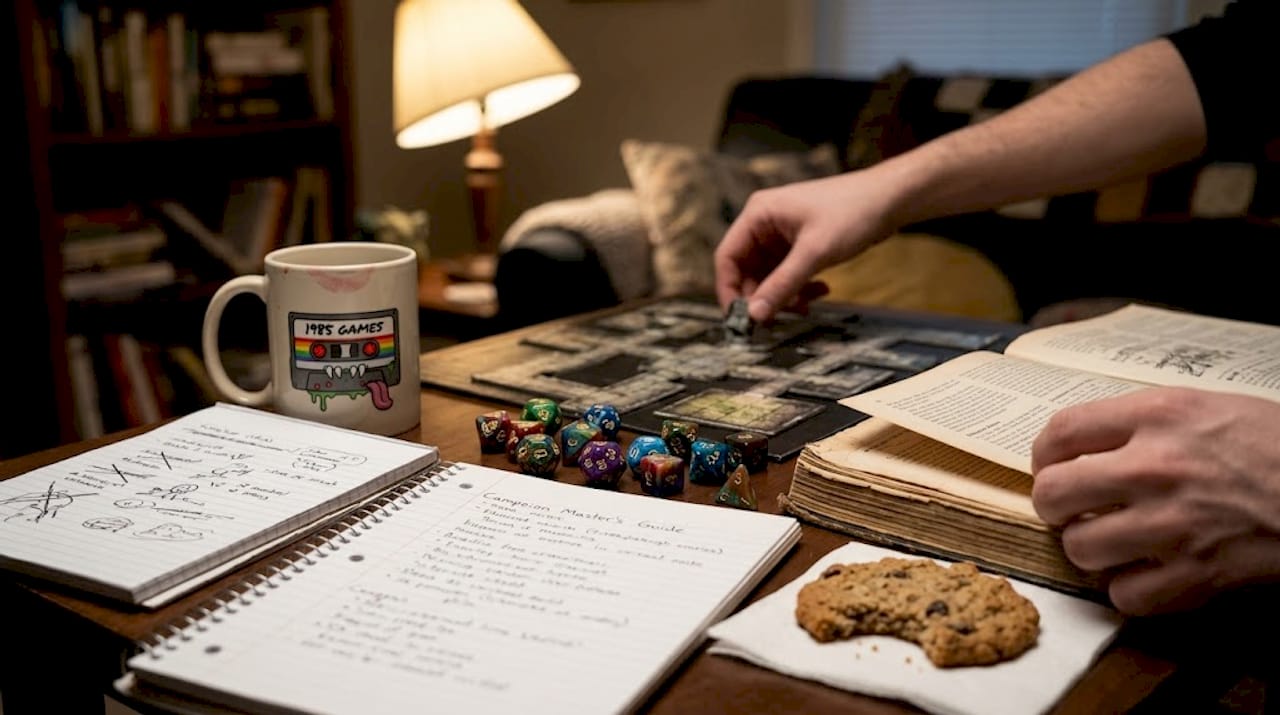
Not sure where to start with themed dice for RPGs and why they hit different? Or curious about what the best D&D accessories look like in practice? Both are worth a deep dive once your foundation is set.
Pro Tip: Prioritize accessories that solve TWO problems at once. A quality DM screen, for example, handles both session management AND immersion. Double-duty tools stretch your budget furthest.
Solve specific pain points and enhance immersion
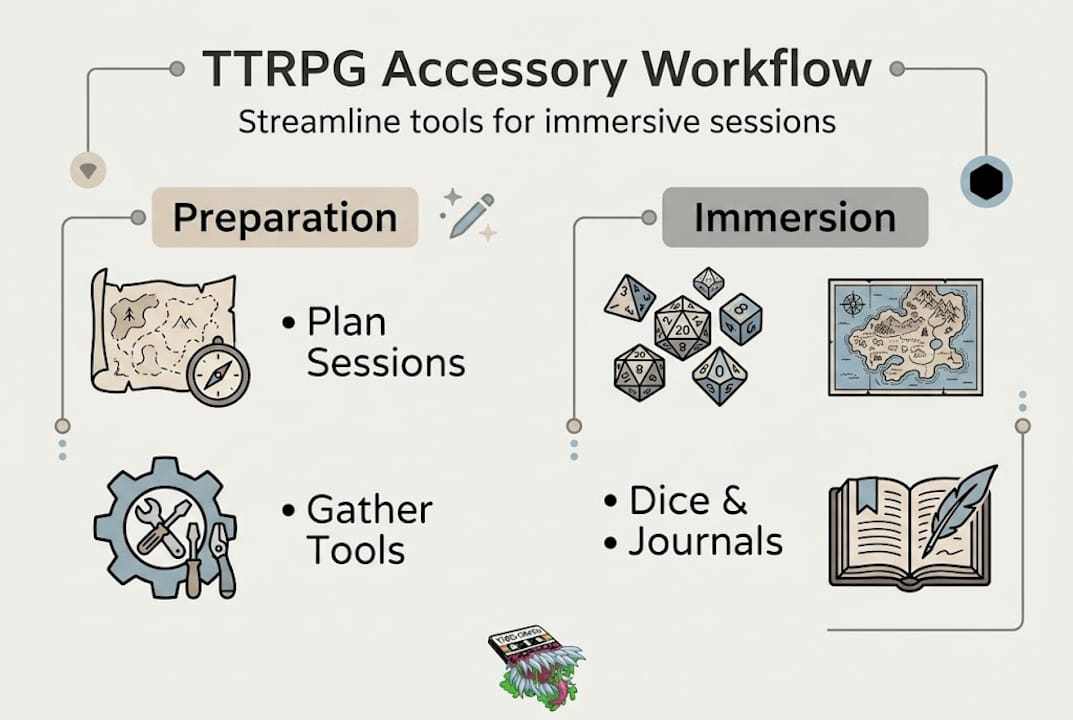
Foundation locked in? Beautiful. Now let’s get surgical. The best tables we know don’t buy accessories randomly — they run a simple test-and-upgrade loop every campaign. Here’s the workflow in action:
- Identify the friction point. Note what’s slowing down or deflating your sessions (example: initiative tracking eats 10 minutes per combat).
- Evaluate solutions. Research two or three accessories that directly address the problem. Check reviews, watch demos.
- Pilot one tool. Buy or borrow one option and run it for two to three sessions. Just one. Resist the urge to overhaul everything.
- Gather feedback. Ask your group: Did that help? Did it get in the way? Was setup worth the payoff?
- Iterate or upgrade. If it worked, keep it. If not, try option two. Only add the next accessory when the last one is working smoothly.
Here’s how common pain points map to real solutions:
| Pain point | Accessory solution | Measured impact |
|---|---|---|
| Slow initiative tracking | Initiative tracker/wheel | Combat pacing improved significantly |
| Combat position confusion | Modular battle maps | Confusion reduced by 40% |
| Shallow character investment | Campaign journals | Character development up 25% |
| Poor atmosphere/mood | Themed dice, mood lighting | Immersion boost up to 30% |
| DM overwhelm | DM screen with inserts | Reference time cut sharply |
Targeted accessories like maps and trackers significantly reduce confusion and speed up complex sequences. And journals boost character development by 25% based on recent benchmark data — which is remarkable for a tool that costs less than a pizza.
“True immersion isn’t built in a single shopping cart. It’s constructed session by session, one solved friction point at a time.”
Want to dig deeper? Check out these guides on tabletop immersion tips, top immersive accessories, and essential immersive accessories for campaign-specific ideas.
Physical, digital, or hybrid? Matching format and workflow
You’ve tackled pain points. Now let’s talk format, because the best accessory in the wrong format is just… a headache. Physical tools feel incredible but need storage. Digital tools travel light but lose tactile magic. Hybrid setups layer both and are increasingly popular for good reason.
Let’s compare:
| Format | Tactility | Cost | Ease of sharing | Setup speed | Sensory layers |
|---|---|---|---|---|---|
| Physical | High | Medium-high | Low | Slower | Rich |
| Digital | None | Low-medium | High | Fast | Minimal |
| Hybrid | Medium | Varies | Medium | Moderate | Rich |
Hybrid physical/digital setups layer tactile and sensory experiences for heightened immersion and work well for the majority of groups. Meanwhile, theater-of-the-mind tables skip props and terrain entirely — hybrid groups genuinely need both.
When to go physical:
- Your group meets in person consistently
- Players love handling dice, minis, and props
- You have storage space and a dedicated game area
When to go digital:
- Remote or hybrid players need shared access
- You run one-shots with rapid setup demands
- Budget is tight and you want to test concepts first
When hybrid is the sweet spot:
- Mixed in-person and remote groups
- Long campaigns where immersion builds over time
- Groups who want both the feel of physical props and the flexibility of digital reference tools
Understanding the broader accessory role in D&D helps make format decisions much clearer.
Pro Tip: Start minimal, always. Add physical or digital layers one at a time based on session feedback. Adding too much at once is how you rebuild that accessory pile of chaos you started with.
What most guides miss: Workflow beats wishlists
Here’s our hot take: most accessory buying advice is backwards. It leads with product recommendations and ends with a receipt full of regret. The real problem at most tables isn’t a lack of cool stuff — it’s a lack of a system for choosing stuff.
Conventional wisdom says buy the best-reviewed tools. But reviews can’t tell you whether YOUR group needs a battle map or a better initiative tracker. Only your workflow can tell you that. Reducing friction through accessories consistently matters more than adding visual complexity or layering in more gear.
Impulse accessory purchases pile up fast. They fill shelves. They slow down setup. They confuse new players. An iterative, pain-point-first workflow — the kind we’ve walked through here — means every accessory earns its seat at the table before you buy the next one.
True immersion isn’t a collection. It’s an ecosystem of well-tested, interlocking tools that each solve something real. That shift in mindset is the real upgrade. Start there, and boosting immersion with accessories becomes straightforward and genuinely fun instead of overwhelming.
Level up your workflow with curated accessories
Ready to put this workflow into action without the guesswork? We’ve got you covered, dice goblins.
The test-and-upgrade principle works best when you’re starting with quality tools worth testing. Our DM’s campaign journals are built to capture every plot twist and NPC detail your campaign throws at you — perfect for that character development boost we talked about. Craving something more flexible? Explore Dungeon Notes journals for modular session tracking. And when it’s time to upgrade your randomization game, our dice set bundles make it easy to try themed sets without breaking the bank. Every stage of your workflow, sorted.
Frequently asked questions
What are the absolute essentials for a tabletop RPG session?
Essentials include rulebooks, a set of dice, a DM screen, and simple note-taking tools — these cover the core needs of most groups right out of the gate.
How do I decide between physical and digital accessories?
Base your choice on playstyle, location, group size, and how often you play — hybrid setups mix digital and physical tools to deliver layered immersion and the most flexibility for varied group needs.
Which accessories make the biggest impact on immersion?
Themed dice, terrain maps, and campaign journals lead the pack — themed dice boost immersion by 30%, modular maps cut confusion by 40%, and journals raise character development scores by 25%.
Should I buy or make my own accessories?
DIY saves money and adds personal flair, while purchased props save prep time and bring professional polish — mixing both approaches is genuinely common and totally valid.
How should I upgrade my table’s accessories over time?
Start with the basics, fix one major pain point per campaign, and upgrade iteratively based on honest group feedback and how frequently you’re actually playing.