

TL;DR:
- Battle mats provide a clear visual representation of terrain, line of sight, and movement during combat.
- They are most effective for complex, multi-enemy, or strategic encounters, but can slow pacing in simple scenarios.
- Using battle mats strategically, reserve them for big moments to enhance engagement and storytelling impact.
Picture this: the rogue just sprinted behind a pillar, the fighter claims she’s in melee range of the dragon, and three players are arguing about whether the fireball hit the tavern wall. Sound familiar? Chaotic combat is basically a rite of passage at the tabletop, but it doesn’t have to be your permanent reality. Battle mats are the quiet heroes of the TTRPG world, turning “wait, where ARE you?” into a clean, visual answer. In this guide, we’re breaking down exactly what battle mats are, how they plug into D&D’s rules, when to use them, and when to ditch them entirely.
Table of Contents
- What are battle mats and why do they matter?
- Core rules and history: How battle mats shape D&D strategy
- Visualization: How battle mats enhance terrain and encounters
- When to use battle mats—and when not to
- Our take: The overlooked secret to making battle mats truly shine
- Enhance your RPG sessions: Where to find quality battle mats and gear
- Frequently asked questions
Key Takeaways
| Point | Details |
|---|---|
| Tactical clarity | Battle mats provide precise movement, positioning, and clear visualization during combat. |
| Rules alignment | Battle mats support and simplify key game mechanics like opportunity attacks and cover. |
| Best use cases | Mats shine in complex, large, or multi-enemy fights while ‘theater of the mind’ works for simple scenes. |
| Balance matters | Switch methods as needed—responsive, intentional use keeps games engaging and snappy. |
What are battle mats and why do they matter?
A battle mat is a reusable, flat surface printed or ruled with a grid that you lay on your table during combat encounters. Most come in vinyl, laminated paper, or neoprene, and they range from small two-foot squares to massive “megamat” sizes that cover an entire dining table. The tactical depth of battle maps comes down to one elegant trick: a standard grid where 1 inch equals 5 feet, matching the movement and positioning rules built into D&D 5e. Every miniature, token, or coin you place on the grid now has an exact location. No more “I’m sort of near the door.”
So what does a mat actually show? Quite a lot, honestly. Terrain, cover, line of sight, and interactive elements all become visible and agreed-upon instead of fuzzy and debated. Here’s a quick hit list of things a good battle mat can communicate at a glance:
- Terrain features: walls, pits, rivers, and rubble
- Cover zones: half-cover pillars, full-cover barricades
- Line of sight: who can see (and target) whom
- Movement paths: how far each token can travel this turn
- Interactive objects: levers, barrels, pressure plates
“The moment we put down the mat, arguments vanished. Suddenly everyone understood the battlefield the same way. It felt like upgrading from radio to HD television.”
Now, not all mats are created equal. Check out this quick comparison before you buy:
| Material | Durability | Marker type | Best for |
|---|---|---|---|
| Vinyl (e.g., Chessex) | High | Wet-erase | Long-term, heavy use |
| Laminated paper | Medium | Dry-erase | Budget-friendly play |
| Neoprene | High | Printed only | Pre-made maps, aesthetics |
| Digital (tablet/TV) | Very high | Virtual tokens | Tech-savvy tables |
The Chessex Megamat is a perennial community favorite for a reason. It’s reversible (square AND hex grids, yes please), holds wet-erase markers beautifully, and rolls up without cracking. Learning how battle mats enhance D&D gameplay starts with picking the right surface for your crew.
Core rules and history: How battle mats shape D&D strategy
Here’s something wild: D&D doesn’t actually REQUIRE a grid. The Player’s Handbook treats grid-based combat as an optional rule. But the moment you introduce opportunity attacks, reach weapons, cover bonuses, or area-of-effect spells, precision suddenly becomes extremely valuable. Grid-based play clarifies opportunity attacks, reach, and cover mechanics in a way that “theater of the mind” simply can’t match at a busy table.
The roots of this go deep. Modern TTRPGs inherited their grid logic from miniatures wargames, specifically the concept of Zones of Control in miniatures history. These rules determined which squares an enemy controlled, making flanking and movement genuinely strategic decisions. D&D absorbed this DNA, and the grid mat is its clearest expression.
Here are five key strategy advantages that battle mats unlock at your table:
- Opportunity attacks: Know exactly when a creature leaves a threat zone.
- Reach weapons: Visualize the 10-foot polearm range vs. a 5-foot sword swing.
- Spell templates: Drop a cone or sphere on the grid and see who gets toasted.
- Cover adjudication: Settle half-cover vs. three-quarters-cover disputes instantly.
- Flanking: Confirm positioning bonuses without any ambiguity.
The mat also makes battle maps for tactical sessions more rewarding because players can make genuinely informed decisions. Your paladin KNOWS she’s two squares from the archer. That knowledge creates better tactics, and better tactics create more memorable moments.
| Rule/Mechanic | Benefits from mat? | Why? |
|---|---|---|
| Opportunity attacks | Yes | Exact exit squares needed |
| Reach weapons | Yes | 10-ft. radius is hard to eyeball |
| Difficult terrain | Yes | Half-movement areas clearly marked |
| Social encounters | No | No positioning needed |
| Simple chases | Optional | Zones can work instead |
Understanding the role of terrain in D&D becomes even more satisfying once you can SEE it on the table in front of you.
Visualization: How battle mats enhance terrain and encounters
Let’s talk about the chaos that happens WITHOUT a mat. Six players, twelve enemies, a burning building, and a trapdoor in the center of the floor. Someone’s rogue is “somewhere near the back,” the paladin swears she’s adjacent to the boss, and nobody can agree on whether the fire spreads to the barrels. This is the traffic jam problem, and it kills momentum FAST.

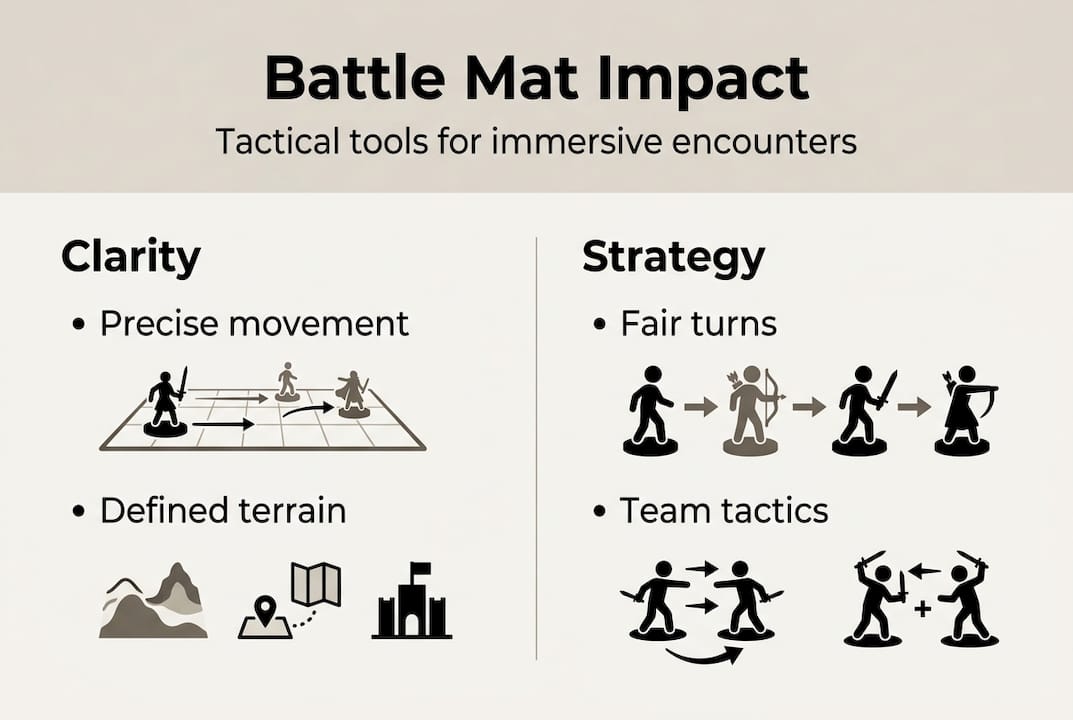
Battle mats solve this by making the entire encounter a shared visual language. Visualizing terrain, cover, and interactive elements prevents common combat issues like disputes over positioning and accidental friendly fire. When the layout is concrete, players stop second-guessing and start strategizing.
Mats are especially golden for:
- Multi-enemy fights: Track twelve kobolds without losing your mind.
- Verticality: Use elevation markers or level indicators on the grid.
- Difficult terrain: Color in the mud, ice, or rubble areas before the fight starts.
- Traps and hazards: Mark them (face-down for hidden, face-up when revealed).
- Choke points: Show narrow corridors that make every step count.
Battle mats are especially valuable for multi-enemy fights, difficult terrain, or when verticality is present. Visual learners (and there are a LOT of them in your average gaming group) absorb spatial information far better when it’s laid out on a surface rather than described verbally.
“We use our mat nearly every session. After 12 years of gaming, it’s still the single biggest upgrade we ever made to our table.”
Pro Tip: Before your session, sketch out interactive terrain elements on the mat: a chandelier the rogue can swing from, a crumbling bridge, a forge the barbarian can shove someone into. Inspiring battle map examples prove that the environment itself can be a character. Players will immediately engage with anything that looks “push-able” or “climb-able.” That’s not an accident. That’s good design.
The difference between a flat, boring fight and a legendary session often comes down to terrain in D&D strategy. Why describe a waterfall when you can DRAW it?
When to use battle mats—and when not to
Okay, real talk. Battle mats are incredible. But they are not the answer to every single situation at your table. Knowing WHEN to pull one out is just as important as knowing how to use it.
Here’s where mats genuinely shine:
- Set-piece boss fights with multiple phases
- Encounters with more than five combatants
- Fights in complex environments (multi-level, lots of terrain)
- Situations where AoE spells or breath weapons are frequent
- Groups with newer players who need visual anchors
But mats can slow pacing in tactical combats when players start over-measuring or “paralysis by analysis” kicks in. Sometimes the most cinematic moments happen when the grid is put away. A quick ambush in a dark alley? Describing that in vivid, breathless prose hits harder than plotting it on squares.
Visual learners and difficult terrain benefit most from mats, but theater of the mind wins when:
- The encounter is small (one or two enemies)
- Pacing and mood matter more than tactics
- Social or roleplay scenes are happening
- Your group is experienced and trusts each other’s spatial memory
- You want a fast, punchy, high-narrative moment
The smartest move is the hybrid approach. Some DMs use abstract “zones” (close, near, far) for simple fights and switch to the full grid for big tactical encounters. Others mix unlocking tactical play with pure storytelling based on the scene’s needs.
Pro Tip: Have a quick conversation with your group before the campaign starts. Ask whether they prefer visual maps or pure description for combat. Some groups love the chess-like satisfaction of the grid. Others find it slows them down. Knowing your crew’s preference is the single most powerful pro tip for tabletop immersion you’ll ever use.
Our take: The overlooked secret to making battle mats truly shine
Here’s something the rulebooks never tell you: using a battle mat for EVERY scene is one of the most common mistakes new DMs make. We’ve seen it happen. The mat comes out for the tavern brawl, the wolf attack on the road, the two-goblin ambush… and suddenly every fight feels like filling out a spreadsheet.
The real magic happens when mats are reserved. Pull the mat out for the dragon’s lair and watch your players sit up straight. That visual moment signals: this is a BIG deal. The contrast does the heavy lifting.
The best DMs we know treat the map like a plot twist. Keep things loose and narrative for 80% of combat. Then, for the climactic fight, unfurl the mat like a challenge accepted. Shifting between abstract and mapped play keeps fights snappy, stakes clear, and energy high.
“The grid is a tool, not a rulebook. Use it with intention and it becomes a storytelling superpower.”
For a step-by-step map building guide that turns this philosophy into practice, we’ve got you covered. The art of TTRPGs is knowing when to engage the grid AND when to let imagination rule.
Enhance your RPG sessions: Where to find quality battle mats and gear
Ready to level up your table setup? Good news: you don’t need to spend a dragon’s hoard to get there.

At 1985 Games, we’ve curated accessories specifically for TTRPG players who care about immersion and fun in equal measure. From terrain battle mats to handcrafted campaign materials, our shop is basically a feel-good factory for dice goblins. Looking for something extra special? Grab some mystery dice packs to add a little chaos to your sessions, or check out our dice bundle deals for maximum value. Because great tactical play deserves great gear, and your adventuring party deserves the whole package.
Frequently asked questions
Do I need a battle mat for every D&D session?
Nope! Battle mats excel in tactical set-piece combats but aren’t necessary for every scene. Simple encounters, social scenes, and fast narrative moments work great without one.
What is the ideal grid size for a D&D battle mat?
The standard is 1 inch equals 5 feet, which aligns perfectly with official D&D movement rules and fits most standard miniatures without any conversion headaches.
How durable are commercial battle mats like Chessex?
Chessex mats are durable, wet-erase compatible, and reversible, with many players reporting 15-plus years of regular use before needing a replacement.
When should I use ‘theater of the mind’ instead of a battle mat?
For quick skirmishes, social encounters, or any moment where theater of the mind excels in fast, immersive, flexible storytelling, skip the mat entirely and let pure description carry the scene.