

TL;DR:
- Terrain enhances spatial clarity, tactical depth, immersion, and storytelling in TTRPG sessions.
- Options range from affordable neoprene mats and printed cardstock to expensive resin or digital maps.
- Using terrain tools benefits both new and experienced players by improving spatial reasoning and memorable gameplay.
Lots of folks assume TTRPG terrain is just a fancy hobby for miniature collectors with too much shelf space. We get it. But here’s the thing: terrain is actually one of the most powerful tools a dungeon master has. It sharpens tactical decisions, sparks genuine “wow” moments at the table, and turns a flat description into something players can see and feel. Whether you’re running your first dungeon crawl or your fiftieth campaign, terrain changes the game. Literally. This guide covers what terrain is, the types available, how the rules treat it in D&D 5e and Pathfinder 2e, and how to pick the right pieces without blowing your entire gold reserve.
Table of Contents
- Defining TTRPG terrain: What it is and why it matters
- Types of TTRPG terrain: From grid mats to modular masterpieces
- How terrain rules work in D&D 5e and Pathfinder 2e
- Practical tips: Choosing, using, and scaling terrain for your sessions
- Why terrain transforms TTRPGs: The expert takeaway
- Find the right terrain: Tools and accessories for immersive play
- Frequently asked questions
Key Takeaways
| Point | Details |
|---|---|
| Terrain boosts clarity | It helps players understand movement, positioning, and environments during gameplay. |
| Many formats available | Terrain can be mats, modular tiles, resin sets, foam builds, or digital maps. |
| Rules affect tactics | Official terrain rules in D&D and Pathfinder impact movement and combat decisions. |
| Start small, scale up | You can begin with simple mats and add complexity as your campaign grows. |
| Easy access to accessories | High-quality terrain and accessories are available for all budgets and player levels. |
Defining TTRPG terrain: What it is and why it matters
So, what exactly is TTRPG terrain? Simply put, TTRPG terrain refers to physical or digital three-dimensional objects and structures placed on the tabletop to represent environments, enhancing spatial clarity for combat and exploration. That’s the textbook answer. But in practice, terrain is the difference between your players arguing about who has line of sight and everyone instantly getting it because there’s an actual stone wall sitting on the table.
Terrain shows up in two main forms. Physical terrain includes anything you can pick up and move: foam hills, resin dungeon tiles, cardstock cutouts, neoprene mats. Digital terrain covers virtual tabletop (VTT) platforms like Roll20 or Foundry VTT, where maps and objects are rendered on screen. Many groups mix both, and we’ll talk more about that in the FAQ.
Why does terrain matter so much? Here are the core benefits that keep dice goblins coming back to it:
- Spatial clarity: No more “wait, am I behind the pillar or not?” debates. Objects on the table answer that instantly.
- Tactical depth: Players can visualize flanking routes, chokepoints, and escape paths in seconds.
- Immersion: A carved stone corridor feels different from a blank grid. Your brain lights up like a Nat 20 when the environment feels real.
- Storytelling support: Terrain communicates mood. A crumbling ruin tells a story before the DM says a word.
“Terrain isn’t decoration. It’s a communication tool between the DM and the players. When players can see the environment, they make smarter, more engaged decisions.”
Terrain works across all kinds of play scenarios too. Combat is the obvious one, but terrain also shines during exploration sequences, social encounters in detailed taverns, and dramatic boss arenas. You can read more about terrain in D&D explained and explore the D&D terrain role in strategic gameplay to go deeper on these use cases.
Types of TTRPG terrain: From grid mats to modular masterpieces
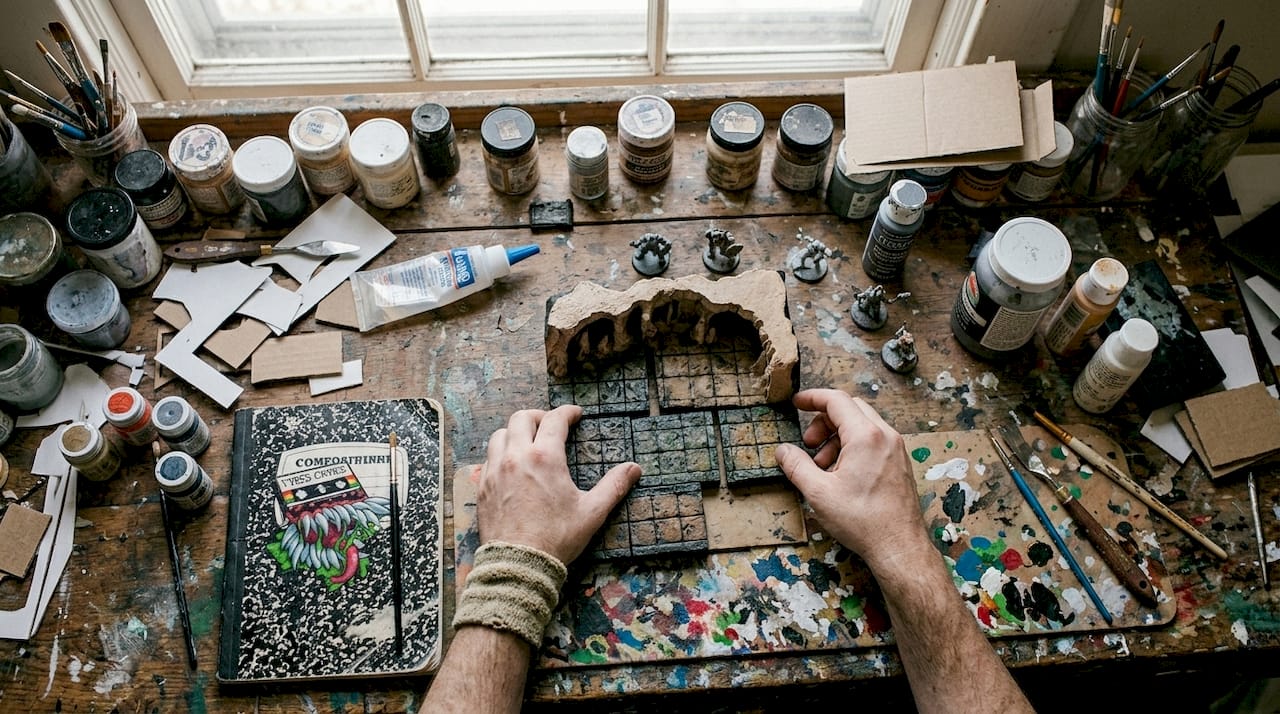
Now that we know what terrain is, let’s talk about what it looks like in the wild. There’s a whole ecosystem of terrain types out there, and picking the right one depends on your budget, storage space, and how deep you want to go.
Terrain includes modular tiles from companies like Dwarven Forge (making resin pieces since 1996), foam carvings, printed cardstock, neoprene mats, and accessories like walls, doors, and props. That’s a lot of options. Here’s a quick breakdown:
| Terrain type | Avg. cost | Pros | Cons |
|---|---|---|---|
| Neoprene grid mat | ~$20 | Cheap, portable, easy to store | Flat, low immersion |
| Printed cardstock | ~$5-$15 | Budget-friendly, customizable | Fragile, less durable |
| Foam carved tiles | ~$30-$80 | Lightweight, paintable | Time-intensive to make |
| Resin modular tiles | ~$100+ | Stunning detail, durable | Expensive, heavy |
| Digital (VTT) | Free-$10/mo | Infinite variety, no storage | Requires screen/device |
One standard you’ll see everywhere: 1 inch equals 5 feet on the tabletop. This scale keeps miniatures and terrain compatible across brands and systems. It’s the universal language of the tabletop world.
Here’s what makes modular terrain especially exciting for campaign-focused DMs:
- Mix and match pieces to build unique layouts every session
- Reuse the same tiles for a dungeon, a tavern, or a cave with different props
- Add accessories like doors, barrels, and torches to make spaces feel alive
- Scale your collection gradually without a huge upfront investment
For DMs who want to explore more options, check out TTRPG accessory examples and where to buy 2D terrain for curated starting points.
Pro Tip: Start with a neoprene grid mat and a few cardstock props. You’ll immediately see which terrain elements your group responds to before spending big on resin sets.
How terrain rules work in D&D 5e and Pathfinder 2e
Okay, dice goblins, this is where it gets tactical. Terrain isn’t just pretty. It has actual mechanical weight in the two biggest RPG systems right now.
In D&D 5e, difficult terrain costs 2 feet of movement per 1 foot traveled. Think mud, rubble, shallow water, or thick snow. Cover from terrain also matters: half cover gives +2 to AC and Dexterity saving throws, while three-quarters cover bumps that to +5. Full cover means you can’t be directly targeted at all. These rules make terrain a live tactical variable every single round.
In Pathfinder 2e, terrain is classified as normal, difficult (costs 1 extra foot per foot), greater difficult (costs 2 extra feet per foot), or hazardous (deals damage). Crucially, difficult terrain types do not stack in Pathfinder 2e. And flying creatures can usually ignore ground-based terrain unless the rules specifically say otherwise.
Here’s a side-by-side comparison to keep things clear:
| Rule | D&D 5e | Pathfinder 2e |
|---|---|---|
| Difficult terrain cost | 2 ft per 1 ft | 1 extra ft per 1 ft |
| Cover bonus | +2 AC / +5 AC | Circumstance bonus system |
| Terrain stacking | Allowed | Does NOT stack |
| Flying exception | DM discretion | Usually ignored unless noted |
| Hazardous terrain | DM-defined damage | Defined damage type |
Here’s how terrain rules play out in a real session:
- The rogue wants to dash across a rubble-filled corridor. That 30-foot dash effectively becomes 15 feet in D&D 5e because of difficult terrain.
- The fighter takes cover behind a crumbling wall. Three-quarters cover means that fireball is going to sting a little less.
- The wizard casts Grease on the floor. Now the area counts as difficult terrain AND is a hazard. Stacking chaos ensues.
- The enemy dragon flies over the spike pit. In Pathfinder 2e, it ignores the difficult terrain entirely unless the spell or trap specifies airborne creatures.
Pro Tip: Watch out for spells that create terrain effects (like Spike Growth or Web). They can interact with existing difficult terrain in ways that surprise even experienced players. Always clarify with your group before the session.
For more on using terrain strategically, explore strategic D&D terrain and battle maps for tactics.
Practical tips: Choosing, using, and scaling terrain for your sessions
Now for the part we love most: actually using terrain at the table. The goal here is simple. Make your sessions more fun, more clear, and more memorable without turning terrain prep into a second job.
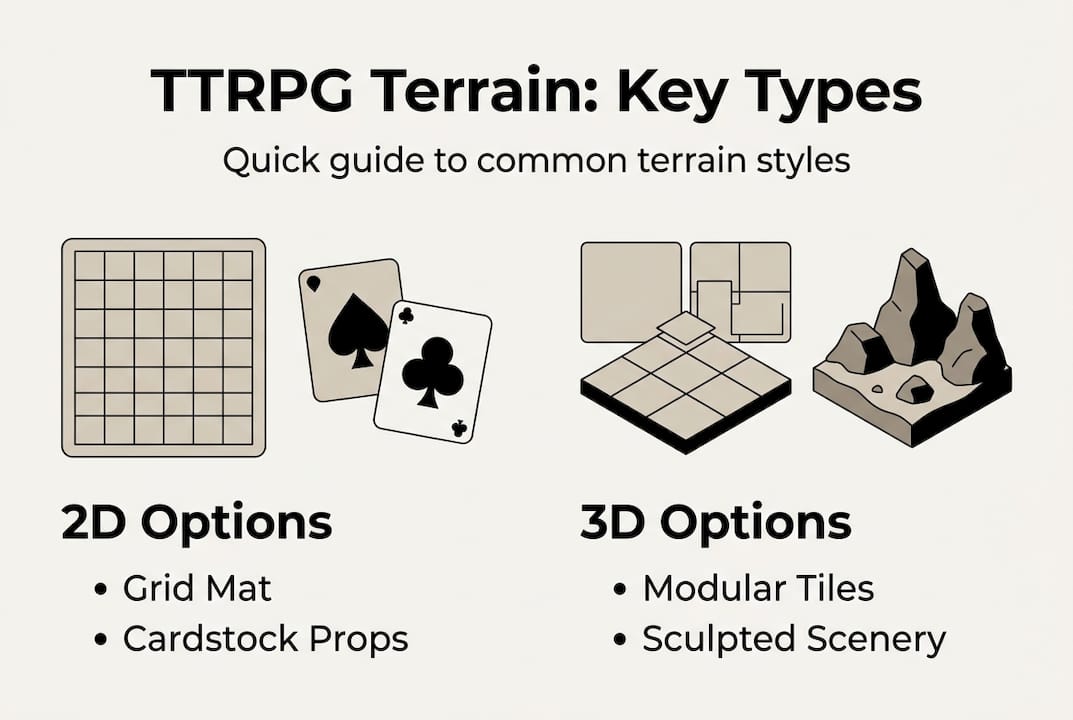
Terrain is a resolution tool for tactical systems, and experts recommend starting minimal with a grid mat around $20 and scaling up to modular sets as your campaign grows. That’s the smartest approach for most groups.
Here’s a simple progression path:
- Start with a grid mat. Erasable or wet-erase mats let you draw any layout on the fly. Cheap, flexible, and instantly useful.
- Add printed props. Download free or low-cost cardstock terrain packs. Barrels, crates, and doors go a long way.
- Invest in a modular starter set. Once you know what your group loves, a small resin or foam tile set pays off fast.
- Build themed collections. Dungeon tiles for one campaign, forest terrain for another. Rotate based on your story arc.
- Layer in accessories. Walls, doors, torches, and scatter terrain (small decorative items) make every scene feel lived-in.
Some practical things to keep in mind as you build your collection:
- Storage matters. Foam and resin pieces can be bulky. Stackable bins and labeled bags save your sanity.
- Portability counts. If you travel to game nights, lightweight cardstock and rolled mats beat heavy resin every time.
- Budget smartly. You don’t need everything at once. One great dungeon set beats five mediocre ones.
Pro Tip: Use terrain to telegraph danger before combat starts. A lava-filled room with narrow bridges tells players “this fight is going to be different” before initiative is even rolled.
For more ideas on building an immersive setup, check out game setup for immersion, browse accessories for gameplay, and see how other DMs boost gameplay immersion with simple tools.
Why terrain transforms TTRPGs: The expert takeaway
Here’s something most terrain guides won’t tell you: terrain isn’t an advanced-player thing. It’s actually more valuable for newer players and DMs than for veterans. Why? Because beginners struggle most with spatial reasoning at the table. “Where am I relative to the goblin?” is a question that kills momentum fast. A physical object answers it instantly, no experience required.
We’ve also noticed something interesting. Sessions with terrain create shareable moments. Players take photos. They post them. They remember that specific encounter years later because they can picture the physical space. That’s the magic no rulebook can manufacture.
The trap most DMs fall into? Overinvesting early. Dwarven Forge Kickstarters have raised millions (including $3M+ in 2018 alone), which tells you how passionate this community gets. But passion doesn’t have to mean debt. A $20 mat and some printed props will genuinely transform your table. Build from there, guided by what your players respond to, not what looks coolest on a shelf.
Check out our tabletop role-playing guide if you want to connect terrain use to the bigger picture of immersive play.
Find the right terrain: Tools and accessories for immersive play
Ready to bring terrain into your games? We’ve got you covered, dear dungeon master.

At 1985 Games, we curate terrain and accessories built for real play, not just shelf display. Our Dungeon Craft Vol. 2 gives you a modular dungeon system that works right out of the box, while Dungeon Craft Cursed Lands adds dark, atmospheric environments perfect for horror or gothic campaigns. Need a battle map that travels well? The BattleMap Snow & Wood is a gorgeous, portable option for wilderness encounters. Whether you’re just starting out or leveling up your setup, we have options for every budget and play style, with global shipping to get your terrain to the table fast.
Frequently asked questions
Can digital terrain be used alongside physical terrain in TTRPGs?
Yes, many groups mix digital mats displayed on a screen or tablet with physical terrain objects for maximum flexibility and immersion without sacrificing convenience.
Do I need expensive terrain to run a fun TTRPG session?
Not at all. A simple grid mat around $20 or printed cardstock props can create genuinely immersive play, and you can scale up to modular sets as your campaign grows.
How does terrain affect movement rules in D&D?
Difficult terrain costs double your movement, meaning you spend 2 feet of movement for every 1 foot traveled, which dramatically affects positioning and tactical choices in combat.
What are common brands or sources for TTRPG terrain?
Top sources include Dwarven Forge resin tiles (crafting pieces since 1996), foam carvers, neoprene printed mats, and cardstock companies offering downloadable and print-on-demand terrain sets.