

Picture this: your party charges into a dragon’s lair, swords drawn, spells crackling. The Dungeon Master describes the scene in vivid detail. But then someone asks, “Wait, am I behind the pillar or not?” Suddenly the epic moment dissolves into a five-minute debate about positioning. Sound familiar? Battle maps fix exactly that. They transform chaotic, confusing combat into something strategic, fair, and genuinely thrilling. Maps enhance strategic gameplay by spreading out combats, encouraging creative use of the environment, and reducing player confusion on battlefield layout. If you’ve been sleeping on battle maps, dear dice goblin, it’s time to wake up.
Table of Contents
- Why battle maps matter in D&D
- Battle maps vs. theater of the mind: A practical comparison
- Core elements of effective battle maps
- Designing and revealing battle maps for maximum engagement
- Accessories and tools to level up your battle maps
- Advanced tips: Handling edge cases and hybrid encounters
- Bring your battles to life with immersive maps and tools
- Frequently asked questions
Key Takeaways
| Point | Details |
|---|---|
| Battle maps provide clarity | Maps eliminate confusion and help everyone understand the battlefield instantly. |
| Flexible play styles | Combining grids and theater of the mind adapts to your group’s needs and preferences. |
| Tactical depth and creativity | Maps with terrain features and interactivity reward players who think strategically. |
| Affordable enhancement options | You don’t need expensive products—simple tools can dramatically improve immersion. |
| Preparation boosts play | Prepping maps and choosing the right tools ensures smooth, memorable sessions. |
Why battle maps matter in D&D
Let’s be real. A lot of players assume battle maps are just for “serious” or “crunchy” gamers who love rules. That’s a misconception worth busting wide open. Battle maps aren’t about complexity. They’re about clarity.
When everyone at the table can SEE the battlefield, something magical happens. Players stop second-guessing their moves and start making bold, creative decisions. The rogue actually uses that shadowy alcove. The wizard positions herself behind cover before dropping a fireball. Suddenly, the environment becomes a character in the fight.
“Battle maps elevate D&D from narrative to tactical depth, ideal for strategic players, but hybrid use maximizes flexibility.”
Here’s what using battle maps consistently brings to the table (pun absolutely intended):
- Clarity: No more “wait, where am I?” moments mid-combat
- Fairness: Everyone sees the same battlefield, no favoritism
- Creativity: Players spot opportunities they’d never imagine from description alone
- Engagement: Visual cues keep even distracted players locked in
- Pacing: Decisions happen faster when positioning is obvious
The biggest misconception? That maps slow things down. In reality, they speed up decision-making because players aren’t mentally reconstructing the scene from scratch every turn.
Battle maps vs. theater of the mind: A practical comparison
Neither approach is universally better. Both have their place. The trick is knowing which tool fits the moment. D&D rules support both grid-based maps and theater of the mind, with the 2024 DMG detailing grid, hex, and no-grid options.
Here’s a side-by-side breakdown:
| Feature | Battle maps | Theater of the mind |
|---|---|---|
| Speed of setup | Slower (requires prep) | Instant |
| Tactical options | High (precise positioning) | Limited |
| Immersion | Visual and tactile | Narrative and imaginative |
| Required prep | Moderate to high | Minimal |
| Best for | Complex combats, AoE spells | Simple skirmishes, roleplay |
| Cost | Low to moderate | Free |
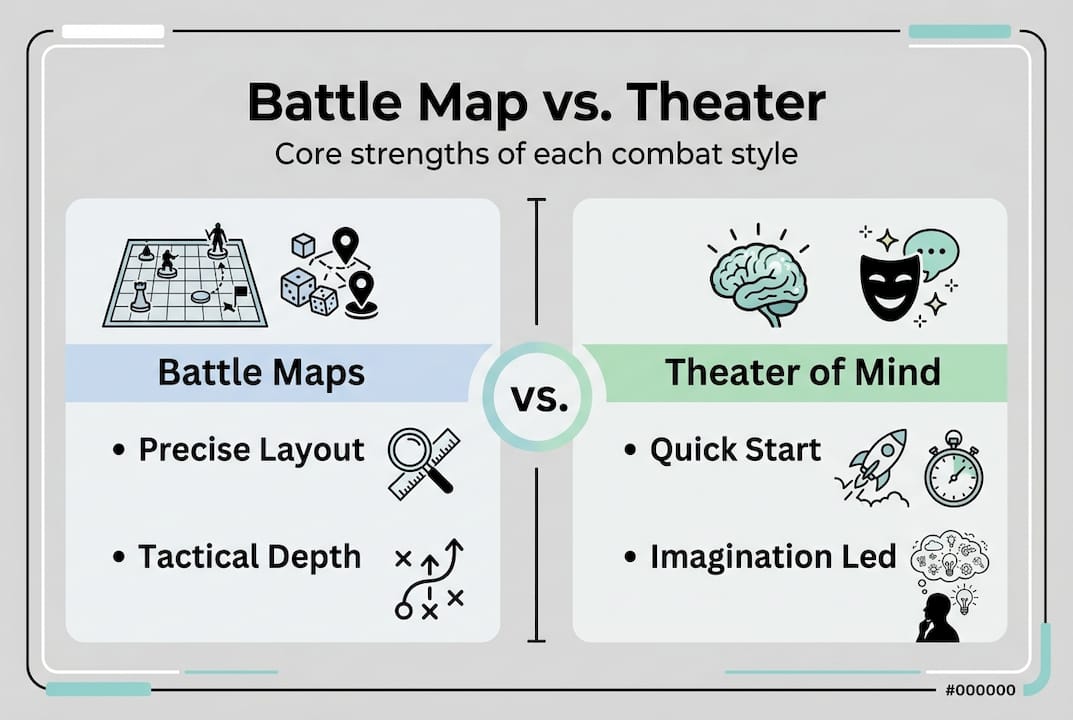
Theater of the mind is faster and cheaper, promotes roleplay and imagination, but struggles with complex positioning, larger groups, or precise mechanics like AoE spells.
Scenarios where each style shines:
- Use battle maps for: Boss fights, dungeon crawls, multi-enemy ambushes, encounters with traps or terrain hazards
- Use theater of the mind for: Quick roadside skirmishes, social encounters with minor combat, one-on-one duels with simple mechanics
Knowing when to use each method is honestly a superpower for any DM. The best tables mix both freely, switching based on what the scene demands.
Core elements of effective battle maps
Not all battle maps are created equal. A flat grid with some walls drawn on it? Functional, sure. But a map with elevation, cover, and interactive terrain? That’s a Nat 20 waiting to happen.
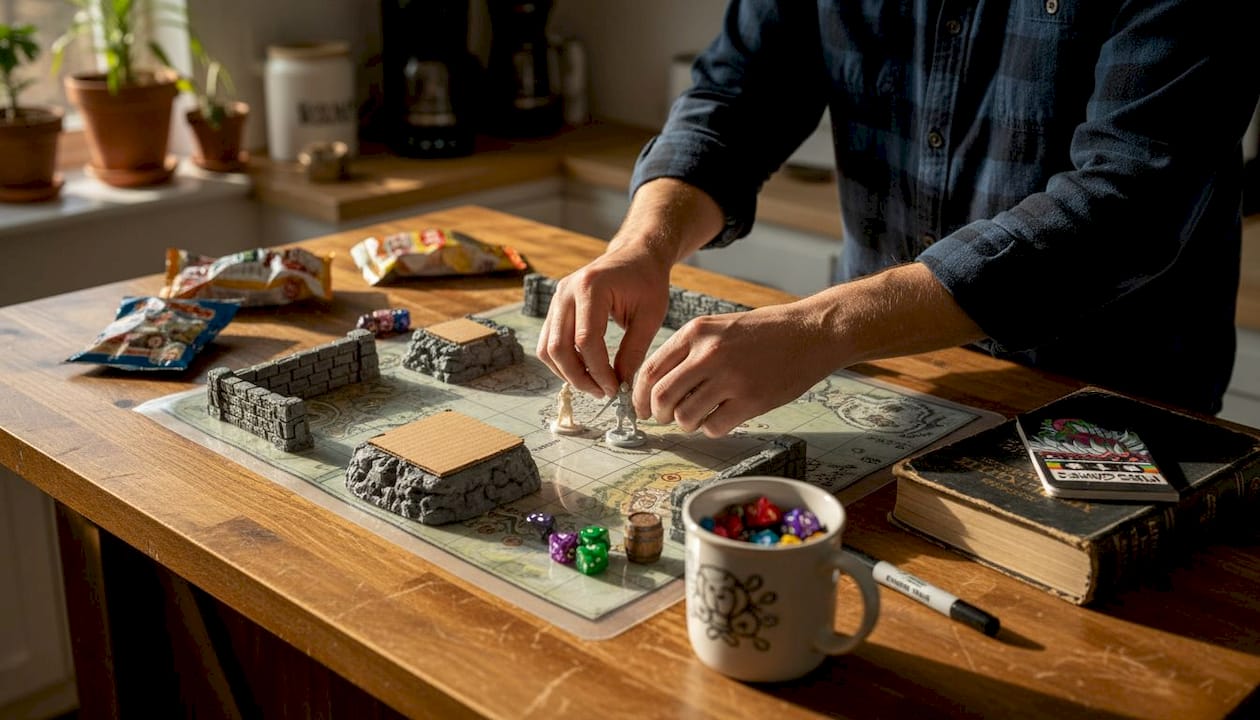
Prioritizing interactivity in maps through cover, elevation, and hazards rewards creativity and prevents boring pile-ins where everyone just rushes the enemy.
Here are the dynamic map elements that separate good maps from legendary ones:
- Cover: Barrels, walls, and pillars give players tactical choices and make positioning matter
- Elevation: High ground advantages create dramatic moments and force interesting decisions
- Hazards: Lava pools, collapsing floors, and poison vents add urgency and unpredictability
- Choke points: Narrow corridors force creative thinking and prevent blob-style combat
- Destructible terrain: Breakable walls and movable objects reward clever players
- Interactive objects: Levers, chandeliers, and barricades invite improvisation
Pro Tip: Add just ONE unexpected interactive element to your next map. A chandelier that can be cut down. A barrel of oil near a torch. Players will talk about that encounter for months. Seriously. One element changes everything.
Designing and revealing battle maps for maximum engagement
Okay, you’re sold on maps. Now how do you actually make and use them well? Let’s get practical.
Use 300 DPI for print and 70 to 140 pixels per square for VTT platforms. Modular layers work great for dynamic elements, and revealing maps progressively creates fog of war and immersion.
Here’s a step-by-step approach for both digital and physical setups:
- Sketch your layout first. Rough pencil sketches save time before committing to digital tools or printing.
- Choose your medium. Digital VTT (like Foundry or Roll20) or physical print? Both work brilliantly.
- Set your scale. One inch per square is standard for physical maps with miniatures.
- Add terrain layers. Start with walls and floors, then layer in furniture, hazards, and interactive elements.
- Plan your reveal. Decide which areas players can see at the start versus what gets uncovered during play.
- Print at quality. For physical maps, 300 DPI keeps details crisp and readable at the table.
- Use overlays. Paper cutouts or tokens can hide secret rooms until players discover them.
The progressive reveal is genuinely one of the most exciting tools in a DM’s kit. Watching players lean forward as you uncover a new section of the dungeon? Pure magic. Pair this with accessories for immersion and top TTRPG accessories to take the atmosphere to another level.
Pro Tip: Pre-draw maps for encounters you know are coming. It cuts setup time dramatically and lets you focus on storytelling instead of scrambling for markers mid-session.
Accessories and tools to level up your battle maps
You don’t need to spend a fortune to run incredible battles. Some of the best tools are surprisingly affordable. Chessex mats and dry-erase boards enhance physical play without high cost.
Here’s a quick comparison of popular options:
| Accessory | Approximate cost | Reusability | Ease of use |
|---|---|---|---|
| Chessex vinyl mat | $25 to $40 | Very high | Easy |
| Dry-erase grid board | $15 to $30 | Very high | Easy |
| Printable map tiles | $5 to $15 | Moderate | Moderate |
| Pre-printed map sets | $20 to $50 | High | Very easy |
| VTT subscription | $5 to $10/month | Unlimited | Moderate |
Some budget-friendly tips to boost gameplay immersion without breaking the bank:
- Print maps on regular paper and laminate them for reuse
- Use colored dry-erase markers to color-code terrain types
- Combine a basic grid mat with printed terrain overlays for variety
- Grab immersive accessories like themed map sets that work for multiple campaigns
Mixing physical and digital tools is honestly the sweet spot for most groups. Use a VTT for prep and sharing, then print your favorites for the tactile experience at the table.
Advanced tips: Handling edge cases and hybrid encounters
Even the most prepared DM hits situations where the standard approach just doesn’t cut it. Mass combats, surprise encounters, and mixed-format sessions all need a little extra strategy.
Mass battles use swarm units, pre-drawn maps speed up known combats, and combining maps with theater of the mind works perfectly for simple encounters within larger sessions.
Here’s how to stay flexible when things get complicated:
- Mass combat: Treat groups of enemies as single units on the map. One token for ten goblins keeps things manageable.
- Surprise encounters: Keep a few generic maps ready (forest clearing, tavern interior, city street) for unplanned fights.
- Mixed sessions: Start theater of the mind for the approach, then drop the map when combat gets complex.
- Narrative moments: Pull the map away entirely for dramatic one-on-one confrontations where story beats matter more than positioning.
Pro Tip: Keep a folder of three to five pre-drawn generic maps on your phone or tablet. When players go off-script (and they WILL), you’re ready in seconds. No scrambling, no awkward pauses. Just smooth, confident DMing.
Knowing when to use battle maps for big encounters versus when to ditch the grid entirely is what separates good DMs from legendary ones. Trust your instincts and read the room.
Bring your battles to life with immersive maps and tools
You’ve got the knowledge. Now let’s talk gear. At 1985 Games, we live and breathe this stuff, and we’ve built a collection specifically designed to make your sessions unforgettable.
Our battle maps collection is packed with beautifully crafted terrain sets ready to drop straight into your campaign. Whether you’re running a gritty dungeon crawl or an open-world adventure, we’ve got you covered. The Dungeon Craft Volume 2 is a fan favorite for its modular versatility, and the Cursed Lands map set brings dark, atmospheric environments that practically write the encounter for you. Less prep time, more epic moments. That’s the 1985 Games promise.
Frequently asked questions
What is the main benefit of using battle maps in D&D?
Battle maps clarify combat positioning, encourage strategic thinking, and make encounters more engaging for every player at the table. They turn vague descriptions into clear, actionable battlefield decisions.
Should every D&D combat encounter use a battle map?
Not at all. Quick, simple scenes often work best with theater of the mind, while complex battles benefit from maps, especially when AoE spells or precise positioning are involved.
What is the best way to reveal a battle map during a game?
Reveal maps progressively using fog of war effects or physical overlays to keep players engaged and maintain suspense as they explore the battlefield.
Are there affordable accessories for creating battle maps?
Absolutely. Dry-erase boards and Chessex mats are popular low-cost options that enhance physical play and can be reused across dozens of sessions.
Can digital tools fully replace physical battle maps?
Digital tools offer incredible flexibility and convenience, but many players prefer the tactile feel and social energy of physical maps spread across a real table with friends.