

Picture this: your party is mid-combat, the DM describes a shadowy corridor, and suddenly everyone is arguing about who is standing where, whether the rogue can flank, and if the wizard is actually in fireball range. Sound familiar? That foggy, frustrating moment is exactly why battle maps exist. They transform vague verbal descriptions into vivid, shared visual spaces where tactics click, creativity sparks, and everyone at the table finally agrees on what is happening. Whether you are a seasoned DM or a player who just rolled their first character, understanding how to use battle maps strategically can completely change the energy of your sessions.
Table of Contents
- What are battle maps and why do they matter in TTRPGs?
- Battle maps vs. theater of the mind: A tactical comparison
- Core mechanics: How maps shape movement, tactics, and clarity
- Designing effective battle maps: Tips for creativity and engagement
- Revealing battle maps: Dynamic methods for in-game drama
- When and how to use maps: Context, hybrid solutions, and advanced tips
- Bring your campaigns to life with premium battle maps
- Frequently asked questions
Key Takeaways
| Point | Details |
|---|---|
| Tactical clarity | Battle maps remove ambiguity by clearly showing positions and obstacles during play. |
| Enhanced engagement | Visual maps keep everyone involved and streamline both planning and action. |
| Creative combat | Well-designed maps inspire unique strategies and help avoid repetitive battles. |
| Balanced flow | Mixing mapping with narration adapts to any session for peak enjoyment. |
What are battle maps and why do they matter in TTRPGs?
Battle maps are visual representations of a combat or exploration space, usually drawn on a grid or hex pattern, used during tabletop RPG encounters. They can be physical (printed sheets, dry-erase boards, modular terrain tiles) or digital (used on virtual tabletops, or VTTs, like Roll20 or Foundry). Either way, their job is the same: make space real.
Here is what battle maps actually do at the table:
- Clarify positioning so everyone knows exactly where their character stands
- Make terrain explicit, turning “there is a wall somewhere” into a concrete obstacle
- Promote fairness by giving all players the same visual information
- Speed up turns because players can plan moves visually instead of asking endless questions
- Reduce DM burden by letting the map do the spatial storytelling
As noted by strategic depth researchers, battle maps make spatial tactics explicit, which is ideal for grid-based systems like D&D 5e. That explicitness is not just a convenience. It is a game-changer.
“Maps foster player engagement and reduce GM description burden, turning implicit space into something everyone can see and interact with.”
If you want to go deeper on practical applications, check out how battle maps in D&D can reshape your entire approach to encounter design. And for broader session upgrades, tabletop immersion tips are a great companion read.
Battle maps vs. theater of the mind: A tactical comparison
Theater of the mind (TOTM) is the classic approach: the DM describes the scene, players imagine it, and everyone acts on that shared mental picture. No map needed. It is fast, flexible, and deeply cinematic when done well. But it has real limits, especially as encounters grow more complex.
Here is a side-by-side look at both styles:
| Feature | Battle maps | Theater of the mind |
|---|---|---|
| Tactical clarity | High | Variable |
| Setup time | Moderate to high | None |
| Player engagement | Visual and active | Imagination-driven |
| Rules disputes | Rare | More common |
| Immersion style | Spatial and strategic | Narrative and descriptive |
| Best for | Complex combat, large parties | Simple scenes, roleplay |
Some situations where maps are basically indispensable:
- Large parties (5+ players) where TOTM gets chaotic fast
- Complex terrain like multi-level dungeons, urban rooftops, or underwater caves
- Tactical positioning moments where flanking, cover, and line of sight actually matter mechanically
- New players who benefit from visual anchors to understand the scene
As combat encounter styles research shows, large groups complicate theater of the mind significantly, and complex environments like urban chases are almost always better served with a map. Meanwhile, pro-map advocates point to clarity, consistency, and reduced mid-combat questions as major wins.
Pro Tip: You do not have to pick a side. Use maps for your big, dramatic set-piece battles and TOTM for quick skirmishes or heavy roleplay scenes. This hybrid approach keeps prep manageable and sessions dynamic. It also pairs beautifully with strategic terrain in D&D thinking, where terrain becomes a storytelling tool, not just a backdrop. For more ways to level up your sessions, accessories for immersive gameplay are worth exploring.
Core mechanics: How maps shape movement, tactics, and clarity
Battle maps are not just pretty pictures. They are mechanical engines. Here is a breakdown of the core features they bring to life:
| Map mechanic | What it does in play |
|---|---|
| Grid movement | Standardizes distance, prevents disputes |
| Line of sight | Determines who can target whom |
| Cover | Adds defensive bonuses based on position |
| Elevation | Creates tactical advantages for ranged attackers |
| Fog of war | Hides unexplored areas for suspense |
| Dynamic lighting | Simulates torchlight, darkness, and vision limits |
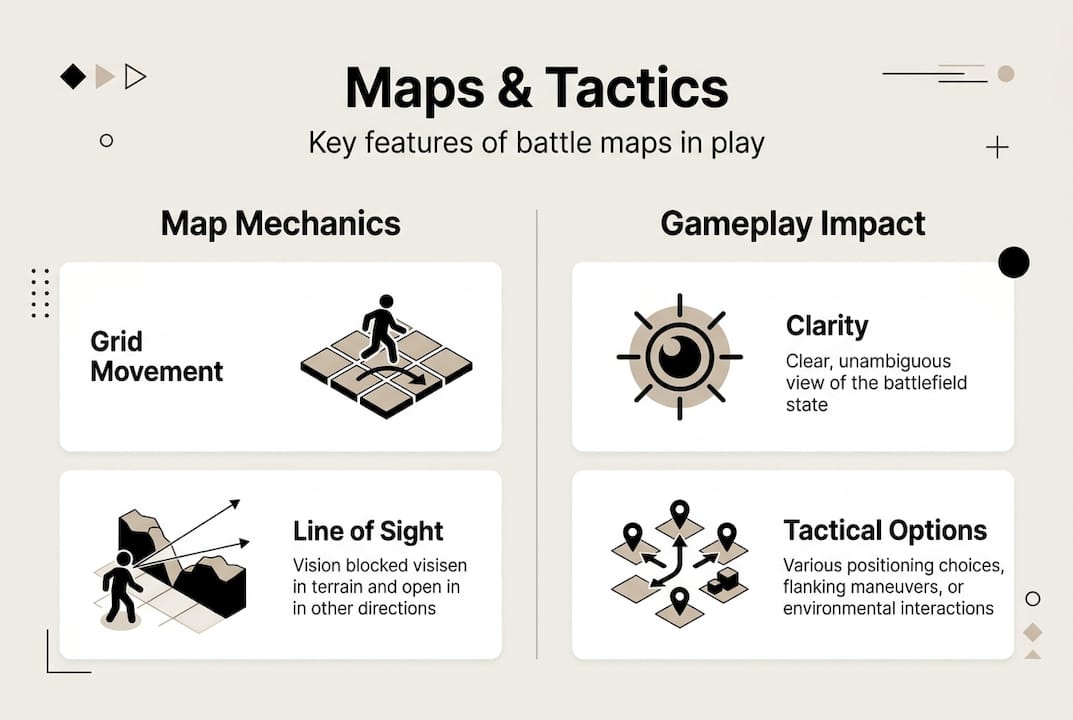
These grid movement and fog of war mechanics are especially powerful in VTTs, where they can be automated. But even on a physical table, just having a grid transforms how players think.
Here is how map features directly influence combat decisions:
- Positioning becomes a real choice. Do you rush the enemy or hold the chokepoint?
- Action economy improves because players plan ahead visually instead of asking “wait, how far away is that?”
- Teamwork clicks naturally. Players can see where to set up flanks, who needs healing, and where the tank should stand.
- Environmental interaction becomes obvious. That pillar? Players will use it for cover. That pit? Someone is getting shoved into it.
- Spellcasting decisions sharpen. Area-of-effect spells require real spatial thinking when you can see the grid.
Visualization also prevents the dreaded mid-combat rules argument. When everyone can see the map, disputes about range or positioning resolve in seconds. Explore how terrain in D&D interacts with these mechanics, and consider the advantages of using 2D terrain if you want a cost-effective physical setup. For digital play, using digital battlemaps covers the full VTT workflow.
Designing effective battle maps: Tips for creativity and engagement
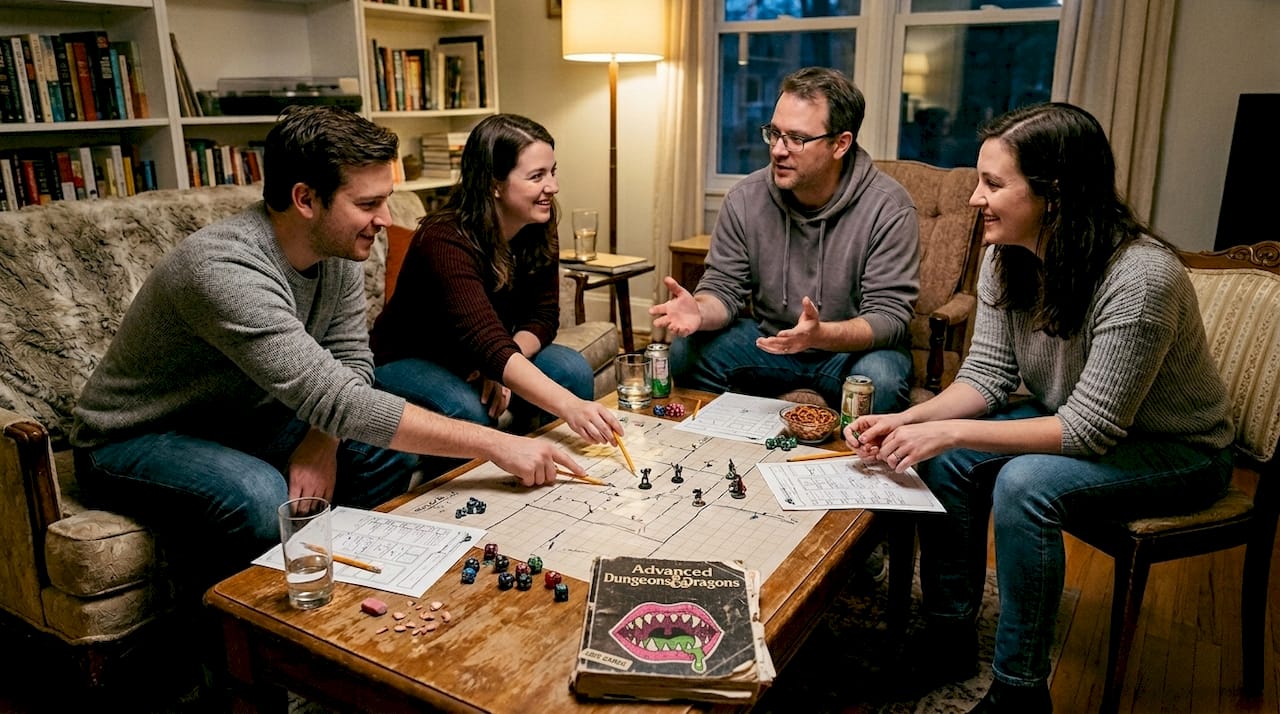
A flat, empty grid is technically a battle map. But it is also a recipe for a boring, clustered fight where everyone just runs at each other. Great map design is what separates a memorable encounter from a forgettable one.
Key elements every engaging map should have:
- Interactive terrain: Barrels to hide behind, chandeliers to swing from, levers that open trapdoors
- Multiple movement paths: At least two or three routes through the space so players have real choices
- Obstacles and chokepoints: Walls, pillars, and narrow passages that force tactical decisions
- Thematic flavor: A tavern brawl map should feel different from a throne room showdown
- Environmental hazards: Lava flows, collapsing floors, or a raging river add stakes beyond hit points
Pro Tip: Add at least one objective-based element to your map. A lever that opens a portcullis, a hostage in the corner, or a ritual circle that must be disrupted. These elements pull players away from simple “stand and swing” combat and create genuinely cinematic moments.
“Poor map design leads to dogpiling and box-fights where players cluster in one spot and the encounter loses all its drama. Good design forces movement, creativity, and risk.”
For design great battlemaps, the technical standard is 300 DPI for print maps and modular layers for VTT use. That resolution keeps your map crisp whether it is on a table or a screen. Pair smart design with pro tips for tabletop immersion and your players will be talking about that encounter for months. You can also browse accessories that boost immersion to complement your map setup.
Revealing battle maps: Dynamic methods for in-game drama
How you reveal a map matters almost as much as the map itself. A dramatic reveal can spike the tension in the room instantly. A clumsy one can kill the mood before initiative is even rolled.
Here are the major reveal methods and when to use each:
- Live drawing: Sketch the map in real time as players explore. This is incredible for suspense and fog-of-war style play. Players only see what their characters have discovered.
- Pre-made gradual uncover: Lay the full map face-down or covered with paper, then reveal sections as players move through the space. Great for dungeon crawls.
- Full reveal at encounter start: Flip the whole map at once for a dramatic “here is what you are dealing with” moment. Best for set-piece battles where the stakes are already clear.
- Player sketching: Let players draw their own map based on your descriptions during exploration. Adds a collaborative, old-school feel and keeps everyone engaged.
“Live mapping during sessions creates a sense of discovery and suspense that pre-made maps simply cannot replicate. Players lean in. They pay attention. Every new room feels earned.”
As map reveal methods experts note, live drawing and gradual uncovering are the gold standard for engagement. For digital sessions, revealing digital maps with VTT fog-of-war tools takes this to a whole new level.
When and how to use maps: Context, hybrid solutions, and advanced tips
Not every encounter needs a map. Knowing when to pull one out (and when to leave it in the bag) is a real DM skill.
Here is a quick guide:
- Maps are essential: Boss fights, multi-phase encounters, large parties, complex terrain, tactical set pieces
- Maps are optional: Medium-sized skirmishes with straightforward terrain, encounters where roleplay matters more than tactics
- Maps are unnecessary: Quick ambushes resolved in two rounds, purely narrative confrontations, social encounters
Some systems, like FATE, skip grids entirely and use abstract zones instead. That is a totally valid approach for narrative-first games. But for D&D and similar grid-based systems, maps are almost always worth the prep.
Pro Tip: The hybrid map strategies approach is the sweet spot for most campaigns. Use maps for your key combats and theater of the mind for everything else. This balances prep time with session flow beautifully and keeps your players on their toes.
For a full breakdown of how to make this work in your actual campaign, battle map enhancement tips walks you through the practical details.
Bring your campaigns to life with premium battle maps
All this tactical knowledge deserves equally epic maps to play on. We have got you covered, fellow dice goblins.
At 1985 Games, we have curated a collection of stunning, ready-to-play battle maps designed to make every encounter feel like a legendary moment. Whether your party is hacking through the Jungles of Dread battle maps or storming the ramparts in Castles & Keeps battle maps, our maps bring the kind of immersive, thematic detail that turns good sessions into unforgettable ones. Browse our full range of battle maps and tools and find the perfect backdrop for your next campaign. Your players will absolutely lose their minds (in the best way).
Frequently asked questions
What is the main role of a battle map in TTRPGs?
A battle map visually clarifies positioning, tactics, and spatial relationships during encounters, reducing confusion and disputes. It makes spatial tactics explicit, which is especially valuable in grid-based systems like D&D.
When should I use a battle map instead of theater of the mind?
Use maps for complex or tactical encounters where positions and terrain matter mechanically. Hybrid use of maps for key combats and theater of the mind for minor scenes balances prep time and session flow perfectly.
How can I keep map reveals dramatic during play?
Reveal maps gradually or live-draw them for maximum suspense. Live drawing and gradual uncovering are the most engaging methods, especially when paired with digital fog-of-war tools.
What map elements boost combat creativity?
Hazards, multiple movement paths, and interactive terrain make fights dynamic and prevent clustering. Obstacles and multiple paths are the two design elements that most reliably create memorable, creative encounters.
Can battle maps slow down gameplay?
Setup takes some effort, but maps actually speed up complex turns and reduce rules arguments. Maps reduce GM burden by making space explicit, which means fewer interruptions and faster, more satisfying tactical action overall.