

Every DM knows the feeling. You’ve spent hours building a campaign, your players sit down, and then… the encounter happens on a blank grid with a couple of rectangles drawn in marker. Crickets. The thing is, a great battle map doesn’t just show where the walls are. It tells a story, creates tension, and makes players lean forward in their chairs. We’ve pulled together standout battle map examples, design criteria, and practical inspiration so you can run sessions that feel like a Nat 20 every single time.
Table of Contents
- How to evaluate a great battle map
- Classic official D&D battle maps
- Innovative homebrew battle map examples
- Theme-based and terrain-focused battle maps
- Quick comparison: Official vs. homebrew vs. themed maps
- The overlooked power of battle maps: Engagement beats art
- Bring next-level battle maps to your table
- Frequently asked questions
Key Takeaways
| Point | Details |
|---|---|
| Criteria for great maps | The best maps offer tactical depth, clear visuals, variety, and interactive features to engage players. |
| Legendary official examples | Official releases like Dead in Thay provide inspiration with their high detail and large encounter spaces. |
| Homebrew customization | Custom maps let you address session-specific needs, add surprises, and resolve layout challenges. |
| Theme and terrain impact | Using varied terrain and strong themes makes combat more strategic and memorable. |
| Engagement over visuals | Player engagement rises when maps encourage meaningful tactical decisions, regardless of artistic detail. |
How to evaluate a great battle map
Before we start drooling over specific maps, let’s talk about what actually separates a legendary battle map from a forgettable one. Because not every map that looks gorgeous actually plays well, and not every simple sketch is a disaster. The best maps hit four core criteria:
- Tactical options: Players should have real choices. Cover, elevation, choke points, and flanking lanes all matter. If every fight plays out the same way, something’s missing.
- Immersion: The map should feel like a real place. A tavern brawl map needs tables to flip. A dungeon corridor needs shadows and secrets.
- Variety: Mixing terrain types, room shapes, and environmental features keeps players on their toes. Flat, open rooms (what designers call “blandscapes”) kill excitement fast.
- Clarity: Players need to read the map at a glance. Cluttered art that obscures movement or line of sight creates frustration instead of fun.
Two of the biggest map killers are dogpiling (where all enemies and players cram into one spot because there’s nowhere else to go) and immersion breaks (when the map looks so generic it could be anywhere). Battle map best practices highlight avoiding dogpiling, using interactive terrain, maintaining clear lines of sight, and building in roleplay opportunities as the foundation of great design. These aren’t just nice extras. They’re what enhance D&D gameplay from a dice-rolling exercise into a genuinely cinematic experience.
Pro Tip: Add at least one unique terrain feature to every encounter map. A crumbling bridge, a bubbling acid pool, or a chandelier players can swing from instantly creates a moment worth talking about after the session.
“The best battle maps give players something to interact with beyond just moving and attacking. When the environment becomes a character, encounters become unforgettable.” — RPG Taverns
Now let’s look at some legendary maps that nail these criteria and boost RPG sessions with tactics in wildly different ways.
Classic official D&D battle maps
Official D&D maps set the gold standard for a reason. They’re built by professional cartographers, playtested for tactical depth, and designed to support large-scale, complex encounters. Two of the most celebrated examples are the Doomvault from Dead in Thay and the Bloodgate Vault.
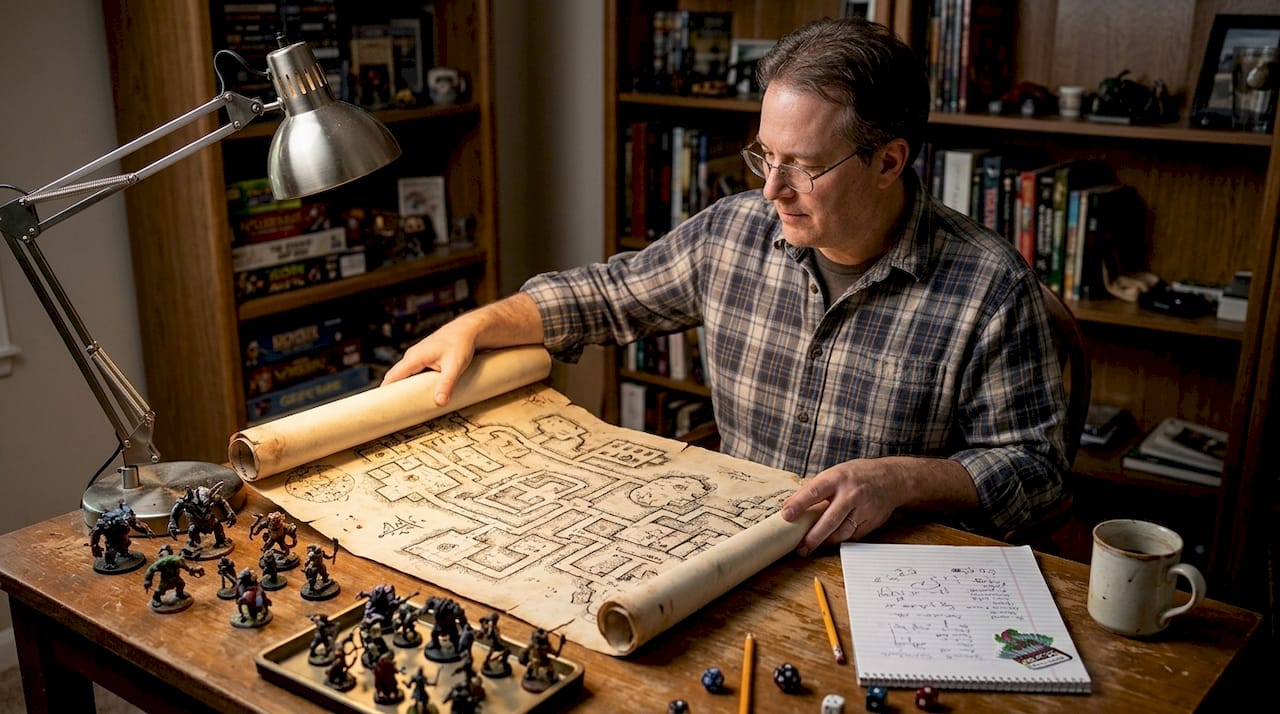
The Dead in Thay poster map by Mike Schley is a masterclass in scale. The Doomvault is a sprawling dungeon complex with dozens of interconnected rooms, each with distinct tactical features. We’re talking teleportation circles, elemental zones, and rooms that reward exploration over brute force. The Bloodgate Vault, meanwhile, layers vertical movement and multiple entry points into a compact space, making every approach feel different.
| Map | Resolution | Best use scenario |
|---|---|---|
| Doomvault (Dead in Thay) | High-res poster (multi-page) | Large-scale dungeon crawl, 5+ sessions |
| Bloodgate Vault | High-res digital print | Mid-tier boss encounter, vertical play |
| Average homebrew map | Standard grid printout | Single-session custom encounter |
Key tactical features these official maps enable:
- Multiple entry and exit points that prevent bottlenecking
- Distinct zones with different environmental rules
- Clear grid lines that support movement calculation
- Layered narrative context baked into the visual design
Official maps like these unlock tactical depth that homebrew maps sometimes struggle to match right out of the box. The sheer detail and intentional design make them reliable anchors for any campaign. And if you’re curious about the advantages of printed versus digital formats, the Dungeon Craft DnD maps breakdown is worth a read.
Innovative homebrew battle map examples
Here’s where things get really fun. While official releases set important standards, DM creativity shines brightest in custom homebrew solutions. Some of the most talked-about sessions in TTRPG history happened on maps made from craft paper, foam, and sheer imagination.
Three homebrew setups that consistently blow players’ minds:
- Verticality maps: Multi-level encounters using stacked platforms, cliffs, or tower floors. Players love the drama of fighting upward while enemies rain arrows from above.
- Room hazard maps: Encounters built around a central danger, like a flooding chamber, a rotating blade trap, or a crumbling floor. The hazard becomes the third combatant.
- Multi-phase fight maps: Maps that physically change mid-encounter. A wall collapses, a new room opens, or the boss retreats to a second arena. These create natural story beats inside a single fight.
Battle map innovation consistently points to avoiding blandscapes, adding interactive terrain, and keeping encounters dynamic as the keys to homebrew success.
| Feature | Official maps | Homebrew maps |
|---|---|---|
| Visual polish | High | Variable |
| Tactical flexibility | Moderate | Very high |
| Session customization | Low | Maximum |
| Setup time | Low (print and play) | Moderate to high |
Pro Tip: Use foldable map sections for surprise reveals. Keep part of the map hidden under a folded flap, then dramatically unfold it when players breach a new area. The table reaction alone is worth the prep time.
For DMs who want to level up TTRPG tactical play, homebrew maps are where you get to experiment. Understanding terrain explained helps you design smarter layouts, and thinking about terrain for strategic play means every square on your map has a purpose.
Theme-based and terrain-focused battle maps
Creative map layouts often rely on more than walls and hallways. Theme and terrain are what transform a generic encounter into a scene players describe to their friends for months. Let’s explore the power of environment-driven design.
Some terrain types and their signature tactical features:
- Swamp maps: Difficult terrain slows movement, fog obscures vision, and hidden hazards punish overconfident players. Perfect for ambushes and horror-adjacent encounters.
- Snowy forest maps: Tree cover creates natural choke points, snow drifts count as difficult terrain, and the open canopy allows aerial movement. Great for chase sequences.
- Volcanic lair maps: Lava flows as an environmental hazard, heat waves affect concentration checks, and unstable ground creates dramatic moments when platforms crumble.
- Underwater maps: Three-dimensional movement, breath management, and sound-based detection flip standard combat assumptions entirely.
How weather, elevation, and cover impact play:
- Elevation advantage grants attack bonuses and forces enemies to spend movement climbing
- Weather effects like rain or wind impose disadvantage on ranged attacks
- Destructible cover rewards creative play and punishes passive positioning
- Lighting conditions (torchlight, magical darkness) change action economy dramatically
Terrain-based maps emphasize interactive terrain and clear lines of sight to support both tactics and immersion simultaneously.
“One rule of thumb: if a player can ignore the terrain entirely and still win the fight, the terrain isn’t doing its job. Every feature should create a decision.”
Theme creates emotional memory. A volcanic boss lair feels different from a snowy ambush, even if the grid dimensions are identical. Understanding terrain importance and applying strategic terrain use is what separates good DMs from great ones.
Quick comparison: Official vs. homebrew vs. themed maps
To wrap up the examples, here’s a quick reference so you can match map style to session needs.
| Map type | Pros | Cons | Best for |
|---|---|---|---|
| Official | High quality, playtested, clear | Less flexible, fixed narrative | Published adventures, new DMs |
| Homebrew | Fully custom, story-driven | Time-intensive, variable quality | Veteran DMs, unique campaigns |
| Themed | Immersive, memorable, dynamic | Requires terrain knowledge | Climactic encounters, boss fights |
Official maps excel in clarity and scope, homebrew allows maximum flexibility, and themed maps boost immersion in ways neither of the others can fully replicate.
Scenarios where each map type shines:
- Official maps: Running a published module, introducing new players, or prepping a session in under an hour
- Homebrew maps: Custom campaign arcs, player-driven story moments, or encounters designed around specific party abilities
- Themed maps: Boss fights, set-piece moments, faction conflicts with environmental stakes
The smartest move? Mix all three. Use official maps as your backbone, layer in homebrew modifications, and save your most elaborate themed designs for moments that deserve the spotlight. For more on using battle maps strategically, we’ve got you covered.
The overlooked power of battle maps: Engagement beats art
Here’s a perspective most guides miss. We’ve compared map types and features, but the real secret is this: players don’t remember the prettiest map. They remember the most interesting decision they made on it.
Most DMs spend enormous energy on visual detail, hunting for the perfect hand-drawn texture or the most realistic stone tile. And look, beautiful maps are wonderful. But players value meaningful tactical choices far more than gorgeous art. We’ve seen a simple pencil sketch on graph paper generate the best story of a campaign because it had one brilliant feature: a trapdoor in the center of the room that nobody expected.
That’s the magic. One interactive element. One moment where the environment demanded a creative response. That’s what gets retold at the next session, not the pixel count of the floor texture.
Pro Tip: Focus your prep energy on one interactive element per encounter map. Make it surprising, make it relevant to the story, and let your players discover it organically.
DMs on a budget, listen up. Printing basic maps and modifying them on the fly with dry-erase markers, sticky notes, or even physical props creates more engagement than a passive, perfect-looking digital display. A tactical session boost doesn’t require a big budget. It requires a big idea.
Bring next-level battle maps to your table
Ready to bring fresh excitement to your next session? We’ve got you covered. At 1985 Games, we believe every encounter deserves a map that makes the whole table lean in.
Our battle map collection is packed with versatile, themed, and tactically rich options built for DMs who want to skip the prep grind and get straight to the good stuff. Whether you’re running a dungeon crawl or a dramatic boss fight, Dungeon Craft Volume 1 and Dungeon Craft Volume 2 give you ready-to-play maps with the kind of interactive terrain features we’ve been raving about all article long. More maps. More moments. More Nat 20 energy.
Frequently asked questions
What makes a battle map effective in TTRPGs?
An effective battle map provides real tactical choices, supports immersion, and includes features like interactive terrain and clear lines of sight that reward creative play.
Where can I find official D&D battle maps?
Official D&D maps like the Dead in Thay Doomvault are available as high-resolution downloads from artists like Mike Schley and through official D&D adventure publications.
How can homebrew battle maps improve gameplay?
Homebrew maps let you tailor every encounter to your party’s strengths, add custom hazards, and build dynamic layouts that support stories no published module could tell.
What are some creative terrain features to include in my map?
Elevation shifts, destructible cover, trapdoors, lava flows, and environmental hazards like flooding rooms all create the kind of decisions that make encounters memorable long after the session ends.