

TL;DR:
- A Dungeon Master toolkit is a personalized, evolving system of physical and digital tools for running campaigns.
- It enhances confidence, organization, and immersion, enabling DMs to craft better storytelling experiences.
- Customizing your toolkit to fit your style and needs is essential for effective and enjoyable gameplay.
Think a Dungeon Master toolkit is just a box of dice and a rulebook? Think again. The toolkit concept is one of the most misunderstood ideas in all of tabletop gaming. Some DMs assume it’s only for beginners who need training wheels. Others think it means buying one official box set and calling it done. Neither is true. A great DM toolkit is a living, breathing system of physical and digital tools that grows alongside your campaign, your players, and your storytelling instincts. Whether you’re running your first session or your five hundredth, the right toolkit changes everything.
Table of Contents
- What is a Dungeon Master toolkit?
- Inside the official Dungeon Master’s Kit
- Modern toolkit essentials: Physical and digital
- How to customize your Dungeon Master toolkit
- The hidden value of a well-built DM toolkit
- Explore top Dungeon Master toolkits and terrain maps
- Frequently asked questions
Key Takeaways
| Point | Details |
|---|---|
| Toolkit is customizable | A Dungeon Master toolkit is adaptable to your play style and campaign needs. |
| Official kits set standards | Classic DM kits introduced essentials like rulebooks, maps, and tokens. |
| Modern tools go digital | Current toolkits blend physical items like dice with software for enhanced play. |
| Upgrading is easy | Start simple and expand your toolkit over time for a richer DM experience. |
What is a Dungeon Master toolkit?
Let’s get this straight right away. A Dungeon Master toolkit isn’t a single product you buy off a shelf. It’s a collection you build. According to the Dungeon Master Toolkit Overview at Roll dFive, a toolkit generally refers to a collection of physical and digital tools to prepare sessions, run games, track story, rules, and NPCs, and enhance storytelling. That includes dice, rulebooks, screens, maps, notes, and software like D&D Beyond.
So what does a toolkit actually DO? Think of it as your DM command center. It helps you:
- Prepare sessions faster and with more confidence
- Manage rules and encounters on the fly without breaking immersion
- Track NPCs, story beats, and campaign lore so nothing slips through the cracks
- Enhance storytelling through visual aids, atmospheric tools, and handouts
- Adapt in real time when your players do something completely unexpected (and they always do)
Toolkits have evolved a LOT over the decades. Classic D&D box sets from the 1970s and 1980s were fairly rigid. You got what you got. But as the game grew, so did the community’s creativity. Today’s DMs mix handcrafted accessories, printable maps, digital apps, and custom props into setups that feel more like a director’s kit than a game box.
“The best toolkit isn’t the one with the most stuff. It’s the one that makes YOU a better storyteller at YOUR table.”
Understanding the Dungeon Master role is the foundation for figuring out which tools actually matter. And if you’re hunting for inspiration, a solid list of DM tool and gift ideas is a great place to start browsing.
No two DMs run their toolkit the same way. A horror campaign DM might lean on atmospheric music and handwritten letters as props. A tactical combat-focused DM might prioritize battle maps and initiative trackers above everything else. That flexibility is the whole point.
Inside the official Dungeon Master’s Kit
Now that the toolkit concept is clear, let’s talk about the most famous official version: the Dungeon Master’s Kit released in 2010 for D&D 4th edition. This set became a benchmark for what a complete DM package could look like.
Here’s what came inside:
| Component | Details |
|---|---|
| Rulebook | 256-page book of rules and DM advice |
| DM screen | Fold-out screen with reference tables |
| Battle maps | 2 double-sided full-color maps |
| Monster tokens | 2 sheets of die-cut tokens |
| Adventures | Two 32-page adventures (Reavers of Harkenwold) |
The official kit contents set a clear standard: a DM needs reference materials, visual tools, and ready-to-run content to hit the ground running. That’s still true today.
What made this kit special wasn’t just the quantity of stuff. It was the COMBINATION. The DM screen kept rules at your fingertips without flipping through a 300-page book mid-session. The battle maps gave players something to look at and interact with. The pre-made adventures gave new DMs a safety net while they found their footing.
Here’s what we love about this legacy:
- It proved that physical tools matter for immersion
- It showed that visual elements (maps, tokens) dramatically boost player engagement
- It demonstrated that structured prep materials reduce DM anxiety
Of course, 4th edition D&D isn’t everyone’s jam. But the philosophy behind this kit absolutely holds up. Before every session, smart DMs still run through a DM session checklist that mirrors exactly what this kit was designed to support. And if you’re starting from scratch, checking out an ultimate DM starter kit gives you a modern version of that same all-in-one energy.
The 2010 kit was a snapshot of its time. Today’s toolkits take that foundation and run with it in every direction imaginable.
Modern toolkit essentials: Physical and digital
Here’s where things get really fun. Modern DMs have access to tools that would make 1980s dungeon crawlers absolutely lose their minds. The toolkit today blends physical and digital resources into one flexible system.
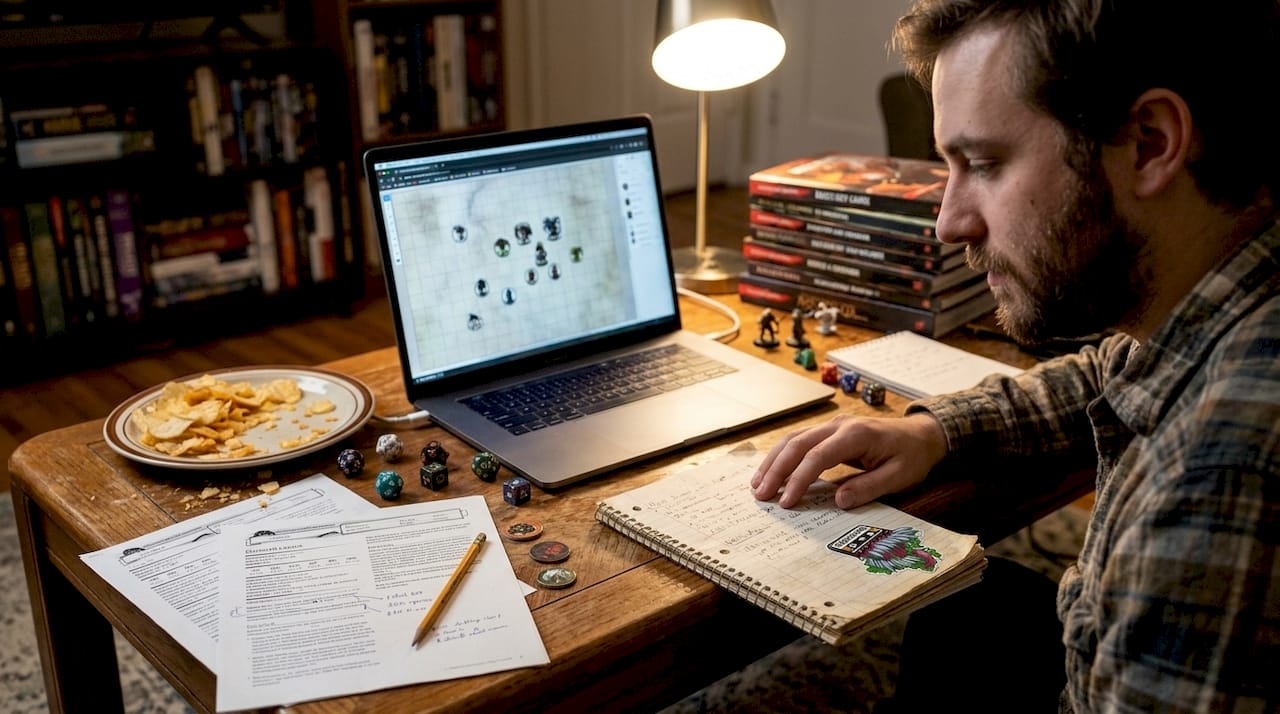
Let’s break it down:
Physical essentials:
- Dice sets (multiple sets, because dice goblins know you can never have too many)
- DM screen with custom inserts for your specific campaign rules
- Battle maps for tactical encounters and world-building moments
- Miniatures or tokens to represent creatures and players
- Campaign journal for tracking lore, NPCs, and story threads
- Condition rings or markers to track status effects in combat
Digital essentials:
- D&D Beyond for rulebooks, character sheets, and encounter building
- Notion or Obsidian for campaign notes and world-building wikis
- Initiative trackers (apps like Improved Initiative or Fight Club 5e)
- Encounter builders to balance combat difficulty on the fly
- Ambient sound apps like Syrinscape or Spotify playlists for atmosphere
| Tool type | Best for | Example |
|---|---|---|
| Physical | Immersion, tactile engagement | Battle maps, dice, tokens |
| Digital | Prep speed, rule lookup | D&D Beyond, Notion |
| Hybrid | Flexibility across settings | Printed maps with digital notes |
The hybrid approach is where the magic happens. Using battle maps alongside digital encounter builders gives you the best of both worlds: visual drama at the table AND fast, accurate rule management behind the screen. Maps also add tactical depth that players genuinely feel during combat.
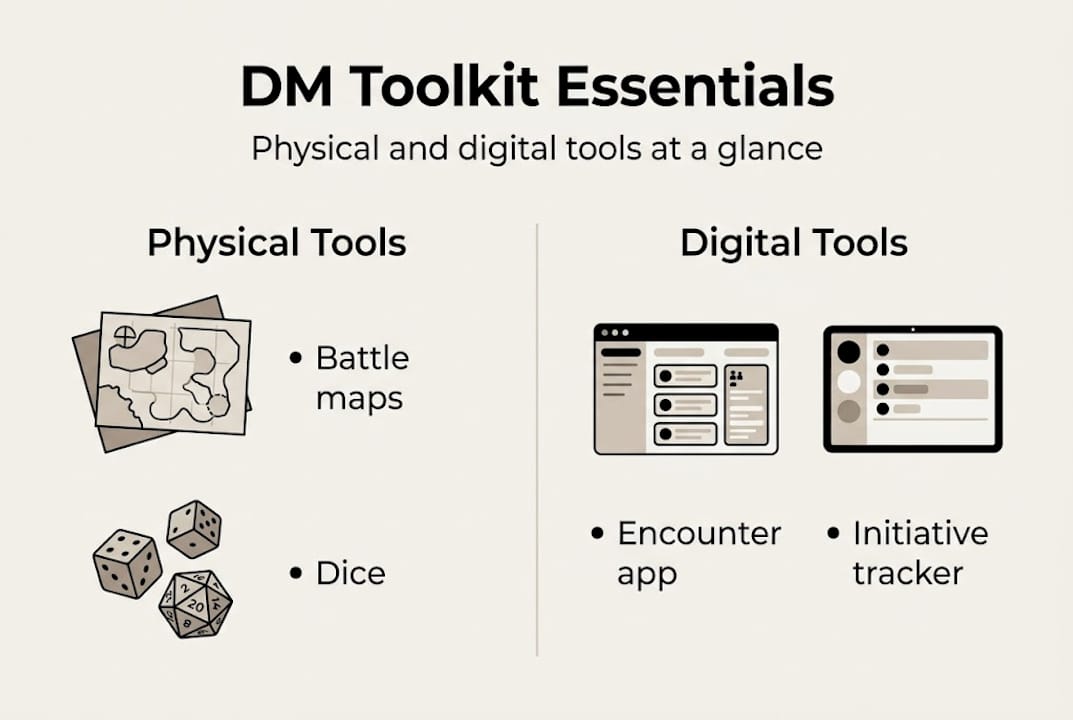
Pro Tip: Don’t try to adopt every tool at once. Add one new physical or digital tool per campaign arc and evaluate whether it actually helps. The goal is a toolkit that feels natural, not one that turns session prep into a second job.
If you’re curious about 2D terrain options, the Dungeon Craft map advantages article breaks down exactly why flat maps often outperform 3D terrain for most tables.
How to customize your Dungeon Master toolkit
Here’s the truth that every experienced DM eventually learns: your toolkit should reflect YOUR style, not someone else’s checklist. The toolkit is personal, built around how you prep, how you narrate, and what your players respond to most.
Start by identifying your core needs:
- What slows you down most during sessions? (Rules lookup? Tracking initiative? Forgetting NPC names?)
- What excites your players most? (Big map reveals? Dramatic dice rolls? Handouts and props?)
- What’s your campaign’s vibe? (Gritty dungeon crawl? Political intrigue? High-fantasy epic?)
Once you know your pain points and your players’ joy points, you can build outward from there. Here’s a simple upgrade path:
- Beginner: Core rulebooks, basic dice, a pre-made DM screen, printed maps
- Intermediate: Custom screen inserts, campaign journal, digital tools, modular battle maps
- Advanced: Handcrafted props, custom tokens, layered terrain maps, full digital campaign wiki
Organization matters more than most DMs admit. A toolkit you can’t find things in is a toolkit that fails you mid-session. Use labeled binders, dice trays, and map folders to keep everything accessible. Some DMs swear by a dedicated game bag that travels with them to every session.
Pro Tip: Ask your players directly what would make sessions more immersive for them. You’ll be shocked how often the answer is something simple, like a printed handout or a visible map. Player input is your best toolkit upgrade tool.
For map-heavy campaigns, Dungeon Craft Volume 1 and Dungeon Craft Volume 2 are incredible resources for building flexible, reusable map setups that grow with your campaign.
Remember: a toolkit is never truly finished. It evolves every time you run a session, try something new, or discover what your table actually needs.
The hidden value of a well-built DM toolkit
Here’s our hot take, and we stand by it: the most valuable thing a DM toolkit gives you isn’t organization or efficiency. It’s confidence.
When you know your tools are ready, you stop second-guessing yourself mid-session. You stop breaking immersion to flip through rulebooks. You stop losing the thread of your story because you can’t find your NPC notes. That mental freedom is what turns a good session into a legendary one.
We’ve seen DMs with expensive, elaborate setups run forgettable sessions. And we’ve seen DMs with a single notebook, a set of dice, and a printed map run sessions that players talked about for months. The difference wasn’t the gear. It was the storytelling confidence that came from knowing their tools cold.
A toolkit is a creative springboard, not a security blanket. The best DMs use their tools to run smooth sessions and then get out of their own way. Build your toolkit around your story, not the other way around. That’s the real secret.
Explore top Dungeon Master toolkits and terrain maps
Ready to level up your setup? We’ve got you covered, dice goblins.
At 1985 Games, we’ve built our product lineup specifically for DMs who want immersive, high-quality tools without the headache of hunting everything down separately. Our Dungeon Craft Vol. 2 and Dungeon Craft Volume 1 map sets are modular, reusable, and designed to drop straight into almost any campaign setting. Pair them with our DM’s Journals for a storytelling and tracking combo that keeps your campaign organized and your creativity firing on all cylinders. Browse the full collection and find your next session upgrade.
Frequently asked questions
What is included in a classic Dungeon Master’s Kit?
The official kit includes a 256-page rulebook, a fold-out DM screen, two double-sided battle maps, two sheets of die-cut monster tokens, and two 32-page pre-made adventures. It’s a solid all-in-one starting point for any DM.
Can I create a Dungeon Master toolkit without buying an official set?
Absolutely. Most DMs build their toolkits from a personal mix of physical and digital tools that match their campaign style. There’s no rule that says you need an official box to run epic sessions.
What digital tools should I have in my DM toolkit?
Prioritize tools for campaign management and tracking like D&D Beyond, initiative tracker apps, encounter builders, and ambient sound platforms. These streamline prep and keep gameplay moving smoothly.
How do I know if my Dungeon Master toolkit is complete?
Your toolkit is complete when it covers your prep, gameplay, and storytelling needs without getting in your way. Since every DM and campaign is different, customization is the real measure of completeness, not a universal checklist.