

TL;DR:
- Game aids include physical and digital tools that enhance gameplay beyond rulebooks.
- Common aids are maps, dice, trackers, reference sheets, and digital platforms for remote play.
- Starting small with targeted tools is more effective than costly, flashy accessories.
Most TTRPG groups think they’ve got it covered once they grab a set of dice and crack open the Player’s Handbook. But here’s the thing: the world of game aids goes SO much deeper than that. We’re talking about a whole universe of tools, trackers, maps, journals, and clever little accessories that can turn a good session into an absolutely legendary one. Whether you’re a fresh-faced adventurer rolling your first character or a veteran DM who’s been running campaigns since the '90s, there’s almost certainly a game aid out there that could make your table feel like pure magic. Let’s break it all down.
Table of Contents
- Defining TTRPG game aids: More than just dice and rulebooks
- Types of TTRPG game aids: Categories and examples
- When and how game aids fit into your sessions
- Choosing the right tools: Physical vs. digital and special cases
- A veteran’s take: What most TTRPG groups miss about game aids
- Upgrade your sessions with premium TTRPG game aids
- Frequently asked questions
Key Takeaways
| Point | Details |
|---|---|
| Game aids defined | TTRPG game aids are tools and accessories that enhance play beyond the core rules. |
| Key categories | Game aids include randomization tools, visual aids, session management, and reference materials. |
| Physical vs digital | Physical aids offer classic immersion, while digital tools are ideal for online or remote sessions. |
| Best fit matters | Choose game aids that suit your group’s style and needs, starting simple then customizing. |
| Impact on play | The right game aids streamline sessions, boost engagement, and make play more memorable. |
Defining TTRPG game aids: More than just dice and rulebooks
So what exactly IS a game aid? Great question, dear reader. TTRPG game aids are physical and digital tools, accessories, and resources that support gameplay beyond core rulebooks. That’s a wide net, and intentionally so. Game aids cover everything from the humble d20 rattling around in your dice bag to elaborate digital platforms that render 3D dungeon maps in real time.
The main game aid categories break down into four big buckets:
- Randomization tools: Dice, card decks, random tables, and apps that generate outcomes
- Visual and spatial aids: Battle maps, terrain pieces, miniatures, and tokens
- Session management tools: DM screens, initiative trackers, condition markers, and combat organizers
- Reference materials: Cheat sheets, campaign journals, spell cards, and quick-reference guides
Physical aids have that irreplaceable tactile magic. There’s something about picking up a chunky resin die and rolling it across the table that no app can fully replicate. It’s the reason dice goblins exist (you know who you are). Digital tools, on the other hand, shine brightest for remote groups and online play, where sharing maps and tracking stats needs to happen fast and cleanly.
Here’s a quick overview of the main categories and what falls under each:
| Category | Examples | Best for |
|---|---|---|
| Randomization tools | Polyhedral dice, oracle cards, random apps | All play styles |
| Visual and spatial aids | Battle maps, terrain, minis, tokens | In-person and VTT |
| Session management | DM screens, trackers, condition rings | GMs and complex combat |
| Reference materials | Spell cards, journals, cheat sheets | All players, especially beginners |
The real revelation here? Game aids aren’t just for complex, rules-heavy systems. Even a super narrative, story-first game benefits from a good journal or a mood-setting map. Check out the top TTRPG accessories for a broader look at what’s out there, and if you want to start simple, the essential accessories for gameplay guide is a great launchpad.
“The best game aid is the one that disappears into your session. You stop noticing the tool and start noticing the story.”
Game aids support creativity. They don’t replace it. Keep that in mind as we dig deeper.
Types of TTRPG game aids: Categories and examples
Alright, dice goblins, let’s get into the good stuff. Now that we’ve defined the categories, here’s how each one actually works at the table.
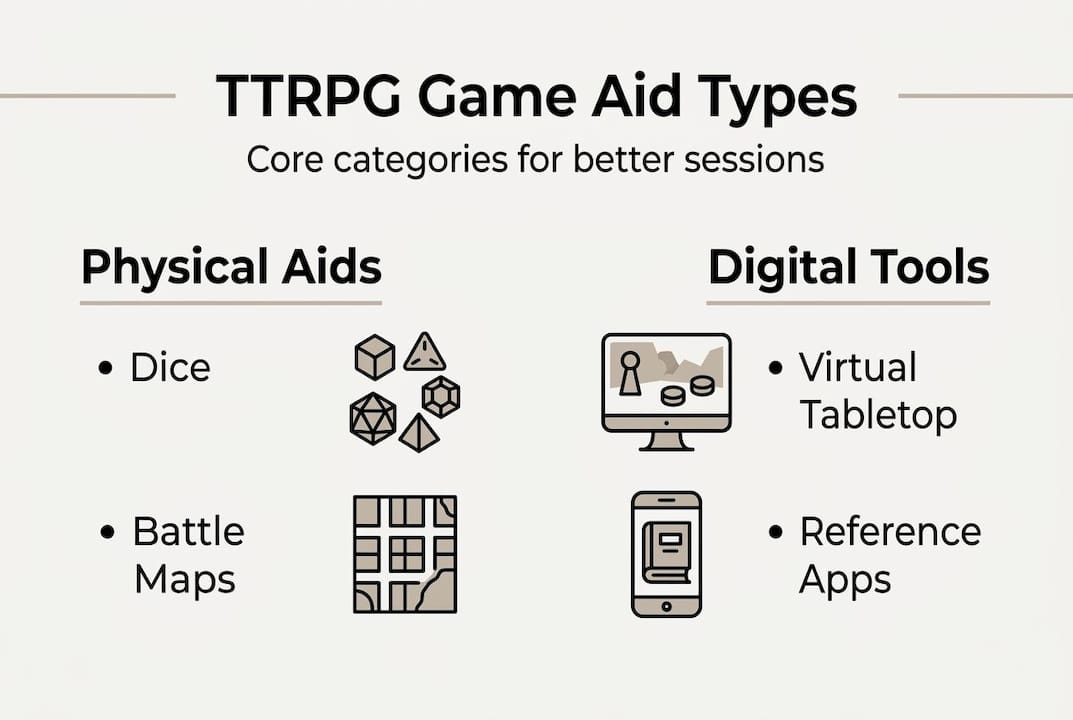
1. Randomization tools This is where most players start. Polyhedral dice sets range from $8 to $15 for basic sets, all the way past $100 for premium sharp-edge or handcrafted resin sets. Beyond dice, you’ve got oracle card decks for solo play, random encounter apps, and even AI-powered generators. If you’re curious about why randomness matters so much, the deep dive on random dice sets explains the psychology behind it beautifully.
2. Visual and spatial aids Battle maps are the MVP here. A good map transforms “you’re in a tavern” into a fully realized space where players can visualize movement, cover, and danger. Terrain pieces add another layer of immersion on top of that. For in-person groups, physical terrain is unbeatable. For virtual tabletop (VTT) groups, digital maps do the heavy lifting. Our TTRPG terrain guide breaks down exactly how terrain works, and if you want to get the most out of flat maps, the guide on using battle maps is packed with practical tips.
3. Session management tools DM screens, initiative trackers, condition tokens. These are the unsung heroes of smooth gameplay. Nothing kills momentum like a DM frantically flipping through a rulebook mid-combat. A good screen keeps your notes hidden and your rules handy. Condition rings or tokens let everyone at the table instantly see who’s poisoned, frightened, or unconscious without a single word.
4. Reference materials Spell cards, cheat sheets, campaign journals. These are especially clutch for newer players who are still learning the rules. A well-organized journal also helps DMs track plot threads, NPC names, and world-building details across long campaigns.
Here’s a quick breakdown by player type:
| Player type | Most useful aids |
|---|---|
| Beginner player | Dice set, character sheet, rules cheat sheet |
| Experienced player | Spell cards, condition tokens, campaign journal |
| New DM | DM screen, initiative tracker, battle map |
| Veteran DM | Terrain, custom tokens, digital map tools |
Pro Tip: Start with one aid from each category before going all-in on a full setup. A single great battle map plus a basic tracker can transform your sessions more than a pile of unused accessories ever will.
When and how game aids fit into your sessions
Here’s something that surprises a lot of groups: game aids aren’t just for DURING the session. They integrate at three layers: pre-session preparation, active session management, and post-session record-keeping. Each phase has its own toolkit.
Before the session (prep phase) This is where DMs do their heavy lifting. Expert prep methods like Lazy DM and Index Card RPG simplify and organize prep so you’re not spending six hours building an encounter that lasts twelve minutes. Index cards, printed maps, and pre-written NPC notes all fall into this phase. Even a simple checklist of session goals counts as a game aid.
During the session (active play) This is where visual aids, trackers, and dice shine brightest. Here’s a quick list of what helps most during active play:
- Initiative trackers to keep combat moving without confusion
- Condition tokens so everyone can see status effects at a glance
- Battle maps for tactical clarity and spatial storytelling
- Reference cards for quick rules lookups without breaking flow
- Dice towers or trays for satisfying, fair rolls
For a full rundown of what to bring to every game night, the RPG session essentials guide covers it all in one place.
After the session (record-keeping) This phase gets overlooked constantly. A campaign journal or digital doc where players and DMs log what happened keeps continuity sharp across long campaigns. Nothing’s more immersive than a DM who remembers that you once accidentally burned down a village in session three.
Pro Tip: Keep a small “session zero” kit: a printed map of your starting area, a one-page world overview, and a set of pre-rolled NPC names. It takes thirty minutes to prep and saves hours of on-the-fly improvisation.
Choosing the right tools: Physical vs. digital and special cases
Okay, so you’re sold on game aids. But which ones? The physical vs. digital tradeoff is real: physical offers tactile engagement while digital enables remote play and advanced tracking. Neither is universally better. It depends entirely on your group.
Here’s a side-by-side comparison to help you think it through:
| Factor | Physical aids | Digital aids |
|---|---|---|
| Immersion | High tactile feel | Visual and interactive |
| Portability | Bulky, can be heavy | Stored on a device |
| Cost | One-time purchase | Often subscription or app cost |
| Online play | Awkward to share | Seamless for VTT groups |
| Accessibility | Always available | Requires device and power |
For groups playing in person, physical tools almost always win on vibe. The sound of dice rolling, the feel of flipping through a journal, the visual pop of terrain on a map. It’s a whole sensory cocktail.
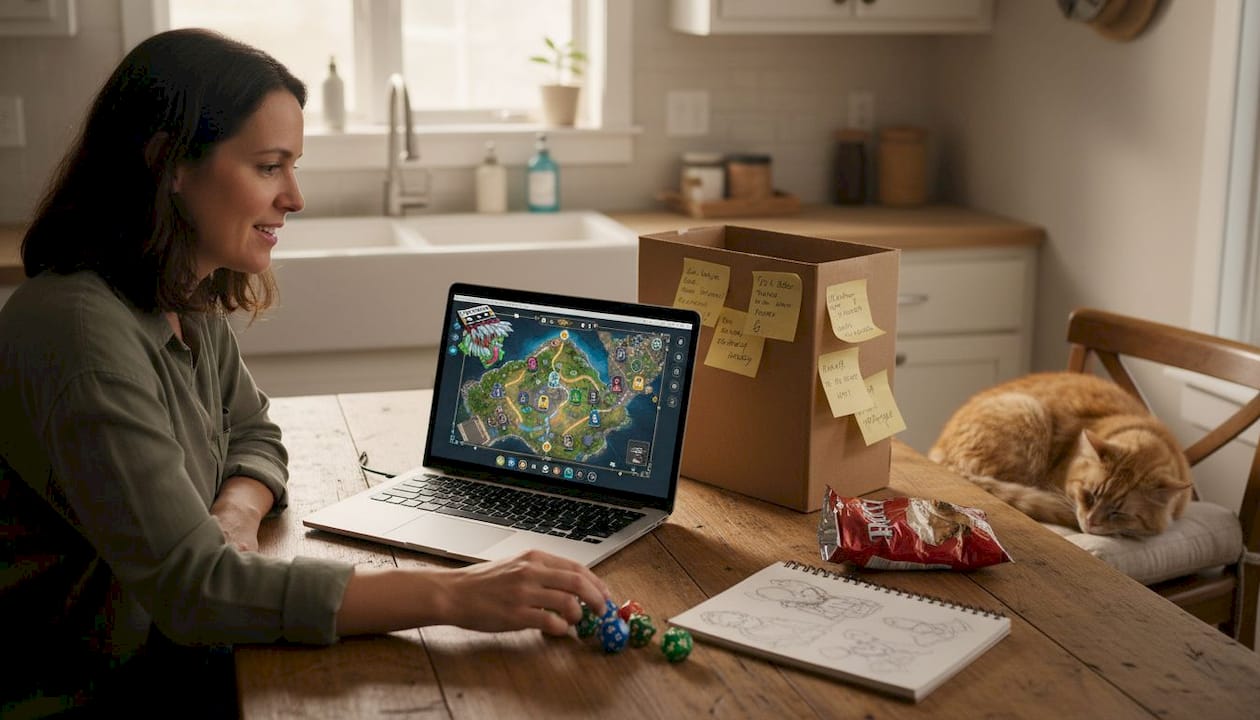
For online groups, digital tools are basically non-negotiable. Platforms like Roll20 or Foundry handle maps, tokens, and dice rolls in one place. Some groups even blend both: rolling physical dice on camera while using a digital map.
Special cases worth knowing:
- Solo play: Solo players benefit most from oracle decks and randomized prompt tools that simulate a GM’s unpredictability. The tools for solo play space has exploded recently and it’s genuinely exciting.
- Heavy combat groups: Condition rings, initiative magnets, and HP trackers are essential. Combat without them turns into a chaos spiral fast.
- Accessibility needs: Digital tools often have accessibility advantages, like adjustable text size and screen reader compatibility, that physical tools simply can’t match.
Pro Tip: Ask your group what slows sessions down the most. That friction point is exactly where a targeted game aid will have the biggest impact. Don’t buy what looks cool; buy what solves a real problem at YOUR table.
The best immersive TTRPG aids are the ones that fit your group’s actual play style, not the ones that look most impressive on a shelf.
A veteran’s take: What most TTRPG groups miss about game aids
Honest talk? We see it all the time. A DM drops serious coin on a premium terrain set, gorgeous resin dice, and a deluxe DM screen. Then they show up to a session where half the players are still confused about action economy and nobody can find the initiative order. The flashy stuff got prioritized over the functional stuff.
The most overlooked game aids are the simple, player-centric ones. A printed condition reference card. A shared campaign journal that everyone can write in. A single laminated battle map that works for every encounter. These aren’t glamorous. But they show up EVERY session.
Here’s our honest take: imagination should always drive every purchase. Game aids should support the story, not replace the storytelling. The moment your terrain becomes more interesting than the plot, something’s gone sideways.
Start small. One or two targeted aids that solve a real friction point. Then iterate based on what your group actually loves. The accessories that boost gameplay aren’t always the most expensive ones. Sometimes it’s a $3 set of condition tokens that saves your entire combat round. Balance tradition with innovation, and always choose consistent value over novelty.
Upgrade your sessions with premium TTRPG game aids
Ready to take your table from “pretty good” to “absolutely legendary”? We’ve got you covered. Whether you’re building your first kit or leveling up an existing setup, quality game aids make a real difference in how your sessions feel, flow, and land.

Our curated dice sets are a perfect starting point, with options for every style and budget. If you love a little mystery (and honestly, who doesn’t?), the mystery dice packs are basically a Nat 20 in a box. And if you want the full experience in one shot, the 1985 Games Megapack bundles everything you need to run immersive, unforgettable sessions. Your next campaign deserves the best tools at the table.
Frequently asked questions
What are the most essential game aids for new TTRPG players?
For beginners, the most essential game aids range from simple dice to rule references. Start with polyhedral dice, printed character sheets, and a quick-reference rules guide.
Are digital tools or physical aids better for online TTRPG play?
Digital enables remote play and advanced tracking, making it the go-to for online groups. That said, some players still love rolling physical dice on camera for that satisfying tactile hit.
How do GM screens and trackers help gameplay?
Session management aids like screens and trackers streamline combat and information access. GM screens keep your notes hidden from players while keeping key rules right at your fingertips.
What special aids are recommended for solo TTRPG play?
Solo players benefit most from oracle decks and story prompt cards that simulate a GM’s unpredictability. Digital tools that automate random events are also a huge help for keeping things surprising.
Are expensive, premium game aids necessary for a good table experience?
Not at all. Polyhedral dice sets start at $8 to $15 for solid basic options, and even simple, affordable aids can dramatically improve your sessions. Premium bundles are a fun upgrade, not a requirement.