

TL;DR:
- Creating immersive battle maps depends on choosing the right approach, whether physical or digital, to enhance player engagement. Simple, well-designed maps with clear choices and purposeful features foster memorable encounters, while dynamic elements elevate storytelling. Combining tactile terrain with digital tools offers the best experience, tailoring the setup to your group’s preferences.
You’ve spent three hours prepping the perfect dungeon crawl. The lore is tight. The villain is menacing. And then you lay out a flat, grid-printed map with a few drawn-on walls and watch your players’ eyes glaze over faster than a failed Perception check. We’ve all been there, fellow dungeon masters. The good news? Creating a truly immersive battle map doesn’t require a Hollywood budget or a degree in architecture. It just requires the right approach, a few clever tricks, and a solid dose of creative energy.
Table of Contents
- Essential tools and materials for immersive mapping
- Step-by-step: Designing your immersive battle map
- Dynamic elements: Bringing encounters to life
- Physical enhancements vs. digital innovation
- The uncomfortable truth about immersive maps: Simplicity wins
- Enhance your maps with ready-made terrain and tools
- Frequently asked questions
Key Takeaways
| Point | Details |
|---|---|
| Flexible layouts | Non-linear map designs empower player choices and engagement. |
| Dynamic elements | Traps, puzzles, and reactive terrain add excitement and challenge to encounters. |
| Physical and digital tools | Both approaches offer unique benefits, and combining them boosts immersion. |
| Simplicity is key | Clear, uncluttered maps with thoughtful dynamics create the best experience. |
Essential tools and materials for immersive mapping
Having set the stage, let’s look at what you’ll need to bring your vision to life. Before you start placing rooms and corridors, it helps to know your options. There are two main paths: physical mapping and digital mapping. Each has serious strengths, and each has its quirks.
Physical mapping is the tactile, old-school approach. We’re talking modular terrain kits, hand-painted tiles, foam-crafted walls, and miniatures that your players can actually reach out and touch. There’s something almost magical about watching a dungeon take shape on the table, piece by piece. Physical enhancements like modular terrain, projection mapping, and LED lights are some of the most effective tools for immersion. Dwarven Forge sets are the gold standard here. Pricey, sure, but they hit different. LED strips tucked under tiles can cast an eerie glow that transforms a kitchen table into the Underdark.
Digital mapping leans into software and screens. Tools like Dungeondraft, Inkarnate, and Foundry VTT let you design detailed maps fast, apply fog-of-war effects, and update layouts mid-session without hauling a box of terrain. If your group plays online, digital is basically essential.
Here’s a quick comparison to help you choose:
| Feature | Physical mapping | Digital mapping |
|---|---|---|
| Immersion feel | High tactile, visceral | High visual, dynamic |
| Setup time | Longer, more hands-on | Faster with templates |
| Cost | Higher upfront | Often subscription-based |
| Flexibility | Limited to what you own | Easily updated |
| Best for | In-person sessions | Online or hybrid play |
Essential materials checklist:
- Grid mat or vinyl battle mat (wet-erase works great)
- Modular terrain tiles (foam, resin, or cardboard)
- LED strips or battery-operated tea lights
- Dry-erase markers in multiple colors
- Miniatures or token pawns for all encounter participants
- Dungeondraft, Inkarnate, or Roll20 for digital design
- A projector or tablet for displaying digital maps at the table
If you want to explore the craft side of things, check out our deep dive into terrain design for immersion and browse some wild battle map inspiration to get those creative juices flowing.
Step-by-step: Designing your immersive battle map
Once you’ve gathered your supplies, it’s time to shape the experience. This is where the real fun begins, and where a lot of dungeon masters accidentally go on autopilot.
Step 1: Choose your stage. Is this a mossy dungeon beneath a cursed temple? A crumbling city rooftop during a thunderstorm? A ship deck mid-ocean, rocking with waves? Your environment sets the emotional tone before a single die hits the table. Commit to it fully. Every design decision after this flows from the stage you pick.
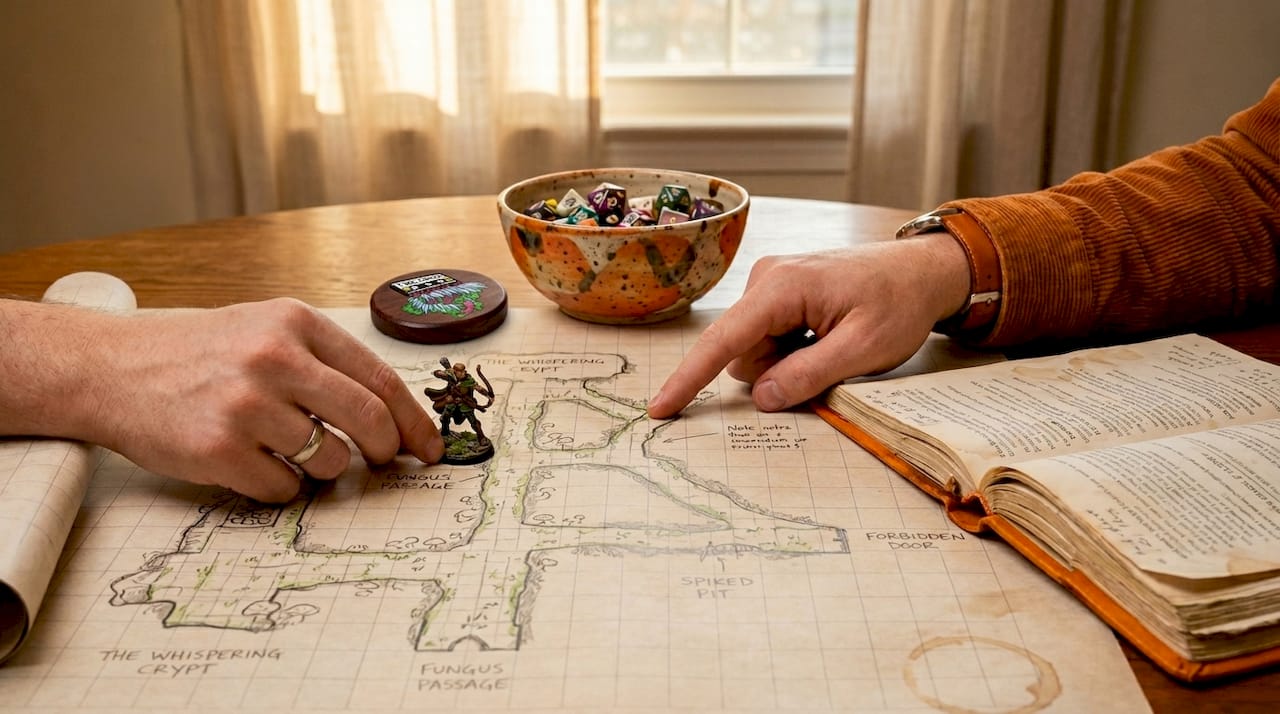
Step 2: Apply Jaquaysing. This is a term from legendary game designer Jennell Jaquays, and it refers to the practice of designing maps with non-linear layouts that give players multiple routes and genuine choices. Linear dungeons where players walk down a hallway and open doors in sequence? They feel like a corridor shoot-em-up. Non-linear maps where players can go left, loop back, find a hidden passage, or trigger a collapse? Those feel like living worlds. Use intersections, loops, secret doors, and overlapping levels to create that web-like complexity.
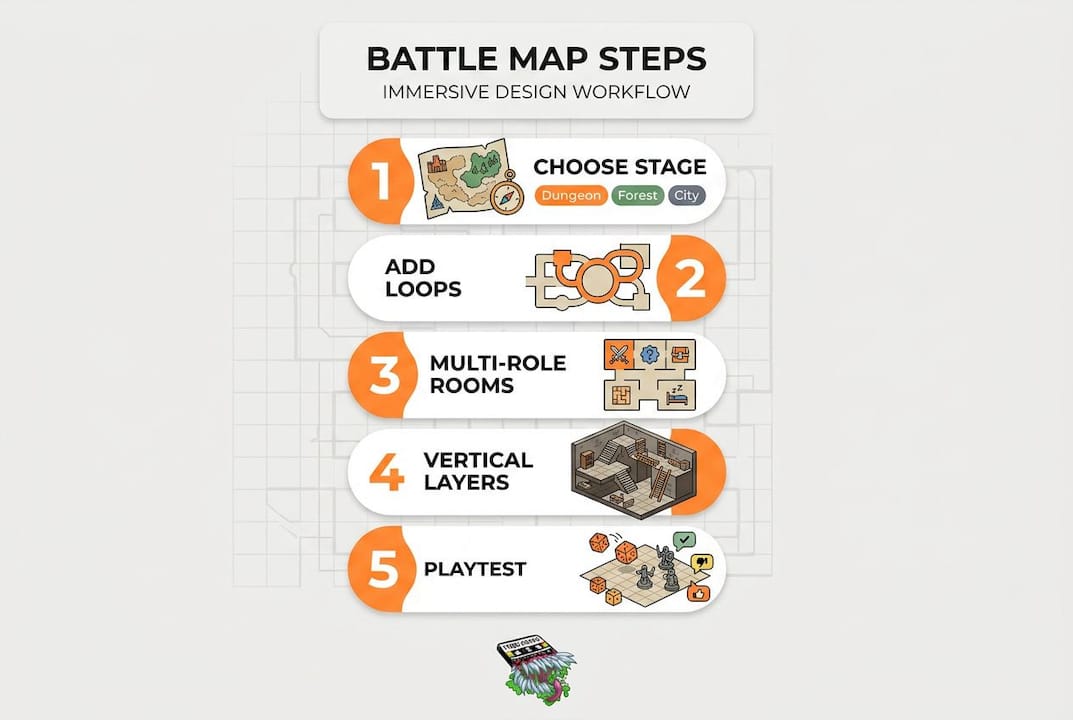
Step 3: Design multi-function rooms. Every room should have at least two purposes. A library isn’t just a library. It’s also a puzzle room (the right books unlock a door), a combat arena (bookshelves become cover and falling hazards), and an exploration space (hidden maps tucked into forgotten tomes). This philosophy, blending tactical play in TTRPGs with narrative depth, is what separates forgettable encounters from legendary ones.
Step 4: Add verticality. Most maps stay stubbornly flat. Don’t. Cliffs, raised platforms, balconies, pit traps, and crumbling stairs all force players to think three-dimensionally. A goblin ambush from above changes everything.
Step 5: Playtest your layout mentally. Before you finalize, walk through the map as a player. Where would you go first? Where would an ambush happen naturally? Are there dead ends that feel cheap rather than tense? If you get bored walking through it mentally, your players will get bored too.
Pro Tip: Always ask yourself, “What choices can players make here?” If the honest answer is “none,” redesign that section. Player agency is the secret ingredient of every memorable battle map. For a full walkthrough of this process, our guide to building immersive maps breaks it down step by step.
Dynamic elements: Bringing encounters to life
With your map structure set, elevate encounters by integrating dynamic challenges. A gorgeous map with nothing moving in it is basically a very expensive painting. Dynamic elements transform your map from a backdrop into an active participant in the story.
What counts as a dynamic element? Think of anything that changes, reacts, or threatens players outside of enemy attacks. Environmental hazards, traps, puzzles, and timed events are the core building blocks. A crumbling bridge that loses a section every round. A rising water level that forces players to move fast. A puzzle altar that must be solved while a boss fight rages. Reactive enemies who retreat to higher ground and knock over a burning brazier as they flee.
Here’s how static and dynamic maps compare in actual play:
| Encounter type | Player experience | Session feel |
|---|---|---|
| Static map, fixed enemies | Predictable, turn-by-turn combat | Board game feel |
| Dynamic map, reactive environment | Improvisation required | Cinematic, story-driven |
| Dynamic + non-linear layout | High agency, emergent chaos | Legendary session |
“The best encounters don’t just challenge players’ characters. They challenge the players themselves, forcing creative decisions, risk assessment, and real tension.”
Quick list of dynamic elements to drop into any map:
- Swinging pendulum blades or rotating wall traps
- Pressure plates that trigger collapsing sections
- Environmental hazards like lava pools, frozen lakes, or toxic gas vents
- Enemies who use the terrain (climb walls, flip tables, open secret doors)
- Timed events like a fortress alarm, flooding chamber, or collapsing ceiling
- Interactive objects like pullable levers, breakable walls, or magical crystals
The trick is not to overload. Two or three well-placed dynamic elements hit harder than ten chaotic ones that just confuse everybody at the table. For more ideas on adding tactical depth to battle maps and how they boost RPG sessions in general, we’ve got you covered.
Physical enhancements vs. digital innovation
To maximize immersion, weigh the pros and cons of each approach. This isn’t really an either-or debate. It’s more of a “know your table” conversation.
Physical terrain wins on feel. When a player reaches across the table and physically moves their miniature around a sculpted stone wall, the game becomes tangible. Physical terrain creates tactile immersion that no screen can fully replicate. LED lighting, fog machines (yes, some DMs use actual fog machines), textured tiles, and hand-painted props all feed into that sensory experience that makes your players feel like they’re really there.
Digital tools win on flexibility. Fog-of-war in Foundry VTT means players only see what their characters can see, adding genuine mystery and tension. You can update a digital map mid-session in seconds, adding a new room after players break through a wall or revealing a hidden chamber. No hauling terrain. No rebuilding a setup between encounters.
Choosing your approach:
- Use physical terrain if your group meets in person and loves tactile immersion
- Use digital tools if you play online or need quick, flexible updates
- Use a projector on a flat table surface if you want digital maps with in-person play
- Use modular terrain plus a tablet overlay for the ultimate hybrid setup
Pro Tip: Combining physical and digital approaches gives you the best of both worlds. Use physical terrain pieces for key set dressing (a stone throne, a summoning circle, a collapsed pillar) and project a digital base map underneath. Players get the tactile magic AND the dynamic flexibility. For more ideas on enhancing D&D gameplay with the right tools, our blog has a deep archive of tips and tricks.
The bottom line? The best approach is the one your players respond to. Pay attention. If they lean forward when physical terrain hits the table, invest in more of it. If their eyes light up when fog-of-war lifts and a new area is revealed, go deeper into digital. Your players are always the best barometer.
The uncomfortable truth about immersive maps: Simplicity wins
Here’s the opinion that might ruffle some feathers in the dungeon master community: most of us overdesign our maps. Seriously. We pile on secret rooms, multiple trap types, color-coded terrain, elaborate elevation systems, reactive enemy AI, AND a puzzle mechanic, and then wonder why the session felt chaotic and exhausting.
We’ve seen this pattern play out again and again. The dungeon masters who run the most memorable encounters? They often use the simplest maps. A single large room with three exits, one environmental hazard, and two enemy types who behave differently. That’s it. But every element is intentional. Every choice has weight. Players feel agency because the space is readable and they can actually see their options.
The true role of battle mats is not to impress players with visual complexity. It’s to give them a shared spatial language so they can make meaningful decisions together. When a map is cluttered and confusing, players freeze. They ask clarifying questions every turn. The fiction collapses under the weight of the logistics.
Simplicity also leaves room for imagination. A lightly sketched dungeon with evocative room names and one vivid detail per space lets players’ minds fill in the rest. And honestly? The story their imaginations create is usually better than anything we could sculpt from foam. The best maps we’ve ever played on weren’t the most detailed. They were the most clear. Clear enough to spark imagination. Focused enough to enable real choices. Dynamic enough to feel alive. That’s the sweet spot, dear dungeon masters. Chase that, not complexity for its own sake.
Enhance your maps with ready-made terrain and tools
If all of this sounds like a lot of design work on top of your already-packed session prep, we hear you. Here’s the thing: you don’t have to build everything from scratch.
Ready-made terrain kits and thematic battle map packs let you skip the hours of layout work and jump straight into the storytelling. Our Dungeon Craft Vol. 2 pack delivers richly detailed dungeon layouts that are designed with player agency and dynamic play in mind. If your campaign has a darker, cursed-world vibe, the Dungeon Craft Cursed Lands pack brings eerie, atmospheric environments to your table in minutes. Both packs are crafted to plug directly into your campaigns, so you can focus on what really matters: the story, the characters, and those glorious, unforgettable dice rolls.
Frequently asked questions
How do I balance visual complexity and playability when designing a battle map?
Aim for clear, readable layouts with just two or three dynamic elements per encounter; too much visual noise slows play and overwhelms players. Clarity always beats spectacle.
What is Jaquaysing and how can I use it in my maps?
Jaquaysing is the design technique of building non-linear dungeon layouts with multiple paths, loops, and choices that put genuine agency in the players’ hands. Use intersections, secret passages, and looping corridors to avoid the dreaded hallway dungeon feel.
Are digital tools or physical terrain better for immersive battle maps?
Digital tools offer easy updates and fog-of-war flexibility, while physical terrain adds the tactile immersion that screens can’t replicate; combining both often delivers the most satisfying result for in-person groups.
How can I make encounters more interactive for my players?
Layer in environmental hazards, traps, puzzles, and timed events to shift encounters from turn-by-turn combat into dynamic, story-driven moments where every player decision feels like it matters.