

Finding the right materials for your first Dungeons & Dragons session can feel overwhelming, especially with so many options to consider. Starting with a set of polyhedral dice, character sheets, and the Player’s Handbook lays the foundation for a memorable adventure. Quality accessories like miniatures, dice trays, and digital tools not only organize your table but help everyone stay immersed in the story, making each session feel special and hassle-free.
Table of Contents
- Step 1: Gather Essential DnD Materials And Accessories
- Step 2: Create Your First Character And Party
- Step 3: Set Up Your Adventure Space Effectively
- Step 4: Run Your First DnD Session Smoothly
- Step 5: Enhance Your Experience With Game Accessories
Quick Summary
| Key Point | Explanation |
|---|---|
| 1. Essential DnD materials needed | Start with polyhedral dice, a character sheet, and the Player’s Handbook for a solid foundation. |
| 2. Character and party creation | Choose diverse character races and classes to enhance gameplay and interactions within the party. |
| 3. Optimize your adventure space | Set up a comfortable table with good lighting and organized materials to create an immersive experience. |
| 4. Run your first session smoothly | Prepare your opening scene and manage turns clearly while balancing roleplay and combat moments. |
| 5. Enhance gameplay with quality accessories | Invest in curated dice, battle maps, and player journals to deepen immersion and solve practical issues during gameplay. |
Step 1: Gather essential DnD materials and accessories
You don’t need a small fortune to start playing Dungeons & Dragons, but having the right materials makes a real difference. Let’s walk through exactly what you need to collect before your first session so you’re prepared and confident.
Start with the foundational items that every player needs. You’ll want at least one set of polyhedral dice (the iconic seven-piece set with d4, d6, d8, d10, d12, and d20). A blank character sheet gives you space to write down your character’s abilities, skills, and backstory. The Player’s Handbook is your rulebook—it answers questions about how your character moves, attacks, and interacts with the world.
DMs have their own checklist that differs slightly from players. You’ll need the Dungeon Master’s Guide and Monster Manual to run encounters, create storylines, and manage non-player characters. A battle map or grid helps everyone visualize combat encounters clearly. A DM screen lets you roll dice privately and reference tables without players seeing everything.
Beyond the core books, consider these practical additions:
- Miniatures to represent characters and enemies on the battle map
- Dice bags or trays so dice don’t scatter across the table (and disappear under furniture)
- Adventure modules if you want pre-written campaigns instead of creating your own
- Digital tools like D&D Beyond for character creation and spell lookups
Quality accessories don’t just look good—they actually speed up gameplay and help everyone stay immersed in the story.
Understanding essential D&D accessories and their roles helps you prioritize what matters most for your table’s playstyle. Some groups focus on combat and love detailed miniatures. Others emphasize storytelling and barely use maps.
Don’t feel pressure to buy everything at once. Start with dice, a character sheet, and the Player’s Handbook. Add more as you play and discover what your group actually needs. The game works fine with basics—the extras just enhance the experience.
Here’s a quick comparison of common DnD accessories and how they enhance gameplay:
| Accessory Type | Primary Benefit | When to Upgrade |
|---|---|---|
| Polyhedral Dice | Resolves actions and outcomes | When you want variety |
| Character Sheet | Tracks stats and story | For better durability |
| Miniatures | Visualize combat positions | When playing with maps |
| Battle Map/Grid | Clarifies tactical movement | For complex encounters |
| DM Screen | Hides notes, quick references | With detailed tracking |
| Dice Bag/Tray | Organizes dice, prevents loss | With larger collections |
| Adventure Modules | Ready-to-play stories | When short on prep time |
| Digital Tools | Speeds up rules lookup | For online sessions |
Pro tip: Purchase mystery dice sets that contain multiple colors and styles; they’re more affordable than buying individual premium sets and give your table visual variety without breaking the budget.
Step 2: Create your first character and party
Building your character is where the magic truly starts. This is your chance to dream up someone memorable and decide how they fit into a larger adventure with other players. Let’s break down how to make this happen smoothly.
Start by choosing your character’s race and class. Your race affects your appearance, cultural background, and minor ability bonuses. Your class determines what you do in combat and beyond, like casting spells as a wizard or swinging weapons as a fighter. These two choices create the foundation for everything else.
Next, assign your ability scores across six core attributes: Strength, Dexterity, Constitution, Intelligence, Wisdom, and Charisma. Your class and race suggestions guide where to place higher scores. A wizard benefits from high Intelligence, while a barbarian thrives with high Strength and Constitution.
Then pick a background that tells your character’s story before the adventure began. Were you a merchant, a soldier, a scholar? Your background adds flavor to roleplay and often provides practical skills.
Finally, choose your alignment, which represents your character’s moral and ethical outlook. Lawful, Neutral, or Chaotic paired with Good, Neutral, or Evil creates nine possible combinations that shape how your character makes decisions.
Building your party means assembling different classes that balance each other. Consider these essential roles:
- Tank like a fighter or paladin who absorbs damage
- Damage dealer like a rogue or ranger who targets enemies
- Healer like a cleric who keeps everyone alive
- Magic user like a wizard or sorcerer who casts powerful spells
A balanced party lets everyone shine during different moments, keeping combat engaging and storylines dynamic.
You don’t need exactly one of each role, but having variety makes character interactions richer and helps the group handle unexpected challenges. Five players with five different classes plays very differently than five monks.
Talk with other players before creating characters so you’re not all making the same class. Coordination takes just minutes but prevents everyone from being disappointed later.
Here’s a summary of DnD character roles and their main party contributions:
| Role | Example Classes | Main Contribution |
|---|---|---|
| Tank | Fighter, Paladin | Absorbs incoming damage |
| Damage Dealer | Rogue, Ranger | Deals high enemy damage |
| Healer | Cleric | Restores health and buffs |
| Magic User | Wizard, Sorcerer | Casts powerful spells |
Pro tip: Write a one-paragraph backstory for your character and share it with your DM before the first session; it helps them weave your personal motivations into the campaign’s opening scenes.
Step 3: Set up your adventure space effectively
Your play space sets the tone for the entire session. A well-organized table keeps the game moving smoothly and helps everyone stay immersed in the story. Let’s build a space where magic happens.
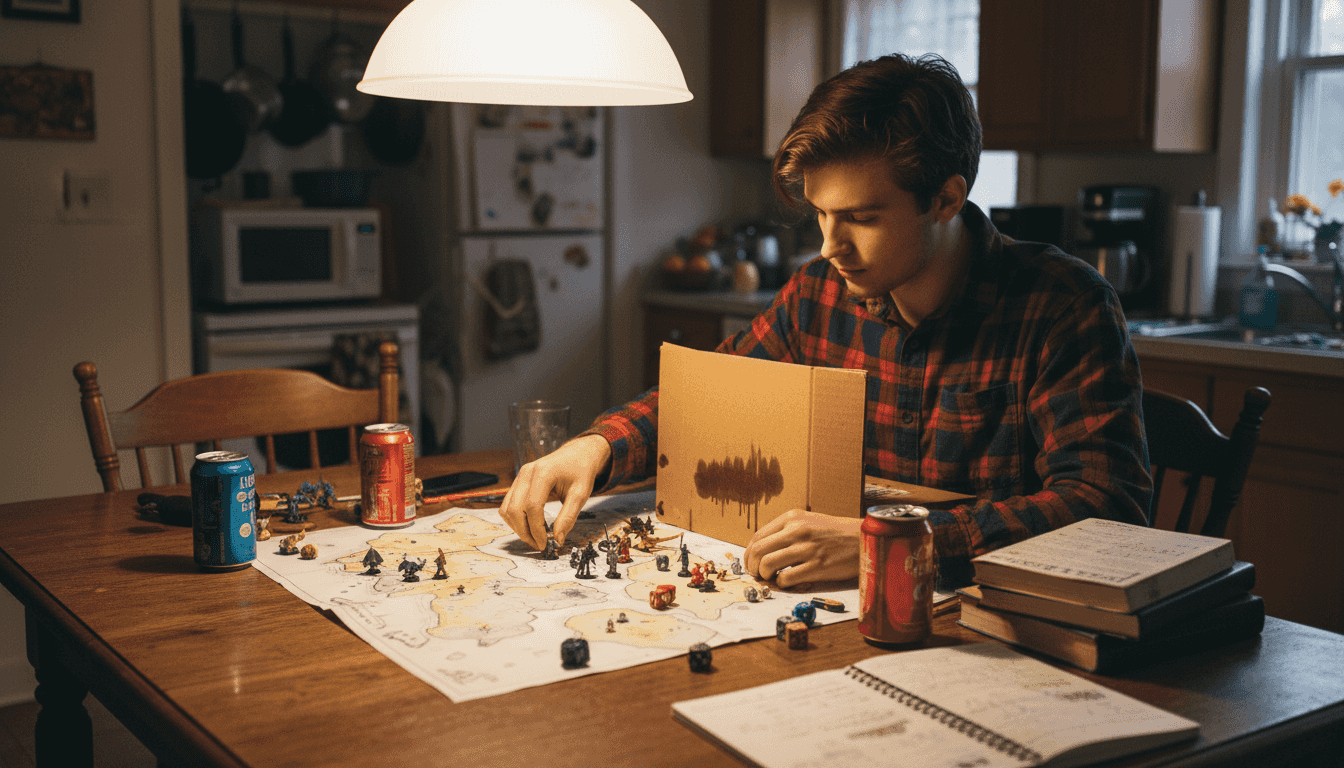
Start by choosing your table location. You need enough room for character sheets, dice, miniatures, and maps without feeling cramped. A dining table works perfectly, but a dedicated gaming table elevates the experience even more. Make sure everyone can reach the center and see the map clearly.
Arrange your seating so the DM sits at one end and players form a semicircle. This setup lets the DM see all the action while players focus on their characters and the battlefield. Avoid having players sit with their backs to each other.
Set up your lighting next. Bright overhead lights can feel clinical, so consider adding a dimmable lamp or string lights for atmosphere. Good lighting prevents eye strain while creating a cozy feel that invites storytelling.
Organize your materials within easy reach. Keep dice in a central bowl or tray so players can grab them quickly. Place the battle map or grid in the center where everyone sees it equally. Store books nearby but not in the way.
Consider these environmental touches to enhance immersion:
- Background music playing softly in the background sets tone and mood
- Snacks and drinks keep energy up during longer sessions
- Minimal distractions like phones face-down away from the table
- Comfortable seating prevents fatigue over several hours
The best adventure spaces balance practical organization with atmospheric details that make players feel transported to another world.
Thinking about how to set up your tabletop game space helps you create an environment where everyone wants to return session after session. Small details matter more than you’d expect.
Test your setup before your first session. Sit at the table, roll some dice, and notice what feels awkward or out of reach. Make adjustments now so game night flows smoothly.
Pro tip: Use a small desk lamp behind the DM screen rather than relying on ceiling lights; it illuminates your notes and dice rolls while keeping the table dramatically lit for players.
Step 4: Run your first DnD session smoothly
Your first session sets the tone for everything that follows. Good preparation and flexible facilitation keep the game flowing while everyone stays engaged and having fun. Here’s how to guide your group through an unforgettable experience.
Start by preparing your opening scene. Write a short description of where the adventure begins—a tavern, a forest road, a castle courtyard. Keep it brief and vivid. This opening hooks players into the story before anything mechanical happens.
Manage combat encounters with clear structure. Track initiative to determine turn order, then guide each player through their turn. Keep the action moving by asking what they do instead of waiting for them to suggest ideas. Use dice rolls to determine outcomes consistently so players trust the rules.
Balance roleplay and combat by alternating between them. Not every session needs intense fighting. Some sessions flourish with character conversations, exploration, and decision-making. Mix it up to keep everyone invested.
Stay organized with these practical tools:
- Initiative tracker to manage turn order clearly
- Reference sheets for common rules you forget quickly
- Battle grid to visualize combat positioning
- NPC voices that differ slightly so players remember who they’re talking to
- A watch or timer to manage pacing and session length
The best DMs are flexible guides, not rigid rule enforcers—bend rules to keep the story moving and players smiling.
Communicate clearly with your players. Describe what they see, hear, and feel. Ask them questions about their intentions. Let them know when you’re applying a rule and why. This transparency builds trust and shared understanding.
Prepare for moments when players surprise you. They always will. Instead of shutting down creative ideas, ask yourself how to make their crazy plans work. This collaborative approach makes sessions memorable.
Pro tip: Keep a notebook open throughout the session to jot down player decisions, NPC names they create, and plot hooks they express interest in; these notes become invaluable for your next session.
Step 5: Enhance your experience with game accessories
Once you’ve mastered the basics, quality accessories transform your sessions from functional to phenomenal. These upgrades aren’t just pretty additions—they solve real problems and deepen immersion for everyone at the table. Let’s explore what makes the biggest difference.
Dice collections are the soul of tabletop gaming. Beyond your starter set, curated dice in complementary colors and styles add personality to your table. Each player benefits from having their own special set that feels meaningful and rolls with confidence.
Character sheets and journals go beyond simple record-keeping. Quality paper stock feels better in hand, and dedicated player journals encourage backstory development and note-taking. These become keepsakes of your campaign.
Battle maps and terrain bring combat to life visually. Instead of imagining positions, everyone sees exactly where each character stands. Reusable grids with dry-erase markers let you create new encounters session after session without constant setup.
Dice bags and trays solve the practical problem of loose dice rolling everywhere. A quality tray keeps dice organized and prevents those heartbreaking moments when a crucial roll disappears under furniture. Upgrade from that sad dice pouch you’ve been using to something that actually protects your collection.
Ambient music and sound effects create atmosphere without distracting from the game. Soft background audio transforms a regular room into an adventure space. Many free platforms offer fantasy-themed soundscapes.
Consider these meaningful upgrades:
- Premium dice sets with specialty finishes that feel luxurious to roll
- Campaign journals for tracking story details and NPC relationships
- DM screens that look impressive and hide your notes
- Miniature painting supplies if your group loves visual details
- Themed tokens instead of generic counters for marking status effects
The right accessories fade into the background while making the entire experience feel more immersive and intentional.
Start small. Pick one or two accessories that address your table’s biggest pain points. Maybe your group struggles with positioning, so a battle map becomes priority one. Maybe players keep losing track of their notes, so a journal collection helps.
Quality accessories show your players you’re invested in creating something special. They signal that this game matters and deserves care.
Pro tip: Invest in mystery dice sets early because they offer variety at lower cost; you’ll discover which colors and styles your group gravitates toward before buying premium singles.
Elevate Your DnD Journey with Essential Accessories from 1985 Games
Starting your first Dungeons & Dragons adventure can feel overwhelming as you gather dice, character sheets, and maps to create an immersive experience. This guide highlights the importance of having quality materials that not only simplify gameplay but also deepen your connection to the story and your party. Whether you need durable character journals, thematic dice sets, or detailed battle maps, the right tools transform your sessions from basic to unforgettable.

Explore our curated collection of Dungeon Notes designed to help you keep track of your character’s journey and game details with style and durability. Dive into the Dungeon Craft Books & Bundles for expert-crafted resources developed to support Dungeon Masters and players alike. Start enhancing your tabletop worlds today at 1985 Games where craftsmanship meets creativity. Shop now and bring your DnD sessions to life like never before.
Frequently Asked Questions
What materials do I need to start playing Dungeons & Dragons?
To start playing Dungeons & Dragons, you’ll need a set of polyhedral dice, a blank character sheet, and the Player’s Handbook. Gather these foundational items so you can understand the game mechanics and develop your character.
How do I create my first character in Dungeons & Dragons?
To create your first character, choose a race and class, assign ability scores, select a background, and determine your alignment. Follow this structured approach to ensure your character fits well within the game’s setting and your group’s dynamics.
What should I consider when setting up my gaming space for Dungeons & Dragons?
When setting up your gaming space, choose a large enough table, organize seating in a semicircle for better interaction, and ensure good lighting for everyone. Create an inviting atmosphere so players feel comfortable and focused during sessions.
How can I effectively run my first Dungeons & Dragons session?
To run your first session smoothly, prepare an engaging opening scene, manage combat encounters with a clear initiative order, and balance roleplay and combat. Practice these steps before the session to ensure a confident and enjoyable gameplay experience.
What accessories should I consider adding to my Dungeons & Dragons setup?
Consider accessories such as premium dice sets, character journals, and battle maps to enhance your gameplay. Start with one or two essential items to address your group’s needs and enhance immersion during sessions.