

Finding the right balance between storytelling and tactical combat often frustrates Dungeons & Dragons groups. Whether you’re running a session in the swamps near Waterdeep or exploring mountains in the Forgotten Realms, every map feature changes how players interact with the world. Using terrain maps and accessories transforms plain encounters into immersive, challenging battles by creating cover, concealment, elevation, and hazards that push players toward smarter decisions. Unlock deeper engagement and flexible strategy with smarter terrain use.
Table of Contents
- Defining Terrain In D&D Gameplay
- Types Of Terrain And Their Effects
- Using Terrain Maps For Immersion
- Terrain Features And Player Strategies
- Common Terrain Mistakes In D&D
Key Takeaways
| Point | Details |
|---|---|
| Importance of Terrain | Terrain significantly influences gameplay by affecting movement, visibility, and combat strategy. |
| Tactical Opportunities | Players can gain advantages through cover, elevation, and obstacles, which encourages strategic positioning. |
| Variety of Terrain Types | Different terrains such as mountains, forests, and swamps provide unique challenges that enhance engagement. |
| Creating Rich Encounters | Utilizing terrain effectively fosters creativity in players and enriches storytelling during both combat and exploration. |
Defining Terrain in D&D Gameplay
Terrain is the physical landscape your characters navigate during adventures. It’s not just background decoration—it’s a core gameplay mechanic that shapes how combat unfolds and exploration feels.
At its core, terrain represents the game world’s physical features. Think elevation changes, walls, trees, rubble, water, and anything else that occupies space on a battle map. These aren’t static props; they actively influence what your characters can do and where they can move.
What Terrain Actually Does
Terrain creates tactical opportunities and strategic depth in your game. Here’s what makes it matter:
- Cover and concealment protect characters from attacks
- Difficult terrain slows movement, forcing tactical choices
- Elevation changes create advantages for ranged attacks
- Obstacles like pillars and walls block line of sight
- Environmental hazards add danger beyond just enemies
Consider a simple scene: your party enters a warehouse with wooden crates stacked everywhere. That’s not just flavor. Those crates become cover during combat, limit sightlines, and force enemies to move around them. Suddenly, positioning matters more than raw damage output.
Terrain transforms combat from a flat, abstract exchange of numbers into a real spatial puzzle where smart positioning wins fights.
How Terrain Shapes Combat Decisions
When terrain objects provide cover and difficult terrain affects movement, players must think strategically about where they stand. A rogue might hide behind a pillar. A wizard chooses high ground for better visibility. A melee fighter charges through difficult terrain knowing they’ll be slower but gain a better tactical position.
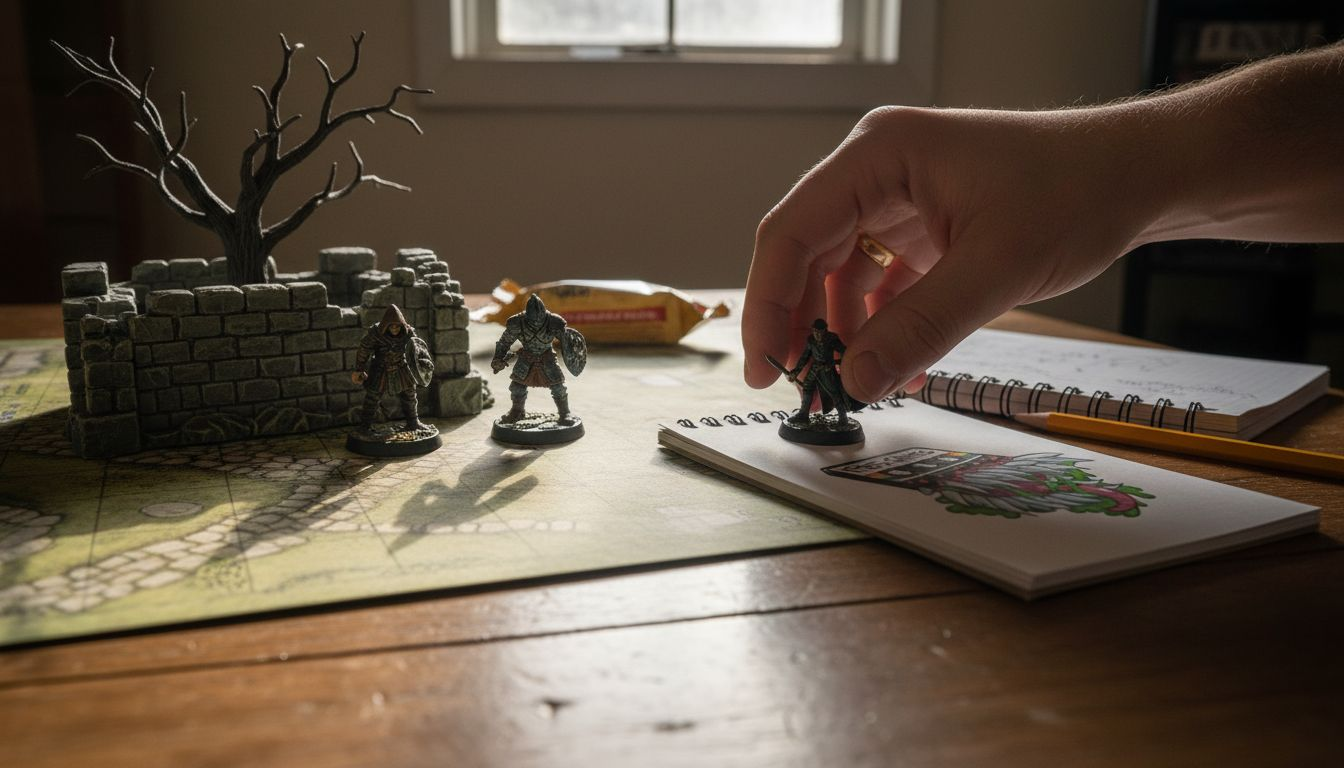
This creates meaningful choices. Without terrain, combat becomes mechanical. With it, every decision has spatial weight.
Terrain Beyond Combat
Terrain matters for exploration too. A ravine blocks direct travel, forcing your party to find another route or use creative solutions. A forest’s dense trees make navigation harder. Swamps slow movement and hide dangers. These details make the world feel real and present.
Pro tip: Use terrain to tell stories about your world—ruins suggest ancient conflicts, cracked earth hints at magical disasters, and carefully placed obstacles reveal how NPCs navigate their environment.
Types of Terrain and Their Effects
D&D offers an incredible variety of terrain types, each one creating unique challenges and opportunities for your game. Rather than generic battlefields, your adventures can span mountains, forests, swamps, deserts, and countless other environments. Each presents distinct rules for movement, visibility, and combat.
Common Terrain Types
Understanding diverse terrain types helps you design encounters that feel authentic and engaging. Here’s what you’ll encounter:
- Mountains - Cliffs limit movement, unstable rocks create hazards, and elevation dominates tactics
- Forests - Dense vegetation reduces visibility, favors ambush tactics, and slows characters down
- Swamps - Mixed water and land creates complex movement challenges and murky visibility
- Desert - Endless open space with extreme heat, limited cover, and visibility for miles
- Underdark - Magical darkness, fungal forests, and underground caverns with unique hazards
- Arctic - Extreme cold, slippery ice, and blinding snow drastically affect travel
- Water - Swimming changes movement rates, reduces visibility, and adds drowning risks
- Tunnels - Cramped spaces limit formations, echo sound, and create claustrophobic tension
How Terrain Affects Movement
Movement is where terrain truly shines mechanically. Mountains slow everyone down—climbing takes longer, terrain blocks direct routes, and falling becomes a real threat.
Forests reduce visibility dramatically. A rogue hiding in thick trees becomes nearly impossible to spot. An archer struggles to see targets beyond 60 feet. This changes how players approach combat entirely.
Swamps combine water and land movement. Some areas are wading, others are swimming. Your barbarian might lose speed advantage while swimming, suddenly making rogues more valuable for positioning.
Here’s a quick reference on how common terrain types impact gameplay elements:
| Terrain Type | Movement Impact | Visibility Effects | Unique Hazard |
|---|---|---|---|
| Mountains | Slow, requires climbing | Long sightlines, risk from heights | Rockfalls, avalanches |
| Forests | Partially slowed | Dense, short distances | Hidden predators |
| Swamps | Unpredictable, mixed swimming | Foggy, concealment | Quicksand, venomous creatures |
| Desert | Easy but exhausting | Clear, sun glare | Heat exhaustion |
| Underdark | Restrictive, tunnels | Darkness, magical effects | Fungi, lava flows |
| Arctic | Very slow, slippery | Snow blindness | Freezing exposure |
| Water | Swimming only | Low below surface | Drowning risk |
| Tunnels | Narrow, slow | Echoes, limited sight | Cave-ins |
Every terrain type reshapes what abilities matter most and which character builds shine.
Hazards and Environmental Effects
Terrain goes beyond just movement penalties. Real terrain creates dangers.
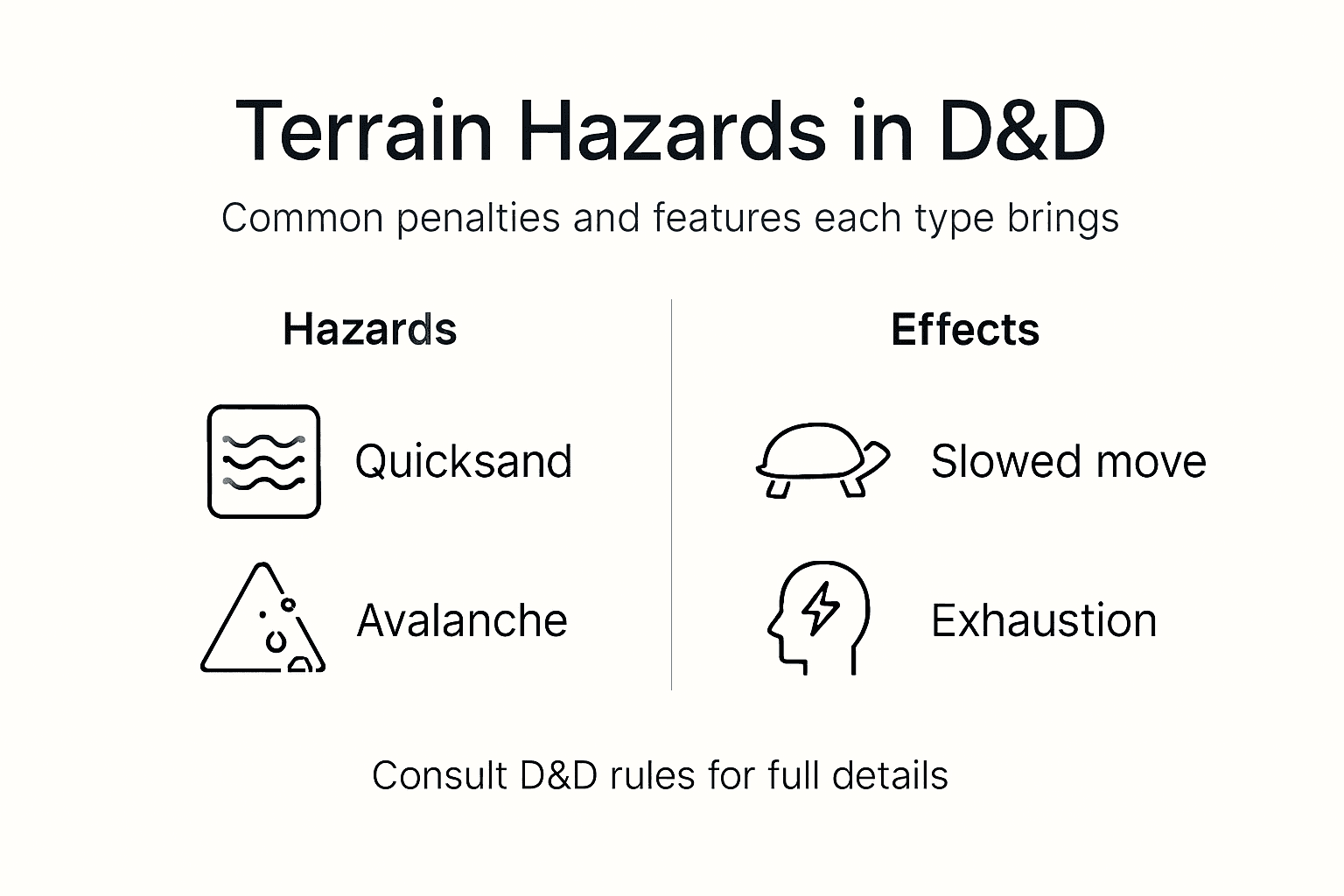
Deserts punish the unprepared—characters without water suffer exhaustion. Mountains trigger avalanches or rockslides. Swamps harbor quicksand and poisonous creatures. Underdark regions feature lava flows and dangerous fungi.
These hazards force creative problem-solving instead of straightforward combat. A wizard uses spells to navigate hazards. A ranger finds paths others miss. A paladin inspires allies through dangerous terrain.
Pro tip: Layer terrain hazards with enemy encounters—imagine fighting goblins while swamp quicksand slowly drags down your party members, forcing tough choices about positioning and movement.
Using Terrain Maps for Immersion
Terrain maps transform your D&D table from abstract to unforgettable. When players see a physical representation of the battlefield, they connect with the world differently. It’s the difference between imagining a tavern brawl and watching your rogue actually flip over that table for cover.
Why Visual Aids Matter
Physical tools like terrain maps and miniatures engage players in ways pure description cannot. Your words paint pictures, but maps paint them together—everyone sees the same layout, the same sightlines, the same opportunities.
Maps reduce confusion about positioning. No more arguments about whether someone can see the wizard behind that pillar. The map settles it instantly.
Miniatures make it personal. When players place their character token on the map, they own the moment. That’s their character standing on the cliff edge. That’s their rogue hiding behind the crate.
Building Immersion Through Layers
Great immersion happens when you layer multiple tools together. Maps provide the visual foundation, but they’re not enough alone.
Combine maps with these elements:
- Vivid descriptions that paint sensory details beyond what’s visible
- Sound effects or music that matches the environment’s mood
- Detailed miniatures that show character positioning clearly
- Terrain pieces like trees, walls, and obstacles that feel tactile
- Lighting effects that highlight danger zones or dramatic moments
When a player’s character stands on your terrain map in a haunted crypt, and you describe the bitter cold, the echoing drips of water, and the way shadows dance across stone walls—that’s immersion. The map is the anchor; everything else builds around it.
Maps focus player attention exactly where it matters, making your narrative descriptions hit harder and feel more real.
Starting Simple
You don’t need fancy digital tools or elaborate miniature collections. A basic grid map with some tokens and a few terrain pieces transforms the game significantly.
Start with what feels comfortable. Hand-drawn maps work great. Printed battle maps get the job done. Even simple sketches on a dry-erase board shift the dynamic toward immersion.
As you grow comfortable, add pieces gradually. Better miniatures. Themed terrain. Specialized maps. Each addition deepens the experience.
Pro tip: Start each session by describing the terrain loudly while players look at the map—connect the visual they see with the world they hear, anchoring their imagination to physical reality.
Terrain Features and Player Strategies
Terrain isn’t just scenery—it’s a toolkit for player creativity. Smart players recognize that terrain features create tactical advantages worth exploiting. Understanding how to use elevation, cover, and difficult terrain separates good strategies from great ones.
Reading the Battlefield
Every terrain feature tells players what’s possible. Elevation advantage helps ranged combatants control the battlefield while forcing melee fighters to climb exposed routes. A caster on high ground gains safety distance from threats below.
Cover transforms survivability. Standing behind a stone pillar means enemies need to move to flank you. Concealment in tall grass hides you entirely until enemies get close.
Difficult terrain punishes careless positioning. A swamp that slows movement becomes a buffer zone. Your party can hold enemies at the edge while staying safe.
Class-Specific Advantages
Different classes shine in different terrain. Recognizing this shapes entire combat strategies.
- Rangers and rogues exploit forests and thickets for stealth ambush tactics
- Ranged fighters dominate open mountain terrain with clear sightlines
- Monks use elevation and movement through difficult terrain to their advantage
- Wizards position on high ground or behind cover to stay safe while casting
- Barbarians charge through difficult terrain less bothered by movement penalties
Your party’s composition should influence terrain selection. An all-melee party struggles in swamps. A ranged-heavy team loves open deserts.
Compare how different D&D classes benefit from specific types of terrain:
| Class | Terrain Advantage | Tactics Enabled |
|---|---|---|
| Ranger | Forests, Swamps | Ambush and ranged attacks |
| Rogue | Urban, Dense Forests | Stealth, increased mobility |
| Wizard | Mountains, High Ground | Safe spellcasting, area control |
| Barbarian | Open Fields, Swamps | Powerful charges, absorbs penalties |
| Monk | Rocky, Varied Elevation | Superior mobility, vertical movement |
Smart terrain use means matching your party’s strengths to the environment, forcing enemies to fight on your terms.
Creative Ability Usage
Terrain encourages players to use abilities they’d normally ignore. A wizard might cast Grease to create difficult terrain. A rogue uses acrobatics to climb walls and control vertical space.
Terrain manipulation spells become essential. Difficult terrain spells trap enemies. Teleportation spells bypass hazards. Entangle spells lock foes in place.
Players who think creatively about terrain always win fights. They’re not just attacking—they’re engineering victory through positioning.
Planning Movement
Terrain forces tactical movement planning. You can’t rush forward blindly when cliffs might be ahead or quicksand lurks beneath mud.
Good terrain teaches players to:
- Scout before committing fully
- Plan escape routes around hazards
- Use difficult terrain defensively
- Control chokepoints with positioned characters
- Recognize when retreating beats fighting
This creates richer, more memorable encounters than flat battlefields ever could.
Pro tip: When designing encounters, choose terrain that rewards creative problem-solving over pure combat skill—this encourages players to roleplay solutions, scout positions, and use their character abilities creatively.
Common Terrain Mistakes in D&D
Even experienced dungeon masters slip up with terrain. These mistakes drain immersion, slow combat, and frustrate players. Recognizing them helps you run smoother, more engaging sessions.
Mistake 1: Forgetting Terrain Exists
The biggest mistake? Treating terrain as decoration. Your beautifully described forest becomes irrelevant once combat starts. Trees don’t block sightlines. Elevation means nothing. Difficult terrain vanishes.
Terrain only matters if you enforce it consistently. If you describe a rocky cliff but let players ignore the climbing difficulty, you’ve wasted the setup.
Actually use the features you describe. When a wizard hides behind a pillar, enemies can’t see them unless they move around it. Make terrain consequences real.
Mistake 2: Creating Boring, Flat Battlefields
A grid with no elevation or obstacles plays flat. Everything becomes “walk forward and attack.” There’s no positioning strategy, no creative use of space.
Add vertical dimension. Elevation creates natural tactical depth. Cliffs, platforms, and different height levels force players to think spatially.
Obstacles matter too. Pillars, trees, and rubble block sightlines and movement. They transform combat from abstract to concrete.
Mistake 3: Overcomplicating Movement Rules
Terrain rules exist in the Player’s Handbook for a reason. Some dungeon masters invent overly complex movement systems that bog down combat.
Stick to standard difficult terrain rules:
- Difficult terrain costs double movement
- Climbing costs double movement
- Swimming costs double movement
- Flying follows normal movement rules
Consistency beats creativity when it comes to mechanics. Players need predictable rules, not endless special cases.
Simple, consistent terrain rules create memorable tactical moments without grinding combat to a halt.
Mistake 4: Ignoring Sensory Details
Terrain needs more than just mechanics. A swamp that only has movement penalties feels empty. Add the smell of stagnant water. Describe the squelching mud underfoot. Make the environment come alive.
Quality accessories and terrain maps help convey these details visually while you paint them with words.
Mistake 5: Not Matching Terrain to Party Composition
Designing a dense forest ambush for an all-ranged party is punishing them for their build. Smart dungeon masters choose terrain that challenges parties without feeling unfair.
Consider your party’s strengths. A melee-heavy group needs different terrain than a ranged-heavy one. Varied terrain across multiple sessions keeps everyone engaged.
Mistake 6: Skipping Exploration Consequences
Terrain during travel matters as much as combat terrain. A mountain crossing creates tension through elevation and weather hazards. Ignoring these moments wastes opportunities for memorable encounters.
Let terrain slow exploration intentionally. Force meaningful decisions about routes and resources.
Pro tip: Before each session, sketch your terrain on paper and walk through it yourself—this catches unrealistic layouts and ensures your descriptions match the actual battlefield your players see.
Elevate Your D&D Adventures with Immersive Terrain Tools
Mastering terrain in Dungeons & Dragons means more than just knowing the rules. It is about bringing your game world to life through tactical battles and vivid exploration. If you want to transform flat battlefields into dynamic, immersive experiences where elevation, cover, and environmental hazards matter every step of the way, you need the right accessories to make terrain an active player in your campaigns.

Explore expertly crafted terrain battle maps from 1985 Games designed to create realistic and engaging battlefields that encourage strategic movement, cover usage, and environmental storytelling. Pair your maps with our premium player journals and mystery dice sets to enhance roleplaying immersion and tactical decision-making. Don’t let your sessions fall flat due to bland setups—visit 1985 Games now and discover tools that turn your terrain from a background detail into a thrilling combat and exploration challenge. Take your next D&D session from ordinary to extraordinary by equipping your table with the best in terrain accessories.
Frequently Asked Questions
What is terrain in D&D?
Terrain in D&D refers to the physical landscape your characters navigate during adventures, including features like elevation, walls, trees, water, and other space-occupying elements that influence movement and combat.
How does terrain affect combat in D&D?
Terrain impacts combat by creating tactical opportunities, such as providing cover, restricting movement, and affecting visibility. Clever use of terrain can lead to strategic advantages during encounters.
What are some common types of terrain in D&D?
Common terrain types include mountains, forests, swamps, deserts, and arctic environments. Each type presents unique challenges and opportunities for movement, visibility, and combat mechanics.
Why is terrain important for exploration in D&D?
Terrain shapes the exploration experience by affecting travel routes and the challenges characters face. It adds realism to the game world and encourages creative problem-solving in navigating obstacles.