

TL;DR:
- Dice originated around 5000 BC as animal bones used in divination and gambling. Over time, they evolved from sacred tools into collectible and customizable items, especially with the rise of tabletop RPGs. Contemporary culture values rare, high-quality, and artisan dice, driven by nostalgia, aesthetics, and community engagement.
Before your first polyhedral set ever hit the table, dice were rolling through the fingers of ancient diviners and gamblers who believed each toss could reveal the will of the gods. Dice originated from knucklebones around 5000 BC in regions like Iran, Egypt, and Mesopotamia, making them some of the oldest human tools ever discovered. That little d20 sitting in your collection right now? It carries thousands of years of cultural weight. In this guide, we’re tracing the full arc from ancient ritual to modern “dice goblin” obsession, because knowing the history makes every roll feel like a Nat 20.
Table of Contents
- Dice through the ages: From ancient knucklebones to RPG icons
- The RPG boom: How D&D transformed dice collecting
- Handmade and artisan dice: The modern collector’s market
- Trends in dice collecting: Scarcity, materials, and the ‘dice goblin’ culture
- What experts know: Quality, precision, and collecting strategies
- A collector’s perspective: What most guides miss about dice collecting
- Explore, discover, and grow your dice collection
- Frequently asked questions
Key Takeaways
| Point | Details |
|---|---|
| Origins in ancient divination | Dice collecting began with knucklebones used for divination and gambling thousands of years ago. |
| RPGs drove the collecting boom | Dungeons & Dragons inspired the surge in dice collecting, making vintage sets valuable for enthusiasts. |
| Handmade dice market explosion | Custom dice creation and artisan marketplaces have reshaped collector trends since the mid-2010s. |
| Scarcity and materials fuel value | Limited editions and premium materials like metal and gemstone make dice more desirable. |
| Expert advice for collectors | Balance artisan creativity with precision manufacturing for a robust dice collection. |
Dice through the ages: From ancient knucklebones to RPG icons
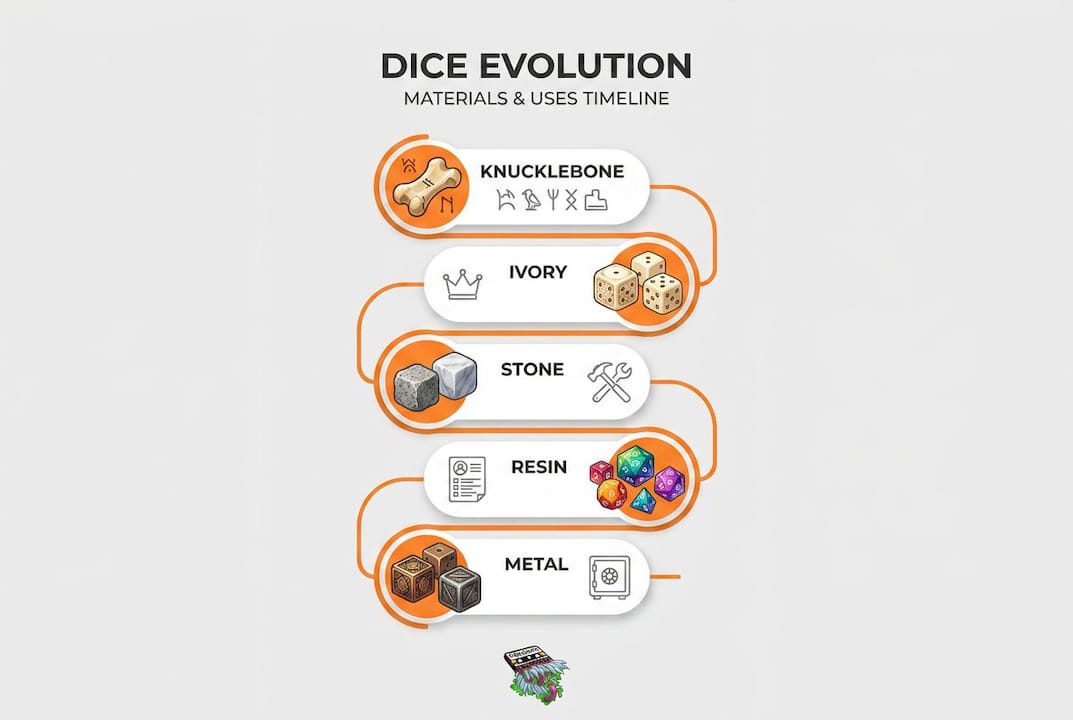
Let’s rewind. WAY back. The very first dice weren’t carved from resin or cast in glittering metal. They were literally animal knucklebones, specifically the astragalus bone, tossed by hand to divine fortunes and settle disputes. Ancient knucklebone dice showed up in Iran, Egypt, and Mesopotamia as early as 5000 BC. Not a game night staple. A sacred ritual tool.
Over centuries, dice evolved from bones into carved ivory, stone, and wood. Eventually, craftsmen started shaping them into recognizable geometric forms with numbered faces. The Romans were obsessed. Greek philosophers debated whether chance was real or divine. And through all of it, dice kept rolling forward.
By the time the medieval era rolled around (pun absolutely intended), dice had picked up a scandalous reputation. The Church frowned on gambling, and dice were seen as instruments of vice rather than virtue. Yet their popularity never faded. People just played in secret.
Then came the material evolution that changed everything:
- Bone and ivory: The originals, used for millennia
- Wood and horn: Cheap, accessible, and widely produced
- Lead and metal: Heavier, more precise, preferred by serious players
- Bakelite and plastic: Mass production in the 20th century
- Resin and gemstone: The modern collector’s dream
The shift to resin especially opened a creative explosion. Suddenly dice could trap flowers, galaxies, and glitter inside a transparent shell. Collectors started noticing. The hobby as we know it began to take shape, and dice’s role in TTRPGs grew from simple randomizers to deeply meaningful storytelling tools.
“Dice are more than instruments of chance. They are artifacts of human culture, connecting every player to thousands of years of history.”
| Era | Primary material | Primary use |
|---|---|---|
| 5000 BC | Knucklebone | Divination and gambling |
| Ancient Greece/Rome | Ivory, stone | Gambling and games |
| Medieval Europe | Bone, wood | Games and vice |
| 19th century | Lead, horn | Games and sport |
| 20th century | Plastic (Bakelite) | Mass market gaming |
| 2000s onward | Resin, metal, gemstone | Gaming and collecting |
The RPG boom: How D&D transformed dice collecting
Here’s where things get really exciting for us tabletop fans. Dungeons & Dragons launched in 1974, and it changed everything. Not just gaming. Dice culture. Collecting culture. The whole vibe.
Before D&D, standard six-sided dice were THE dice. Period. D&D introduced polyhedral sets, d4s, d6s, d8s, d10s, d12s, and d20s, and players needed ALL of them. Suddenly dice weren’t just tools. They were equipment. And equipment, as any adventurer knows, can be upgraded.
Early manufacturers stepped up fast. Companies like Gamescience and Armory began producing precision polyhedral dice for the growing RPG market. Vintage sets like first-gen Armory with distinctive “A” branding are now rare collectibles, hunted down by dedicated dice historians and enthusiasts with the same energy as a legendary magic item drop.
Why were these early dice special? A few reasons:
- They were often uninked, requiring players to color the numbers themselves with crayons or paint
- Manufacturing tolerances varied wildly, making some sets uniquely imprecise (a feature some collectors love)
- Limited production runs mean surviving sets are genuinely scarce
- They carry nostalgia capital that no modern reproduction can replicate
Then came the “Critical Role” era. Watching Matt Mercer and crew roll gorgeous dice on a professional stream made millions of viewers realize: the dice you roll MATTER. Not just mechanically. Aesthetically, emotionally, narratively. RPG dice collecting exploded because streaming culture made dice aspirational objects.
Pro Tip: If you’re hunting retro dice collecting opportunities, focus on pre-1990 sets. Look for intact complete sets (all polyhedrals together), original packaging, and maker marks. Condition matters, but character matters more.
| Manufacturer | Era | Known for | Collector value |
|---|---|---|---|
| Gamescience | 1970s onward | Precision edge cuts | High |
| Armory | 1970s-80s | “A” branded sets | Very high (vintage) |
| TSR official sets | 1970s-80s | D&D co-branding | High (nostalgia) |
| Chessex | 1990s onward | Color variety | Moderate |
| Norse Foundry | 2010s onward | Metal premium | High (modern) |
Handmade and artisan dice: The modern collector’s market
Now THIS is where the dice community went absolutely feral in the best way possible.
The artisan dice market started taking off in the mid-2010s, riding the wave of resin pouring and 3D printing technology. Hobbyists discovered they could make their OWN dice at home. And some of them were breathtakingly beautiful.
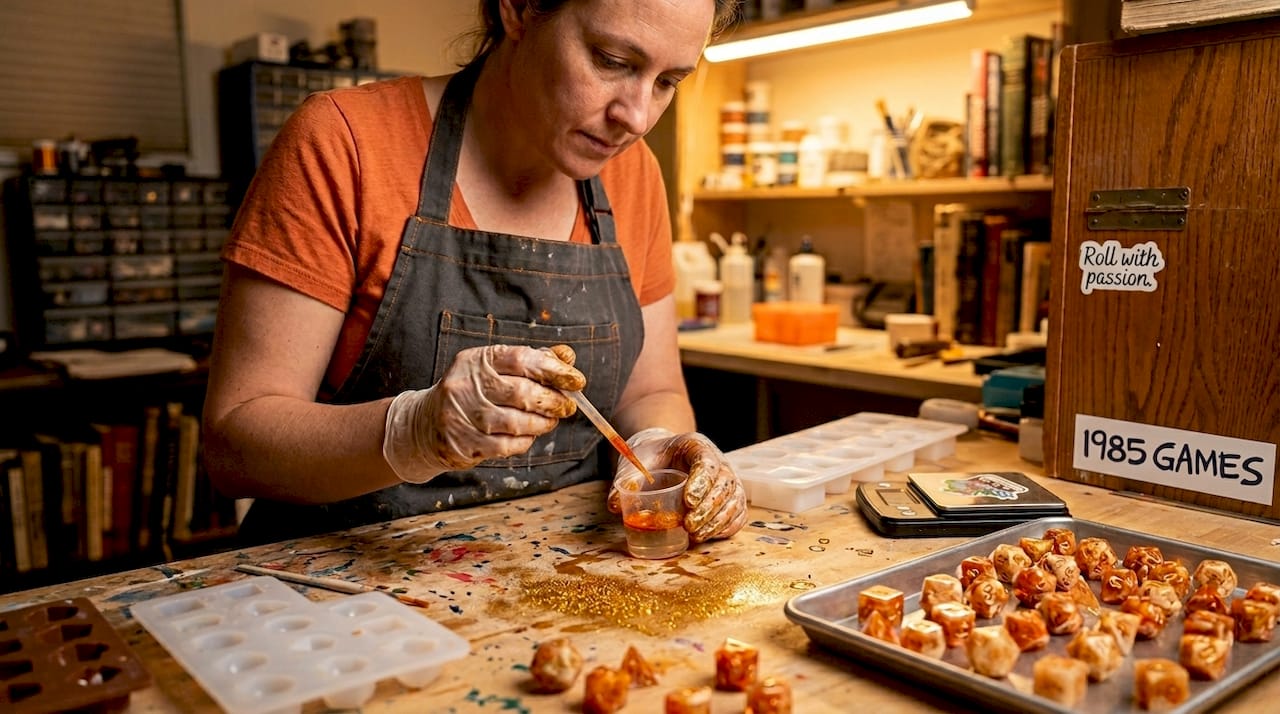
The watershed moment? Dispel Dice launched a Kickstarter in 2019 that raised $2.4 million, yes, MILLION, and sparked a full-on artisan boom. The timing couldn’t have been more interesting. COVID-19 hit shortly after, people were stuck at home, and suddenly everyone was learning to pour resin. The internet filled up with stunning handmade sets featuring botanicals, nebula swirls, and hand-painted inclusions.
The creative possibilities in artisan dice are genuinely wild:
- Resin casting with embedded flowers, glitter, foil, and paint
- 3D printing for entirely custom shapes and unusual geometry
- Wood turning for organic, warm-toned sets
- Metal casting with engraved custom artwork
- Polymer clay for sculptural designs
Understanding custom dice benefits goes beyond aesthetics. A custom set can represent your character’s class, backstory, or personality. A warlock might roll dark obsidian resin with gold runes. A druid might carry forest-green wooden dice. It’s cosplay for your dice pouch.
If you’re curious about making custom dice yourself, the learning curve is real but absolutely worth it. Resin pouring requires temperature control, proper molds, and patience. Lots of patience.
Market stat: The artisan scene grew explosively post-2019, but the market now has thousands of Etsy sellers competing for attention. That saturation makes it tougher for new makers to break through, which means buyers have incredible selection but must develop sharper eyes for quality dice criteria.
Pro Tip: When buying artisan dice, always ask for a balance test video. Beautiful dice that roll unevenly will frustrate you at the table. A good maker will be proud to show their quality.
Trends in dice collecting: Scarcity, materials, and the ‘dice goblin’ culture
Okay, dice goblins. You know who you are. You have three sets already and you’re eyeing a fourth. Maybe fifth. The dice pouch runneth over, and that is FINE. That is beautiful. That is the culture.
Collectible gaming accessories are a major trend right now in 2026. Limited edition releases, blind box dice packs (hello, Sirius D&D packs), convention exclusive sets, and Kickstarter runs designed for intentional scarcity are driving collector demand to new heights. The less available something is, the more we want it. Classic human behavior. Nat 20 on the psychology roll.
The numbers back this up in a big way. The global game dice market hit $1.32 billion in 2024 and is projected to reach $2.41 billion by 2033, growing at a CAGR (compound annual growth rate) of 6.8%. Polyhedral dice are the fastest-growing segment, driven entirely by RPG enthusiasts and collectors like us.
Premium materials are leading the charge:
- Metal dice: Heavy, clicky, satisfying. The metal dice market was worth $225 million in 2024 and is heading toward $425 million by 2033 at a 7.3% CAGR
- Gemstone dice: Obsidian, amethyst, jade, lapis lazuli. Each set is literally carved from the earth
- Liquid core dice: Resin shells with floating metallic liquid inside. Hypnotic to watch roll
- Sharp edge dice: Machine-precision cut for perfectly flat faces and crisp corners
Unique dice sets have become status symbols in the TTRPG community. Pulling out a set of hand-carved amethyst dice at the table is a whole moment. Everyone stops. Everyone looks. Your rogue just gained +5 to charisma from table reaction alone.
“Dice goblin culture isn’t hoarding. It’s curation. Every set tells a story about a character, a campaign, a moment in your gaming life.”
Want to understand all the dice set types that make up a complete collection? From standard plastic to premium dice sets, the range is genuinely staggering and deeply fun to explore.
What experts know: Quality, precision, and collecting strategies
Let’s talk craft for a second. Because not all dice are created equal, and knowing the difference separates casual collectors from serious ones.
Casino dice, the gold standard for precision, are manufactured to tolerances of ±0.0005 inches, which is almost impossibly precise. At that level, every face has exactly equal probability. Most RPG dice don’t come close to casino tolerances, and that’s honestly okay for storytelling games. But it does matter for competitive play and for appreciating what “precision” actually means in context.
Here’s a practical framework for evaluating any dice set:
- Face flatness: Hold the die up to light and check for warping or bubbles in resin sets
- Ink fill: Numbers should be fully and evenly inked, not smudged or missing
- Symmetry: Roll the die 20 or more times and check for bias toward certain numbers
- Edge quality: Sharp edges indicate precision cutting, rounded edges are standard mass production
- Weight distribution: Especially important for metal dice, heavier inclusions can shift balance
Understanding quality dice standards helps collectors avoid disappointment and make smarter purchases. A gorgeous set that rolls terribly will end up in a display case instead of at your table, and while display collections are totally valid, you should make that choice intentionally.
“The best dice for you are the ones you love rolling. Precision matters, but so does the feeling of the dice in your hand and the story they help you tell.”
Pro Tip: Build your collection in tiers. Start with one exceptional mass-produced set for regular play (Chessex or Q Workshop are solid choices), then add artisan and premium sets as display or special occasion pieces. You protect your valuable sets and still get satisfying dice time every session.
A collector’s perspective: What most guides miss about dice collecting
We’ve seen a LOT of dice guides. And most of them start at the same place: “Here are some cool sets to buy.” That’s fine! But it misses something important.
The truth is, the cultural roots of dice collecting run deep, and that depth is what makes the hobby genuinely meaningful rather than just another consumer hobby. Dice began as objects of divination and early gambling, literally devices people used to interpret divine will or decide life-altering gambles. Medieval churches condemned them. Emperors banned them. And people rolled them anyway.
Fast forward to today. We’ve taken that ancient, sometimes forbidden object and transformed it into a tool for collaborative storytelling, creative expression, and community building. That’s not trivial. That’s genuinely remarkable.
Here’s where we think most guides also go wrong: they either chase hype or chase nostalgia without helping collectors develop their own authentic taste. The artisan market post-COVID is genuinely saturated, with thousands of makers on Etsy producing sets of wildly varying quality. Some of the most hyped Kickstarter dice are beautiful but impractical. Some of the most valuable vintage sets look pretty rough by modern standards.
The collectors we admire most balance passion with perspective. They know WHY they want a set before buying it. Is it for daily play? Display? Character connection? Historical significance? Each motivation leads to different purchasing decisions, and being clear about your own motivations saves money and builds a more coherent collection.
Also: don’t sleep on the community itself. Dice Discord servers, TTRPG subreddits, collector groups on social media. These communities share knowledge, warn about bad actors, celebrate beautiful sets, and connect you with sellers you’d never find through a simple search. The culture around collecting is as valuable as the collection itself.
Explore, discover, and grow your dice collection
You’ve just traveled from ancient knucklebones to the modern artisan boom, and we hope your brain is lighting up like a Nat 20. Because knowing the history, the trends, and the expert strategies transforms dice collecting from impulse buying into intentional curation. That’s the good stuff.

At 1985 Games, we live and breathe this hobby alongside you. Whether you’re hunting for your first premium set or expanding an already impressive hoard, our collections are designed to spark that exact megadose of euphoria that comes with finding the PERFECT dice. From mystery sets (because surprise is its own reward) to sharp-edge beauties and premium handcrafted options, we’ve got the pieces that’ll make your collection sing. Browse our dice set deals, check our buy-2-get-1 offers, and find the set that feels like it was always meant for your character. Roll well, dear dice goblins.
Frequently asked questions
Why are vintage dice sets valuable to collectors?
Vintage sets like first-gen Armory with “A” branding are valued for their scarcity, historical connection to early RPG culture, and the nostalgia they carry for the hobby’s roots.
What defines a premium dice set for tabletop RPGs?
Premium dice sets feature high-quality materials such as metal, resin, or gemstone combined with precision manufacturing and often limited edition designs. The metal dice market alone is projected to reach $425 million by 2033, reflecting enormous collector demand.
How has the handmade dice market changed since 2015?
The handmade dice market launched in the mid-2010s with resin pouring and 3D printing, exploded after Dispel Dice’s $2.4 million Kickstarter in 2019, and now faces saturation with thousands of competing makers on Etsy.
What is ‘dice goblin’ culture in collecting?
Dice goblin culture describes the joyful, unapologetic habit of collecting dice sets for their beauty, rarity, and the pure delight of ownership, even well beyond what any single campaign could use.
Are polyhedral dice more collectible today?
Yes. Polyhedral dice are the fastest-growing segment among RPG enthusiasts, fueled by creative custom designs, premium materials, and the cultural influence of streaming shows that put gorgeous dice front and center.