

TL;DR:
- TTRPG memorabilia includes rare rulebooks, signed modules, artisan dice, and original artwork.
- Effective collecting focuses on rarity, provenance, condition, and personal significance.
- Community forums, conventions, and organized storage protect and enhance your collection.
There’s a moment every tabletop RPG player knows. You’re digging through a box at a game store, and suddenly your hand closes around something that makes your brain light up like a Nat 20. A first-edition module. A hand-signed rulebook. A set of dice with a history. Most folks think TTRPG collecting is just “hoarding dice” (no judgment, we’ve all been there). But it’s so much more. It’s preserving culture, celebrating craft, and building a personal archive of shared adventures. In this guide, we’ll walk you through everything: what counts as real memorabilia, how to build and curate a collection, how to protect your treasures, and where to connect with your fellow dice goblins.
Table of Contents
- What counts as TTRPG memorabilia?
- How to start and curate your collection
- Safeguarding and showcasing your collection
- Finding community and trading knowledge
- A collector’s wisdom: What most guides miss
- Bring your collection to the next level with 1985 Games
- Frequently asked questions
Key Takeaways
| Point | Details |
|---|---|
| Recognize collectible value | Know what items and features define valuable TTRPG memorabilia. |
| Curate and organize smartly | Build your collection with clear goals, expert sources, and careful organization. |
| Preservation is key | Protect memorabilia through correct storage and display to maintain worth and enjoyment. |
| Build community connections | Engage in online and real-world groups to share, trade, and expand your collecting knowledge. |
| Collect for passion and play | Balance investment value with personal enjoyment and the stories behind each item. |
What counts as TTRPG memorabilia?
Let’s bust the myth right away. TTRPG memorabilia isn’t just old rulebooks gathering dust in someone’s basement. The world is wonderfully wide. Rare books, dice, handmade accessories, signed modules, and original art all fall squarely within its scope, and each category carries its own unique flavor of nostalgia and value.
So what exactly qualifies? Here’s a starter list:
- First-edition and out-of-print rulebooks: Think the original Dungeons & Dragons white box set or early Traveller supplements. These are the crown jewels of any serious collection.
- Adventure modules: Legendary campaigns like Tomb of Horrors or Keep on the Borderlands in original print are highly sought after.
- Limited-edition and artisan dice sets: Hand-poured resin, sharp-edge, or vintage bakelite dice carry serious collector appeal.
- Terrain pieces and battle maps: Handcrafted, one-of-a-kind dungeon tiles and illustrated maps are increasingly prized by collectors and players alike.
- Signed items: A module signed by Gary Gygax or Dave Arneson? That’s a piece of history, full stop.
- Original artwork: Concept art, cover illustrations, and hand-drawn player maps from notable artists can command serious prices.
What makes an item truly collectible often comes down to three things: rarity, provenance, and condition. Rarity speaks for itself. Provenance means you can prove where the item came from and who owned it. Condition affects value dramatically, though we’ll challenge that idea a little later.
“Collecting TTRPG memorabilia is an act of cultural preservation. Every signed module and hand-poured dice set tells a story bigger than the game itself.”
Experienced collectors often use price guides, community forums, and auction records to identify high-value items hiding in plain sight. A seemingly ordinary module could be a rare regional print run worth far more than you’d expect. Check out our guide on essential TTRPG accessories for a deeper look at what items pull double duty as both gameplay tools and collectibles.
The beauty of TTRPG collecting is that you get to define your own focus. Some collectors specialize in a single game system. Others chase items from a specific era or creative team. Your collection is your story.
How to start and curate your collection
With a clear understanding of memorabilia, it’s time to discuss how you can start, smartly and selectively, curating your own collection. Don’t just grab everything you find. That’s how you end up with a room full of reading material and zero focus. Intentional collecting is where the real magic happens.
Here’s a practical roadmap:
- Define your focus. Pick a game system, an era, or an item type. Specialization makes your collection more coherent and often more valuable.
- Start local. Game stores, thrift shops, and estate sales are goldmines. Sellers often don’t know what they have.
- Go digital. eBay, Facebook Marketplace, and specialized TTRPG groups on Reddit or Discord offer huge variety. Set up alerts for your most-wanted items.
- Use auction houses for high-end pieces. Heritage Auctions for high-value sales and community forums like Acaeum are excellent resources for appraisals, though always be cautious with ungraded items.
- Catalog everything. Use a spreadsheet or a dedicated app to track item name, edition, condition, purchase price, and provenance notes.
- Learn to grade condition. Terms like Fine, Very Good, and Good have specific meanings in the collecting world. Don’t assume a seller’s description is accurate.
Authenticity is a big deal. Ask for photos of copyright pages, spine labels, and any signatures. Compare against known examples in online databases. When in doubt, get a second opinion from the community before spending big.
Pro Tip: Never pay top dollar for an ungraded, high-value item without first posting photos to a collector forum. Fellow enthusiasts can spot fakes, wrong print runs, or mislabeled editions in minutes.
For deeper strategies on how to organize TTRPG collections efficiently as they grow, we’ve got you covered with a full breakdown of cataloging workflows and smart storage systems.
Safeguarding and showcasing your collection
Once your collection grows, protecting and displaying your treasures becomes just as important as finding them. A poorly stored rare module can lose significant value and, worse, its story, in just a few years.
Proper storage and display methods preserve memorabilia value and prevent deterioration. Here’s how to think about your two main options:
| Feature | Archival storage | Display setup |
|---|---|---|
| Best for | Rare, fragile, or signed items | Items you want to enjoy and show off |
| Materials | Acid-free boxes, Mylar sleeves, foam | UV-protective cases, shadow boxes, LED lighting |
| Humidity control | Silica gel packs essential | Climate control recommended |
| Light exposure | Zero direct light | Filtered or low-UV lighting only |
| Accessibility | Minimal handling | Regular viewing, careful handling |
For books and modules, archival-quality Mylar sleeves and acid-free boards are your best friends. They prevent yellowing and spine damage. Keep items upright, not stacked flat, to avoid warping.
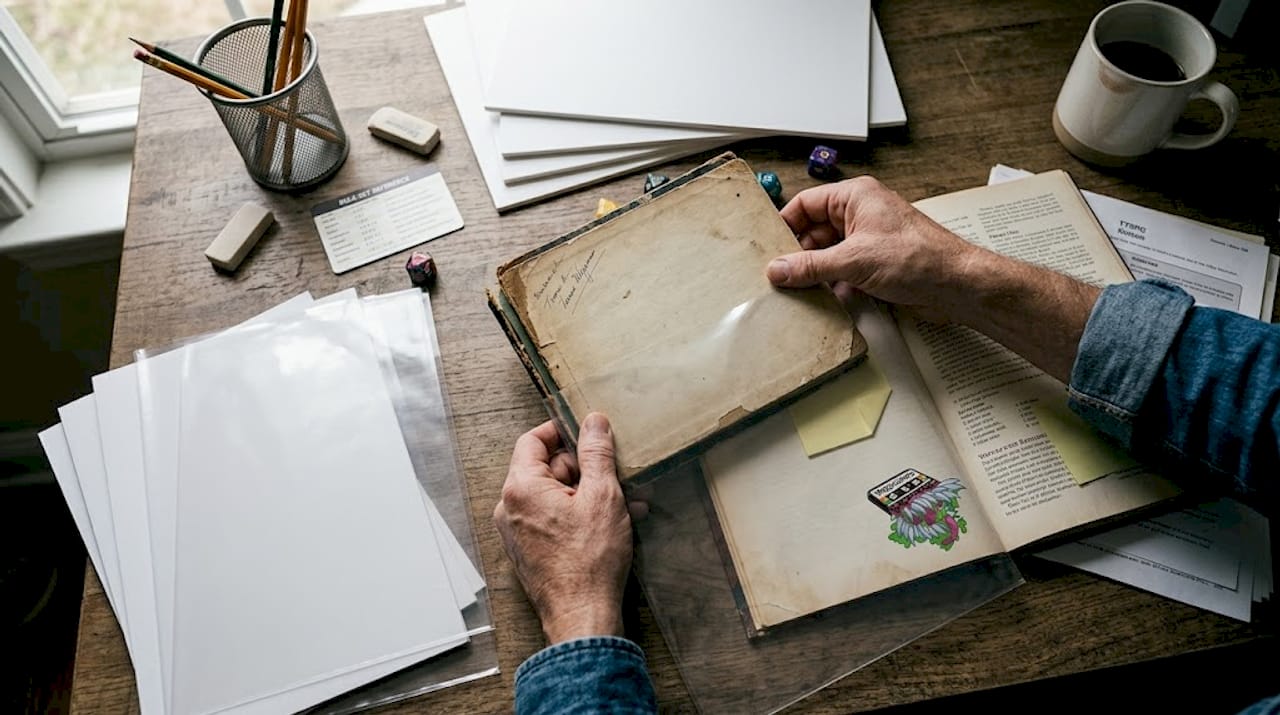
Dice collections deserve their own moment of glory. Shadow boxes with foam inserts let you arrange your rarest sets like the art they truly are. Lighting matters more than you’d think. Warm LED strips can make resin dice glow like little gemstones.
Pro Tip: For signed items, never use regular plastic sleeves. PVC off-gasses over time and can literally eat through ink and paper. Always go archival.
Thinking about what to display alongside your memorabilia? Browse our top TTRPG accessories picks for items that look stunning on a shelf and still get plenty of table time. You can also check our tabletop essentials list for gear that bridges the gap between collector’s pride and active play.
Finding community and trading knowledge
Protecting your items is key, but the real magic often happens when you share your passion and expertise with a like-minded community. Collecting in isolation misses the point entirely. The TTRPG community is one of the warmest, most generous fandoms out there, and collectors are no exception.
Here’s a quick look at the most active communities and what they offer:
| Community | Platform | Best for |
|---|---|---|
| Acaeum | Web forum | D&D appraisals and print-run ID |
| RPG Geek | Web forum | Broad TTRPG collecting and trading |
| TTRPG Collectors | Facebook Group | Buying, selling, swapping |
| Various Discord servers | Discord | Real-time advice and community |
| Gen Con, PAX Unplugged | In-person events | Trading, demos, exclusive items |
Active TTRPG forums and auction communities provide expert appraisals and a marketplace for rare items, and being an engaged member pays off massively over time.
Here’s how to make the most of these spaces:
- Lurk before you leap. Spend time reading before posting. Learn the community norms.
- Share your finds. Posting photos of cool pickups builds goodwill and earns you credibility.
- Be honest about condition. Reputation is everything in collector communities.
- Join local game store events. Many stores host swap meets and collector nights.
Conventions are another goldmine. Dealers’ halls often feature rare items, and you’ll find knowledgeable sellers willing to talk history and provenance. Connecting with the broader D&D community and following what’s trending in popular TTRPG shows can also tip you off to surging demand for specific items before prices spike.
A collector’s wisdom: What most guides miss
Here’s our honest, slightly contrarian take: most collecting guides obsess over condition and monetary value. We get it. But they often miss the thing that makes TTRPG memorabilia genuinely special.
The real value is personal. That worn copy of a 1981 module with scribbled margin notes from a long-ago campaign? It’s arguably more meaningful than a mint-condition copy sealed in plastic. The story it carries, the hands it passed through, the battles it witnessed, that’s irreplaceable. No price guide captures that.
New collectors often make the mistake of chasing investment value over joy. They buy things because they’re “worth something” rather than because they spark that Nat 20 feeling. Collections built purely for profit rarely stay fun for long.
Playability and nostalgia matter enormously. A dice set that’s been through a hundred sessions has character that a pristine set in a display box simply doesn’t. We’re not saying ignore condition entirely. We’re saying don’t let perfect be the enemy of meaningful.
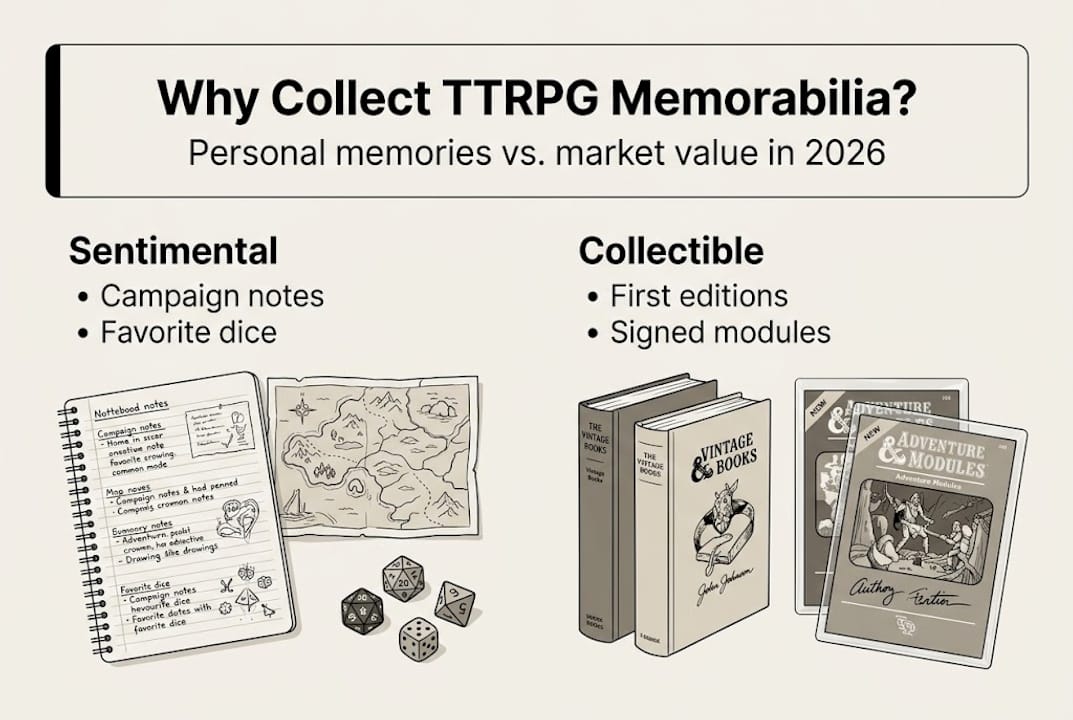
Use efficient TTRPG organization systems not just to track monetary value but to record the stories behind your pieces. Where did you find it? Who sold it to you? What campaigns has it survived? That’s the archive worth protecting.
Bring your collection to the next level with 1985 Games
Equipped with practical knowledge, you may be wondering where to find the next standout piece for your collection. Good news: we’ve got you covered, dice goblin.

At 1985 Games, we handcraft and curate accessories built for players AND collectors. Whether you’re hunting for a showstopper terrain piece or a dice set with serious personality, our shop delivers. Check out Dungeon Craft: Volume 2 for stunning battle maps that look incredible on a wall and even better on the table. And if your dice collection needs a serious upgrade, our premium dice sets are made for the dice goblin who refuses to settle for ordinary. Every piece ships globally, because great collections know no borders.
Frequently asked questions
What types of TTRPG memorabilia are the most valuable?
First edition books, limited-run dice, signed modules, and items with proven provenance are usually the most sought after by serious collectors. Rarity and documented history are the two biggest drivers of value.
How can I verify if a piece is authentic?
Check for provenance documentation, compare with trusted auction sites and forums, and seek community appraisals for expert validation. Photos of copyright pages and edition markers are a great starting point.
Where should I store rare TTRPG accessories?
Store them in archival-safe sleeves or cases, away from direct sunlight and fluctuating humidity for best long-term preservation. Acid-free materials and silica gel packs are your go-to tools.
Are there online groups for trading and advice on TTRPG memorabilia?
Absolutely. Collectors can join forums, Discord servers, and social media groups devoted to TTRPG collecting. Online forums and auction communities are hubs for expert appraisals and active trading opportunities.