

Many players think dice in tabletop role-playing games are just random number generators, but that’s a misconception. Dice serve as the heartbeat of strategic gameplay, introducing controlled randomness that transforms every action into a meaningful decision. In games like Dungeons & Dragons, dice resolve uncertainty in ways that balance player agency with narrative surprise. Understanding how different dice function, when to leverage advantage mechanics, and how modifiers shape outcomes can dramatically improve your sessions. This guide breaks down the specific roles of polyhedral dice, explores probability mechanics that affect your strategies, and reveals how to use these tools to create more engaging gameplay experiences for both dungeon masters and players.
Table of Contents
- Key takeaways
- Understanding the core role of dice in TTRPGs
- Exploring different dice types and their specific roles in gameplay
- The impact of advantage, disadvantage, and modifiers on dice outcomes
- Common misconceptions and fairness of physical dice in gameplay
- Enhance your dice experience with premium RPG accessories
- FAQ
Key Takeaways
| Point | Details |
|---|---|
| Dice drive uncertainty | Dice provide controlled randomness that makes actions meaningful and fair rather than simply declaring outcomes. |
| Die types and roles | Different polyhedral dice serve specific functions such as attack checks, skill checks, saving throws, and damage to guide strategy and character builds. |
| Advantage mechanics | Advantage mechanics shift the odds toward higher rolls and influence when to roll with advantage. |
| Physical dice biases | Physical dice can exhibit minor biases, but large samples converge toward fair results over time. |
| Probability guided play | Understanding how probability distributions shape outcomes helps you optimize builds and decision making. |
Understanding the core role of dice in TTRPGs
Dice exist in tabletop role-playing games to resolve uncertainty. When your character attempts something with an unclear outcome, whether swinging a sword at a goblin or persuading a suspicious merchant, dice introduce randomness that determines success or failure. This mechanic prevents players or dungeon masters from simply declaring outcomes, creating tension and fairness that makes every action feel consequential.
In Dungeons & Dragons specifically, dice govern three primary resolution types. Attack rolls determine whether your weapon connects with an enemy. Skill checks measure your ability to climb walls, decipher ancient texts, or sneak past guards. Saving throws test your character’s reflexes, willpower, or constitution against external threats like dragon breath or mind control spells. Each of these mechanics relies on rolling a 20-sided die and adding modifiers, comparing the total against a target number.
Damage rolls use different dice depending on your weapon or spell. A dagger might deal 1d4 damage while a greatsword deals 2d6, creating distinct probability distributions that affect combat strategy. Understanding these random dice set applications helps you make informed choices about character builds and tactical decisions.
The beauty of dice mechanics lies in their democratic nature. No player can guarantee success, and no dungeon master can predetermine failure without rolling. This shared uncertainty creates authentic moments of triumph and disaster that become the stories players remember for years. When you roll a natural 20 on a desperate saving throw or fumble with a natural 1 at a critical moment, the dice have spoken in ways that pure storytelling cannot replicate.
Key functions dice serve in gameplay include:
- Resolving contested actions between characters and environment
- Determining variable damage from weapons, spells, and abilities
- Creating unpredictable narrative moments that surprise everyone at the table
- Balancing player agency with mechanical fairness through consistent probability
Exploring different dice types and their specific roles in gameplay
Tabletop RPGs use polyhedral dice, each with a specific number of sides and distinct gameplay purpose. The standard set includes seven dice: d4, d6, d8, d10, d12, d20, and d100 (percentile dice). Each die serves particular functions that become second nature once you understand their applications.
| Die Type | Sides | Primary Uses | Common Examples |
|---|---|---|---|
| d4 | 4 | Low damage weapons, healing cantrips | Dagger damage, Cure Wounds at 1st level |
| d6 | 6 | Medium weapons, spell damage | Shortsword, Fireball damage dice |
| d8 | 8 | Versatile weapons, healing spells | Longsword, Cure Wounds at higher levels |
| d10 | 10 | Heavy weapons, percentile rolls | Pike damage, one half of d100 |
| d12 | 12 | Two-handed weapons, barbarian features | Greataxe, Barbarian Rage damage |
| d20 | 20 | Attack rolls, skill checks, saving throws | All resolution mechanics |
| d100 | 100 | Percentile tables, random encounters | Wild Magic Surge, treasure tables |
The d20 dominates resolution mechanics in D&D. Every attack roll, ability check, and saving throw starts with rolling this die and adding relevant modifiers. The result compares against a Difficulty Class (DC) or Armor Class (AC) to determine success. This single die creates a flat probability distribution where every outcome from 1 to 20 has equal 5% chance, making dramatic swings possible on any roll.
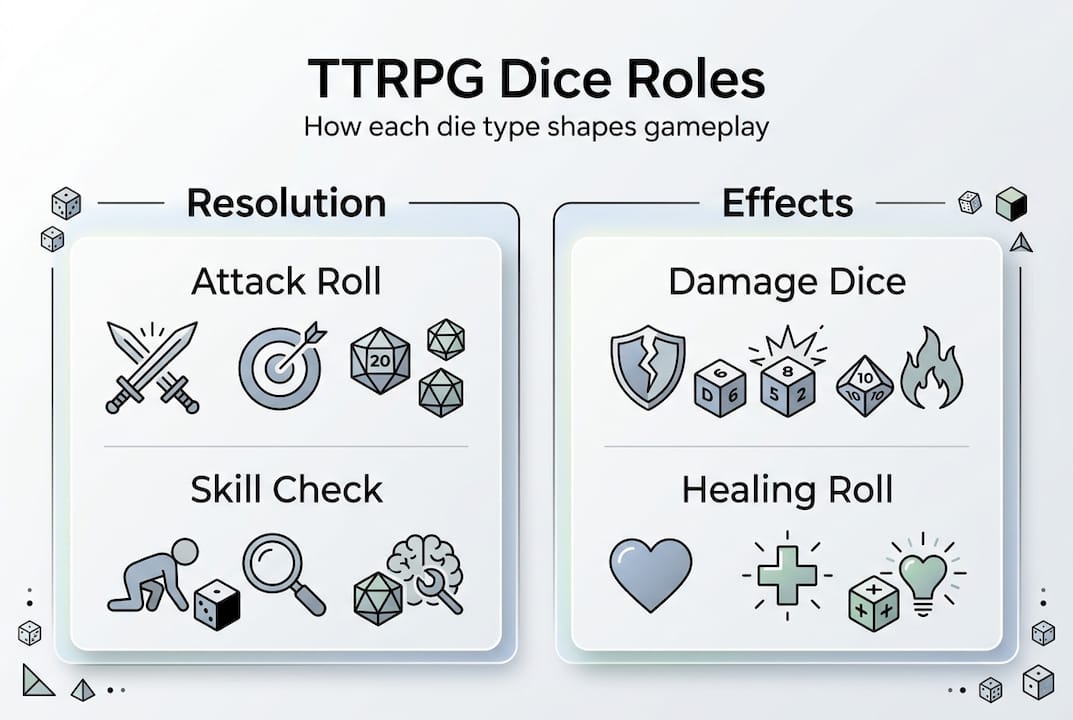
Smaller dice calculate damage and variable effects. When you hit with an attack, your weapon determines which damage die you roll. A rogue’s dagger uses 1d4, dealing 1 to 4 damage with equal probability. A fighter’s greatsword uses 2d6, creating a bell curve where 7 damage is most likely and extreme results (2 or 12) are rare. This distinction matters because understanding dice types helps you evaluate weapon choices and predict combat outcomes.

The d100 or percentile die consists of two d10s, one representing tens and one representing ones. Rolling a 7 on the tens die and 3 on the ones die gives you 73. Dungeon masters use this for random encounter tables, loot generation, and special mechanics like the Wild Magic Sorcerer’s surge table. Some classes and subclasses have features that trigger on specific percentile ranges, making this die crucial for certain character builds.
Pro Tip: Keep your dice organized by type in a dice tray or bag with compartments. This speeds up gameplay when you need to grab multiple dice quickly for damage rolls, and investing in custom dice sets with clear numbering prevents confusion during fast-paced combat encounters.
Common dice combinations you’ll roll frequently:
- 1d20 + modifier for any resolution check
- Multiple damage dice (3d6, 8d6) for powerful spells
- 1d4 + 1 for Magic Missile, which never misses
- 2d10 for percentile rolls using tens and ones dice
The impact of advantage, disadvantage, and modifiers on dice outcomes
Dungeons & Dragons introduced advantage and disadvantage mechanics that fundamentally change probability without complex math. When you have advantage, you roll two d20s and take the higher result, shifting your average roll from 10.5 to approximately 15.3. Disadvantage works inversely: roll two d20s and take the lower, dropping your average to roughly 5.7. These mechanics do not stack, meaning multiple sources of advantage still only let you roll two dice.
The strategic impact becomes clear when you consider success thresholds. Against a DC 15 challenge, a normal roll succeeds 30% of the time (rolling 15-20 on d20). With advantage, your success rate jumps to 51%, nearly doubling your chances. This makes advantage incredibly valuable for crucial rolls where failure has serious consequences. Smart players engineer situations that grant advantage before attempting high-stakes actions.
Critical hits and automatic failures override normal probability. A natural 20 always hits and often doubles damage dice, regardless of modifiers or target AC. A natural 1 always misses on attack rolls, though some tables apply additional fumble consequences. These extremes inject dramatic moments into gameplay, where even the weakest character can land a devastating blow or the mightiest warrior can embarrass themselves.
Modifiers stack with advantage to create powerful combinations. Your ability score modifier, proficiency bonus, magical item bonuses, and spell effects all add to your d20 roll. A character with +5 Strength modifier, +4 proficiency bonus, and +1 magic weapon adds +10 to attack rolls before rolling the die. Combined with advantage, this creates situations where success becomes highly probable but never guaranteed.
Understanding probability curves helps you make better tactical decisions:
- Stack modifiers and advantage before attempting high DC actions rather than relying on luck alone
- Use abilities that grant rerolls (like Halfling Lucky trait) on important rolls where failure means disaster
- Recognize that 3-4 dice pools create optimal bell curves without excessive calculation time
- Remember that advantage provides diminishing returns when your base chance already exceeds 50%
- Consider when to use limited resources like Inspiration or Bardic Inspiration for maximum impact
Pro Tip: Track which party members can grant advantage through abilities like Help action, Faerie Fire spell, or class features. Coordinating these resources before boss encounters dramatically improves your odds of landing critical hits or passing deadly saving throws, turning dice roll probabilities in your favor through teamwork.
“The difference between advantage and a normal roll is roughly equivalent to a +5 bonus, but it’s more valuable on moderate DCs where you need that extra push toward success. Understanding when to burn resources for advantage versus accepting normal odds separates experienced players from novices.”
Rerolls function differently than advantage. Features like the Lucky feat let you reroll any d20 and choose which result to use, effectively giving you a second chance after seeing a bad outcome. This differs from advantage because you see the first result before deciding to reroll, providing information that influences your choice. The Halfling Lucky racial trait automatically rerolls natural 1s, eliminating critical failures on important checks.
Common misconceptions and fairness of physical dice in gameplay
Many players worry that physical dice produce biased results, but empirical testing shows they approximate theoretical randomness remarkably well. A comprehensive study involving 4.38 million dice throws demonstrated that physical dice align closely with expected probability distributions, though significance levels ranged from 7-15% compared to the ideal 5%. This means physical dice behave fairly over large sample sizes, with minor deviations that rarely impact actual gameplay.
The misconception stems from small sample bias. If you roll ten times and get mostly low numbers, it feels like the die is cursed. Statistically, such streaks occur naturally within random distributions and balance out over hundreds of rolls. Your perception of “bad luck” often reflects normal variance rather than actual bias. Professional dice manufacturers use precision molding and balanced materials to minimize physical imperfections that could skew results.
Another study tested a single d20 over 1,000 rolls using Bayesian analysis and chi-square tests, confirming fairness within expected parameters. Unlike digital random number generators that produce truly uniform distributions, physical dice can have microscopic weight imbalances from air bubbles, uneven inking, or material density variations. These factors create negligible bias in practice, affecting outcomes by fractions of a percent across thousands of rolls.
“Physical dice introduce authentic randomness that feels more tangible than digital alternatives. While they may have minor manufacturing imperfections, these variations are statistically insignificant for tabletop gaming purposes. The tactile experience of rolling physical dice, hearing them clatter across the table, and watching them settle adds irreplaceable atmosphere to gameplay that perfectly fair digital dice cannot replicate.”
Quality matters when selecting dice. Cheaper dice with visible bubbles, uneven edges, or poor balance can exhibit noticeable bias. Premium dice made from materials like resin or metal with careful quality control provide more consistent results. Testing dice fairness involves float tests in saltwater to check balance or rolling large samples to compare against expected distributions.
No peer-reviewed benchmarks exist specifically for TTRPG dice beyond general fairness studies. The gaming community relies on manufacturer quality standards and anecdotal testing rather than standardized certification. This lack of formal benchmarking means players should purchase from reputable sources that prioritize manufacturing precision. Most gaming dice perform adequately for casual play, while competitive or tournament settings might warrant stricter quality requirements.
The practical takeaway: physical dice work well for tabletop gaming despite not being perfectly random. Their minor imperfections add character without compromising gameplay integrity. If you suspect a die is significantly biased, simple home tests like rolling it 100 times and recording results can reveal obvious problems. For the vast majority of gaming sessions, your dice are fair enough that skill, strategy, and teamwork matter far more than microscopic manufacturing variations.
Enhance your dice experience with premium RPG accessories
Now that you understand how dice mechanics shape gameplay strategy, consider how premium accessories can elevate your entire tabletop experience. Quality tools transform sessions from functional to memorable, helping you visualize combat encounters and track campaign details more effectively.

Detailed battle maps bring tactical depth to encounters by providing clear visual references for positioning, terrain effects, and environmental hazards. Instead of describing distances verbally, you can show exactly where characters stand relative to enemies and obstacles. This clarity speeds up combat resolution and helps players make more informed tactical decisions based on spatial relationships.
Campaign organization becomes effortless with dedicated journals designed for tabletop gaming. Dungeon master journals help you track NPCs, plot threads, and session notes in structured formats that make information retrieval quick during gameplay. Player journals let you record character development, treasure inventories, and personal quest goals in one convenient place. These tools complement your dice strategy by ensuring you never lose track of important modifiers, abilities, or story details that affect your rolls.
FAQ
What is the primary function of dice in tabletop RPGs?
Dice introduce randomness to resolve uncertain player actions and game events, creating fair outcomes that neither players nor dungeon masters can predetermine. They determine success or failure for attacks, skill checks, and saving throws while adding tension to every action. This mechanical uncertainty transforms gameplay into collaborative storytelling where unexpected results create memorable moments.
How does advantage and disadvantage affect dice rolling in D&D?
Advantage means rolling two d20s and taking the higher result, increasing your average roll from 10.5 to approximately 15.3 and roughly doubling success rates on moderate difficulty checks. Disadvantage works inversely by taking the lower roll, dropping your average to about 5.7 and significantly reducing success probability. These mechanics do not stack regardless of how many sources you have, and they provide roughly equivalent impact to a +5 or -5 modifier depending on the target DC.
Are physical dice truly fair or biased?
Physical dice mostly approximate theoretical randomness in large sample sizes, with empirical tests of millions of rolls showing close alignment to expected probability distributions. Minor manufacturing biases exist from factors like air bubbles or uneven inking, but these imperfections create negligible impact during regular gameplay. Professional testing confirms that quality dice perform similarly to digital random number generators for practical tabletop gaming purposes, with any deviations balancing out over the hundreds of rolls that occur during campaigns.
What are some pro tips for using dice effectively in gameplay?
Stack modifiers and advantage strategically before attempting high difficulty checks rather than relying on base rolls alone, as this dramatically improves success probability. Understand probability curves like binomial distributions for dice pools to evaluate weapon and spell choices objectively. Use rerolls thoughtfully by saving them for crucial moments where failure has serious consequences, such as death saving throws or boss encounter attacks. Coordinate with party members who can grant advantage through Help actions or spells, and track which dice usage strategies work best for your character build and play style.