

TL;DR:
- Collect dice thoughtfully by considering rarity, material, craftsmanship, and provenance for value and experience.
- Proper care, organization, and storage are essential to maintain dice quality and enhance collection display.
- Focus on meaningful, curated sets rather than quantity, and explore unique materials and mystery packs for variety.
Let’s be honest, dice goblins: the struggle is real. You spot a gorgeous set of hand-poured resin dice with galaxy swirls and your brain lights up like a Nat 20. But a collection without strategy is just a beautiful pile of chaos. Between choosing what’s actually worth adding, keeping everything in pristine condition, and figuring out how to display your hoard without it looking like a dragon’s treasure dump, there’s a LOT to manage. We put together this guide to help you collect smarter, protect better, and show off your dice sets like the legendary curator you truly are.
Table of Contents
- Set smart criteria for collecting dice
- Identify unique dice types and materials
- Best practices for caring for and protecting your collection
- Organizing, tracking, and displaying your dice sets
- What most collectors get wrong about dice sets
- Explore unique dice sets and mystery packs
- Frequently asked questions
Key Takeaways
| Point | Details |
|---|---|
| Set clear criteria | Valuable collections focus on rarity, material, craftsmanship, and provenance. |
| Recognize unique materials | Different dice materials affect value, look, and care requirements. |
| Protect and store wisely | Regular cleaning, proper handling, and padded storage maintain dice quality. |
| Track your sets | Cataloging by spreadsheet or app prevents loss and boosts long-term enjoyment. |
| Curation beats quantity | Intentional, meaningful curation makes a collection more satisfying than amassing generic sets. |
Set smart criteria for collecting dice
Not all dice are created equal, and that’s exactly what makes collecting so thrilling. But before you impulse-buy your fifteenth set (no judgment, we’ve been there), it helps to have a clear framework for what actually deserves a spot in your collection.
Here’s what we think about when evaluating a new set:
- Rarity: Is this a limited run or a mass-produced set you can grab anywhere?
- Material: Gemstone, metal, hand-poured resin, or standard acrylic? Rarer materials carry more weight.
- Artisan creation: Was this made by a small-batch maker or a big factory?
- Edition size: Smaller print runs mean higher long-term collectible value.
- Provenance: Do you know the story behind the set? Where it came from, who made it, when?
These factors matter for two big reasons: investment and experience. A set with a great story feels different in your hand during a campaign. And when it comes to unique dice set examples, the sets that hold or grow in value almost always check multiple boxes on that list.
For collectible value, prioritize limited editions, artisan craftsmanship, small-batch runs, unique materials like gemstone or ivory, and documented provenance. That’s not just collector wisdom, that’s the difference between a set worth $20 and one worth $200 (or more).
Balancing passion with smart selection is its own art form. Some sets will call to you purely because they match your campaign aesthetic. That’s valid! But knowing the quality dice criteria helps you avoid buyer’s remorse and build a collection that genuinely excites you every time you open the case.
“A great dice collection isn’t just about what you own. It’s about what each set means to you and why you chose it.”
Pro Tip: Keep a small notebook or digital doc for each set you acquire. Log the maker, material, purchase date, price, and any fun backstory. Future you will thank present you enormously.
Identify unique dice types and materials
Once you know what makes a dice set worth collecting, exploring different dice types and materials unlocks even more possibilities. And trust us, the rabbit hole goes DEEP.
Here’s a quick breakdown of the most common (and most exciting) materials you’ll encounter:
- Acrylic: Affordable, lightweight, and available in endless colors. Great for everyday play but lower on the collectible scale.
- Resin: Hand-poured resin sets are where artisan magic happens. Inclusions like flowers, glitter, or tiny skulls make each set one-of-a-kind.
- Metal: Heavy, satisfying, and intimidating on the table. Metal dice have serious presence.
- Gemstone: Some dice use unique materials like gemstone or even ivory for heightened collectible value. Amethyst, obsidian, and tiger’s eye are collector favorites.
- Wood: Warm, natural, and surprisingly rare. Wood dice feel like artifacts from another era.
You can explore the full range of types of D&D dice sets to see how each material affects gameplay feel and display appeal.
| Material | Cost | Rarity | Care needs | Risk factors |
|---|---|---|---|---|
| Acrylic | Low | Common | Minimal | Fading over time |
| Resin | Low to mid | Uncommon | Light cleaning | Scratching |
| Metal | Mid to high | Uncommon | Occasional polish | Chipping tables |
| Gemstone | High | Rare | Padded storage | Cracking, chipping |
| Wood | Mid | Rare | Avoid moisture | Warping, splitting |
If you want to go truly custom, you can even create custom dice tailored to your campaign theme or personal aesthetic. That’s next-level collector energy right there.
Best practices for caring for and protecting your collection
With your collection growing, proper care and storage become crucial. Don’t lose value to accidents or neglect. This is where many collectors drop the ball, and it’s such a fixable problem.
Here’s a numbered routine to keep your sets in top condition:
- Clean regularly. Clean with mild soap and water, then dry thoroughly before storing. Avoid harsh chemicals that can strip finishes or cloud resin.
- Roll on trays or mats. Hard surfaces chip metal dice and scratch gemstone sets. A soft rolling mat protects both your dice and your table.
- Test for fairness. Float dice in a saturated salt water solution to check balance. A fair die sinks without spinning. Biased dice will favor one side.
- Avoid heat and direct sunlight. UV light fades acrylic and resin over time. Heat can warp wood and soften certain resin blends.
- Organize by type and theme. Organize by type, color, set, or theme using spreadsheets to track condition and location.
- Use appropriate storage. Pouches work for acrylic. Padded boxes are better for metal and gemstone. Display cases are ideal for your prized pieces.
Speaking of storage, if you’re still using a beat-up bag from 2019, it’s time to upgrade your dice storage. Your collection deserves better than that.
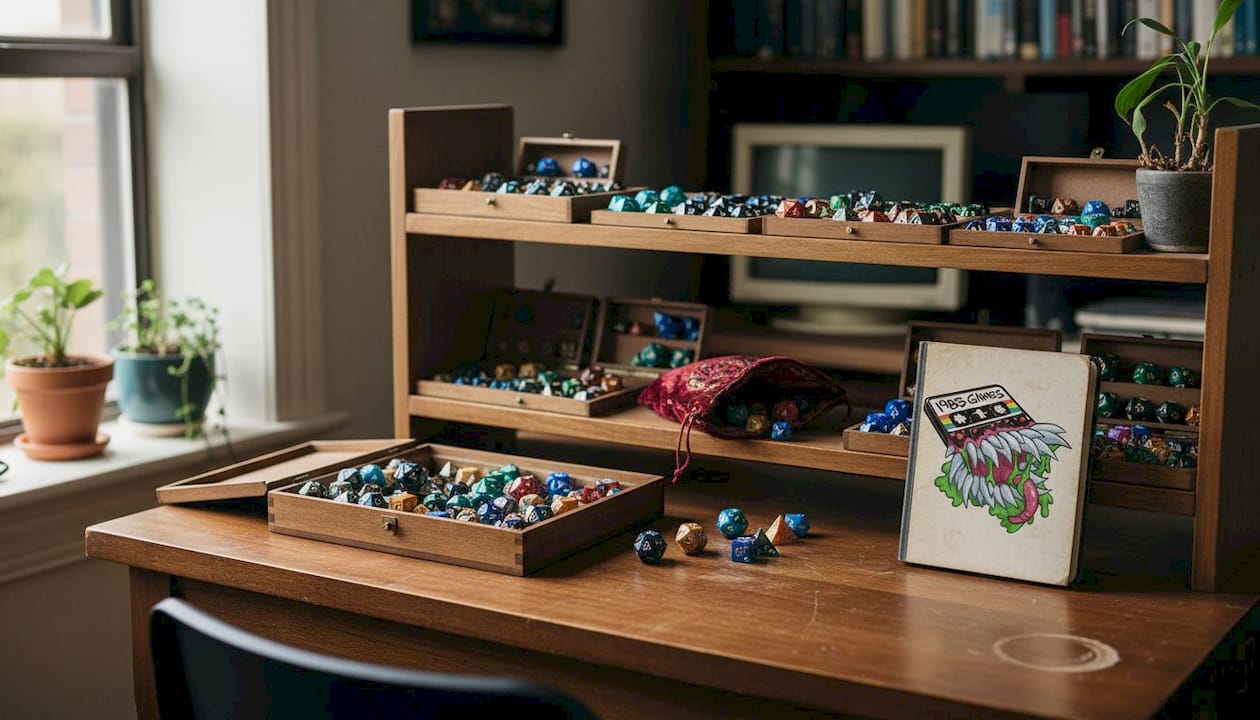
And if you’re wondering why all this care matters beyond aesthetics, consider this: well-maintained dice sets hold their value far longer and make collecting for RPG fun genuinely rewarding over the years.
Pro Tip: Store gemstone and metal dice separately from each other and from acrylic sets. Metal can scratch softer materials, and gemstone dice can crack if they knock together in a shared pouch.
Organizing, tracking, and displaying your dice sets
After you’ve got care routines down, organizing and displaying lets you fully enjoy and manage your collection. This is honestly one of the most satisfying parts of being a collector.
There are several ways to organize your sets, and the best method depends on your collection size and personality:
- By theme: Group sets that match specific campaigns or aesthetics (forest, undead, celestial).
- By material: Keep all metal together, all gemstone together, and so on.
- By rarity: Display your rarest pieces prominently and store everyday sets more practically.
- By color: Purely visual, but incredibly satisfying for display purposes.
- By campaign: Assign specific sets to characters or adventures for a personal touch.
For tracking, a simple spreadsheet works wonders. Organize by type, color, set, or theme using spreadsheets to log condition, acquisition date, and estimated value. Dedicated collector apps are also emerging as solid options for larger hoards.
| Method | Accessibility | Protection | Aesthetics | Best for |
|---|---|---|---|---|
| Spreadsheet | High | N/A | N/A | Tracking value and condition |
| Collector app | High | N/A | N/A | Large or growing collections |
| Display case | Medium | High | Excellent | Showcase pieces |
| Shadow box | Low | High | Excellent | Retired or display-only sets |
| Rotating tray | High | Medium | Good | Active gaming collections |
For display inspiration, shadow boxes are incredible for retired campaign sets. Rotating trays keep your active gaming dice accessible. And a dedicated shelf with small stands turns your collection into wall art. Check out this step-by-step guide to using dice sets to see how organization connects directly to better gameplay experiences.
What most collectors get wrong about dice sets
Here’s the uncomfortable truth we’ve learned from years in the dice community: bigger isn’t always better. We see collectors chase quantity, buying set after set, until their collection feels more like a storage problem than a source of joy.
The most meaningful collections we’ve seen are intentional. Every set has a story. Every set was chosen, not just accumulated. That’s the real flex, not owning 200 sets, but owning 30 that each mean something.
Another mistake? Forgetting to test for fairness. A gorgeous gemstone set that rolls biased is a display piece, not a gaming tool. Know what you have and use it accordingly.
And please, cycle out sets that no longer inspire you. It’s okay. Gifting or trading a set that’s lost its spark to a new player is one of the best things you can do for the community. Before your next session, think about upgrading before game night with something that genuinely excites you. A curated collection of meaningful sets will always outshine a pile of forgotten purchases.
Explore unique dice sets and mystery packs
Ready to put all these tips into action? Your next great addition might be closer than you think.

At 1985 Games, we handpick every set with collectors and players in mind. Our mystery dice sets are a brilliant way to discover artisan-grade and rare sets without the research overload. It’s like opening a loot box, but the loot is actually incredible. If you want to go bigger, the mystery dice 6 pack is perfect for growing your collection fast while applying everything you just learned about materials, rarity, and curation. Every pack is a surprise, and every surprise is a potential new favorite.
Frequently asked questions
How do I know if my dice set is valuable?
Check for limited editions, artisan craftsmanship, unique materials, and documented provenance to judge value. Sets that combine multiple of these factors tend to hold or grow in worth over time.
What’s the safest way to clean D&D dice sets?
Clean with mild soap and water and dry thoroughly before storing. Avoid abrasive cleaners or soaking, especially for wood and gemstone dice.
What should I use to organize and track my dice collection?
Use spreadsheets or dedicated collector apps to log dice by type, color, set, or theme. This makes it easy to monitor condition and track value over time.
How do I avoid damaging metal or gemstone dice?
Store in padded boxes and roll only on soft trays or mats to prevent chips and scratches. Keep metal and gemstone sets stored separately to avoid them damaging each other.