

TL;DR:
- Sharp edge dice feature precise, angular edges that enhance geometric accuracy and fairness.
- Empirical testing shows sharp edge dice often roll more consistently than rounded ones.
- They are ideal for serious players, collectors, and high-stakes gaming, but less durable for casual use.
Not all dice are created equal, dice goblins. We know, we know — that sounds like the kind of thing a suspiciously enthusiastic dungeon master would say before revealing a house rule that ruins everything. But hear us out. Most players grab a set of pretty dice, toss them across the table, and assume the math works out fair and square. Sharp edge dice challenge that assumption completely, and the deeper you go into their design, their manufacturing quirks, and their real-world impact on your rolls, the more your gaming brain will light up like a Nat 20 crit on a dragon.
Table of Contents
- What are sharp edge dice?
- How do sharp edge dice impact fairness and randomness?
- Sharp edge vs rounded dice: What’s the real difference?
- When should you choose sharp edge dice for your games?
- Why sharp edge dice are more than a trend: Our take
- Explore premium dice and gaming accessories
- Frequently asked questions
Key Takeaways
| Point | Details |
|---|---|
| Dice fairness explained | Sharp edge dice expose manufacturing flaws and may roll more fairly, but only when quality control is ensured. |
| Comparing dice types | Sharp edge dice favor precision while rounded dice excel in durability and affordability for casual RPG play. |
| Testing matters | Fairness isn’t guaranteed by shape; empirical testing of rolls is crucial for identifying bias. |
| Choosing for your needs | Select sharp edge dice if you value balanced rolls or unique aesthetics, but rounded dice work well for everyday gaming. |
| Practical application | Enhance your D&D sessions with dice tested for fairness and choose accessories that fit your gaming style. |
What are sharp edge dice?
Let’s start at the beginning. Sharp edge dice are exactly what they sound like: dice with crisp, angular, precise edges instead of the soft, rounded edges you find on most mass-produced sets. Pick up a standard polyhedral set from a game store and run your finger along the edges. Smooth, right? Rounded. Almost comfortable. Now imagine those same edges cut with surgical precision, sharp enough to feel almost architectural.
The manufacturing process behind sharp edge dice is genuinely fascinating. Most are made from resin or high-grade acrylic poured into precision molds, then finished by hand. That handcrafted element is a big deal. It means every face, every edge, every corner gets deliberate attention. The sharpness isn’t just cosmetic. It’s a byproduct of a process that prioritizes geometric accuracy over convenience or speed.
So why do edges matter for D&D players? Here’s the sneaky truth:
- Rounded edges can hide air bubbles, uneven resin distribution, or weighted imperfections that subtly skew results
- Sharp edges make manufacturing flaws more visible and therefore easier to catch before a set ships to your table
- The geometry of a sharp edge die is closer to a mathematically ideal polyhedron, which supports more consistent tumbling behavior
- Sharp edge dice are widely favored in premium dice sets built for serious RPG players who want their rolls to feel earned
According to empirical testing, sharp edge dice are claimed to roll more consistently than rounded ones due to precision manufacturing that exposes imbalances, though true fairness still requires formal testing methods like chi-square analysis.
You can check out our dice set quality guide for a full breakdown of what separates a mediocre set from one that belongs on your adventuring table.
How do sharp edge dice impact fairness and randomness?
Here’s where things get juicy. Fairness in dice isn’t just a vibe. It’s measurable. And sharp edge dice have a reputation for sitting closer to the “fair” end of the spectrum, though the word “reputation” is doing some heavy lifting there. Shape alone doesn’t guarantee fairness. Testing does.
So how do D&D players actually evaluate dice fairness? The two most popular methods among serious players are chi-square testing and Bayesian analysis. Chi-square testing (a statistical method that compares observed results to expected results) requires anywhere from 100 to 1,000 rolls per die. Bayesian analysis adds another layer of probability modeling to refine the conclusion. Both methods are nerdy in the most spectacular way possible.
The real-world fairness testing data reveals something compelling: running chi-square or Bayesian analysis across 100 to 1,000 rolls does confirm that some sets are statistically fairer than others.
Here’s a quick data snapshot comparing popular dice types based on SSE (Sum of Squared Errors, meaning how far results deviate from perfect randomness; lower is better):
| Dice type | Average SSE score | Edge style | Manufacturing method |
|---|---|---|---|
| Gamescience sharp edge | 80 | Sharp | Precision poured resin |
| Standard RPG rounded | 98 to 150 | Rounded | Mass-produced plastic |
| Budget random sets | 150 and above | Rounded | Injection molded |
| Handcrafted premium resin | 85 to 100 | Sharp | Hand finished resin |
That SSE gap between Gamescience sharp dice (around 80) and standard rounded dice (98 to 150) is not trivial. It represents real deviation in how often each face lands. Over a long campaign, those numbers add up in ways that matter.
Statistic callout: Gamescience sharp edge dice consistently score an SSE of approximately 80, while standard rounded polyhedral dice score between 98 and 150, according to empirical roll testing. That’s nearly double the deviation in some cases.
Pro Tip: Before you run a campaign with brand new dice, roll each die 100 times and tally results in a spreadsheet. If one number appears more than 15 times or fewer than 5 times, your die might have a bias worth investigating before it decides the fate of your rogue.
Understanding what makes quality dice for RPGs goes way beyond aesthetics. It’s about knowing whether your dice are actually giving your character a fair shot. And if you love the unpredictable thrill of variety, our guide on random dice sets shows how randomness itself can enhance immersion when used intentionally.

Sharp edge vs rounded dice: What’s the real difference?
Alright, dice goblins. Time for the head-to-head. Sharp edge vs rounded dice is one of the great TTRPG debates, somewhere between “theater of the mind vs battle maps” and “should clerics get cantrips.” Here’s how both camps really stack up.
| Feature | Sharp edge dice | Rounded dice |
|---|---|---|
| Edge precision | High | Low to moderate |
| Fairness potential | Higher (with quality control) | Variable |
| Durability | Lower (prone to chipping) | Higher |
| Typical price | Premium | Budget to mid-range |
| Manufacturing style | Handcrafted or precision poured | Mass-produced |
| Aesthetic appeal | Striking, collector-worthy | Casual and accessible |
| Best suited for | Serious players, collectors, competitive play | Casual groups, beginners |
The testing data makes it clear: proponents of sharp edge dice argue their precision gives them a fairness edge, with Gamescience sharp dice scoring SSE of 80 compared to rounded sets scoring 98 to 150. But critics rightly point out that sharp edges don’t guarantee fairness without strong quality control, and rounded dice can be more durable and practical for players who aren’t tracking SSE scores between sessions.
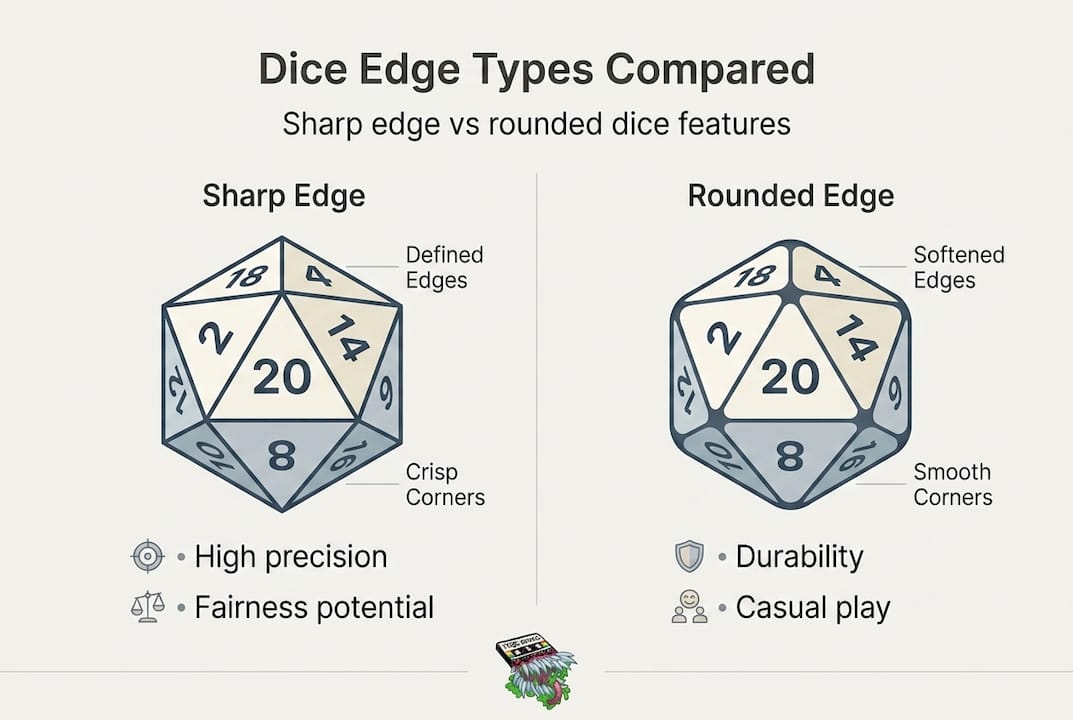
Sharp edge dice also win on the collector and immersion front. There is something undeniably satisfying about pulling out a set of geometrically perfect, resin-cast polyhedrals before a boss fight. It sends a message. It says: I came prepared.
Here’s what each camp of player tends to prioritize:
Sharp edge dice fans value:
- Statistical precision and accountability in rolls
- Premium aesthetics that enhance table presence
- The collector experience of owning something handcrafted
- Competitive play scenarios where fairness disputes actually matter
Rounded dice fans value:
- Durability over long-term use
- Accessibility and lower price points
- Availability in wider color and style ranges
- Casual gameplay where fairness analysis isn’t part of the fun
“The question isn’t which dice type is objectively better. The question is which dice type is better for you and your table.” That’s real talk from our corner of the gaming community.
Understanding the role of dice in D&D gameplay helps clarify why this choice matters more in some gaming contexts than others. And if you’re just starting your collection, our best dice for D&D guide will help you navigate your first set with confidence.
When should you choose sharp edge dice for your games?
Great question, dear reader. Let’s get practical. Sharp edge dice aren’t the right call for every gaming situation, and knowing when to reach for them is its own kind of skill. Here’s a clear breakdown of scenarios where sharp edge dice shine brightest.
-
Competitive or high-stakes play. When you’re in a tournament-style TTRPG event or a campaign where every roll carries serious narrative weight, fairness disputes need a clear answer. Sharp edge dice with documented quality control give you that baseline.
-
When you want to geek out on fairness. If you’re the kind of player who loves tracking roll distributions and running chi-square tests for fun, sharp edge dice give you the most interesting data. They’re basically the scientist’s choice.
-
Collector and aesthetic goals. Sharp edge dice sets often come in strikingly beautiful resin colors, patterns, and finishes that rounded dice simply can’t replicate. If your dice collection is part of your identity (no judgment, we get it), sharp edge sets deliver hard on that front.
-
When manufacturing transparency matters. Precision manufacturing exposure means flaws are less likely to hide inside a sharp edge die, making it easier for manufacturers and buyers to spot and reject bad sets before they hit the gaming table.
-
Long-term campaign investment. If you’re starting a campaign that’ll run for months or years, investing in quality dice that you’ve tested and trust pays dividends in peace of mind. No more wondering if your D20 is secretly conspiring against your paladin.
Now, sharp edge dice aren’t ideal when:
- You’re buying for kids or newer players who may drop or mishandle dice (the chipping risk is real)
- Budget is a genuine constraint and the price difference is hard to justify
- Your gaming group plays fast and loose with narrative over mechanics anyway
Pro Tip: If you’re committed to sharp edge dice but worried about durability, store them in individual compartments in a padded dice tray or case. Keeping them from clacking together dramatically extends their lifespan and keeps those edges pristine.
Exploring custom dice for RPGs opens up a whole creative world alongside the fairness conversation. And for a broader view of how dice function in TTRPGs across different game systems, that’s a rabbit hole worth diving into.
Why sharp edge dice are more than a trend: Our take
Here’s our hot take, and we’re sticking to it: most conversations about sharp edge dice get laser-focused on fairness statistics and miss the bigger picture entirely.
Yes, SSE scores matter. Yes, chi-square testing is cool and useful. But here’s the thing almost nobody talks about: the ritual of choosing and using premium dice is genuinely part of the gaming experience. Sharp edge dice aren’t just tools. They’re artifacts. They carry weight in how a player shows up to the table.
We’ve seen it happen over and over in the gaming community. A player upgrades from a basic plastic set to a handcrafted sharp edge set, and suddenly they’re more invested. They take their rolls more seriously. They feel more connected to their character. That’s not superstition. That’s the psychology of immersion doing its thing.
The uncomfortable truth is that quality control matters far more than edge style alone. A poorly manufactured sharp edge die is worse than a well-made rounded one. Every time. Edge precision is a signal of care in the manufacturing process, not a guarantee of fairness on its own. That’s why sourcing from makers who prioritize quality control is the real alpha play here.
We also think the “sharp edge vs rounded” debate gets framed too much as an either/or situation. Many serious players own both. Rounded dice for casual sessions. Sharp edge for campaigns where immersion and accountability are at their peak.
What we tell every dice goblin who asks us: choose for your table, not for the internet’s opinion. Explore premium dice for RPGs when you’re ready to level up, and do it because it adds something real to your experience, not because a blog told you to.
Explore premium dice and gaming accessories
If this deep dive into sharp edge dice has your inner collector doing a happy dance, we’ve got exactly what you need next.

At 1985 Games, we stock an incredible selection of premium dice sets built for serious adventurers and casual dice goblins alike. Our sharp edge dice sets are handcrafted, visually stunning, and built to bring real precision to your rolls. We ship globally because great dice shouldn’t have borders. And while you’re leveling up your dice game, don’t sleep on our player’s journals — the perfect companion for tracking your campaign, your character arc, and yes, your roll statistics if you’re going full nerd mode. We support that lifestyle completely.
Frequently asked questions
Are sharp edge dice always fairer than rounded dice?
Not always. Sharp edges expose manufacturing flaws more readily, but true fairness depends entirely on quality control and verifiable testing, not edge style alone.
How can I test if my sharp edge dice are balanced?
Roll each die 100 to 1,000 times and apply a chi-square or Bayesian analysis to the results to determine whether the distribution is statistically fair.
Do sharp edge dice chip or wear more easily?
Yes, sharp edge dice are more prone to chipping than rounded dice because their precise edges are more vulnerable to impact, so careful storage in padded cases is essential.
Are sharp edge dice worth the price for casual play?
For casual sessions, rounded dice are usually more practical and durable, but sharp edge dice offer real value for collectors, competitive players, and those who find that sharpness doesn’t guarantee fairness without proper quality control.