

You’ve probably heard someone say they can test dice fairness by rolling a few times or floating them in water. While these ideas sound reasonable, they rarely prove anything about actual dice quality. True dice fairness involves statistical testing, balanced manufacturing, and understanding what makes a die genuinely unbiased. This guide walks you through the science behind dice quality assessment, practical testing methods, and how to choose reliable dice sets for your tabletop sessions.
Table of Contents
- Why Understanding Dice Quality Matters For Your Game
- How Dice Fairness And Balance Are Tested Statistically
- Common Pitfalls And Nuances In Dice Quality Testing
- Applying Dice Quality Knowledge: Choosing And Testing Your Dice Set
- Enhance Your RPG Sessions With Quality Gaming Products
- Frequently Asked Questions
Key takeaways
| Point | Details |
|---|---|
| Dice quality depends on manufacturing precision and balance | Properly crafted dice minimize bias through weight distribution and machining accuracy. |
| Statistical testing reveals true fairness | Methods like Pearson’s chi-square test detect bias by comparing observed versus expected roll frequencies. |
| Sample size matters critically | Reliable testing requires 500+ rolls for d4, 1000+ for d6, and 2000+ for d20 dice. |
| Visual appeal differs from functional fairness | Aesthetics enhance immersion but don’t guarantee balanced, unbiased results. |
| Proper testing avoids false conclusions | Understanding statistical power and error thresholds prevents mistaken fairness claims. |
Why understanding dice quality matters for your game
Dice fairness directly affects game balance and player enjoyment in tabletop RPGs. When your d20 consistently rolls high or low, combat encounters become skewed, skill checks feel rigged, and players lose trust in outcomes. Quality dice minimize bias and increase confidence in results, making every roll feel legitimate.
High quality dice are typically machined for precision or crafted with balanced weight distribution. These manufacturing methods ensure each face has an equal probability of landing face up. While appearance and feel matter for immersion and tactile satisfaction, they’re secondary to functional fairness.
Consider these core quality factors:
- Manufacturing precision determines how symmetrical and balanced each die is
- Material consistency affects weight distribution across all faces
- Edge sharpness and corner uniformity influence rolling physics
- Surface finish impacts how dice interact with rolling surfaces
For serious players and dungeon masters who want consistent game outcomes, understanding dice quality is essential. A biased die can ruin critical story moments, invalidate character builds, or make encounters impossibly hard or trivially easy. Knowing what makes dice fair helps you choose sets that support rather than undermine your game.
How dice fairness and balance are tested statistically
Testing dice fairness involves rolling each die many times and recording outcomes. You then compare observed frequencies to expected frequencies using statistical methods. The two main approaches are Pearson’s chi-square test and the sum squared error method.
Pearson’s chi-square test works like this:
- Roll the die a specific number of times and record each result
- Calculate expected frequency for each face (total rolls divided by number of faces)
- Compare observed versus expected frequencies using the chi-square formula
- Determine if differences are statistically significant at the 5% level
For example, if you roll a d6 thirty times, you expect each face to appear five times. The chi-square test calculates whether your actual results deviate enough to indicate bias.
The sum squared error method provides a simpler alternative:
- Roll the die and tally results for each face
- Calculate the difference between observed and expected for each face
- Square each difference and sum them all
- Compare the total to a threshold specific to the die type
For a d6 with 30 rolls, a fair die should have SSE ≤ 55. For a d20 with 100 rolls, the threshold is ≤ 150. These thresholds control Type I errors (false positives) with 5% significance, meaning you’ll incorrectly reject a fair die only 5% of the time.
Key thresholds for common dice types:
- d4: SSE ≤ 33 for 20 rolls
- d6: SSE ≤ 55 for 30 rolls
- d8: SSE ≤ 73 for 40 rolls
- d10: SSE ≤ 92 for 50 rolls
- d12: SSE ≤ 110 for 60 rolls
- d20: SSE ≤ 150 for 100 rolls
Both methods require sufficiently large sample sizes for reliable results. Small samples produce high variability that masks true bias or falsely suggests problems with fair dice.
Common pitfalls and nuances in dice quality testing
Many dice tests posted online are based on too few rolls, making their fairness claims unreliable. Rolling a d20 fifty times might seem thorough, but it lacks the statistical power to confidently detect bias. Insufficient sample sizes undermine validity; a d4 requires about 880 rolls for reliable testing power.
Another common mistake involves misinterpreting total rolls versus per die sample sizes. If someone tests five d6 dice with 200 total rolls, that’s only 40 rolls per die, far below the recommended 1000+ for confident assessment. This confusion leads to false confidence in testing results.
Chi-square tests are often misused when comparing dice precision or fairness. The test determines if one die differs from expected values, but it doesn’t effectively compare multiple dice against each other. Proper dice comparison requires different statistical approaches entirely.
Expert recommendations for minimum sample sizes:
- d4: 500+ rolls minimum, 880+ for statistical power of .8
- d6: 1000+ rolls minimum
- d8: 1200+ rolls minimum
- d12: 1500+ rolls minimum
- d20: 2000+ rolls minimum
Testing at statistical power of .8 with appropriate rarity thresholds ensures you can detect genuine bias while avoiding false positives. Lower sample sizes dramatically increase the chance of missing real problems or flagging fair dice incorrectly.
Pro Tip: When testing multiple dice from the same set, test each die individually with full sample sizes rather than splitting rolls across dice. This approach gives you reliable data for each die instead of weak data for all.
Understanding these nuances helps you evaluate dice collecting claims and testing videos critically. Most casual tests simply don’t provide enough data to prove fairness, even when results look reasonable.
Applying dice quality knowledge: choosing and testing your dice set
Start by selecting dice made with precision machining or well balanced craftsmanship. Look for manufacturers that discuss quality control processes, material consistency, and testing procedures. Metal dice are often machined for accuracy, while resin dice quality varies widely by maker.

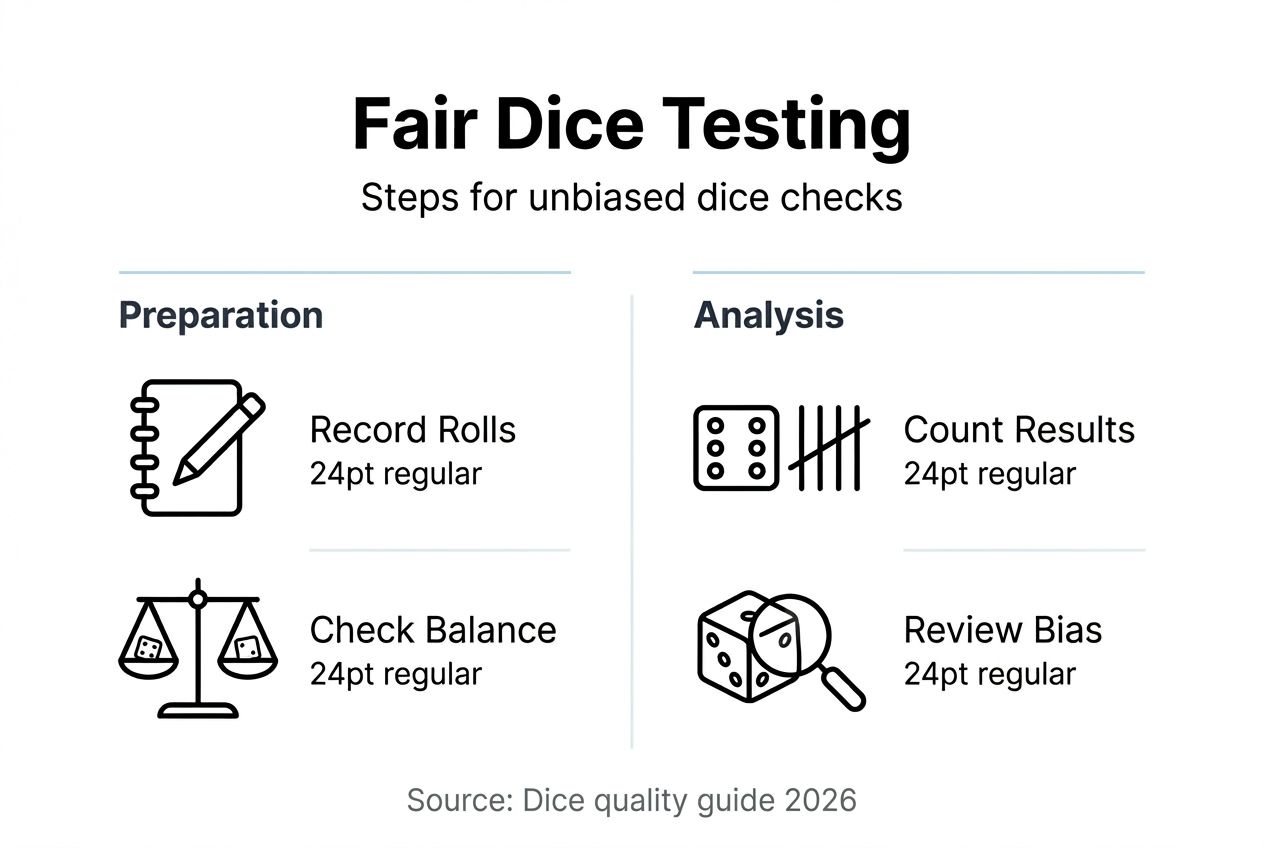
Test new dice sets by rolling each die sufficient times following the statistical methods outlined earlier. While full testing requires hundreds or thousands of rolls, even 50 to 100 rolls per die can reveal obvious bias. Record results in a simple spreadsheet to calculate SSE and compare against thresholds.
Maintain your dice by keeping them clean and storing them safely. Dirt and residue can affect rolling physics slightly. Store dice in padded bags or cases to prevent chipping and surface damage that might create imbalance over time.
Quick dice quality checklist:
- Balance: uniform weight distribution across all faces
- Fairness: statistically unbiased roll results
- Manufacturing precision: symmetrical faces and consistent dimensions
- Material quality: no bubbles, voids, or inconsistencies
- Aesthetics: visual appeal that enhances your game immersion
Here’s a comparison of testing requirements by die type:
| Die Type | Minimum Rolls | Recommended Rolls | SSE Threshold (minimum) |
|---|---|---|---|
| d4 | 100 | 500-880 | 33 (20 rolls) |
| d6 | 200 | 1000+ | 55 (30 rolls) |
| d8 | 250 | 1200+ | 73 (40 rolls) |
| d10 | 300 | 1400+ | 92 (50 rolls) |
| d12 | 350 | 1500+ | 110 (60 rolls) |
| d20 | 400 | 2000+ | 150 (100 rolls) |
Quick balance test for a d6:
- Roll the die 30 times and record each result
- Count how many times each face (1-6) appeared
- Calculate expected frequency: 30 ÷ 6 = 5 times per face
- For each face, subtract expected from observed and square the result
- Add all squared differences together to get SSE
- Compare your SSE to the threshold of 55
- If SSE exceeds 55, the die may be biased and needs more testing
Pro Tip: Test dice multiple times on different days to confirm consistency. A single test session might show bias due to rolling technique or surface variations rather than die imbalance.
Consider investing in custom or premium dice for important sessions. Higher quality manufacturing typically correlates with better fairness. While no die is perfectly balanced, precision crafted sets minimize bias significantly.
When upgrading your dice, prioritize functional fairness over pure aesthetics. Beautiful dice that roll poorly create frustration. Balanced dice that also look stunning deliver the best experience.
Enhance your RPG sessions with quality gaming products

Once you’ve secured reliable, fair dice for your game, consider enriching your sessions with premium terrain and campaign tools. Dungeon Craft Vol. 2 provides detailed battle maps that bring encounters to life with tactical depth. For darker campaigns, Dungeon Craft Cursed Lands offers haunting terrain perfect for horror themed adventures.
Organize your campaign notes, NPC details, and session prep with the DM’s Journals 3 Pack. These journals help you track complex storylines and maintain consistency across sessions. Pairing quality dice with thematic terrain and organized campaign management creates an immersive tabletop experience where every element supports your storytelling.
Pro Tip: Combining fair dice with tactile terrain maps and well organized notes elevates player engagement dramatically. The physical elements of quality gaming products reinforce the collaborative storytelling at the heart of great RPG sessions.
Frequently asked questions
What makes a dice set high quality?
High quality dice sets feature balanced weight distribution, precise manufacturing, and consistent materials that ensure fair rolling outcomes. Quality also includes durability, readability, and aesthetic appeal that enhances your gaming experience.
How many rolls are needed to test dice fairly?
Reliable testing requires 500+ rolls for d4, 1000+ for d6, and 2000+ for d20 dice to achieve statistical confidence. Smaller samples lack the power to detect bias or may falsely suggest problems with fair dice.
Do expensive dice roll more fairly than cheap ones?
Expensive dice often use precision machining and quality control that improve fairness, but price alone doesn’t guarantee balance. Test any dice set regardless of cost to verify actual rolling fairness.
Can you test dice at home without special equipment?
You can perform basic statistical tests at home by rolling dice many times and recording results. Calculate sum squared error and compare to thresholds, or use online chi-square calculators to analyze your data.
Why does dice appearance matter if fairness is key?
Appearance enhances immersion and tactile enjoyment during gameplay, making sessions more engaging and memorable. While fairness ensures mechanical integrity, aesthetics contribute to the overall experience and storytelling atmosphere.
Should I test every die in my collection?
Test dice you use for critical rolls or important campaigns to ensure fairness. Casual dice for low stakes games need less scrutiny, but knowing your main set performs fairly builds confidence and trust at the table.