

Every roll of the dice in Dungeons & Dragons determines whether your hero survives a dragon’s breath or falls to a goblin’s arrow. Yet many players misunderstand how different dice types actually shape their gaming experience. The d20 isn’t just a random number generator, it’s the heartbeat of narrative tension. Understanding dice roles in gameplay transforms you from passive participant to strategic storyteller. This guide reveals how dice mechanics, probability distributions, and even controversial DM practices influence every session you play.
Table of Contents
- How Dice Introduce Randomness In Dungeons & Dragons
- Understanding Dice Notation And Probability Distributions
- The Debate Over Fudging Rolls: Fairness Versus Storytelling
- Ensuring Fairness: Quality And Testing Of Physical Dice
- Enhance Your D&D Game With Quality Dice And Accessories
Key takeaways
| Point | Details |
|---|---|
| Dice create randomness | Different dice types like d20 and damage dice determine action outcomes through specific probability patterns |
| Notation matters | Understanding XdY+Z format helps players interpret rolls and calculate results accurately during gameplay |
| Strategic dice use | Mixing flat and bell curve distributions balances dramatic tension with consistent outcomes |
| DM fudging debate | Secret roll adjustments can enhance storytelling but may damage player trust if discovered |
| Physical fairness | Quality dice tested statistically show minimal bias, ensuring fair randomness in critical moments |
How dice introduce randomness in Dungeons & Dragons
The d20 die serves as the primary arbiter of success and failure in D&D. Dice introduce randomness to resolve uncertain actions through ability checks, attack rolls, and saving throws against Difficulty Class or Armor Class targets. Your character’s modifiers and proficiency bonuses add to these rolls, reflecting training and natural talents. A rogue with +7 to Stealth rolls d20+7, hoping to beat the guard’s passive Perception of 14.
Damage rolls use a different approach entirely. When your barbarian swings a greataxe, you roll a d12 for damage. Spellcasters might roll 8d6 for a fireball, while a dagger deals only 1d4. Each weapon and spell uses specific dice types based on power level and character class features. The variety creates distinct combat feels for different character builds.
Every face on a d20 has roughly a 5% chance of appearing. This flat probability means critical successes on natural 20s feel genuinely exciting because they’re genuinely rare. The same applies to critical failures on natural 1s, which can turn epic moments into comedic disasters. This unpredictability generates the dramatic tension that keeps players engaged session after session.
Dice notation communicates these mechanics efficiently. When you see “2d6+3” on a spell description, you know to roll two six-sided dice, sum them, then add three. The format follows XdY+Z where X is the number of dice, Y is the die type, and Z is any modifier. Mastering this notation speeds up gameplay and prevents confusion during complex combat sequences.
Common dice types and their primary uses:
- d4: Small weapon damage, low-level spell effects
- d6: Versatile damage, ability scores, common spell damage
- d8: Medium weapon damage, healing spells, class hit dice
- d10: Heavy weapon damage, percentile rolls when paired
- d12: Greataxe damage, barbarian hit dice
- d20: All ability checks, attacks, and saving throws
Understanding dice notation and probability distributions
Dice notation provides the mathematical language for D&D mechanics. The XdY+Z format tells you exactly how to generate results for any game action. When your paladin uses Divine Smite for 3d8+4 radiant damage, you roll three eight-sided dice, total them, then add four. This standardized system lets designers balance abilities and lets players quickly calculate expected outcomes.
Single dice create uniform probability distributions. Each face on a d20 has an equal 5% chance of appearing, making every outcome equally likely. This flat distribution generates maximum unpredictability, perfect for dramatic moments like death saving throws or crucial ability checks. You never know if your next roll will be a 1 or a 20, creating genuine suspense.
Multiple dice produce bell curve distributions instead. Rolling 2d6 gives you results from 2 to 12, but 7 appears far more often than 2 or 12. Bell curves reduce extreme outcomes and cluster results around average values. This consistency works well for damage rolls where you want reliable output rather than wild swings. A greatsword dealing 2d6 damage averages 7 points, making combat more predictable.
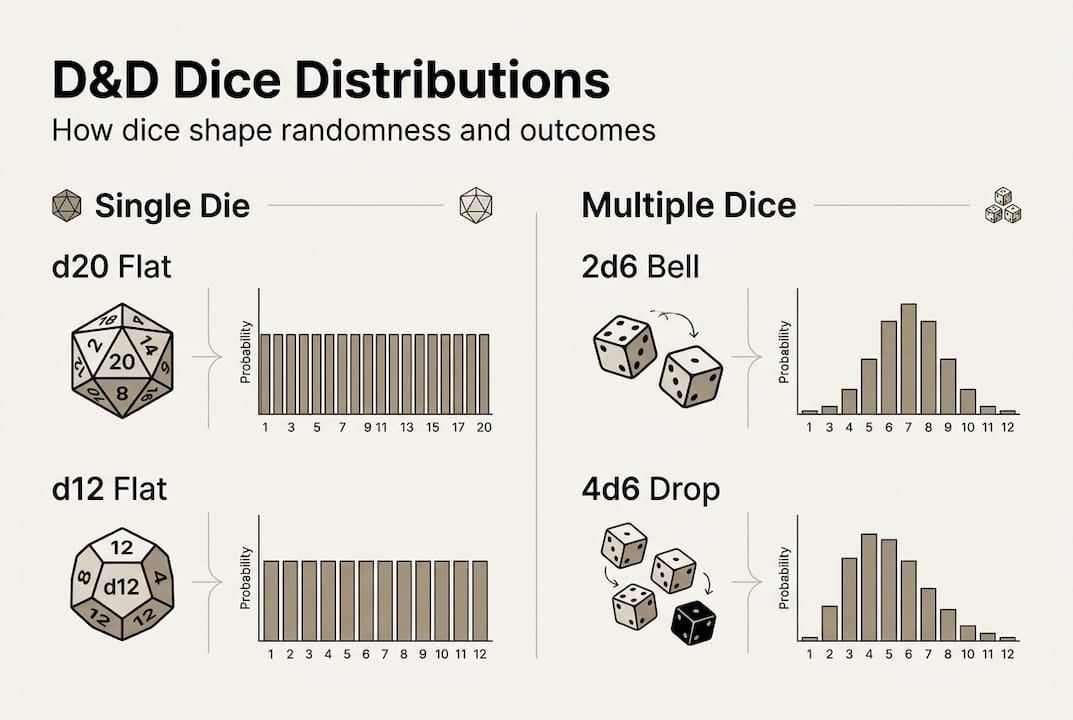
Game designers deliberately choose distributions based on desired gameplay feel. Attack rolls use d20 for excitement and variability, any character might hit or miss regardless of skill level. Damage often uses multiple dice to smooth results, preventing the frustration of rolling minimum damage repeatedly. Understanding these patterns helps you predict outcomes and make tactical decisions.
| Roll Type | Distribution | Outcome Range | Best Use Case | | — | — | — | | 1d20 | Flat/Uniform | 1-20 (equal chance) | Attack rolls, ability checks, saving throws | | 2d6 | Bell Curve | 2-12 (7 most common) | Consistent damage, ability score generation | | 3d6 | Narrow Bell | 3-18 (10-11 most common) | Very consistent results, character stats | | 1d12 | Flat/Uniform | 1-12 (equal chance) | High damage variance weapons |
Pro Tip: When choosing between weapons with similar average damage, consider the distribution. A longsword (1d8) has higher variance than a rapier (1d8) when used two-handed (1d10 vs 1d8), but paired shortswords (2d6) offer more consistent damage through bell curve distribution.
Key probability insights:
- Rolling with advantage (roll twice, take higher) dramatically improves success rates
- Disadvantage (roll twice, take lower) severely reduces your chances
- Adding +1 to a d20 roll increases success chance by 5%
- Multiple small dice (3d4) give more consistent results than one large die (1d12)
The debate over fudging rolls: fairness versus storytelling
Dungeon Masters sometimes secretly alter dice results to guide narrative outcomes. Fudging rolls means changing what the dice show to avoid total party kills, preserve story arcs, or maintain dramatic pacing. A DM might turn a critical hit into a regular hit if it would instantly kill a beloved character during an otherwise minor encounter. This practice sparks heated debates within the gaming community.
Advantages of fudging center on narrative control and player enjoyment. Preventing a random goblin from ending a year-long campaign with a lucky critical keeps the story moving toward its intended climax. DMs can smooth pacing issues, ensure boss fights feel appropriately challenging, and avoid anticlimactic deaths from bad luck. Some groups explicitly prefer this approach, valuing collaborative storytelling over pure randomness.
Disadvantages focus on player agency and trust. When players discover their DM fudges rolls, they may feel their choices and character builds don’t matter. Every victory becomes questionable, was it earned through skill or granted by DM mercy? The emotional investment in tense moments diminishes if players suspect the dice aren’t truly random. Some argue fudging undermines the core appeal of tabletop gaming.
Different DM philosophies shape fudging practices significantly. Narrative-focused DMs prioritize story flow and may fudge frequently to maintain dramatic arcs and character development. Simulationist DMs prefer letting dice fall where they may, believing true consequences create meaningful stakes. Most DMs fall somewhere between these extremes, fudging rarely for extreme situations only.
“The debate over fudging reveals a fundamental tension in tabletop gaming: Should dice serve the story, or should the story emerge from the dice? Neither answer is wrong, but transparency with your group about your approach builds trust and sets appropriate expectations for the type of game you’re running together.”
When DMs might consider fudging:
- Preventing instant death from a single unlucky roll in low-stakes encounters
- Ensuring boss fights last long enough to feel epic and memorable
- Avoiding campaign-ending total party kills from random encounters
- Smoothing extreme statistical outliers that break immersion
Pro Tip: If you choose to fudge rolls, do so sparingly and only for low-stakes situations. Never fudge during climactic battles or when players have made tactical sacrifices to gain advantages. Consider discussing your philosophy openly with your group to establish trust and set clear expectations about the type of game you’re running together.
The key lies in matching DM style to player preferences. Some groups thrive on brutal randomness where character death feels earned and meaningful. Others prefer collaborative storytelling where the DM guides outcomes toward satisfying narrative conclusions. Neither approach is inherently superior, communication determines success.
Ensuring fairness: quality and testing of physical dice
Physical dice fairness matters more than many players realize. Statistical testing methods including Chi-square tests and Bayesian analysis evaluate whether dice produce truly random results over 1000+ rolls. Researchers compare actual roll distributions against theoretical probabilities to detect biases. Most quality dice approximate fairness closely, but manufacturing imperfections can create subtle advantages for certain faces.
Chi-square tests measure how much observed results deviate from expected values. If you roll a d20 one thousand times, you should get roughly 50 rolls of each number. Significant deviations suggest manufacturing defects like uneven weight distribution or irregular face sizes. Premium dice manufacturers use precision molds and balanced materials to minimize these issues, though perfect fairness remains theoretically impossible.
Minor biases in physical dice rarely impact actual gameplay significantly. A die favoring certain numbers by 2-3% over thousands of rolls won’t noticeably affect your weekly game sessions. However, extreme biases from cheap manufacturing or damage can create unfair advantages. Cracked dice, worn edges, or air bubbles inside transparent dice all potentially skew results enough to matter during critical moments.
| Dice Quality Level | Fairness Rating | Typical Bias Range | Best Use Case |
|---|---|---|---|
| Premium metal/stone | 98-99% fair | 0.5-1% deviation | Tournament play, high-stakes games |
| Standard plastic | 95-97% fair | 1-3% deviation | Regular campaign sessions |
| Novelty/decorative | 90-95% fair | 3-5% deviation | Casual play, collection display |
| Damaged/cheap | Below 90% | 5%+ deviation | Avoid for serious gameplay |
Choosing quality dice sets improves both fairness and tactile enjoyment. Well-balanced dice feel better to roll, produce satisfying sounds, and build confidence that results reflect true randomness rather than manufacturing defects. Many players develop preferences for specific materials like metal, resin, or precision-edged dice based on weight and rolling characteristics.
Pro Tip: Test new dice yourself before using them in critical sessions. Roll each die 100 times and record results. If any number appears significantly more or less than expected (outside 8-12 times for a d20), consider retiring that die or using it only for low-stakes rolls. This simple test catches obvious defects without requiring advanced statistical knowledge.
Factors affecting dice fairness:
- Material density and uniformity throughout the die
- Manufacturing precision in face sizes and angles
- Internal air bubbles or inclusions in transparent dice
- Edge wear from repeated use on hard surfaces
- Paint or number inlay depth creating weight imbalances
Regular dice inspection catches problems before they affect gameplay. Check for chips, cracks, or excessive wear that might alter rolling characteristics. Store dice properly to prevent damage, avoiding extreme temperatures or pressure that could warp plastic dice. Quality dice properly maintained can last decades while preserving their fairness and aesthetic appeal.
Enhance your D&D game with quality dice and accessories
Now that you understand how dice mechanics shape your D&D experience, it’s time to upgrade your collection with premium options that combine fairness with visual appeal. Quality dice don’t just look impressive, they roll better and last longer through countless sessions.

Explore our buy 2 get 1 dice sets to build your collection affordably while ensuring you always have backup sets for different characters. Each set provides the complete polyhedral range you need for any class or situation. For players who love surprises, our unique mystery dice packs deliver exciting variety with premium quality dice in unexpected color combinations and materials.
Beyond dice, enhance your entire gaming experience with our RPG battle maps that bring encounters to life visually. Quality accessories complement the knowledge you’ve gained about dice mechanics, transforming abstract probability into tangible, immersive gameplay moments your group will remember for years.
FAQ
What types of dice are essential for playing D&D?
The core polyhedral set includes d4, d6, d8, d10, d12, d20, and percentile dice for various checks and damage rolls. The d20 handles all ability checks, attacks, and saving throws, making it the most critical die. Different dice types serve specific mechanical purposes based on weapon damage, spell effects, and class features.
How does dice notation like ‘2d6+3’ work?
The notation ‘2d6+3’ means roll two six-sided dice, add their results together, then add 3 to the total. This standardized format quickly communicates complex rolls used throughout combat and skill checks. Understanding dice notation speeds up gameplay and prevents calculation errors during intense moments.
Why do some Dungeon Masters fudge dice rolls?
DMs sometimes alter results secretly to maintain story pacing, prevent frustrating random deaths, or preserve narrative arcs they’ve planned. However, this practice can reduce player trust and diminish the feeling that their choices matter if discovered. The fudging debate reflects different philosophies about whether dice should serve the story or vice versa.
How can I tell if my dice are balanced and fair?
Roll each die 100 times and record results to check for obvious biases. For a d20, each number should appear roughly 5 times, with 3-7 occurrences being normal variation. Significant deviations suggest manufacturing defects or damage requiring replacement.
Should I use digital dice rollers or physical dice?
Physical dice provide tactile satisfaction and visual drama that enhance the social experience of tabletop gaming. Digital rollers guarantee perfect mathematical randomness but lack the ceremonial feel of rolling real dice. Most players prefer physical dice for the complete sensory experience they bring to every session.