

TL;DR:
- Terrain maps do not slow your game down; instead, they enhance immersion and tactical clarity when used effectively. Different map types—2D grids, hexes, and 3D modular tiles—serve distinct purposes, with hybrid setups offering flexibility for engaging gameplay. The best terrain encourages player interaction and storytelling, making shared visual space a tool for collaboration rather than distraction.
Here’s a hot take for your next session zero: terrain maps don’t slow your game down. They speed it UP. We know, we know, plenty of GMs have been burned by a fifteen-minute setup for a two-minute skirmish. But that’s not a terrain problem, that’s a preparation problem. The truth is that maps enhance immersion without slowing play if modular, and when you understand how to wield them properly, terrain maps become one of the most powerful storytelling and tactical tools in your dungeon master’s toolkit. This guide is here to show you exactly how.
Table of Contents
- What are terrain maps? A TTRPG foundation
- Terrain rules: How maps shape movement and tactics
- Beyond the grid: Player agency and creative terrain use
- Choosing the right terrain map: 2D, 3D, and hybrid options
- Our take: The real secret of terrain maps in TTRPGs
- Bring your adventures to life with the right terrain maps
- Frequently asked questions
Key Takeaways
| Point | Details |
|---|---|
| Terrain maps increase tactics | Using maps adds strategic depth and creates more engaging encounters. |
| Rules shape movement | Game systems turn map layout into tactical choices through movement and cover mechanics. |
| Boost player creativity | Terrain features encourage player agency and innovative problem-solving. |
| 2D vs. 3D tradeoffs | Flat maps are fast and budget-friendly; 3D adds immersion but requires more setup. |
| The right map fits your group | Choose terrain maps that suit your group’s play style, not just what looks cool. |
What are terrain maps? A TTRPG foundation
To understand their impact, let’s start with what terrain maps really are and why they matter.
If you’re new to the hobby or just leveling up your game prep, what is TTRPG terrain is actually a bigger question than it sounds. At the most basic level, terrain maps in D&D and Pathfinder serve as tactical play spaces. They’re the shared visual language between you and your players, turning abstract descriptions into something everyone can see, point at, and argue about in the best possible way.
According to the core framework, terrain maps are 2D grids or hexes (usually 1-inch squares representing 5 feet) or hexes for overland travel, enhanced with 3D modular tiles for elevation and obstacles. That’s the technical definition. But the real magic? They make the fictional world feel real.
Here’s a quick breakdown of the main types:
| Map type | Best used for | Pros | Cons |
|---|---|---|---|
| 2D grid (paper/vinyl) | Dungeons, towns, set encounters | Fast, cheap, portable | Less immersive, no elevation |
| Hex map | Wilderness, overland travel | Great for exploration pacing | Less intuitive for close combat |
| 3D modular tiles | Boss fights, key encounters | Stunning visuals, tactile feel | Expensive, slow to set up |
| Hybrid (2D + props) | Any encounter | Flexible, visual pop | Requires good organization |
Now, each type has its sweet spot. Grid maps are the workhorses of dungeon crawls. Hex maps shine when your party is trekking across cursed forests or icy tundras. And 3D modular setups? Those are your cinematic “final boss” moments.
What makes terrain in D&D explained so interesting is the hybrid approach. You don’t have to choose one style and stick with it forever. Smart DMs mix a flat vinyl grid for most encounters and drop a few 3D pieces (think a raised altar, a crumbling wall) to signal that THIS moment matters. That visual cue alone shifts how players engage.
“The best terrain isn’t the most elaborate. It’s the terrain that communicates information instantly and keeps play flowing.”
That’s the mantra. Clarity over complexity, always.
Terrain rules: How maps shape movement and tactics
With the map types in mind, here’s how terrain mechanics fundamentally alter gameplay.
Movement is the heartbeat of tactical combat. When players can SEE the space, every decision lands differently. The D&D 5e difficult terrain rule is clean and brutal: difficult terrain costs 2 feet of movement per 1 foot traveled. So a character with a 30-foot speed can only cross 15 feet of difficult terrain in one turn. That mud pit, those snow drifts, that field of grasping vines? Suddenly they’re not flavor. They’re obstacles that could mean life or death.
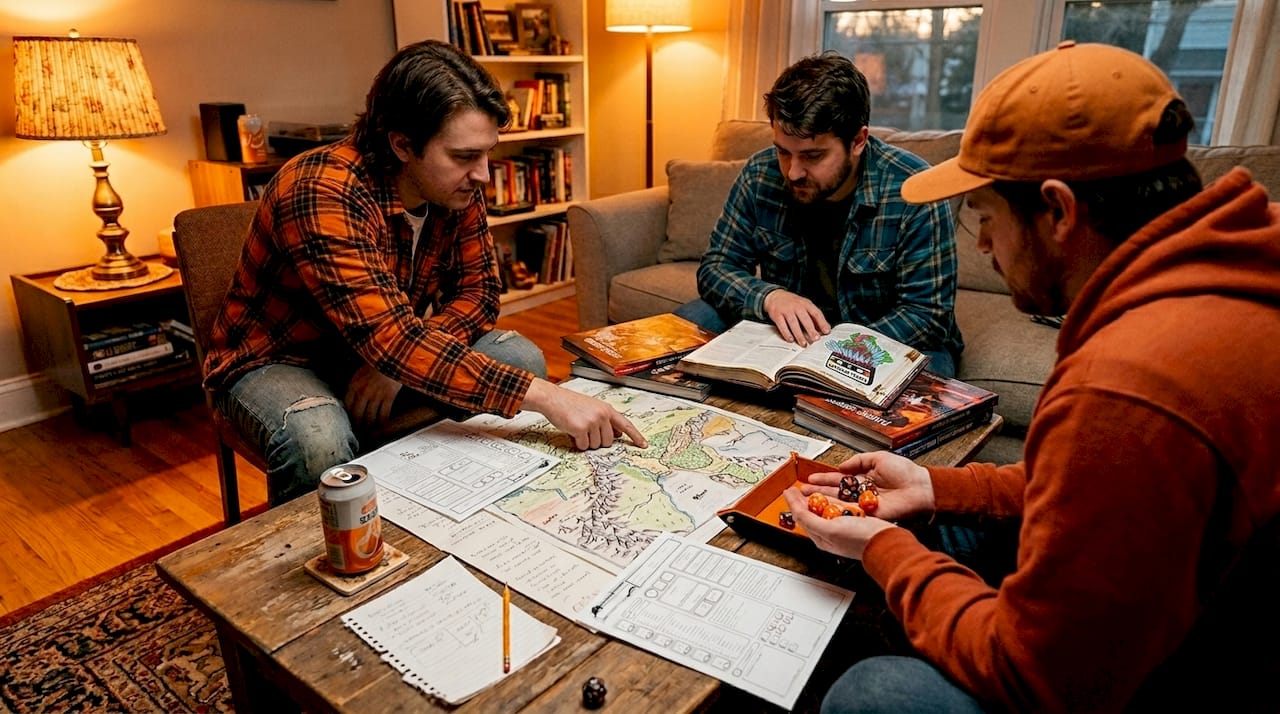
Pathfinder 2e cranks this up a notch. Pathfinder difficult terrain comes in two tiers: Difficult (2 ft per 1 ft) and Greater Difficult (4 ft per 1 ft), and critically, it does NOT block flanking. That nuance changes how rogue players position themselves completely.
Here’s a comparison for your game table reference:
| Mechanic | D&D 5e | Pathfinder 2e |
|---|---|---|
| Difficult terrain movement cost | 2 ft per 1 ft | 2 ft per 1 ft |
| Greater difficult terrain | Not defined separately | 4 ft per 1 ft |
| Cover (light/half) | +2 AC | +1 AC (standard cover) |
| Cover (heavy/three-quarters) | +5 AC | +2 AC (greater cover) |
| Flanking | Advantage (optional rule) | +1 circumstance bonus |
Cover is its own tactical universe. D&D cover rules break it into three levels: Half cover grants +2 AC, Three-Quarters cover grants +5 AC, and Total cover blocks attacks entirely. And here’s the spicy part: cover is determined by drawing a line from the corners of the attacker’s space to the corners of the target’s space. Without a map? That judgment call creates arguments. With a map? It’s a clean, satisfying ruling every time.
Here’s a step-by-step for running cover adjudication at the table:
- Identify the attacker’s space on the map.
- Draw imaginary lines from all four corners of the attacker’s square.
- Check if any of those lines pass through a wall, pillar, or large object.
- Count how many lines are blocked to determine cover level.
- Apply the AC or saving throw modifier and move on.
That process takes about ten seconds when players can SEE the map. Without it? Double that time minimum, plus one mild argument.
Pro Tip: Pre-mark “difficult terrain” zones on your maps before the session with a specific color or symbol. Your players will read the battlefield faster, make bolder choices, and the whole encounter runs smoother. Less ruling, more rolling.
And the terrain strategies in D&D extend far beyond just movement. Elevation is a huge one. High ground advantages (or disadvantages for certain attacks) create memorable moments. The ranger who climbed the tower. The barbarian who leapt from the cliff. Those scenes happen BECAUSE the map made the option visible.
Beyond the grid: Player agency and creative terrain use
Rules are only half the story. Here’s where maps really become game-changers.
Here’s what separates TTRPGs from board games: the players can do ANYTHING. A board game gives you preset actions and pathways. D&D gives you a world. And terrain maps, when used well, are a physical representation of that world’s possibilities.
Designing immersive terrain is about building spaces players can interact with, not just move through. The difference is massive. A table on a map isn’t just decoration. It’s a barricade. A chandelier isn’t ambiance. It’s a swinging escape route. A barrel of oil isn’t set dressing. It’s a fire hazard waiting to happen (usually courtesy of your most chaotic player).
What does player agency via terrain actually look like? It looks like spiking a door shut to prevent reinforcements, or using rope to create a tripwire across that narrow corridor on the map. Manipulating features turns narrative elements into strategic tools, and THAT is what sets TTRPGs apart from every board game on the shelf.
Here’s a quick list of interactive terrain elements that spark creativity:
- Doors and gates (can be spiked, barricaded, or held shut with a Strength check)
- Furniture (overturned tables become half cover in seconds)
- Light sources (torches and lanterns can be thrown or extinguished for stealth)
- Environmental hazards (ice patches, shallow water, loose rubble)
- Magical effects (circles of light, zones of silence, animated objects)
- Elevation changes (stairs, ledges, cliff faces, balconies)
When players SEE these elements on a map, they engage with them. When the map is just a grid with miniatures, players default to “I attack.” Give them a rope bridge and watch the chaos unfold.
“A map is a promise to your players: everything you can see, you can try to interact with. That promise is what makes the world feel real.”
Pro Tip: Before each combat encounter, identify at least THREE interactive terrain elements you’ll highlight or describe to players. You don’t need to announce them. Just describe them in the setup. “The tavern’s upper balcony overlooks the main floor, a chandelier swaying gently above the crowded tables.” Watch what happens next.
Choosing the right terrain map: 2D, 3D, and hybrid options
Now that you’re inspired to use terrain creatively, let’s look at picking the perfect map for your table.
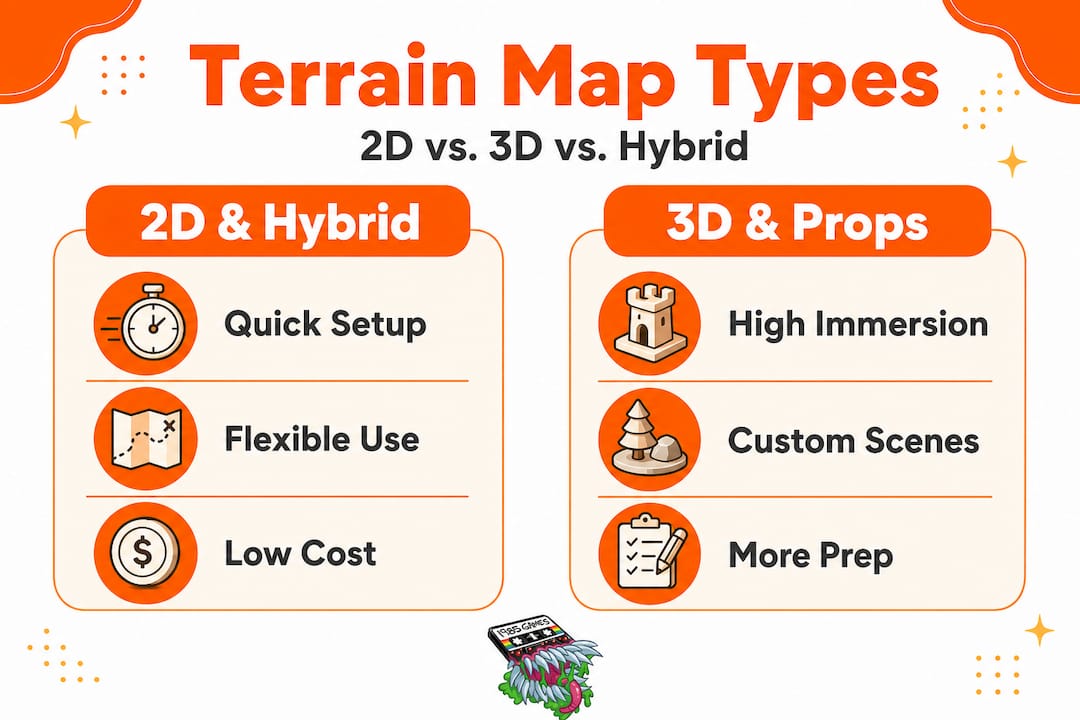
Here’s the real talk: you don’t need to spend hundreds of dollars to have amazing terrain. The best map is the one you’ll actually USE, set up in time, and store without losing your mind. The 2D vs 3D tradeoffs come down to this: flat maps are fast, cheap, and portable, while 3D terrain adds verticality and immersion but increases setup time and storage demands. Hybrid setups, combining a printed or vinyl base map with a few key 3D elements, are by far the most common approach for serious DMs.
Check out this breakdown to find your setup:
| Setup type | Estimated cost | Setup time | Best for |
|---|---|---|---|
| Printed paper maps | Very low | Under 5 minutes | One-shot games, beginners |
| Vinyl/wet-erase mat | Low to medium | 5-10 minutes | Flexible, reusable sessions |
| Pre-made card/tile sets | Medium | 10-20 minutes | Regular campaigns |
| Full 3D modular terrain | High | 30-60 minutes | Showcase encounters, big groups |
| Hybrid (flat map + 3D props) | Medium | 10-15 minutes | Most regular DMs |
For new DMs, start with a good vinyl wet-erase mat and dry-erase markers. Seriously. That combo has powered thousands of legendary campaigns. From there, you can check out top battle maps for D&D to find pre-designed layouts that save you hours of prep.
Want more reasons to love flat maps? The advantages of 2D terrain maps are real and plentiful. They’re portable (no hauling a milk crate of terrain to game night). They’re quick to swap mid-session. And beautifully illustrated 2D maps carry enormous visual impact without the weight or cost of 3D alternatives.
Some practical storage and reuse tips that your future self will thank you for:
- Roll paper maps in cardboard tubes (never fold, unless you enjoy wrinkle-induced rage)
- Store vinyl mats flat or loosely rolled in a tube
- Bag 3D terrain pieces by biome or encounter type for fast grabbing
- Use color-coded folders for printed maps organized by campaign chapter
- Label every map on the back with the session it belongs to
Pro Tip: If you’re running a long campaign, build a “terrain library” in labeled bags or boxes sorted by theme (dungeon, forest, water, urban). When a session rolls around, you grab one bag and you’re ready. No hunting, no scrambling, just gaming.
Our take: The real secret of terrain maps in TTRPGs
So, after weighing rules and tools, what truly sets terrain maps apart in tabletop RPGs?
Here’s our honest, slightly contrarian take: the most powerful thing a terrain map does is NOT give players a grid to move on. It’s what it does to the conversation around the table. When everyone is looking at the same shared space, something shifts. Players negotiate. They plan together. They point and say “what if we…” And THAT is collaborative storytelling at its finest.
We’ve seen it over and over in the community. The fights that become legend aren’t the ones with the most elaborate 3D setups. They’re the ones where a clever player spotted an opportunity on a simple map and did something nobody expected. The tactical depth unlocked by maps isn’t about complexity. It’s about shared visual vocabulary sparking shared imagination.
But here’s the uncomfortable truth too: too many props can actually HURT your game. If players are spending more time marveling at your terrain than making decisions, the map has become a distraction. Sometimes a clean, well-illustrated 2D map with just enough detail is more powerful than an elaborate 3D masterpiece.
The key insight from theater of the mind vs. maps is this: maps are essential for tactical systems like D&D and Pathfinder because they enable precise movement and cover adjudication. But use them sparingly in narrative-heavy systems to avoid railroading players into thinking only about what they can physically see.
Read your group. Are they tactical gamers who love dissecting positioning? Give them rich maps with lots of interactive elements. Are they storytellers who just want a quick visual reference? A simple sketch does the job beautifully. The real art of terrain is knowing which tool serves the story happening at YOUR table tonight.
Bring your adventures to life with the right terrain maps
Ready to elevate your game nights? We’ve got exactly what you need to put all of this into practice.

Whether you’re running a gritty dungeon crawl or a sweeping wilderness campaign, the right map transforms your session from good to unforgettable. Our Dungeon Craft Volume 2 maps pack in beautifully illustrated modular dungeon layouts perfect for tactical play, while the Dungeon Craft Cursed Lands set delivers atmospheric overland and hex-ready terrain that makes exploration feel genuinely epic. If your campaign is heading into wintry wilds, the BattleMap Snow and Wood set has you covered with stunning seasonal detail. All designed to hit the table fast, look incredible, and keep your players locked in.
Frequently asked questions
What makes a map ‘tactical’ in D&D or Pathfinder?
A tactical map allows precise movement, placement, and line-of-sight determination, giving players meaningful decisions each turn. In both D&D and Pathfinder, terrain maps use grids where 1-inch squares represent 5 feet, making positioning and area effects clear and consistent.
How do difficult terrain and cover rules differ in popular systems?
D&D 5e makes difficult terrain cost double movement, while Pathfinder 2e adds a “greater difficult” tier that costs even more. The D&D 5e difficult terrain rule halves your effective speed (30-foot speed covers only 15 feet), and Pathfinder greater difficult terrain can reduce movement to a crawl at 4 feet of cost per foot traveled.
What are quick ways to make terrain more dynamic for my games?
Add interactable elements like doors, traps, or climbable objects, and vary elevation to create interesting positioning choices. Manipulating terrain features such as spiking doors shut or using furniture as barricades transforms static maps into living, reactive environments.
Do I need 3D terrain for a great tabletop experience?
Absolutely not. Many legendary campaigns run entirely on flat or hybrid maps that are faster to set up and just as engaging. The 2D vs 3D tradeoff really comes down to your group’s style: flat maps win on speed and portability, while 3D terrain is a treat for key encounters.