

TL;DR:
- Roleplay etiquette is an unwritten social contract that fosters fun, safety, and storytelling quality at the gaming table. It emphasizes communication, turn-taking, respecting boundaries, and including quieter players, rather than mechanical rules. Establishing clear norms during Session Zero and using safety tools ensures long-lasting, inclusive, and immersive gameplay experiences.
Picture this: your party is deep in a tense negotiation with a dragon, the GM is setting the scene perfectly, and then someone blurts out their action without waiting, another player checks their phone, and the whole moment collapses like a house of cards. Frustrating, right? Here’s the thing that surprises a lot of players: roleplay etiquette isn’t about memorizing the rulebook. It’s about the unwritten social contract that keeps your table fun, safe, and absolutely electric with good storytelling. Let’s break it all down.
Table of Contents
- What is roleplay etiquette?
- Essential etiquette principles during play
- Session Zero and establishing group norms
- Navigating edge cases: safety tools and meta boundaries
- Why etiquette matters more than ever in RPGs
- Upgrade your tabletop experience with the right tools
- Frequently asked questions
Key Takeaways
| Point | Details |
|---|---|
| Etiquette vs. rules | Roleplay etiquette guides social interaction and group comfort, not just game mechanics. |
| Safe, immersive play | Establishing boundaries and using safety tools creates fun, respectful sessions for everyone. |
| Session Zero setup | Discuss group norms and comfort topics before play to prevent problems later. |
| Handle discomfort | Use safety tools and out-of-game discussion to resolve issues without harming play. |
| Adapting etiquette | Modern etiquette evolves for new group formats, inclusivity, and organized play demands. |
What is roleplay etiquette?
So, what exactly are we talking about when we say “roleplay etiquette”? It’s NOT the same as knowing how many action points you have on your turn. We’re talking about something much more human than that.
Tabletop RPG etiquette is informally or semi-formally enforced, distinct from game mechanics, and shaped by group consensus. Think of it as the social glue holding your table together. No rulebook covers it. No dice roll determines it. Your group decides it, together.
Here’s a quick way to see the difference:
| Formal rules | Roleplay etiquette |
|---|---|
| Dice roll procedures | Taking turns to speak in character |
| Turn order in combat | Checking in with players before big decisions |
| Spell mechanics | Managing how much phone time is okay |
| HP and damage rules | How to handle uncomfortable story topics |
| Initiative systems | Encouraging quieter players to contribute |
See the difference? Formal rules are printed in the Player’s Handbook. Etiquette lives in the vibes of your table.
Understanding tabletop RPG fundamentals is the first step, but mastering the social layer is what makes sessions truly memorable. According to the etiquette framework most experienced groups use, the core pillars look something like this:
- Communication: Be clear, be kind, be open to feedback.
- Turn-taking: Give everyone space to shine.
- Boundaries: Know what your table is and isn’t comfortable with.
- Group immersion: Protect the shared story experience.
“Good etiquette isn’t about being polite for politeness’s sake. It’s about protecting everyone’s ability to have fun and feel safe at the table.”
Etiquette also adapts. Home games are usually more relaxed. Organized play, like events at your local game store, often enforces stricter conduct expectations. That flexibility is actually a strength. Your table’s etiquette should fit your crew like a well-worn adventurer’s cloak.
Make sure you also check out table gaming best practices for a deeper look at how structure and atmosphere work together.
Essential etiquette principles during play
Now we get to the juicy stuff. What does good behavior actually look like when dice are hitting the table and characters are coming to life?

Paying attention on turns, avoiding interruptions, and asking before in-character actions that affect others are some of the most universally agreed-upon basics. Sounds simple, right? But wow, it’s easy to slip up when you’re excited.
Let’s talk specifics. Here are the big do’s and don’ts every player (and GM!) should keep in mind:
DO:
- Wait for your turn before announcing your action.
- Ask out-of-character if you’re unsure your character’s action will affect another player.
- Celebrate other players’ great moments, not just your own.
- Keep side conversations quiet during focused scenes.
- Check in if a player seems disengaged or uncomfortable.
DON’T:
- Steamroll quieter players with constant spotlight-grabbing moves.
- Make major plot-impacting decisions for your whole party without discussion.
- Bring your real-life frustrations into your character’s behavior as a workaround.
- Use in-character drama as a vehicle for out-of-character conflict.
- Assume everyone is fine just because no one said anything.
Player etiquette involves balancing in-character immersion with table awareness and including quieter participants. That second part is HUGE. It’s so easy to get caught up in the fun of the loud, charismatic characters while the shy rogue player at the end of the table barely gets a word in. Good etiquette means actively making space.
Pro Tip: Before a session, spend two minutes asking each player if there’s anything they want their character to explore this session. It takes almost no time and it transforms how invested everyone feels in the story.
“The best tables we’ve ever seen aren’t necessarily the ones with the most rules knowledge. They’re the ones where everyone genuinely roots for each other’s moments.”
When it comes to maintaining immersion, managing the balance between in-character play and real-world awareness is an ongoing practice, not a one-time fix. And if you’re newer to the hobby, don’t stress. There’s a wealth of beginner etiquette tips that can fast-track your comfort at any table.
Session Zero and establishing group norms
Here’s where things get REALLY powerful, dice goblins. Before your campaign even begins, you have a golden opportunity to set the tone for everything that follows. That opportunity is called Session Zero.
Session Zero is used to align expectations, cover social agreements, and define content boundaries and safety tools. It’s basically a pre-game meeting where you figure out what kind of story you all want to tell, and just as importantly, what you want to avoid.
A solid Session Zero agenda looks something like this:
- Scheduling and availability: When will you play? How long are sessions? What happens if someone can’t show up?
- Campaign tone and content: Is this a gritty, dark story or a lighthearted adventure? What genres and themes are everyone excited about?
- Character creation guidelines: Party composition, power level, and character backstory connections to the world.
- Content boundaries: What topics are off-limits entirely? What themes need a gentle touch?
- Safety tools: Introduce and explain the tools you’ll use if anyone feels uncomfortable mid-session.
- Communication expectations: How will the group handle conflicts or feedback between sessions?
Now let’s talk safety tools, because common safety tools include the X-Card, Lines, and Veils for managing uncomfortable content. Here’s a simple breakdown:
| Safety tool | How it works | Best for |
|---|---|---|
| X-Card | Tap or hold up a card to stop/skip content immediately | Real-time discomfort during play |
| Lines | Topics that never appear in the game at all | Setting hard limits before play begins |
| Veils | Topics that can happen “off-screen” but aren’t detailed | Sensitive content handled with distance |
| Open Door | Players can step away anytime without explanation | Ongoing comfort throughout sessions |
These tools aren’t signs of weakness or over-sensitivity. They’re signs of a table that takes everyone’s experience seriously. And that’s a table that keeps going for years instead of falling apart after three sessions.
Good session planning best practices always include revisiting your safety tools at the start of a new story arc, not just at Session Zero.
Pro Tip: Even if you’re playing with your best friends who you’ve known for years, run a mini Session Zero check-in at the start of a new campaign. People change, comfort levels shift, and a quick conversation prevents a thousand awkward moments later.
Navigating edge cases: safety tools and meta boundaries
Okay, so what happens when something unexpected comes up mid-session? Because it WILL. Even the most carefully planned games can drift into territory that makes someone uncomfortable.
Here’s the good news: players and GMs should prioritize real player comfort over character-driven drama, using safety tools as needed. The story is always secondary to the people telling it.
Here’s how to handle common discomfort scenarios at the table:
- Someone uses the X-Card: Immediately skip or reframe the scene. No questions asked. No explanations required. Just move on and check in after the session.
- A player seems tense or quiet: Pause the scene. Say something like, “Hey, do we want to take a five-minute break?” Low pressure, no spotlight on the uncomfortable person.
- In-character conflict starts bleeding into real feelings: Call an out-of-character check-in. Distinguish what the characters feel versus what the players feel.
- A theme comes up that wasn’t discussed in Session Zero: Flag it openly. “This feels like it’s heading somewhere we didn’t cover. Should we talk about it quickly?”
- A player feels their character is being sidelined: Address it after the session or during a break. Create a moment in the next session to give them meaningful spotlight time.
Trends across the TTRPG community consistently show that groups who use safety tools and establish clear meta boundaries report higher satisfaction and longer-lasting campaigns than groups who wing it. The practice of setting explicit table norms is growing fast, especially as gaming becomes more diverse and inclusive.
Pro Tip: Normalize using safety tools from the very first session. If the first time you tap the X-Card is during a crisis moment, it feels jarring. If you’ve used it casually before (even just to practice), it becomes a natural, drama-free part of play.
For even more ideas on creating a comfortable and exciting atmosphere, check out immersion tools and tips that complement your etiquette work beautifully.
Why etiquette matters more than ever in RPGs
Here’s our hot take, and we stand by it completely: roleplay etiquette is not a “nice-to-have.” It’s the actual engine of great tabletop gaming.
We see so many posts in gaming communities where people blame bad sessions on bad rules, bad dice luck, or bad GMs. And sometimes those things are factors! But more often, the root cause is a table that never talked about how to treat each other. That’s an etiquette failure, not a mechanics failure.
Here’s the contrarian take worth chewing on: strict, explicit etiquette does NOT kill fun or spontaneity. It actually unlocks MORE of both. When players feel safe and respected, they take bigger creative swings. Characters do braver, stranger, more memorable things. The story gets WILDER because everyone trusts the container holding it.
Modern TTRPG tables also look very different than they did even ten years ago. Online play via virtual tabletop platforms has introduced players from completely different cultural backgrounds and comfort levels. Organized play events bring together total strangers for one-shot adventures. In these contexts, you cannot assume shared norms. You have to build them intentionally.
Etiquette also evolves. What worked for a small group of close friends in 2015 might not serve a diverse, eight-player campaign in 2026. Great tables treat etiquette as an ongoing conversation, not a one-time setup.
Think of it this way: running engaging sessions is so much easier when every player at your table feels heard, included, and excited to be there. Etiquette is how you build that foundation, session by session, story by story.
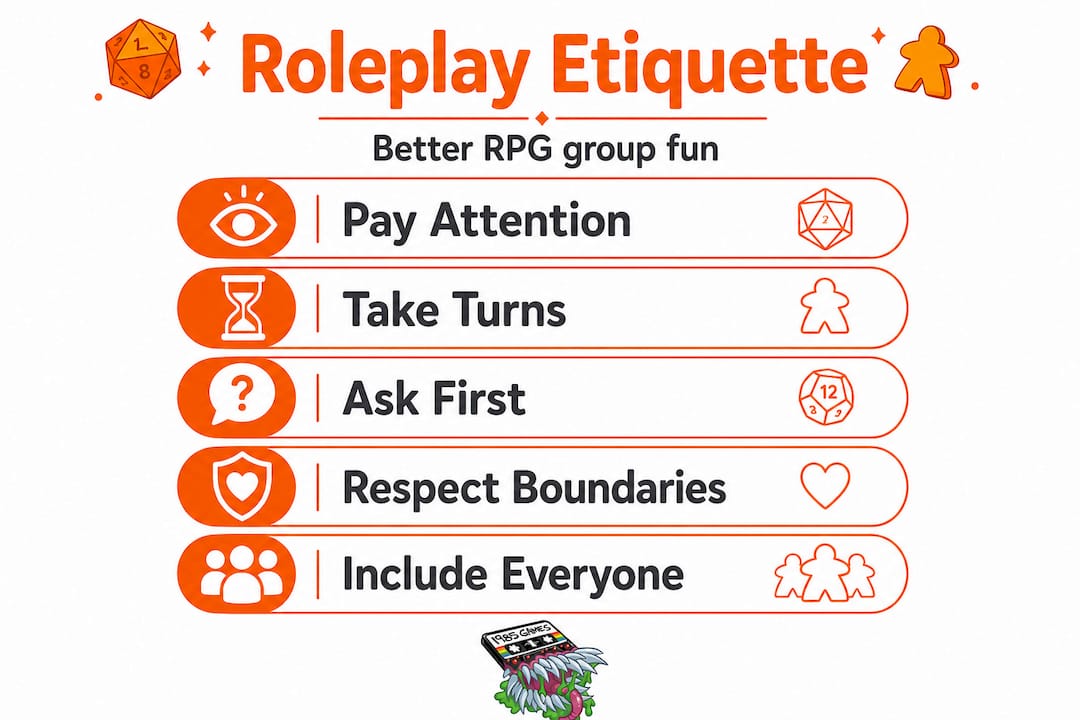
The tables that last, the campaigns that become legendary inside jokes and cherished memories, are ALWAYS the ones where people genuinely cared about each other’s experience. Not just the story. The people.
Upgrade your tabletop experience with the right tools
You’ve now got the full picture on roleplay etiquette, from the basics to the nuanced edge cases. Here’s the beautiful truth: when the social layer of your game is solid, the physical experience of playing becomes even more magical. The right accessories can reinforce that sense of occasion, investment, and shared excitement that etiquette helps create.

At 1985 Games, we’re huge believers in the power of a well-equipped table to set the tone for respectful, immersive, ridiculously fun play. When everyone has their own gorgeous set of premium dice sets, something wonderful happens. Players feel ownership over their character’s fate. They engage more fully. They wait for their turn because rolling those beautiful dice is a moment worth savoring. It’s a small thing with a surprisingly big impact on table culture.
Explore our collections and find the accessories that match your table’s energy.
Frequently asked questions
Is roleplay etiquette the same as following the rulebook?
No. Roleplay etiquette is distinct from rulebook mechanics and focuses on social interactions, group comfort, and shared norms rather than formal game rules.
What if a player breaks etiquette and ruins immersion?
Conflict management encourages resolving complaints outside play and using safety tools mid-session if needed. Calmly addressing the issue between sessions is almost always more effective than confronting it in the moment.
How should content boundaries be set for new groups?
Session Zero is key for setting content boundaries and safety tools. Use tools like the X-Card and Lines and Veils so every player starts on the same comfortable page.
Are safety tools really necessary for established groups?
Yes, absolutely. Safety tools like the X-Card and Lines/Veils support group comfort regardless of experience level, because unexpected discomfort can arise even in long-running campaigns with close friends.
Does etiquette change for organized play?
Yes. Organized play can formalize etiquette as enforceable codes of conduct, often with stricter expectations and clearer consequences than the flexible norms of a home game.