

TL;DR:
- Journals preserve campaign continuity by tracking NPCs, events, loot, and player progress.
- Both campaign logs (DM-managed) and character journals (player-managed) deepen immersion and story consistency.
- Structured, regular journaling enhances campaign organization, player engagement, and collaborative storytelling.
Picture this: you’re three months into an epic D&D campaign, the whole party is hyped, and then someone asks, “Wait, what was that NPC’s name again? The one who gave us the cursed artifact back in session four?” Cue the awkward silence. Sound familiar? Campaign journals preserve continuity, track details like NPCs, events, loot, and XP across sessions, and prevent the kind of inconsistencies that quietly unravel long-term campaigns. And yet, most groups treat journaling like homework rather than a superpower. We’re here to change that.
Table of Contents
- Why journals matter in long-running RPG campaigns
- Types of journals: Campaign logs vs. character journals
- How to structure an effective RPG journal
- Paper or digital? Choosing your journaling style
- Expert insights and common pitfalls in RPG journaling
- Our perspective: Why most RPG groups miss the real power of journals
- Level up your RPG sessions with the right tools
- Frequently asked questions
Key Takeaways
| Point | Details |
|---|---|
| Journals build campaign memory | Consistent journaling preserves plot details, NPCs, and story arcs across long campaigns for both GMs and players. |
| Roleplay immersion deepens | Character journals help players get into character, expanding personal stories and motivations. |
| Structure and format matter | Using effective frameworks for journal entries ensures information is usable and easy to review. |
| Hybrid methods are effective | Combining handwritten and digital tools leverages the strengths of both for durability and memory. |
| Avoid journaling pitfalls | Focus on meaningful events and review notes after sessions to stay motivated and organized. |
Why journals matter in long-running RPG campaigns
Let’s be honest. Memory is a trickster. You can remember every lyric to a song from 2003, but completely blank on what the party decided to do with the dragon’s hoard from last Saturday’s session. That’s not a you problem. That’s just how brains work, especially when sessions are weeks apart and real life keeps crashing the party.
This is exactly where journals shine. Good journals preserve continuity and serve as the group’s shared memory, keeping everyone connected to the story even after a two-week break. Think of them as the ultimate “Previously on your campaign…” recap, but one you actually wrote yourself.
Here’s what journals track that your brain definitely won’t:
- NPCs and their motivations (Was Gregor the blacksmith a friend or a secret cultist? Classic.)
- Key story events and plot hooks dropped in passing
- Loot, XP, and character milestones so no one argues about who found what
- Session attendance because knowing who missed session seven matters for continuity
“A journal isn’t just a record. It’s the living DNA of your campaign, holding everything together when memory fails and chaos reigns.”
Journals also serve as a bridge for players who miss sessions. Instead of a ten-minute verbal recap that leaves everyone half-confused, a written log gives the absent player real context. It’s also a huge boost to role-playing immersion, because when everyone knows the details of the world, every decision feels weightier and more meaningful. That’s the magic we’re chasing, dice goblins.
Types of journals: Campaign logs vs. character journals
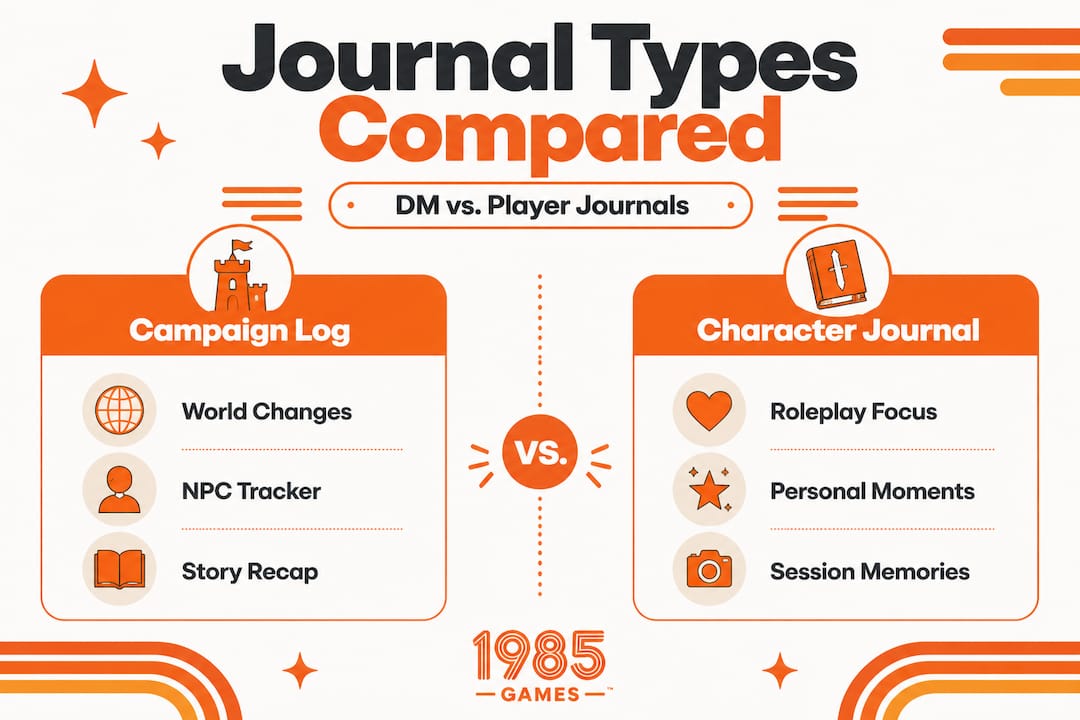
Not all journals are built the same, and knowing the difference between a campaign log and a character journal is a genuine game-changer. Both serve wildly different purposes, and honestly? The best campaigns use both.
Here’s a quick breakdown:
| Feature | Campaign log (DM-managed) | Character journal (Player-managed) |
|---|---|---|
| Who writes it | Dungeon Master | Individual players |
| Focus | World events, NPCs, plot arcs | Personal story, thoughts, backstory |
| Tone | Objective and factual | In-character and subjective |
| Best for | Continuity and consistency | Immersion and roleplay depth |
| Reviewed by | Whole group | Usually personal or shared selectively |
Campaign logs are the DM’s secret weapon. They track world-state changes, political shifts, which NPCs have appeared, what information the party has learned, and where every major plot thread currently stands. Without one, even the most seasoned DM will eventually drop a plot ball.

Character journals, on the other hand, are deeply personal. Player character journals enhance roleplay by recording in-character experiences, thoughts, relationships, and backstory, which deepens immersion in ways that no stat sheet can. When a player writes an entry from their character’s perspective after a morally gut-punching session, they come back to the next game already emotionally invested.
Journals primarily serve continuity and immersion, with DM campaign logs handling world-state management and player journals contributing personal roleplay depth. Integrate both for an optimal campaign experience.
Pro Tip: Encourage players to read a journal entry aloud at the start of each session. It works better than any recap, gets everyone in the headspace of the story, and feels genuinely cinematic. We love a good dramatic reading moment.
Want to go deeper? Check out how to craft the ultimate player’s journal for a full breakdown on building one that actually gets used.
How to structure an effective RPG journal
Okay, so you’re sold on journals. Now what? The most common pitfall is starting a journal with zero structure and ending up with a chaotic mess of scribbled notes that nobody can actually use. Structure is everything, friends.
Here’s what a well-organized RPG journal looks like in practice. Use this numbered system to set up every entry:
- Header with the real-world date, session number, in-game date or timeline marker, and who attended
- Key events summary covering the major story beats of the session in chronological order
- NPC and monster log listing every named character encountered, their role, and any key details
- Loot and XP tracker so nobody forgets who found the Bag of Holding
- PC actions and quotes because the wildly chaotic things players say deserve to be immortalized
- Hooks and mysteries still unresolved, so they don’t vanish into the narrative abyss
- Post-session notes for DMs to reflect on pacing and player reactions
Solid journaling methodology includes header notes with date, session number, in-game time, and attendees, then recording key events, NPCs, loot, PC actions, and memorable quotes. Using shorthand and organizing by encounter keeps things manageable, while color-coding and reviewing post-session make it genuinely useful.
| Journal section | What to include | Time to write (estimate) |
|---|---|---|
| Header | Date, session #, attendees, in-game time | 1 minute |
| Key events | Story beats, decisions, outcomes | 5 to 10 minutes |
| NPC log | Names, roles, key info | 3 to 5 minutes |
| Loot and XP | Items found, XP gained | 2 minutes |
| Hooks remaining | Unresolved threads | 2 to 3 minutes |
Digital platforms like Obsidian Portal or Google Docs are fantastic for structuring campaign journals with search functions and easy sharing. But analog journals have their own irreplaceable charm. We’ll get into that battle next.
Pro Tip: Use shorthand during the session (think abbreviations like “BBE” for Big Bad Enemy or “QC” for quest complete) and then expand your notes immediately after the session ends, while the details are still fresh in your brain.
Paper or digital? Choosing your journaling style
Ah, the eternal debate. Paper versus digital. This one gets spicy in TTRPG communities, and for good reason. Both formats have genuine strengths, and the right choice actually depends on your table’s vibe and game style.
Here’s the honest breakdown:
Paper journals:
- Boost memory and comprehension through the physical act of writing
- Create a gorgeous, tangible artifact your whole group can flip through
- Work anywhere, no battery required (critical for long sessions)
- Feel deeply immersive when you crack open an actual leather-bound tome at the table
Digital journals:
- Lightning-fast to search when you need that NPC’s name RIGHT NOW
- Easy to back up (please back up your notes, we’re begging you)
- Perfect for remote or hybrid groups who share notes online
- Collaborative tools like Google Docs let multiple players contribute in real time
Handwriting activates brain regions associated with memory and creativity far more effectively than typing, based on EEG studies. So if immersion and retention are your top priorities, paper wins on a neurological level.
“The pen doesn’t just capture the story. It wires the story into you.”
That said, digital tools offer speed and searchability that paper simply cannot match, making them ideal for larger groups with complex world-states to manage.
Our spicy take? Go hybrid. Write in-session notes by hand for that brain-boost effect, then transfer key information into a digital document after the session for easy reference and backup. Best of both worlds, zero regrets.
Pro Tip: If you go paper, photograph your pages after every session and store them in a cloud folder. Journals are irreplaceable. Water damage and heroic pets have claimed more than a few campaign legends.
Curious about purpose-built options? Explore DM’s journal pros and cons to find the format that fits your table perfectly.
Expert insights and common pitfalls in RPG journaling
Even the most enthusiastic groups fall into the same traps with journaling. Let’s talk about what actually goes wrong so you can dodge these pitfalls like a rogue dodging a trap (with advantage, ideally).
Common mistakes that kill journal effectiveness:
- Over-detailing mundane moments. Nobody needs a paragraph about the party’s uneventful walk through the forest. Log the highlights, not the footsteps.
- Never reviewing the journal. A journal nobody reads is just expensive paper. Review before every session. Seriously.
- Mixing narrative and mechanical notes carelessly. Keep your dramatic story beats separate from your XP tallies or things get confusing fast.
- Forgetting to record consequences. Players make big decisions that ripple forward. If you don’t log them, the world feels static and fake.
Avoid over-detailing mundane events. Focus on plot hooks, character changes, and genuinely fun moments to keep journals both usable and motivating over a long campaign.
For DMs especially, journals are more than a record. Post-session review and reflection using journals improves GM skills, session energy, and campaign dynamism by tracking consequences and player plans. It’s basically a free skill-up for your DM game.
Journals also capture the magic of unplanned moments. When your Paladin dramatically fails a Persuasion check and accidentally starts a tavern brawl, you want that written down. Those chaotic, joyful moments ARE the campaign. They deserve to live on.
Pro Tip: At the end of every session, ask each player for “one moment they’ll remember.” Write those answers in the journal. It takes two minutes and creates a living highlight reel of your campaign’s greatest hits.
For more on building sessions that generate moments worth recording, dig into tabletop gaming best practices for crafting genuinely immersive experiences.
Our perspective: Why most RPG groups miss the real power of journals
Here’s our hot take, and we stand by it fully: most groups use journals as a reactive tool. They reach for them AFTER they’ve forgotten something. They treat them like a backup hard drive rather than a creative engine. And that’s where enormous potential gets left on the table.
The real power of journaling is proactive. When players write character journal entries between sessions, they show up to the next game already inhabiting their character. Their emotional investment goes through the roof. The DM reads through the campaign log before session prep and suddenly spots three forgotten plot threads that would blow the party’s collective minds if revisited. That’s not just good record-keeping. That’s world-building fuel.
We’ve seen it transform tables. When journaling becomes a ritual instead of a chore, the whole campaign energy shifts. Players start referencing past events voluntarily. They make decisions that honor their character’s history. The DM’s world feels alive because the consequences of old choices keep rippling forward.
There’s also something deeply powerful about integrating player and DM insights. A character journal entry might reveal that a player’s rogue feels betrayed by the party’s last decision. If the DM reads that before the next session, they can weave it into the story in a way that makes that player feel genuinely SEEN. That’s the collaborative storytelling gold we’re all chasing.
Journals are not admin work. They are the connective tissue of your campaign’s emotional core. Treat them that way and your sessions will never feel the same again. Check out these immersion pro tips to pair your journaling practice with other high-impact session upgrades.
Level up your RPG sessions with the right tools
Ready to bring these journaling strategies to life at your actual table? We thought so.

At 1985 Games, we know that the right physical tools make journaling feel less like homework and more like an adventure in itself. A beautifully crafted player journal becomes a campaign artifact, something your whole group will treasure long after the final boss is defeated. Pair it with a set of dice sets for immersive sessions and you’ve got a table setup that practically hums with story energy. Whether you’re a first-time DM building your campaign bible or a veteran player ready to finally commit to a character journal, we have the tools to make it happen. Your next legendary campaign starts here.
Frequently asked questions
What makes a good RPG journal entry?
A good RPG journal entry captures key events, NPC names, character decisions, and memorable quotes without getting lost in minor details. Focus on plot hooks and fun moments to keep entries genuinely useful for future sessions.
Should everyone in the RPG group keep a journal, or just the DM?
Both DMs and players gain real benefits from keeping journals. DM campaign logs handle world-state management while player journals add personal roleplay depth and immersion.
Does handwriting really help compared to typing RPG notes?
Yes, genuinely. Handwriting activates memory and creativity more effectively than typing, according to EEG studies, making your handwritten notes stickier and your campaign world more vivid in your mind.
What are the best tools for RPG journaling?
Custom RPG journals and quality notebooks excel for memory and immersion, while digital tools like Google Docs or Obsidian Portal shine for collaboration, searchability, and secure backups across your whole group.