

TL;DR:
- The RPG accessory scene in 2026 is booming, blending analog and digital tools to enhance gameplay experiences. Community feedback, compatibility, immersion, and replay value are key criteria for evaluating new accessories, especially hybrid gadgets like the Arcalink One. Balancing tradition with innovation and choosing tools suited to your group’s needs will ensure more engaging and memorable sessions.
The tabletop RPG scene in 2026 is absolutely buzzing, dear dice goblins, and keeping your sessions fresh has never been both this exciting and this overwhelming. Walk into any online store or game convention floor and you’ll find a dizzying cocktail of hybrid gadgets, retro handcrafted sets, and family-friendly game kits all screaming for your gold pieces. How do you know what’s actually worth the hype versus what’s just shiny loot that’ll collect dust in the Bag of Holding? That’s exactly what this guide is here to solve. We’re breaking down the freshest 2026 accessory trends by category, comparing them head-to-head, and helping you build the ultimate kit for your game table.
Table of Contents
- How to evaluate new RPG accessories in 2026
- Hybrid gadgets: Blending physical and digital play
- Accessible accessories for the next generation
- Accessory showdowns: What fits your game style?
- Our take: Balancing tradition with innovation in the 2026 RPG scene
- Explore must-have RPG accessories for every game style
- Frequently asked questions
Key Takeaways
| Point | Details |
|---|---|
| Hybrid innovations rise | Accessories blending digital and analog features are reshaping tabletop experiences in 2026. |
| Family focus broadens market | Kid- and family-friendly RPG accessories are making storytelling more accessible than ever. |
| Choose based on gameplay style | The best accessory for your table depends on how you play and who you play with. |
| Test, blend, and adapt | Mixing tradition with trends delivers the most engaging gaming sessions. |
How to evaluate new RPG accessories in 2026
Before you start panic-buying everything that glows or makes a satisfying click, let’s talk about the framework. Not every accessory deserves a spot at your table, and knowing what to look for saves you real money and real frustration.
Here are the key criteria we use to judge whether a new accessory earns its keep:
- Compatibility: Does it work with the systems you already love? A fancy GM screen add-on that only syncs with one specific app is basically a beautiful paperweight.
- Immersion value: Does it pull players deeper into the story, or does it interrupt the narrative flow with setup headaches?
- Accessibility: Can everyone at your table use it without a 20-minute tutorial? The best tools disappear into play seamlessly.
- Price and replay value: Is the cost justified by how often and how many ways you can use it? A one-trick-pony accessory rarely earns a second session.
- After-market support and community reviews: Is there an active user base sharing tips, fixes, and expansions? Longevity matters.
One of the biggest shifts shaping this market is the rise of hybrid tools. 2026 RPG accessories are increasingly hybrid, blending analog and digital features in ways that feel genuinely additive rather than gimmicky. Think about the classic GM screen: perfectly functional, beloved by thousands, but essentially a static piece of cardboard. A digitally augmented version might include ambient sound triggers, dynamic lighting cues, or session notes that sync to a companion app. Same basic form, radically different experience.
You can check out accessory examples for 2026 to see how the market is evolving across categories, and explore immersion tools and pro tips for practical ways to layer these tools into your existing sessions.
Pro Tip: Before buying any new accessory, search for it in active TTRPG subreddits and Discord servers. Community feedback after two to three months of real use is worth more than any product description.
With an evaluation framework in place, let’s dive into the standout accessory trends set for 2026.
Hybrid gadgets: Blending physical and digital play
Okay, here’s where things get genuinely exciting. Hybrid gadgets are the rock stars of 2026, and they’re changing what it means to sit around a physical table.
The defining characteristic of a hybrid accessory is simple: it has a real, tactile presence at the table AND layers in digital features that would be impossible or clunky to replicate with purely analog tools. You get the satisfying thud of dice and the warmth of miniatures, but you also get animated spell effects, ambient soundscapes, or intelligent DM support tools that respond to what’s happening in the game.
The biggest name making waves right now is the Arcalink One from Arca Studio. This small but mighty device brings animated spell effects and session recording to your analog session, priced in the $100 to $150 range. That puts it squarely in “group buy” territory, which honestly makes it even better because it becomes a shared investment for your entire party.
Here’s a quick feature comparison of leading hybrid gadget categories in 2026:
| Feature | Arcalink One | Standard Digital App | Traditional Analog Tool |
|---|---|---|---|
| Physical presence | Yes | No | Yes |
| Voice-triggered actions | Yes | Limited | No |
| Session recording | Yes | Yes | No |
| Setup time | Low | Medium | Very low |
| Average cost | $100–$150 | Free to $15/mo | $10–$60 |
| Replay value | High | High | High |
Some standout features that make hybrid devices worth your attention:
- Voice-triggered actions let the DM keep their hands free and their eyes on the table, which sounds small but feels massive in practice
- Searchable session logs mean you can actually find that obscure lore detail from three sessions ago without scrolling through six pages of Discord messages
- Animated visual overlays provide spell and environmental effects that fire players’ imaginations without requiring a full digital VTT (virtual tabletop) setup
- Modular companion apps let you customize which features you actually use, so the gadget grows with your play style
“The ‘edge’ trend in tabletop accessories is all about giving physical play a digital superpower without replacing what makes analog gaming magical in the first place. When tech serves the story rather than interrupting it, that’s when you see the real fun factor spike.” — TTRPG accessory reviewer, 2026
If you’re curious about how these tools stack up against more traditional options for building immersive sessions, the team has put together guides on accessories that boost immersion and what belongs in your essential RPG gear lineup.
Alongside hybrid gadgets, accessory trends are also expanding to serve younger audiences. Let’s take a look.
Accessible accessories for the next generation
Here’s a trend that genuinely warms our hearts: 2026 is the year tabletop RPG accessories made a serious play for kids and families, and it’s not just adorable, it’s strategically brilliant.
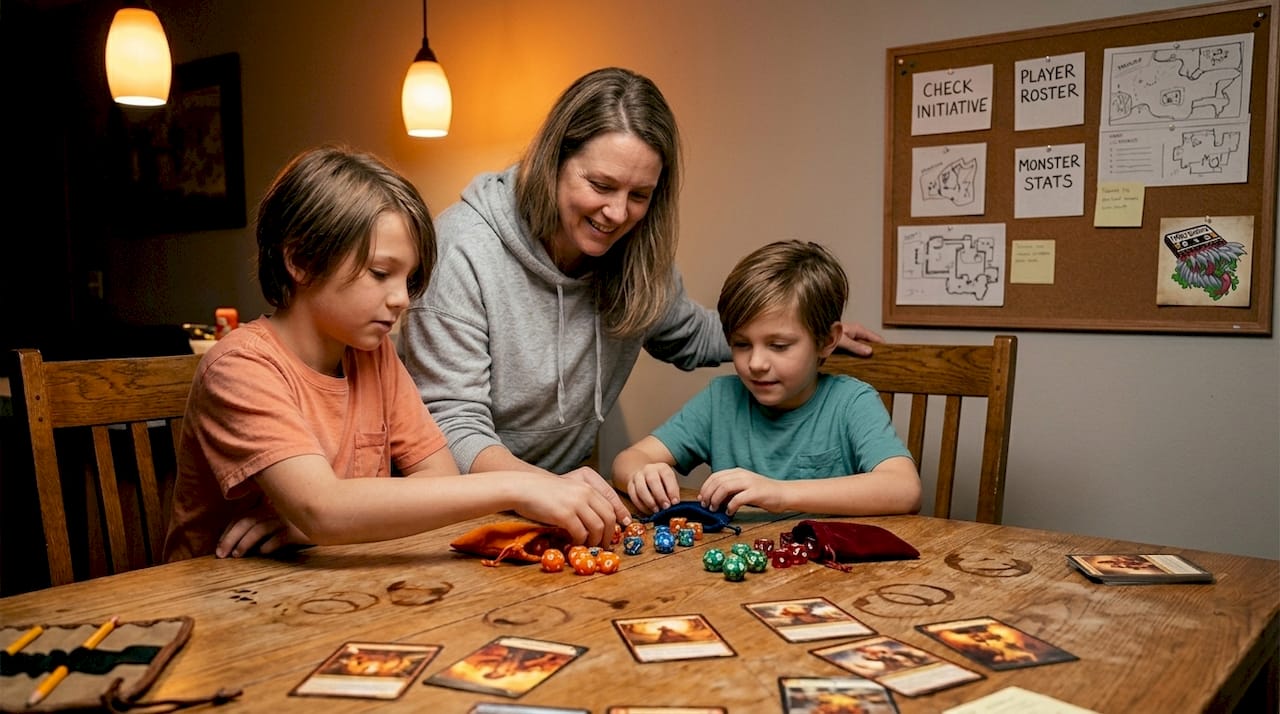
The market is seeing an explosion of accessories specifically designed to scaffold play for younger players, lower the learning curve dramatically, and make family game nights feel like epic adventures rather than homework assignments. Mass-retail toy lines for D&D now scaffold play for kids using D20-style prompts, which means the hobby is reaching households that never would have touched a Player’s Handbook. That is a big deal for the entire RPG ecosystem.
So what does this category actually look like in practice? Here are the top three types of kid-friendly accessories making an impact:
- Simplified dice sets with prompt cards: These bundle a D20 (20-sided die) with color-coded result cards that tell young players what happens based on their roll. No memorizing tables. No cross-referencing rulebooks. Pure storytelling magic in a beginner-friendly format.
- Modular toy props and miniature kits: Stackable, interchangeable terrain pieces and character tokens that make the world feel real without the precision painting skill (or the three-hour assembly session). These double brilliantly as visual aids for neurodivergent players of all ages.
- Story prompt card decks: Think of these as narrative training wheels. Each card gives a character, a setting, or a dramatic moment for the group to riff on. They’re perfect for warming up new players and they actually make experienced DMs better storytellers too.
The creative play benefits here are massive. When kids have physical tools they can hold and manipulate, their engagement skyrockets. A child who rolls a die and draws a card feels like a hero. That’s not just good game design. That’s childhood memory-making.
Pro Tip: If you’re introducing a beginner group to TTRPGs, start with one simplified dice set and one prompt deck before layering in anything else. Build confidence first, then add complexity. Your whole table will have more fun.
Want to see how unique dice choices can supercharge storytelling at any age? Browse through unique dice set examples to find sets that spark imagination the moment they hit the table.
With both high-tech hybrids and family-friendly basics covered, how do these options compare head-to-head for different needs?
Accessory showdowns: What fits your game style?
Alright, dice goblins, time to get practical. You’ve got three major categories of trending accessories in 2026. Let’s pit them against each other so you can figure out which one (or which combination) belongs at YOUR table.
| Category | Best for | Cost range | Immersion level | Learning curve |
|---|---|---|---|---|
| Hybrid gadgets | Tech-friendly tables, veteran DMs | $100–$150+ | Very high | Medium |
| Traditional analog tools | Purists, budget-conscious players | $10–$60 | High | Very low |
| Family/kid-friendly sets | New players, families, beginners | $15–$40 | Medium to high | Very low |
Now let’s break down the real-world trade-offs:
Hybrid gadgets (like Arcalink One):
- Pros: Incredible immersion boost, great for dramatic moments, grows with your campaign
- Cons: Higher upfront cost, requires some tech setup, occasional app dependency
- Best when: Your group loves theatrical flair and invests in long-term campaigns
Traditional analog tools (maps, screens, handcrafted dice):
- Pros: Zero setup friction, universally compatible, satisfying to use, no batteries required
- Cons: Limited to what the physical tool can do
- Best when: You want plug-and-play reliability and timeless quality
Family and kid-friendly accessory sets:
- Pros: Super approachable, builds confidence, often budget-friendly, great for mixed-age groups
- Cons: May feel too simple for veteran players on their own
- Best when: You’re onboarding new players or running a family-friendly one-shot
Here’s the key insight: players increasingly want physical gadgets with digital flair rather than purely digital workflow apps, which tells us the physical-first instinct of the TTRPG community is alive and well. We just want our physical stuff to do cooler things now. Fair enough.
For specific recommendations, check out our picks for 2026 D&D dice sets and explore tabletop best practices to layer accessories thoughtfully into your sessions.
Having weighed the leading options, let’s look at how experienced DMs and players can make the most of these trends.
Our take: Balancing tradition with innovation in the 2026 RPG scene
We’ve been knee-deep in TTRPG accessories for a long time, and here’s the honest truth that doesn’t get said enough: the sexiest new gadget in the world won’t fix a session that lacks good storytelling, engaged players, and a DM who cares about the experience.
That’s not a knock on hybrid gadgets or digital tools. We genuinely love what Arcalink One is doing. But we’ve seen plenty of tables collapse into fiddling with tech instead of playing the game. The dopamine hit from a new toy is real. The disruption from a misbehaving app at a critical story moment is equally real.
Our hard-won wisdom? Integrate one new accessory at a time. Give it two or three sessions to find its natural place at the table before you add another layer. When a tool truly belongs, it becomes invisible. Players stop noticing the accessory and start feeling the immersion it creates. That’s the goal.
The family-friendly accessory wave is something we’re particularly excited about, not just because it’s good business but because it means the hobby grows. Every kid who rolls a D20 and feels like a hero today is a future DM building homebrew campaigns in ten years. That’s the long game.
The real edge in 2026 isn’t about going fully digital or staying purely analog. It’s about being intentional. Pick tools that serve YOUR table’s story and YOUR group’s energy. If you’re not sure where to start, a set of custom dice for your RPG is still one of the most universally effective immersion upgrades you can make, because everyone touches dice, everyone sees dice, and the right dice make every roll feel like fate itself.
Build your kit deliberately. Blend old-school craftsmanship with the innovations that genuinely serve your story. That’s our take, and we’re rolling with it.
Explore must-have RPG accessories for every game style
Ready to start building your 2026 accessory kit? We’ve got you covered at 1985 Games. From handcrafted dice sets with personality to immersive terrain maps and campaign tools, our collections are curated for exactly the kind of player who read this far.

Whether you’re a veteran DM hunting for that next-level dramatic prop or a newcomer looking for the perfect starter set, we’ve got something that’ll make your brain light up like a Nat 20. Right now, our dice set bundles are an incredible way to experiment with multiple styles at once, including mystery sets, premium edges, and collector-worthy sharp-edge designs. Browse, explore, and find the accessories that belong at your table.
Frequently asked questions
What is a hybrid RPG accessory?
A hybrid RPG accessory combines physical elements, like dice or maps, with digital enhancements such as animations or app integrations to create a more immersive experience. The 2026 “edge” trend reflects hybrids and digital augmentations appearing as standalone tabletop gadgets and DM-support software.
How much does a digital hybrid gadget for tabletop RPGs cost in 2026?
Expect to pay between $100 and $150 for new digital tabletop gadgets like the Arcalink One. The Arcalink One pricing places it in an accessible range for groups splitting the cost as a shared table investment.
Are there RPG accessories designed for kids in 2026?
Yes, the market now includes toy lines and accessories that use simple game prompts and props to help children and families enjoy storytelling together. Mass-retail D&D toy lines designed for children are one of the biggest category expansions of 2026.
Should I mix analog and digital accessories or stick to one type?
Both styles have real advantages, and many groups enjoy combining them for maximum flexibility, but the best approach always depends on your table’s preferences and tech comfort level. Hybridization is bifurcating between players who want standalone physical gadgets with digital flair and those who adopt purely digital apps, so there’s no single right answer.