

TL;DR:
- Dice balancing ensures each face of a die has an equal chance to land face-up over many rolls, providing fair odds. Manufacturing flaws, such as density variations, mold defects, and engraving depth, can cause significant imbalances that affect gameplay. While physical biases are detectable with tests like float checks and statistical analysis, system mechanics in games like D&D often outweigh minor physical biases in determining outcomes.
You grab your fancy d20, give it a dramatic roll, and watch it land on a 1. Again. Most of us chalk that up to cursed dice or cosmic punishment from the dice gods. But what if it’s actually physics? Understanding what is dice balancing separates the casual roller from the player who knows their tools, and it genuinely affects whether your attack roll reflects fate or a manufacturing flaw hiding inside a pretty resin shell.
Table of Contents
- Key takeaways
- What is dice balancing?
- How dice imbalance happens (and how makers fight it)
- Testing your dice: from quick checks to statistical proof
- Why dice balance matters in D&D and TTRPGs
- Practical tips for choosing and maintaining balanced dice
- My honest take on dice balancing
- Level up your game beyond the dice roll
- FAQ
Key takeaways
| Point | Details |
|---|---|
| Dice balance means fair odds | A balanced die gives every face an equal chance of landing face-up across thousands of rolls. |
| Manufacturing flaws cause imbalance | Air bubbles, uneven engraving, and mold shifts all create hidden biases in commercial dice. |
| Roll tests need big sample sizes | Meaningful DIY roll tests require at least 100 to 200 rolls per die to produce usable data. |
| Saltwater float tests have limits | Float tests catch extreme imbalance but miss subtle biases that actually affect gameplay. |
| Game mechanics often outweigh dice bias | D&D system mechanics like advantage matter more to outcomes than minor physical dice imbalance. |
What is dice balancing?
Let’s get the definition locked in first. Dice balancing is the process of making sure every face on a die has an equal probability of landing face-up over a large number of rolls. That’s it. No dark arts. No arcane measurements. Just physics and probability working together (or against you).
A perfectly balanced die distributes its mass uniformly. Think of it like a perfectly symmetrical cube where every side is identical in weight and density. When that’s true, you get equal probability distribution on every face. Mathematically beautiful. Practically harder to achieve than it sounds.
Here’s where it gets interesting for us dice goblins. There are a few very different types of “unfair” dice worth knowing:
- Loaded dice: These are intentionally rigged. Someone added dense inserts or shifted internal mass on purpose to favor specific outcomes. These show up in cheating scenarios, not your friendly local game store.
- Weighted dice: Often the result of manufacturing defects rather than malice. A small air bubble or density variation can shift center-of-mass just enough to nudge outcomes without anyone knowing.
- Unbalanced dice: The broad category. Any die where physical asymmetry, poor finishing, or structural irregularities create a non-uniform probability. This is what most gamers are actually dealing with.
The principle behind fair dice is sometimes called “fair by symmetry.” A shape is fair by symmetry when its geometry guarantees that no face has any physical advantage over another. Regular polyhedra (your d4, d6, d8, d10, d12, and d20) all qualify theoretically. The real question is whether manufacturing brings them to life correctly.
How dice imbalance happens (and how makers fight it)
So your dice look like perfect little geometric gems. What could go wrong? Quite a lot, actually.

The biggest culprit is material density variation. Resin dice are poured into molds. If the resin doesn’t cure evenly, denser pockets form. Those pockets make certain faces heavier, meaning the die tends to rest with that face down and its opposite face up more often. The face you see most is the one sitting on top.
Beyond density, here’s what else messes with your rolls:
- Engraving depth: Numbers and symbols carved deeper on some faces remove more material, lightening that side and shifting the die’s balance. This is especially common with high-number faces on d20s where the “20” glyph is large.
- Mold imperfections: Even tiny mold seams or slightly off-center cavities produce dice that aren’t true to their intended geometry.
- Edge sharpness: Sharp edges prevent bias more reliably than trying to perfect internal mass distribution, which is exactly why casino dice are made with precision-cut edges rather than rounded corners.
- Drilling or shaving: Any post-production modification that removes material from specific spots will bias the die. This is how deliberate loading is done, but it also happens accidentally in low-quality manufacturing.
High-quality commercial dice makers combat these issues through precision molds, controlled resin formulas, and careful finishing. Handmade dice (especially hand-poured resin sets) are particularly vulnerable because the process is inherently less controlled.
Pro Tip: When buying dice, feel the edges with your fingertips. Sharp, crisp edges with consistent depth across all faces are a strong signal of quality manufacturing. Soft or uneven edges suggest the mold wasn’t precise.
Testing your dice: from quick checks to statistical proof
Okay, dice goblins. This is where we get practical and a little nerdy. There are several ways to test dice balance, ranging from “good enough for a casual Saturday game” to “I have a spreadsheet and I’m not afraid to use it.”
The saltwater float test
Drop your die into a saturated saltwater solution (about 1/4 cup of salt per cup of warm water). A balanced die should spin freely and land on different faces each time you flick it. If it consistently returns to the same face, that’s a red flag.
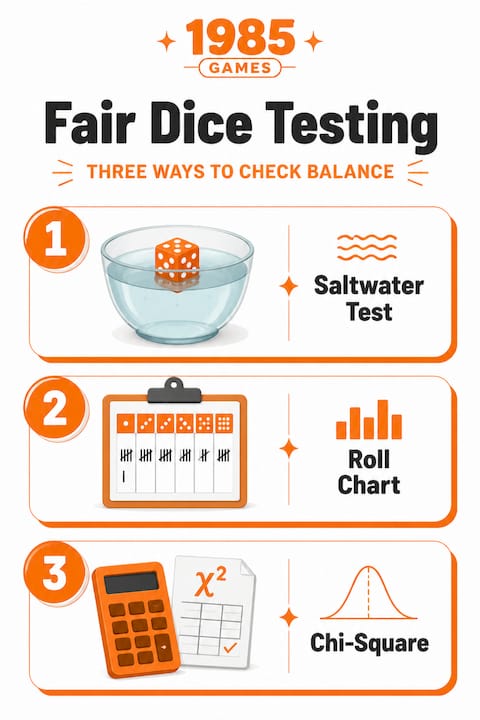
But here’s the honest truth: float tests detect extreme imbalance but miss subtle biases. Water surface tension alone can affect results. A die can pass the float test and still produce skewed rolls over hundreds of sessions. Use it as a quick triage tool, not a verdict.
The roll test
This one’s slower but far more revealing. Roll the die on a flat, consistent surface and record every result. The key word is consistent. Roll tests need 100 to 200 rolls per die to generate meaningful data. Rolling technique variance (how hard you throw, the surface you use) can actually outweigh the die’s own bias if you’re not careful. Same surface, same force, every time.
The chi-square test
Once you have your roll data, you can apply Pearson’s chi-square test to check whether your results differ significantly from what a fair die would produce. For a d20, the critical chi-square value is 30.143 at 5% significance. For a d6, it’s 11.07. If your test statistic is below those numbers, your die is probably balanced. Above them? Something’s up.
You also need a minimum of 5 expected rolls per face to make the test valid. For a d20, that means at least 100 total rolls. For a d12, at least 60. Statistical hypothesis testing using chi-square goodness-of-fit gives you an actual framework instead of a gut feeling.
Here’s a quick comparison of the three main methods:
| Method | Ease of use | Accuracy | What it catches |
|---|---|---|---|
| Saltwater float test | Very easy | Low | Severe imbalance only |
| Manual roll test | Moderate | Medium | Moderate to severe bias |
| Chi-square statistical test | Requires math | High | Subtle and severe bias |
Pro Tip: Record your roll results in a simple tally chart on paper or a phone note. You don’t need fancy software. Even a basic percentage breakdown per face will show you patterns faster than memory alone.
Why dice balance matters in D&D and TTRPGs
Here’s the thing most players never stop to consider. The role dice play in D&D goes way beyond random number generation. Every roll is a story beat. A biased d20 that favors high numbers sounds amazing until your DM starts noticing you never fail stealth checks.
So, how much does physical dice imbalance actually affect your game?
- Skewed probability: A die that rolls its highest face just 10% more often than fair would noticeably shift outcomes over a long campaign. Saving throws, attack rolls, skill checks: every mechanic bends.
- Advantage mechanics: D&D advantage doubles the probability of rolling a natural 20 from 5% to roughly 9.75%, adding an effective +3.3 expected value on d20 rolls. That’s a system-level tool doing far more work than most physical dice biases.
- Psychological trust: Perceived unfairness poisons the table. Even if a die is technically within normal variance, a player who suspects their dice are cursed will second-guess every outcome. That erodes immersion fast.
- Casual vs. competitive play: In a Friday night home game, minor imbalance is basically noise. In organized play or tournament-style TTRPG events, the stakes are higher and the scrutiny is real.
It’s worth noting that digital tools are attacking this problem too. The Colonist balanced dice algorithm replaced pure random number generation with a virtual deck system, improving statistical goodness of fit from 0.25 to 0.8 and reducing frustrating double-streaks. That kind of design is a direct response to psychological frustration with pure RNG, which plagues both digital and physical dice experiences.
Practical tips for choosing and maintaining balanced dice
You don’t need a lab. You need good habits. Here’s how to keep your dice honest:
- Inspect before you buy. Look for consistent edge sharpness, uniform paint or ink fill in engraved numbers, and no visible air bubbles in resin sets. The beginner’s dice guide from 1985games walks through what quality dice actually look like in practice.
- Run a float test first. It’s not perfect, but it weeds out the obvious disasters before they hit your table.
- Do a roll test on dice you use constantly. If one die shows up in every session, log 150 rolls on it. You’ll know in an evening if something’s wrong.
- Store your dice safely. Dice stored loose in pockets or bags get dinged and chipped. Micro-damage to edges or faces changes how they roll over time.
- Replace dice that feel wrong. You know the feeling. That one d6 that has rolled three 1s in a row across three different games. Sometimes the statistics back up your gut. Retire it.
- Use dice trays and towers. These aren’t just aesthetic. Dice towers create a consistent, randomized tumble that reduces technique-based bias. A dice tower gives every roll the same chaotic journey to the table.
Pro Tip: Separate your “tested and trusted” dice from your collection display dice. Not every beautiful set needs to be your combat die. Some are just there to look gorgeous on the shelf, and that’s perfectly valid.
My honest take on dice balancing
I’ll be real with you. I spent an embarrassing amount of time obsessing over dice fairness early in my tabletop life. Saltwater tests, spreadsheets, color-coded tally charts. The whole production. What I actually learned wasn’t about dice. It was about statistics.
Here’s the uncomfortable insight: over the course of a typical campaign session, variance from an imperfectly balanced die is almost always swamped by the natural randomness of rolling itself. System mechanics like advantage, inspiration, or reroll abilities do more to shape outcomes than a slightly biased d20 ever could.
That said, I don’t think the awareness is wasted. Knowing how dice balance works made me a smarter buyer. I stopped grabbing cheap gas station dice (yes, I did that) and started paying attention to manufacturing quality. The difference in feel alone was worth it, and the statistics followed.
My advice? Run a basic roll test on any die you use seriously. Skip the obsessive chi-square spreadsheets unless you genuinely love that kind of thing (no judgment, we see you). Focus your energy on the story, the characters, and the chaos. That’s where the magic lives. The dice are just the delivery mechanism.
— Lenny
Level up your game beyond the dice roll
Fair dice are just the beginning, dice goblins. The best tabletop sessions happen when every tool at your table is pulling its weight, from the d20 in your hand to the notes on the page in front of your DM.

At 1985games, we know that great gameplay is built on great gear. If your Dungeon Master is still scribbling campaign notes on napkins, it’s time for an upgrade. Our DM’s Journals 3 Pack gives your DM everything they need to track encounters, NPCs, and world-building details in one gorgeous package. Players, we haven’t forgotten you. The Player’s Journals 3 Pack keeps your character history, session notes, and spell lists organized and ready. Balanced dice plus organized notes? That’s the kind of campaign setup that actually makes legends.
FAQ
What is dice balancing in simple terms?
Dice balancing is the process of making sure every face on a die has an equal chance of landing face-up. A balanced die produces fair, unbiased results across many rolls.
How does the saltwater float test work?
You submerge a die in a saturated saltwater solution and flick it to see if it lands on random faces or consistently returns to one. Float tests catch major imbalance but miss subtle biases that can still affect gameplay.
How many rolls do I need to test a d20?
At least 100 rolls are recommended as a minimum. For statistically reliable results using a chi-square test, you need enough data to average 5 or more expected results per face, which means 100 rolls minimum for a d20.
Does dice balance really matter in D&D?
For casual play, minor imbalance matters less than most players think. Game mechanics like advantage add more expected value to rolls than most physical dice biases. That said, consistent imbalance across many sessions can skew outcomes in ways that feel unfair at the table.
What causes dice to become unbalanced over time?
Chipping, edge wear, and micro-damage from rough storage or hard surfaces can shift a die’s balance after extended use. Dice stored loose in bags or pockets are especially vulnerable to this kind of gradual degradation.