

TL;DR:
- Choosing the right terrain map type enhances immersion and tactical clarity for your tabletop campaigns. Procedural maps are ideal for vast worlds and rapid generation, while sculpted maps excel in cinematic key locations; blending both offers optimal results. Ultimately, match your map style to your campaign’s scale, focus, and your players’ preferences for the best experience.
Picture this: your players are mid-session, fully invested, and then someone squints at the map and goes, “Wait, is that a mountain or a hill?” Mood. Shattered. The right terrain map fixes that before it ever happens. Knowing the top terrain map types for your tabletop game is not just a Dungeon Master flex. It is the difference between a session that feels alive and one that feels like reading from a script. Let us break down exactly what is out there, how each type works, and which one your campaign actually needs.
Table of Contents
- Key takeaways
- Top terrain map types: key criteria to know first
- 1. Procedural generation terrain maps
- 2. Manually sculpted or artist-designed terrain maps
- 3. Heightmap-based terrain maps and digital elevation models
- 4. Topographic map styles for tabletop play
- 5. Illustrated fantasy cartography maps
- 6. Battle grid maps for tactical combat
- 7. Terrain map comparison: which type fits your campaign?
- My honest take on picking terrain maps
- Level up your tabletop sessions with the right terrain maps
- FAQ
Key takeaways
| Point | Details |
|---|---|
| Match map type to campaign scale | Procedural maps suit massive worlds; sculpted maps shine in focused, cinematic encounters. |
| Heightmaps add real elevation data | Digital elevation models bring geographic realism to virtual tabletop setups. |
| Artistic control vs. speed | Manual sculpting wins on detail; procedural generation wins on speed and replayability. |
| Hybrid workflows are the sweet spot | Most pros blend all three map types to balance quality, efficiency, and immersion. |
| Player feedback shapes map choices | Let your table’s reaction guide which map style you lean into for future sessions. |
Top terrain map types: key criteria to know first
Before we get into the types themselves, let us talk about how to actually evaluate them. Because picking a terrain map without a framework is like rolling a character without checking your stats. Here is what actually matters.
- Scale and detail level. A massive overworld map needs different detail than a tight dungeon corridor. Standard topographic maps like the USGS 7.5-minute series cover 49 to 64 square miles at 1:24,000 scale, which tells you just how much detail scale decisions can affect.
- Artistic style and visual clarity. If players cannot read the map intuitively, it breaks immersion instead of building it.
- Physical vs. digital format. Physical maps feel tactile and nostalgic. Digital maps plug into virtual tabletop software like Roll20 or Foundry and let you toggle layers mid-session.
- Compatibility with your system. D&D 5e uses a grid by default. Your map should match that or at least adapt easily.
- Cost and accessibility. Gorgeous hand-illustrated maps can run pricey. Procedurally generated ones are often free or low-cost through terrain mapping software.
- Ease of customization. Can you add a secret door? A new settlement? The best maps let you modify without starting from scratch.
- Durability for physical maps. Laminated or printed on cardstock, a map needs to survive a full campaign, not just one session.
Pro Tip: Print your physical maps at a slightly larger scale than you think you need. Players love to lean in and explore details, and a bigger map gives you room to add annotations as the campaign evolves.
Understanding terrain’s role in D&D goes hand-in-hand with picking the right map type. Once you know what you need terrain to DO, the right format becomes obvious.
1. Procedural generation terrain maps
Procedural generation terrain maps are built by algorithms, not artists. Software uses noise functions and rule-based systems to algorithmically build terrain, generating hills, rivers, and forests without a single manual brushstroke.
Why gamers love them:
- They are FAST. Spin up an entire continent in minutes.
- Replayability is insane. Every generation produces a different map.
- They scale beautifully for massive sandbox campaigns.
- Many tools are free or bundled with virtual tabletop software.
Where they fall short:
- Less artistic control means less personality. Two procedural forests can look nearly identical.
- Repetitive patterns creep in, especially on smaller maps.
- They rarely create the “wow” moment that a hand-crafted landmark delivers.
Procedural maps shine when your campaign spans huge territories and you need terrain fast. Think hexcrawl adventures, wilderness survival arcs, or large-scale wars. Tools like Azgaar’s Fantasy Map Generator are a dice goblin’s dream for this style.
Pro Tip: Use procedural generation for your overworld and then layer in manually designed points of interest on top. You get speed AND soul.
2. Manually sculpted or artist-designed terrain maps
These are the show-stoppers. Manually sculpted terrain maps are created by artists who shape every hill, every cliff face, and every river bend by hand. Manual sculpting offers the highest degree of artistic control, making it ideal for cinematic and stylized environments.
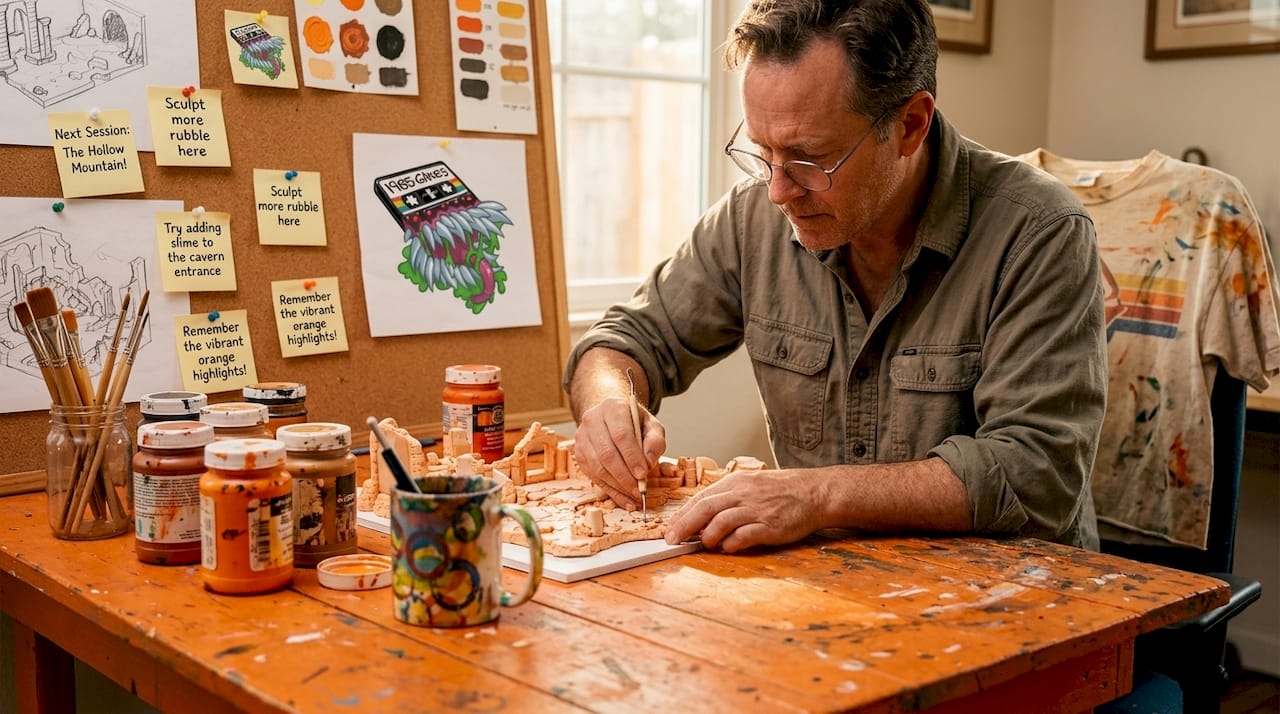
When your players finally reach the Dragon’s Keep after three sessions of buildup, you want a map that earns that moment. Artist-designed maps deliver on that promise in a way no algorithm can replicate.
Best use cases for sculpted maps:
- Boss encounter arenas with unique environmental hazards
- Key story locations like temples, throne rooms, or cursed forests
- Small-scale battlefields where every terrain feature matters tactically
The tradeoff is time and effort. Creating a detailed sculpted map can take hours or days. But here is the flip side: if you source pre-made artist-designed terrain battle maps, you get that handcrafted look without the time investment.
Recognizing terrain features like ridges, valleys, and saddles elevates a map from decoration to a genuine tactical navigation tool. Artist-designed maps typically highlight these features far better than procedural ones.
3. Heightmap-based terrain maps and digital elevation models
Heightmaps are grayscale images where pixel brightness represents elevation. White means high, black means low, and every shade in between maps to a specific altitude. They are the backbone of realistic terrain visualization techniques in both game development and tabletop gaming.
Digital Elevation Models (DEMs) are the real-world equivalent, used by NASA and geographic agencies to map terrain across nearly 80% of Earth’s surface. Dungeon Masters borrow this concept to build geographically believable worlds.
Here is a quick comparison of heightmap tools relevant to tabletop gaming:
| Tool | Best for | Cost | VTT compatible |
|---|---|---|---|
| World Machine | Realistic landscape generation | Paid (free tier) | Export only |
| Terragen | High-fidelity rendering | Free/Paid | Export only |
| Inkarnate | Fantasy map creation with elevation | Subscription | Yes |
| Dungeondraft | Dungeon and region maps | One-time purchase | Yes |
The big advantage of heightmaps is realism. Modern LiDAR terrain mapping achieves horizontal accuracy between 2 and 30 centimeters, and tabletop-inspired terrain tools borrow that same elevation-first philosophy to produce landscapes that feel physically believable.
The limitation? Heightmaps can feel sterile without artistic polish layered on top. They prioritize structure over style.
Pro Tip: When reading or creating a heightmap-inspired topographic map, always check the contour interval first. A 5-meter versus 50-meter interval changes how you interpret steepness completely, and misreading it can tank your tactical planning.
4. Topographic map styles for tabletop play
Topographic maps use contour lines to show elevation changes. They originated as military and geographic tools, but tabletop gamers have adopted them for their incredible information density. A well-read topo map tells you exactly where a canyon narrows, where a ridge blocks a sightline, and where a river floods in spring.
For dungeon masters running overland travel or wilderness campaigns, these different terrain map styles offer something no battle grid can: a sense of the world BREATHING. Players can actually plan routes, anticipate ambush spots, and debate which mountain pass is safer.
The 10 standard terrain features from military navigation doctrine (hills, ridges, valleys, saddles, depressions, draws, spurs, cliffs, cuts, and fills) map beautifully onto D&D terrain encounters. Teaching your players to read a simplified topo map turns every overland session into a mini-game of its own.
One catch: topographic maps require a bit of player literacy. Drop a complex topo in front of new players and you might get blank stares. Simplify with color coding or layer labels to keep things accessible.
5. Illustrated fantasy cartography maps
Fantasy cartography is its own art form, and it is the style most players immediately picture when they think “D&D map.” Think parchment backgrounds, illustrated mountain ranges, decorative compass roses, and hand-lettered city names. These maps prioritize storytelling over tactical precision.
The genius of illustrated fantasy maps is emotional impact. They do not just show where things are. They make players WANT to go there. A beautifully illustrated coastal city with tiny ships in the harbor and a serpent lurking offshore fires up the imagination in a way a clean grid never will.
These maps work best as campaign overview tools rather than combat grids. Use them to establish the world at session one, then zoom into more tactical map types when combat hits.
Artists like Dyson Logos (whose maps are free for non-commercial use) have made illustrated fantasy cartography accessible for every dungeon master budget. Communities like the Cartographers’ Guild overflow with inspiration and downloadable resources.
6. Battle grid maps for tactical combat
Battle grid maps are the workhorses of D&D. Square or hex grids, scaled to 5 feet per square, built specifically for miniature placement and tactical combat. They are not trying to be pretty. They are trying to be CLEAR.
Every terrain feature on a battle grid has a mechanical purpose. That column of stone is cover. That pool of water is difficult terrain. That balcony is a high ground advantage. Terrain design in TTRPGs works best when every element on the map can influence a combat decision.
The best battle grid maps layer visual interest on top of tactical clarity. You want players to feel like they are in a burning tavern, not just moving minis around graph paper. High-contrast art, clear line-of-sight indicators, and distinct terrain zones (difficult terrain marked differently from open ground) make these maps sing.
Physical battle maps on vinyl or neoprene are reusable, wet-erase friendly, and feel incredible on the table. Digital versions in virtual tabletop tools allow dynamic lighting, fog of war, and real-time updates.
7. Terrain map comparison: which type fits your campaign?
Here is the side-by-side breakdown every dungeon master needs before session prep:
| Map type | Scale | Artistic control | Realism | Setup effort | Cost | Best for |
|---|---|---|---|---|---|---|
| Procedural generation | Massive | Low | Medium | Very low | Free to low | Sandbox campaigns, hexcrawls |
| Manually sculpted | Small to medium | Very high | Medium to high | High | Medium to high | Cinematic encounters, key locations |
| Heightmap/DEM-based | Medium to large | Medium | Very high | Medium | Free to medium | Realistic landscapes, VTT setups |
| Topographic | Large | Low to medium | High | Low | Free to low | Overland travel, wilderness arcs |
| Fantasy cartography | Campaign-wide | High | Low | Low to medium | Free to high | World-building, player handouts |
| Battle grid | Small | Medium | Medium | Low | Low to medium | Tactical combat, encounter zones |
Professional terrain workflows blend procedural generation for base areas, heightmaps to refine elevation, and sculpting for key landmarks. The same logic applies to tabletop campaigns. You do not have to pick just one.
The best terrain mapping approach depends on your campaign scale and how much you value artistic detail versus speed. There is no wrong answer. There is only the wrong answer for YOUR table.
My honest take on picking terrain maps
I have seen dungeon masters spend three weeks crafting a stunning hand-illustrated map that players glance at once and never reference again. And I have seen a dungeon master throw down a hand-sketched battle grid on a napkin that sparked the most memorable combat of the whole campaign. Here is what I have actually learned from watching tables run.
The artistic value of a map matters far less than its clarity during play. Players need to make decisions fast in combat. If they have to decode the map instead of playing, you have already lost. My strong preference is a hybrid setup: a gorgeous fantasy cartography map for the campaign world overview, and clean, high-contrast battle grids for any encounter that matters.
I also think dungeon masters underestimate how much player feedback shapes map needs. One table loves exploring overland topo-style maps. Another wants pure combat grids and does not care about the wider world geography. Ask your players after a session or two. Their answer will tell you everything.
The biggest mistake I see? Choosing a map type based on what looks coolest in an article (yes, even this one) rather than what your specific campaign calls for. Heightmaps are incredibly cool. They are also overkill for a five-room dungeon. Match the tool to the job, not to the hype.
— Lenny
Level up your tabletop sessions with the right terrain maps

Now that you know your way around the top terrain map types, it is time to gear up. At 1985games, we stock terrain battle maps designed specifically for D&D and TTRPG encounters, whether you want dramatic dungeon corridors, sprawling wilderness encounters, or cinematic boss arenas. Every map in our collection is built to enhance immersion and give your players something worth fighting over. Pair a great map with the right accessories and your table goes from “fun session” to “legendary campaign.” Browse our full terrain collection and find the battlefield your story deserves.
FAQ
What are the top terrain map types for D&D?
The top terrain map types for D&D include procedural generation maps, manually sculpted maps, heightmap-based maps, topographic-style maps, illustrated fantasy cartography, and battle grid maps. Each serves a different purpose, from overland travel to tactical combat encounters.
Which terrain map type is best for combat encounters?
Battle grid maps are the gold standard for tactical combat in D&D, offering clear square or hex grids scaled to 5 feet per square for precise miniature placement and terrain interaction.
Can I mix different terrain map styles in one campaign?
Absolutely. Most experienced dungeon masters use hybrid terrain approaches, pairing a wide-scale fantasy cartography map for the overworld with detailed battle grids for specific encounters.
What is a heightmap and how does it help tabletop gaming?
A heightmap is a grayscale image where brightness represents elevation, used to generate realistic terrain with accurate hills and valleys. In tabletop gaming, it supports geographically believable world-building, especially for virtual tabletop setups.
How do I choose between procedural and sculpted terrain maps?
Choose procedural maps when you need to generate terrain quickly across large areas, and opt for sculpted maps when artistic detail and immersion at a specific location matter most to your story.