

TL;DR:
- Terrain maps are essential tools that clarify spatial relationships and speed up gameplay during sessions. They standardize movement, improve tactical decision-making, and enhance immersion by showcasing elevation, cover, and line-of-sight details. Proper pre-session map preparation and clear design prioritize gameplay clarity, making encounters more engaging and less argumentative.
Think terrain maps are just pretty decorations spread across the table to make your dungeon look cool? Yeah, we thought so too. Then someone’s barbarian tried to charge through a swamp and the whole table erupted into a 20-minute argument about distances. The importance of terrain maps goes way beyond aesthetics, fellow dice goblins. A good map is the referee’s best friend, a player’s tactical bible, and the difference between a session that FLOWS and one that grinds to a frustrating halt. Let’s dig into why terrain maps are the unsung heroes of your game table.
Table of Contents
- How terrain maps resolve spatial ambiguity in gameplay
- Movement and positioning mechanics influenced by terrain maps
- The tactical significance of cover and line of sight on terrain maps
- How Dungeon Master terrain map prep improves session quality
- Incorporating realistic terrain elevation into tabletop maps
- Rethinking terrain maps: Why precision matters more than beauty
- Enhance your tabletop RPG experience with terrain tools and dice
- Frequently asked questions
How terrain maps resolve spatial ambiguity in gameplay
Here is the honest truth: most in-session arguments are not about rules. They are about space. “How far away is the goblin?” “Can my ranger see through that pillar?” “Am I in the blast radius or not?” These questions feel small, but they eat up precious game time and spike tension at the table fast.
Terrain maps are a resolution tool first. As tabletop terrain experts note, for TTRPGs including D&D, maps remove spatial ambiguity: with a grid of 5-foot squares, questions like “can I reach the orc before it reaches the archer” become measurable and faster to adjudicate, rather than depending on a GM judgment call. That is a HUGE deal. No more gut-feeling rulings. Just count the squares.
“A terrain map is not scenery. It is the rulebook made visible. Every square is a decision point waiting to happen.”
Here is what terrain maps actually do for your session, broken down in order of impact:
- Standardize movement distances so every character knows exactly how far they can travel each turn.
- Clarify positioning so flanking, reach weapons, and opportunity attacks are judged consistently.
- Speed up initiative tracking by giving everyone a shared visual reference for turn order actions.
- Enable area-of-effect adjudication so a fireball’s 20-foot radius is measured, not estimated.
- Support line-of-sight assessments so cover and visibility are clear rather than debated.
Combat-heavy sessions especially depend on terrain map applications like these. Want to master terrain maps tactics and stop those mid-session disputes for good? It starts with understanding the grid as a gameplay system, not just a visual aid.
Movement and positioning mechanics influenced by terrain maps
Movement is the heartbeat of tactical combat. When players know exactly how far their character can go and what costs them extra, choices become rich and meaningful. When they do not know? Chaos. Friendly chaos, sure, but still chaos.
Difficult terrain is one of the most impactful mechanics tied directly to terrain map applications. The movement and positioning rules in D&D 5e are precise: difficult terrain costs double the movement, meaning 2 feet of movement for every 1 foot traveled. A creature with 30 feet of speed moving through 15 feet of difficult terrain burns all 30 feet. That creature is not going anywhere else that turn. That is a MASSIVE tactical constraint.
Here is what effective uses of terrain mapping for movement look like in practice:
- Mark difficult terrain clearly using texture or color so players spot it before committing their move.
- Show impassable terrain like deep water or sheer walls so players route around, not through.
- Place chokepoints intentionally such as narrow corridors that funnel movement and force decisions.
- Indicate elevation changes on the map so movement between levels feels measured, not improvised.
- Reveal terrain features gradually as characters explore to build anticipation and reward scouting.
The role of terrain in strategic play extends far beyond “you move slower here.” Positioning relative to terrain determines who gets attacked, who gets to attack, and who gets to play it safe behind a convenient boulder.
Pro Tip: Use two different colored tokens or markers on your map to distinguish difficult terrain from hazardous terrain (like fire or acid). Players will thank you when their rogue avoids the acid pit entirely because they could actually see it.
The tactical significance of cover and line of sight on terrain maps
Cover is where terrain maps shift from useful to genuinely game-changing. Half cover, three-quarters cover, and total cover are not just flavor words. They have hard mechanical effects that swing combat outcomes dramatically.
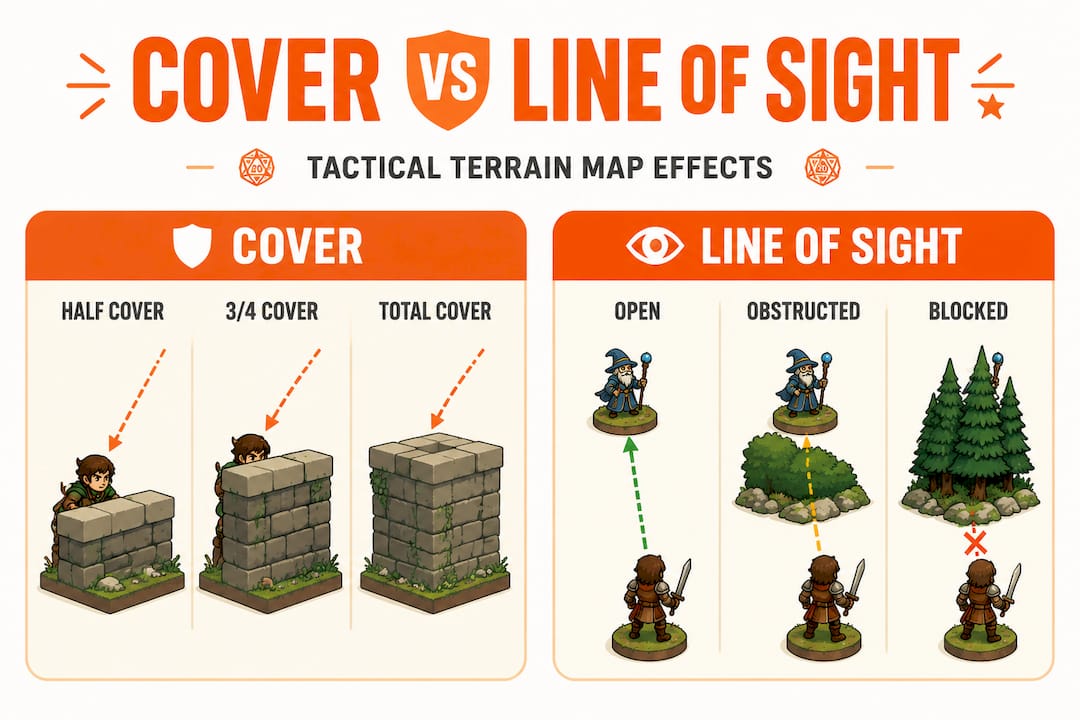
The math is simple but the impact is enormous. Half cover grants a +2 bonus to AC and Dexterity saving throws. Three-quarters cover bumps that to a +5 bonus. As cover rules confirm, cover states depend on whether an obstruction between attacker and target blocks parts of the target from the attacker’s perspective. That low wall your fighter is crouching behind? That is +2 to AC. That stone pillar the enemy wizard is peeking around? That is +5, and suddenly hitting them feels nearly impossible.
Here is a quick reference for how terrain features translate to cover on your maps:
| Terrain feature | Cover type | AC bonus |
|---|---|---|
| Low wall, crate, bush | Half cover | +2 |
| Stone pillar, doorframe, thick tree | Three-quarters cover | +5 |
| Solid wall, floor, large obstruction | Total cover | Cannot be targeted |
| Open ground, shallow water | No cover | None |
Key tactical points players often miss about cover and terrain maps:
- Elevation changes cover calculations. A creature on higher ground may have clear line of sight to targets that would otherwise be in cover.
- Cover is relative to the attacker’s position, not absolute. Moving one square can change a target from half cover to no cover entirely.
- Large creatures interact differently with cover due to their size, occupying multiple squares and being harder to fully block.
- DMs must adjudicate cover from each attacker’s perspective, which is why good terrain design for tactics places obstacles in positions that create genuinely interesting decisions, not just defensive camping.
How Dungeon Master terrain map prep improves session quality
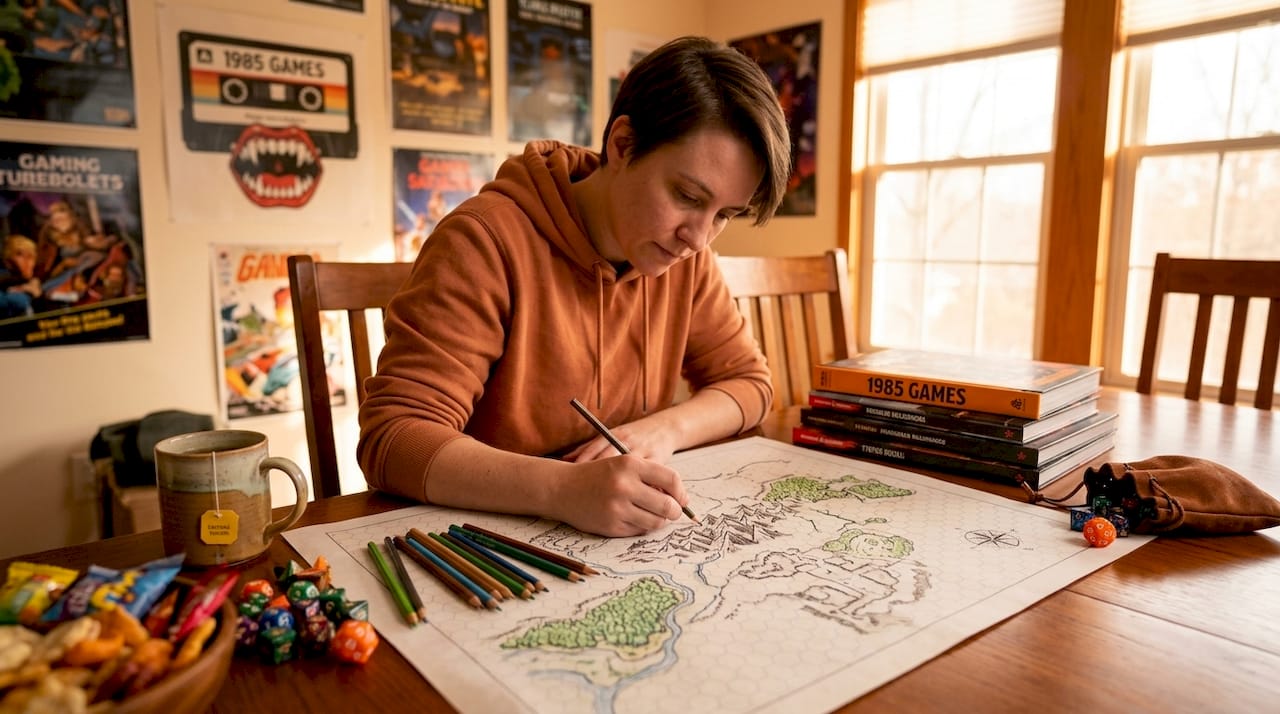
Here is something every DM learns the hard way: improvising a map mid-session is rough. You sketch something fast, players find the edges weird, and tactical depth evaporates. Pre-made maps change everything. As one DM prep resource puts it, a pre-drawn floor plan helps the DM plan crossroads, paths, and terrain layouts that create tactical advantages, while improvised maps simply do not compare.
Why does this matter so much? Because linear maps kill momentum. When players can only move forward or backward, combat becomes a slugfest with no decision-making involved. Where is the fun in that? A thoughtfully designed map with multiple paths, elevated platforms, and environmental hazards turns every encounter into a puzzle.
Here is what great DM terrain prep looks like in practice:
- Design at least two routes to major objectives so players never feel railroaded into one approach.
- Vary terrain height across the encounter space to reward flying characters, archers, and climbers.
- Include interactive environmental features like collapsing pillars, oil slicks, or rising water that change the map over time.
- Swap maps between major act breaks in longer sessions to refresh player focus and signal a new tactical phase.
- Pre-mark difficult terrain, hazard zones, and lighting conditions before the session begins so you are not slowing down play to answer the same questions twice.
The importance of topographic maps and terrain prep also extends to how players emotionally engage. A beautifully drawn or professionally printed map signals that the encounter matters. Players lean in. Decisions feel weightier. That is the magic of good preparation.
Pro Tip: Build a small library of reusable map layouts for common encounter types (forest clearing, dungeon room, tavern brawl). Swap in fresh terrain features each time so the layout feels familiar but the tactical problem feels new.
Incorporating realistic terrain elevation into tabletop maps
Elevation is the secret weapon of advanced terrain map design. Flat maps are fine, but maps with meaningful height variation? Those create a different kind of tactical experience entirely. Archers love high ground. Melee fighters hate stairs. Casters develop a whole new appreciation for flying.
Real-world cartography gives us useful principles here. NASA’s terrain modeling work describes Digital Elevation Models as 3D “bare earth” surfaces showing topography improved with lidar data. We do not need to get that technical at the game table. But the underlying idea, that contour patterns reveal route options and ambush points, maps beautifully onto tabletop play.
Here is how real topographic concepts translate to your ttrpg terrain basics:
| Real-world concept | Tabletop equivalent | Tactical effect |
|---|---|---|
| Steep contour lines | Cliff or sheer wall | Impassable without climbing gear |
| Gradual slope | Difficult terrain hillside | Costs extra movement, may offer elevation bonus |
| Valley or ravine | Canyon encounter space | Funnels movement, creates ambush risk |
| Plateau | Elevated platform | Range advantage, line-of-sight bonus |
| River or water feature | Aquatic hazard | Movement cost, drowning risk, cover disruption |
The strategic variety elevation adds to a session is genuinely hard to replicate any other way. Players start thinking three-dimensionally. “Can I jump to that ledge?” “Does the dragon get cover from the mountain ridge?” These are the questions that make a combat encounter feel like an adventure.
Rethinking terrain maps: Why precision matters more than beauty
Here is our hot take, and we stand behind it fully: the most beautifully painted, meticulously detailed terrain piece in the world is worth less than a clearly drawn, accurate grid map if the decorative model is confusing gameplay.
We see this happen at tables all the time. A DM spends 40 hours crafting stunning modular terrain, then the players spend 40 minutes arguing about whether a sculpted tree blocks line of sight or not. As the terrain resolution principle makes clear, terrain is a resolution tool, not a storytelling one. It does not change the rules. It makes applying them faster and less argumentative, especially at combat-heavy tables where spatial mechanics decide outcomes.
This is not an argument against beautiful terrain. Beautiful terrain is AMAZING and we love it dearly. It is an argument for making clarity the first priority. A small misplacement of a terrain feature can legitimately change whether a player’s character survives a round. That is not a dramatic exaggeration. That is a flanking bonus, a cover denial, or a reach weapon interaction that changes the math entirely.
New DMs especially benefit from treating maps as an information schedule. Reveal terrain features progressively as the encounter unfolds. Do not front-load every environmental detail at session start. It builds suspense, rewards scouting, and keeps players engaged with the map as a living, changing space rather than static wallpaper. Experienced DMs can layer in more complexity, but the principle of precision over prettiness never stops being true.
Enhance your tabletop RPG experience with terrain tools and dice
Now that you know exactly why terrain maps are the tactical backbone of any great session, the next question is how to build a kit that actually delivers. Good maps deserve good dice. And good dice deserve a great deal.

We at 1985 Games are all about giving dice goblins and dungeon masters alike the tools to run sessions that leave everyone buzzing. Right now, our dice sets promotion lets you buy two sets and get one free, so you can stock up on beautiful, tactile dice to roll alongside your terrain maps. Pair crisp battle maps with sharp-edge dice that feel as satisfying as a Nat 20 on the final boss. Your table deserves the upgrade. We ship globally so no matter where your dungeon is located, we have got you covered (three-quarters cover, minimum).
Frequently asked questions
Why are terrain maps important in Dungeons & Dragons?
Terrain maps remove spatial ambiguity by showing exact positions and distances, helping players and DMs make faster, fairer tactical decisions. As tabletop sources confirm, questions like “can I reach the orc before it reaches the archer” become measurable rather than subject to GM judgment.
How does difficult terrain affect movement on maps?
Difficult terrain doubles the movement cost: a creature spends 2 feet of movement for every 1 foot traveled, effectively cutting usable movement in half. As D&D movement rules show, a character with 30-foot speed moving 15 feet through difficult terrain uses all 30 feet.
What is the role of cover on terrain maps?
Cover represents physical obstructions that grant defensive bonuses, with half cover giving +2 AC and three-quarters cover giving +5 AC. Per D&D cover rules, cover type depends on how much of the target an obstruction blocks from the attacker’s perspective.
Why should Dungeon Masters prepare maps in advance?
Pre-made maps help DMs design tactical layouts with multiple paths and terrain features that improve player choices and session pacing. DM prep resources note that a pre-drawn floor plan creates tactical advantages that improvised maps simply cannot match.