

TL;DR:
- Starting as a new Dungeon Master requires only a small setup, including a free rulebook, a basic dice set, and a notebook.
- Proper preparation focuses on one or two sessions ahead, with a clear session zero to set expectations and ensure safety.
- Emphasizing improvisation over over-preparing helps prevent burnout, making the game fun and accessible for beginners.
So you’ve decided to step behind the screen. Welcome to the best seat at the table! A lot of new Dungeon Masters assume they need a mountain of gear, a photographic memory of every rule, and a custom-painted miniature army before they can run their first session. That’s just not true. What are beginner DM essentials, really? Spoiler: the list is shorter than you think, and most of it is either free or already sitting in your junk drawer. This guide is here to show you exactly what you need, what you can skip, and how to actually have fun doing it.
Table of Contents
- Key takeaways
- What are beginner DM essentials: the physical stuff
- Digital tools that actually help
- Session zero and prep methods that keep you sane
- Running sessions smoothly: in-game basics
- Lenny’s honest take on starting out
- Level up your DM kit with 1985games
- FAQ
Key takeaways
| Point | Details |
|---|---|
| Start for free | The D&D Basic Rules are free online and cover everything needed to run levels 1 through 20. |
| Dice come first | One polyhedral dice set is all you need to get rolling. Specialty sets are fun but totally optional. |
| Session Zero saves sessions | A short pre-game chat about expectations, tone, and safety tools prevents most common table disasters. |
| Prep less, play more | Focusing your prep on the next one or two sessions keeps you sane and your story flexible. |
| Add tools gradually | Introduce trackers, apps, and extras only when a specific problem shows up at your table. |
What are beginner DM essentials: the physical stuff
Let’s start with the tactile goodies. The physical items that live on your table.
The single most important purchase you will make is a polyhedral dice set. You need the classic seven: a d4, d6, d8, d10, d%, d12, and d20. That’s it. You don’t need sharp-edge resin sets in three colorways (yet). One standard set from any game store does the job. If you want a little guidance on what to look for, our beginner dice guide breaks it down beautifully.
Next up: rules access. The D&D 5E Basic Rules are available free online, covering core mechanics and character creation from levels 1 to 20, with zero cost to you. Free. Like, actually free. You can print them, read them on your phone, or just have the tab open during play. A physical Player’s Handbook is a lovely upgrade eventually, but it is not required on day one.
Here’s the rest of your physical starter kit:
- A notebook or loose paper. You will need somewhere to jot NPC names, locations, and player decisions mid-session. Any notebook works. Seriously, the back of a cereal box works in a pinch.
- Pencils. Stats change. Plans change. Pencils are forgiving.
- Index cards. Underrated tool. Use them for initiative tracking, monster stat reminders, or quick location sketches.
What you do NOT need right now: miniatures, a DM screen, a battle mat, or terrain tiles. A DM screen can help you hide notes and reference rules faster, but many DMs run entire campaigns without one. Those things are upgrades. Treat them that way.
Pro Tip: Write the names of your main NPCs on index cards and keep them in front of you during sessions. When your brain freezes mid-scene, a quick glance at a card beats a frantic page-flip every time.
Digital tools that actually help
You live in a golden age of free DM software. The trick is not to download all of it at once.

D&D Beyond is the closest thing to a one-stop digital toolkit for new DMs. It gives you access to digital rulebooks, character sheet management, spell databases, and even a built-in dice roller. The free tier is genuinely useful. If your players create characters on D&D Beyond, you can even see their sheets as DM. That alone prevents about a hundred “wait, what’s my modifier?” slowdowns per session.
For remote or hybrid play, Owlbear Rodeo offers simple virtual tabletop setups that require no account and almost no learning curve. You get a map, tokens, and a shared space. That’s the whole thing. Roll20 is another solid option with more features, though the extra complexity can feel like a lot when you’re still learning the rules themselves.
Here’s a short list of free digital tools worth bookmarking:
- D&D Beyond for rules, character sheets, and spell lookup
- Owlbear Rodeo for lightweight virtual tabletop play
- Google Docs or Notion for session notes and story tracking
- YouTube for actual play references (watching other DMs run a scene teaches more than most written guides)
The key insight from experienced DMs is this: add tools only when a specific problem arises. If you’re not running online games, you don’t need a VTT. If your initiative tracking is working fine with index cards, don’t download an app just because it exists.
Pro Tip: Resist the urge to optimize your digital setup before your first session. Pick one or two tools, learn them a little, and run the game. You can add the fancy stuff after you know what’s actually slowing you down.
Session zero and prep methods that keep you sane
Here’s the thing most beginner DM guides bury at the bottom: your most important session happens before the campaign even starts.
Session Zero is a pre-game conversation, usually one to two hours, where you and your players align on tone, expectations, and boundaries. You cover things like: Is this campaign dark and gritty or lighthearted and comedic? What topics are off-limits? How do players want to handle in-game conflict? A Session Zero establishes safety tools and table etiquette that prevent real friction down the road. Skipping it is one of the most common new DM mistakes. Don’t skip it.
Once Session Zero is done, here’s how to prep without losing your mind:
- Pick your adventure. Start with a pre-made module like The Lost Mine of Phandelver or a free adventure from D&D Beyond. Pre-made adventures give you structure so you can focus on running the game rather than building it from scratch.
- Prep only one to two sessions ahead. Effective prep focuses on the next session or two, not the whole arc. A single sheet with three locations, five NPC names, and two encounters is enough scaffolding to run a great night.
- Know your key NPCs. You don’t need a backstory novel for every character. Give each important NPC one personality trait, one goal, and one secret. That’s enough to improvise convincingly.
- Write a one-sentence session goal. Something like: “The players discover the thieves guild is run by the innkeeper.” One clear narrative hook per session keeps the story moving even when players go sideways.
- Prepare a “yes, and” mindset. This is the improv principle. When players do something unexpected, say yes and add a consequence. It’s more fun than saying no, and it makes you look like a genius.
The Lazy DM approach isn’t lazy at all. It’s smart resource management. Over-preparing wastes hours and often goes unused because players will always find the one door you didn’t prep behind.
Running sessions smoothly: in-game basics
Okay. The players are seated. The dice are out. Now what? Here’s what actually matters once the game is live.
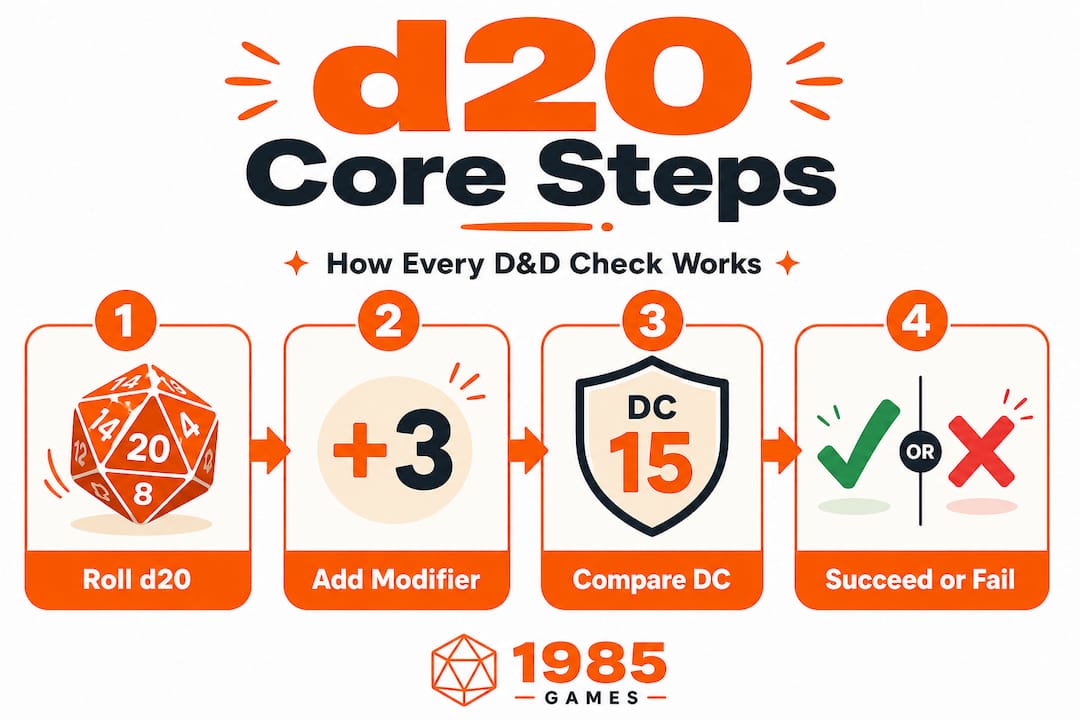
Understanding DCs and the d20
The core mechanic of D&D 5E is beautifully simple. A player rolls a d20, adds a modifier, and you compare it to a Difficulty Class (DC). The six DC levels range from 5 to 30, with DC 10 as easy and DC 15 as standard medium difficulty. That’s the whole system. Once you internalize that, you can adjudicate almost any situation on the fly without cracking a rulebook.
Tracking initiative and conditions
Combat is where new DMs feel the most pressure. Keep it simple:
- Write the initiative order on a piece of paper and cross off turns as they go.
- Use different colored index cards for monsters vs. players.
- Track conditions (like “frightened” or “poisoned”) by clipping a sticky note to the relevant card.
You don’t need a battle mat or a combat tracker app on session one. The most important first-time DM tool isn’t a product. It’s the willingness to improvise and the permission to have fun. Monsters can miss dramatically. Villains can monologue. The rules serve the story, not the other way around.
Pro Tip: If you forget a rule mid-session, make a quick ruling, write the question on a sticky note, and look up the actual rule after the game. Keeping the story moving is always more important than a perfect rules call in the moment.
That willingness to bend rules for fun and narrative creates a more engaging experience for everyone at the table. Your players didn’t come to watch you read a rulebook. They came to go on an adventure.
Lenny’s honest take on starting out
I’ve been at enough tables to say this with real conviction: over-preparing is the number one thing that burns out new DMs before they ever find their groove.
I’ve seen first-time DMs spend three weeks building a world map, writing detailed lore documents, and crafting elaborate backstories for every shopkeeper in a town the players walked through in four minutes. And I get it. The preparation feels safe. It feels like control. But the moment players do something unexpected (and they always, ALWAYS will), all that prep becomes dead weight.
What actually works? Knowing your next two scenes and trusting yourself to fill in the gaps. The table doesn’t know what you didn’t prep. They only experience what you give them. And honestly? Some of the best moments I’ve ever seen at a table came from pure improvisation, a DM who said “yes” to a wild player idea and spun gold out of nowhere.
Session Zero is the one piece of prep I would never skip. Not because of some rule, but because it transforms a group of strangers into a crew. When everyone knows the tone, the limits, and the vibe before the first dice roll, the whole game just breathes easier.
My advice? Run your first session with a free adventure, one set of dice, and a notebook. Check out our essential DM skills guide when you want to go deeper. Build your toolkit as the real problems show up. And remember that the only DM who isn’t good enough to run a session tonight is the one who’s still waiting to feel “ready.”
You’re ready. Go roll.
— Lenny
Level up your DM kit with 1985games
You’ve got the knowledge. Now let’s talk about the gear that actually makes sessions feel special.

At 1985games, we know you don’t need to spend a fortune to run a great game. That said, there’s a real difference between scribbling session notes on a napkin and keeping your campaign organized in a Dungeon Notes campaign journal. These journals are designed specifically for Dungeon Masters, giving you dedicated space for NPCs, session recaps, plot threads, and locations. No more memory bottlenecks. No more “wait, what did the players do last session?” panic.
When you’re ready to treat yourself to a proper dice set (because you will be, dear dice goblin), check out our buy 2 get 1 dice bundles for seriously good value on sets that have genuine personality. Start simple, grow the toolkit as your sessions grow in ambition. We’re here for the whole ride.
FAQ
What are the absolute minimum essentials for a beginner DM?
A polyhedral dice set, access to the free D&D Basic Rules, and something to write on. Those three things are genuinely enough to run your first session tonight.
Do I need to buy a Player’s Handbook to start DMing?
No. The D&D 5E Basic Rules PDF is free online and covers all core mechanics for levels 1 to 20, making it a solid starting point before you invest in a physical book.
What is Session Zero and why does it matter?
Session Zero is a pre-campaign conversation where the DM and players align on tone, expectations, and safety tools. It takes about one to two hours and prevents most common table conflicts before they start.
How much should I prep for my first D&D session?
Keep it tight. Prep only one to two sessions ahead with a handful of NPCs, key locations, and a couple of encounters. Over-prepping wastes time and goes unused when players take the story in unexpected directions.
Do I need digital tools or apps to run D&D as a new DM?
Not at all. Digital tools like D&D Beyond are helpful but never required. The best approach is to add tools only when a specific problem appears at your table rather than loading up on apps before you even know what you need.