

Running a Dungeons & Dragons campaign often starts with excitement and a stack of notes, but confusion quickly settles in when myths and misunderstandings cloud the process. The idea of a campaign has roots in military strategy and storytelling, shaping every adventure since D&D began in 1974. If you want to create immersive journeys that matter to your players, understanding what truly defines a campaign and breaking common myths will help you build a more dynamic, responsive narrative for your group.
Table of Contents
- Defining A D&D Campaign And Common Myths
- Popular Campaign Types And Settings Explained
- How Campaigns Work: Structure And Progression
- Dungeon Master’s Role And Essential Responsibilities
- Top Pitfalls To Avoid In D&D Campaign Creation
Key Takeaways
| Point | Details |
|---|---|
| Crafting a Campaign | A D&D campaign is a cohesive narrative made up of interconnected adventures that require both planning and player agency. |
| Understanding Settings | Different campaign settings, like Forgotten Realms or Eberron, offer unique tones and mechanics that significantly impact gameplay experiences. |
| Balancing Plot and Player Freedom | Successful campaigns blend structured plots with the flexibility to adapt to player choices, allowing for meaningful character development and exciting unpredictability. |
| Avoiding Common Pitfalls | New DMs should start small, keep plots simple, and align campaign expectations with player preferences to foster an engaging experience. |
Defining a D&D Campaign and Common Myths
A D&D campaign is a series of connected adventures that form one continuous story across multiple game sessions. Think of it as the epic narrative arc that binds your players’ actions together, not just random encounters scattered throughout your gaming calendar.
Pro tip: Before your first session, clarify with your group whether they want a tight, interconnected narrative or episodic adventures that can stand alone—this shapes how you prep and improvise.
Campaigns have deep roots in the game itself. The term comes from wargaming traditions and has been part of D&D since 1974, originally describing connected warfare battles. Your campaign brings that military concept to fantasy storytelling—a series of battles, negotiations, mysteries, and quests that escalate into something larger.
Here’s what separates a real campaign from just running random sessions:
- Recurring stakes that grow more complex as characters level up
- NPCs and factions that appear multiple times with changing relationships
- Plot threads that weave through separate adventures and eventually converge
- Character arcs where player decisions shape the world’s future
- A unifying conflict or goal that ties adventures together
Many new Dungeon Masters fall into common traps about campaigns. Let’s bust a few myths right now.
Myth 1: “Campaigns must be completely planned.” Wrong. The best campaigns balance your prep work with improvisation and player agency. You plan the framework—the key encounters, NPCs, and story beats—but let your players surprise you. If they decide to burn down the tavern instead of gathering information there, adjust on the fly. Your prep gives you a safety net, not a railroad.
Myth 2: “A campaign is the same as a campaign setting.” This one trips up lots of folks. A campaign setting is the world itself—the geography, history, culture, and magic system. Your campaign is the specific story happening inside that world. You could run five completely different campaigns in the same setting.
Myth 3: “Campaigns must follow one rigid plot line.” Campaigns range from heavily episodic tales with loose connections to tightly woven narratives. Some groups love sandbox campaigns where players explore and create the story. Others prefer guided narratives where you shape major events. Both are valid campaigns—it depends on your group’s preferences.
A campaign isn’t about how much you’ve written before session one; it’s about weaving your players’ choices into a coherent story arc over time.
The heart of any campaign is the Dungeon Master’s role as storyteller and referee. You’re the one who translates player actions into world consequences, manages NPCs that react to party decisions, and ensures each session builds toward something meaningful. Your campaign succeeds when players feel their characters’ journeys matter.
Understanding this foundation helps you avoid wasting energy on unnecessary prep while still creating experiences your players remember months later. Let’s move forward with a clearer picture of what you’re actually building.
Popular Campaign Types and Settings Explained
D&D campaigns come in wildly different flavors, and your choice of setting shapes everything your players experience. Some Dungeon Masters build campaigns in officially published worlds bursting with lore, while others create entirely original homebrewed realms from scratch.
Officially published campaign settings range from sword and sorcery to horror to swashbuckling adventures and even space-themed quests. Each setting brings its own vibe, tone, and mechanical quirks that influence how your story unfolds.
Here’s what the most popular official settings offer:
- Forgotten Realms stands as the flagship setting—high fantasy with deep lore, magic-infused cities, and world-shaking conflicts that span centuries
- Eberron blends fantasy with technology, featuring noir atmosphere, artificial constructs, and a world shaped by magical warfare
- Ravenloft delivers gothic horror with cursed domains, undead lords, and survival against supernatural threats
- Planescape explores philosophical questions across multiple dimensions and realities
- Wildemount brings critical role’s adventures into the official fold with epic storylines and rich character history
Each setting serves different storytelling goals. Want gritty political intrigue? Pick Eberron. Craving classic dungeon delving? Forgotten Realms has you covered. Looking to terrify your players? Ravenloft’s your choice.
Here’s how official D&D settings differ in mood and mechanics:
| Setting | Core Mood | Distinct Mechanics | Ideal Group Style |
|---|---|---|---|
| Forgotten Realms | Epic, magical | Classic fantasy rules | Adventurers, lore seekers |
| Eberron | Noir, tech-magical | Magic-tech integration | Tactical, story explorers |
| Ravenloft | Dark, suspenseful | Horror, fear mechanics | Fans of suspense, tension |
| Planescape | Surreal, philosophical | Multiverse travel | Thinkers, abstract players |
| Wildemount | Heroic, diverse | Custom subclasses | Role players, story lovers |
Homebrew campaigns are equally valid. You build the world, the rules, the history—everything. This takes more prep work, but gives you total creative control. No need to memorize official lore. Your setting is whatever serves your story.
Beyond choosing a setting, campaigns also differ in structure. Sandbox campaigns let players explore freely and create their own narrative. Linear campaigns guide players through a predetermined story. Hexcrawl campaigns involve exploring dangerous wilderness regions methodically. Intrigue campaigns focus on politics, negotiations, and social maneuvering instead of combat.
Here’s a quick comparison of campaign types and their player experiences:
| Campaign Type | Player Freedom | Story Structure | Typical Challenge Focus |
|---|---|---|---|
| Sandbox | High, self-directed | Loose, emergent | Exploration, discovery |
| Linear | Guided by DM | Tight, sequential | Story-driven, pacing |
| Hexcrawl | Moderate, map-based | Geographical, modular | Survival, navigation |
| Intrigue | Focused, social | Dynamic, shifting | Politics, negotiation |
The best setting isn’t the one with the most published books—it’s the one your players actually want to explore.
Your setting choice affects mechanics too. A swashbuckling Forgotten Realms campaign feels different from a Ravenloft gothic horror crawl. Eberron’s magic-tech fusion demands different encounter design than traditional fantasy.
Don’t get paralyzed by choice. Start by asking your group what they want: exploration or story-driven narrative? Magic-heavy or grounded? Lighthearted or dark? Your answer points toward the right setting.
Pro tip: Mix official settings with homebrew elements—use Forgotten Realms’ framework but reskin a city as your own creation, or steal Eberron’s tech-magic aesthetic for your original world. Hybrid approaches give you published support without losing creative freedom.
How Campaigns Work: Structure and Progression
Campaigns operate across multiple time scales, layering encounters, adventures, and larger story arcs into one cohesive experience. Understanding this structure helps you organize your prep work and know what to improvise.
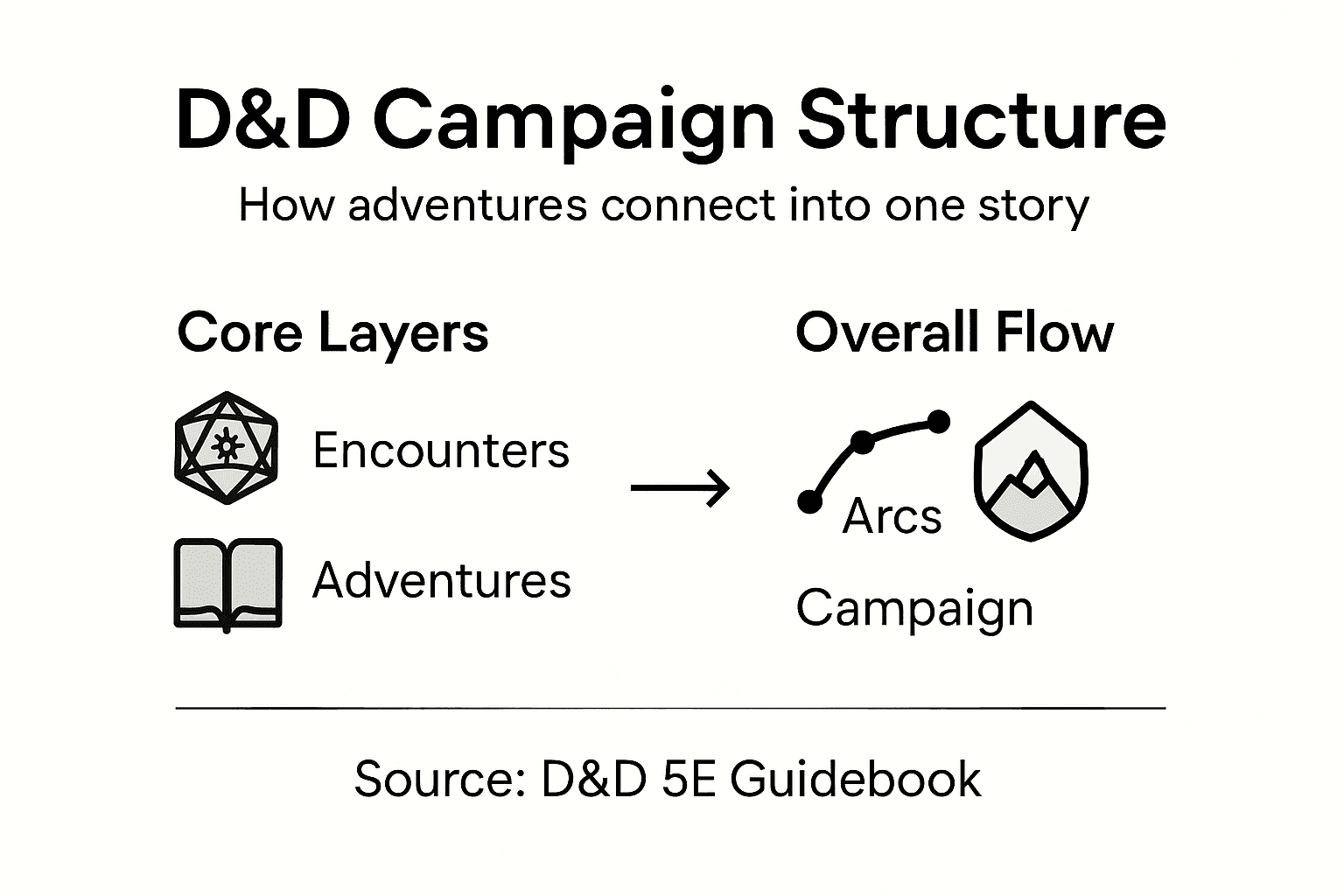
Think of it like a pyramid. At the bottom sits individual encounters—a single combat, puzzle, or social interaction that takes one or two hours. Stack several encounters together, and you get an adventure, which typically spans three to five sessions around a specific goal or location.
Above that sits your campaign, the grand narrative connecting all those adventures into something larger. This is where campaigns operate with player freedom while maintaining narrative causality. Your players’ choices ripple outward, changing the world in meaningful ways.
Here’s how the progression actually works:
- Session one introduces hooks and lets players shape their goals
- Early sessions establish tone, introduce key NPCs, and develop player agency
- Mid-campaign escalates stakes as player decisions create world-changing consequences
- Late campaign brings earlier threads together, forces final choices, and builds toward climax
- Endgame resolves major conflicts and shows how players transformed the world
The beauty of D&D campaigns is their collaborative unpredictability. Your players aren’t following a script—they’re actively writing the story with you. They might solve a problem you expected to take three sessions in one clever moment. Or they’ll ignore your prepared encounters entirely and chase a subplot you mentioned once.
This requires balancing preparation with improvisation. Plan your major plot points, key NPCs, and intended conflicts. But stay flexible about how players reach them. If your adventurers want to negotiate instead of fight, let that change the story.
The strongest campaigns evolve as players shape the world, not despite their freedom but because of it.
Meaningful character development naturally emerges when player choices matter. A wizard who once served a corrupt mage faces redemption opportunities. A rogue with a wanted posters has to deal with consequences. These arcs develop through play, not prep.
Progression also means escalation. Early challenges should feel manageable. Mid-campaign threats become personal. Final conflicts threaten everything your players care about. Pacing this climb keeps tension high without exhausting your group.
Pro tip: Create a one-page timeline of your intended major plot points, but leave 60% blank for player-driven detours—this gives you structure without rigidity, and you’ll fill those blanks as your campaign unfolds.
Dungeon Master’s Role and Essential Responsibilities
As a Dungeon Master, you’re simultaneously storyteller, referee, world-builder, and game facilitator. It’s a lot. Understanding what each role demands helps you balance these responsibilities without burning out.
Your core job is creating worlds and managing game environments where adventures unfold. You describe what players see, hear, and experience. You control every NPC they meet, every monster they fight, every trap they trigger. You interpret the rules and decide outcomes based on player actions.
But that’s just the framework. Here’s what actually matters:
- Worldbuilding establishes the setting’s logic, geography, culture, and history
- Narrative design weaves player choices into a coherent story that makes sense
- Rule arbitration keeps the game fair and moving without grinding to a halt
- Pacing management ensures sessions feel engaging, not rushed or dragging
- Player engagement means reading the room and adjusting to keep everyone invested
Good DMs balance preparation with improvisation. You prep your major encounters, key NPCs, and plot hooks. But when players inevitably go off-script, you improvise consequences that feel real, not punitive. That shopkeeper they decided to befriend becomes an ally later. The dungeon they avoided entirely opens new problems elsewhere.
You’re also responsible for maintaining continuity. NPCs remember what players did. The kingdom changes when players act. Promises made in session three matter in session fifteen. This makes the world feel alive and reactive.
A DM’s real power isn’t controlling the story—it’s making players feel their choices genuinely matter.
Fostering an inclusive and fun environment matters more than perfect rule knowledge. New players need encouragement. Shy players need space to shine. Spotlight hogs need gentle redirection. Your job includes reading social dynamics and adjusting accordingly.
Managing game mechanics smoothly keeps action flowing. Know your rules well enough to make quick calls without constant rulebook checks. When you’re unsure, make a decision and move forward. You can verify later.
Finally, you adapt constantly. Plans change when players surprise you. NPCs die unexpectedly. Plot hooks fall flat. A single player comment sparks a better story direction. Flexibility beats rigid adherence to your prep notes.
Pro tip: Keep a digital or physical quick-reference sheet with your major NPCs, plot hooks, and world details—this prevents you from inventing contradictions mid-session and frees mental bandwidth for actual storytelling.
Top Pitfalls to Avoid in D&D Campaign Creation
New Dungeon Masters often sabotage their own campaigns through well-intentioned mistakes. Knowing what to avoid saves you months of frustration and keeps your players engaged instead of confused.
The biggest trap is starting too big. You sit down with grand ambitions and design an entire world—complete geography, every kingdom’s politics, detailed histories spanning centuries. Then session one arrives and your players only care about the tavern in one small town. All that prep goes unused, and you’re scrambling to improvise.
Start small instead. Build the immediate area where your campaign begins. Detail the town, the NPCs, the nearby dungeons. Expand the world as your players explore. This approach keeps prep manageable and ensures your work actually matters.
Another killer mistake is overcomplicating your plot. Too many factions. Too many competing agendas. Too many pre-planned events happening whether players engage or not. Your intricate plot collapses the moment players deviate, and you’re left desperately trying to steer them back onto your rails.
Plan your major plot points instead. Leave the connections flexible. Let player choices determine which factions matter and when events unfold. This requires less prep and adapts naturally to what your group actually does.
Common worldbuilding mistakes include inaccurate map distances and inconsistent geography that break immersion when players notice. If your map shows a town as two days’ travel away, traveling there should actually feel like two days—not five hours because you underestimated distances. Inconsistencies make the world feel fake.
Here’s what catches most new DMs:
- No factions or guilds means NPCs feel random, not interconnected
- Ignoring player agency treats the campaign like a railroad instead of a story
- Forgetting to track consequences makes player choices feel meaningless
- Pacing issues where you rush climaxes or drag through boring stretches
- Abandoning your prep because players went sideways, then improvising lazily
The worst campaign mistake isn’t being unprepared—it’s being so attached to your prep that you resent your players for not following it.
Another pitfall is ignoring your group’s preferences. You prep a horror campaign for a group that wants humor and heroism. You plan combat-heavy encounters for players who love roleplay. Misaligned expectations create friction nobody enjoys.
Talk to your players before you start building. Ask what they want. Then build toward that vision, not against it.
Pro tip: Write down your campaign’s core promise in one sentence—“Explore a haunted jungle” or “Stop an evil empire”—and refer back to it whenever you’re unsure whether something belongs in your campaign.
Elevate Your D&D Campaign with Immersive Tools and Unique Accessories
Crafting a memorable D&D campaign demands balancing detailed worldbuilding and flexible storytelling while keeping your players deeply engaged. If you want to bring your adventures to life and avoid common pitfalls like overwhelming prep or inconsistent narrative flow your gaming experience can benefit from high-quality tools designed to enhance immersion and streamline creativity. At 1985 Games we understand that the heart of every campaign is player agency and dynamic storytelling. Our Dungeon Craft and Battlemap Bundles provide handcrafted terrain and maps that breathe life into your settings letting you visually communicate your world and adapt quickly to player choices.

Transform your session planning and storytelling today by exploring our carefully curated Dungeon Craft collection filled with unique game aids and thematic accessories. Whether you want to create tension with a gothic-inspired layout or bring excitement with detailed player journals your campaign can feel more cohesive and engaging. Don’t let your creativity be stifled by rigid prep or vague tools. Visit 1985 Games now for passionate craftsmanship and the resources your campaign deserves.
Frequently Asked Questions
What is a D&D campaign?
A D&D campaign is a series of connected adventures that form a continuous story across multiple gaming sessions, allowing players to engage in an epic narrative arc.
How do I create a successful D&D campaign?
To create a successful D&D campaign, define your setting, establish major plot points, incorporate player agency, and remain flexible to adapt to the players’ choices throughout the game.
What are common myths about D&D campaigns?
Common myths about D&D campaigns include beliefs that they must be fully planned, that a campaign is the same as a campaign setting, and that they must follow one rigid plot line. In reality, campaigns thrive on flexibility and player-driven narratives.
What types of D&D campaigns exist?
D&D campaigns can vary greatly in style, including sandbox campaigns that allow player freedom, linear campaigns that follow a structured path, hexcrawl campaigns focused on exploration, and intrigue campaigns centered on political maneuvering.